PT-141 vs melanotan II
PT-141 (bremelanotide) and melanotan II are related melanocortin-receptor-agonist peptides with very different regulatory and evidence profiles: bremelanotide has an FDA label (Vyleesi) and phase 3 trial data in premenopausal women with hypoactive sexual desire disorder, while melanotan II has no approved use and has been studied only in small, older human studies. 1,2,3,4,5 PubChem structural records list the same acetylated cyclic core for both, differing at the C-terminus (a carboxylic acid for bremelanotide and a carboxamide for melanotan II). 6,7
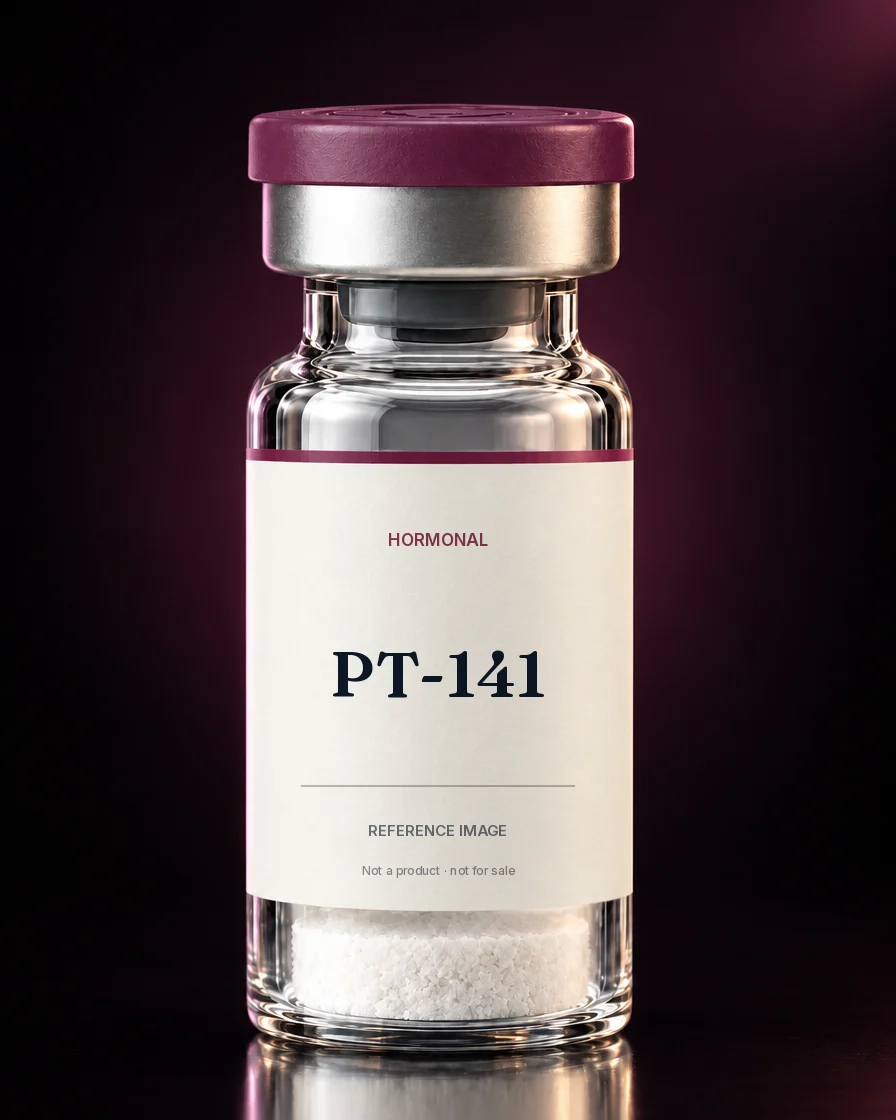
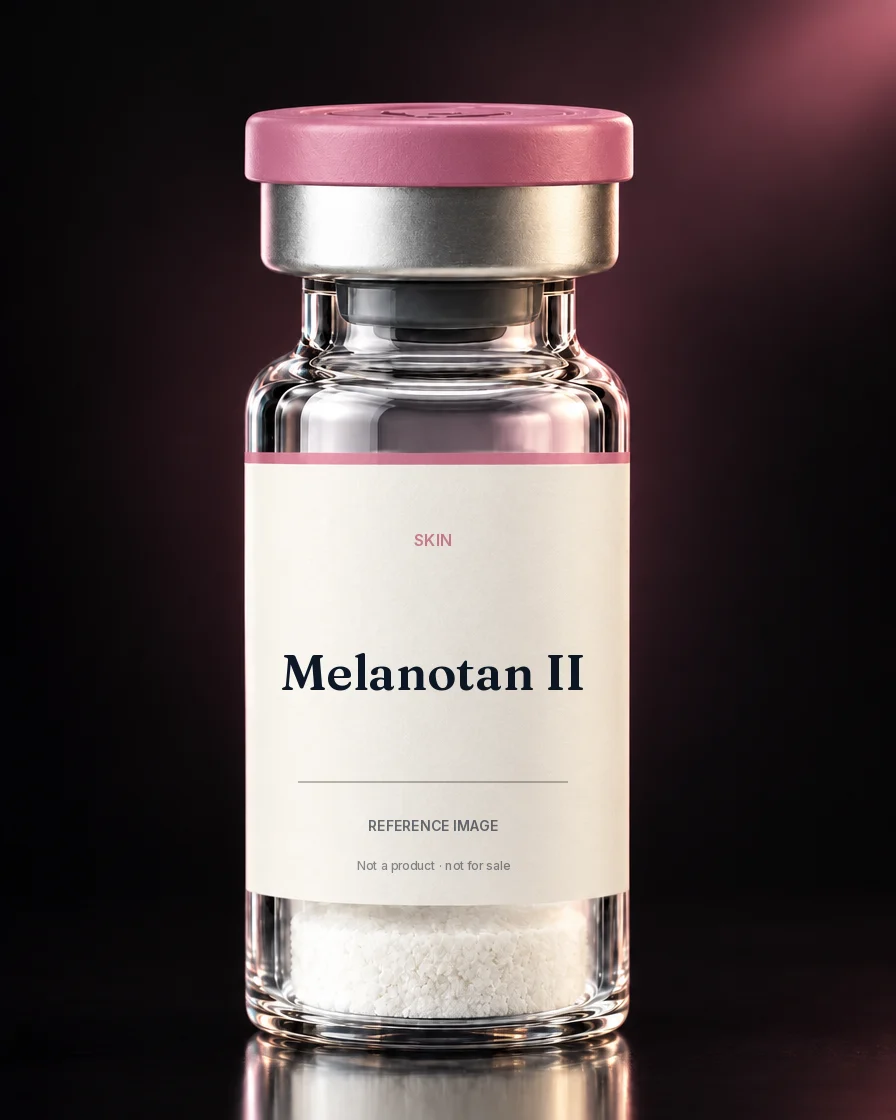
Side by side
| Field | PT-141 | Melanotan II |
|---|---|---|
| Class | Melanocortin receptor agonist 2 | Non-selective melanocortin receptor agonist, an alpha-MSH analogue 8,9 |
| Mechanism / receptors | Nonselectively activates several melanocortin receptor subtypes with potency order MC1R, MC4R, MC3R, MC5R, MC2R; MC1R and MC4R binding is described as most relevant at therapeutic levels, and the mechanism in HSDD is stated to be unknown. 2 | Described as a non-selective melanocortin receptor agonist; a case report describes primary activity at MC1R on melanocytes, stimulating eumelanin production. 8,10 |
| Origin | Synthetic cyclic peptide of 7 amino acids; PubChem lists the formula C50H68N14O10. 2,6 | Synthetic cyclic alpha-MSH analogue; PubChem lists the formula C50H69N15O9. 4,7 |
| Half-life | Mean terminal half-life of approximately 2.7 hours (range 1.9 to 4.0) per label. 2 | Not established in the sources reviewed. |
| Highest trial phase | Phase 3 (RECONNECT) followed by a 52-week open-label extension 3,11 | Small early-phase human studies (1998 to 2000); no phase 3 trial identified 4,8,9 |
| FDA status | FDA-approved (Vyleesi) for premenopausal women with acquired, generalized HSDD; not indicated in postmenopausal women or men. 2 | No approved use identified; FDA Import Alert 66-41 lists Melanotan (I and II) as an unapproved new drug. The Australian TGA states it is not approved for sale or use as a tanning agent there. 5,12 |
| Published outcomes | RECONNECT (1,267 women randomized, 24 weeks): increases in the FSFI-desire domain and reductions in distress scores versus placebo (integrated differences 0.35 and -0.33). 3 | Small crossover studies in men with erectile dysfunction reported erections in 17 of 20 men in the absence of sexual stimulation, and increased sexual desire after 13 of 19 doses versus 4 of 21 with placebo. 8 |
| Safety signals | Nausea in 40.0% vs 1.3% placebo, flushing 20.3% vs 0.3%, transient blood-pressure increase, focal hyperpigmentation; contraindicated in uncontrolled hypertension or known cardiovascular disease. 2 | Nausea, yawning and stretching in trials; severe nausea in 12.9% of subjects in one review; case reports of oral mucosal pigmentation and of oral mucosal melanoma after unlicensed use. 8,10,13 |
| Evidence level | Regulatory and randomized phase 3 human evidence 2,3 | Small human studies and case reports; no regulatory approval 8,10 |
PT-141: what the data says
Bremelanotide (PT-141) was described in a 2007 review by company-affiliated authors as one of several melanocortinergic agents that followed the observation that melanotan II caused penile erections in humans. 1 The Vyleesi label lists bremelanotide for premenopausal women with acquired, generalized HSDD and states that it is not indicated for postmenopausal women, for men, or to enhance sexual performance. 2 In two identical 24-week phase 3 trials (RECONNECT), 1,267 women were randomized to bremelanotide or placebo, and the integrated increase in FSFI-desire score versus placebo was 0.35 with a reduction in distress score of -0.33. 3 Nausea, flushing and headache were reported by at least 10% of bremelanotide-treated women in both studies. 3
The label reports no statistically significant difference between bremelanotide and placebo in the number of satisfying sexual events in either trial (P=0.76 and P=0.70). 2 In the 52-week open-label extension, 684 women enrolled, 272 completed, and nausea (40.4%), flushing (20.6%) and headache (12.0%) were the most common treatment-related adverse events. 11
The label describes transient blood-pressure increases and heart-rate decreases after each dose, focal hyperpigmentation reported by 1% of patients, and nausea reported by 40%. 2
Melanotan II: what the data says
The human literature on melanotan II consists of small studies from 1998 to 2000 in men with erectile dysfunction. 4,8,9 A double-blind crossover study in 10 men with psychogenic erectile dysfunction reported clinically apparent erections in 8 of 10, with a mean duration of tip rigidity above 80% of 38.0 minutes versus 3.0 minutes with placebo. 4 A second study in 10 men with organic risk factors reported subjectively reported erections after 12 of 19 injections versus 1 of 21 placebo administrations, with severe nausea after 4 of 19. 9
The Australian TGA states that melanotan products are not approved there as tanning agents and lists reports of increased moles and freckles, kidney dysfunction and swelling of the brain with melanotan II. 5 Case reports describe oral mucosal pigmentation after injections and a mucosal malignant melanoma in a person who used a nasal spray, and these reports do not establish causation. 10,13
Key research differences
- Regulatory status differs: bremelanotide is FDA-approved for a defined HSDD indication, whereas melanotan II has no approved use and appears on an FDA import alert as an unapproved new drug. 2,12
- Evidence base differs: bremelanotide has two phase 3 randomized trials and an open-label extension, while melanotan II has small crossover studies in men with erectile dysfunction from 1998 to 2000. 3,4,9,11
- Studied populations differ: RECONNECT enrolled premenopausal women with HSDD, whereas the melanotan II studies enrolled men with erectile dysfunction. 3,8
- Structurally, the two peptides share an acetylated cyclic core in PubChem records and differ at the C-terminus (carboxylic acid versus carboxamide). 6,7
- Documented safety signals differ in source type: bremelanotide's come from a prescribing label and trials, while melanotan II's come from small trials, a regulator's public notice and individual case reports. 2,5,8,10
Where the evidence is limited
Controlled human data for melanotan II are limited to small studies from around 2000, and no phase 3 trial was identified. 4,8,9 Case reports of pigmentation or melanoma after melanotan II use cannot establish causation, and the products involved were unlicensed and of uncertain composition. 5,10,13 A half-life for melanotan II was not found in the sources reviewed. 8 Bremelanotide's mechanism in HSDD is stated on its label to be unknown. 2
Frequently asked questions
Are PT-141 and bremelanotide the same thing?
Is melanotan II approved for any use?
How are the two molecules structurally related?
What was bremelanotide studied for in its pivotal trials?
References
- Melanocortins in the treatment of male and female sexual dysfunction Curr Top Med Chem. 2007
- VYLEESI (bremelanotide) injection, prescribing information FDA label (DailyMed). 2025
- Bremelanotide for the Treatment of Hypoactive Sexual Desire Disorder: Two Randomized Phase 3 Trials (RECONNECT) Obstet Gynecol. 2019
- Synthetic melanotropic peptide initiates erections in men with psychogenic erectile dysfunction: double-blind, placebo controlled crossover study J Urol. 1998
- Don't risk using tanning products containing melanotan Therapeutic Goods Administration (Australia). 2025
- Bremelanotide, compound record (CID 9941379) PubChem. 2026
- Melanotan II, compound record (CID 92432) PubChem. 2026
- Melanocortin receptor agonists, penile erection, and sexual motivation: human studies with Melanotan II Int J Impot Res. 2000
- Effect of an alpha-melanocyte stimulating hormone analog on penile erection and sexual desire in men with organic erectile dysfunction Urology. 2000
- Changes in Oral Mucosa Associated with Melanotan II Injections: A Case Report Life (Basel). 2026
- Long-Term Safety and Efficacy of Bremelanotide for Hypoactive Sexual Desire Disorder Obstet Gynecol. 2019
- Import Alert 66-41 (entries listing Melanotan I and II) FDA Import Alert. 2019
- Melanotan II nasal spray: a possible risk factor for oral mucosal malignant melanoma? Int J Oral Maxillofac Surg. 2025
For research use only. Not for human or veterinary use. Not a drug, food, or dietary supplement. This page compares published research and is not medical advice or a recommendation.