Paired compounds, on the evidence
Stacks and blends are marketed with confident schedules. Here is what has actually been tested together in humans (very little) and what each pairing rests on instead.
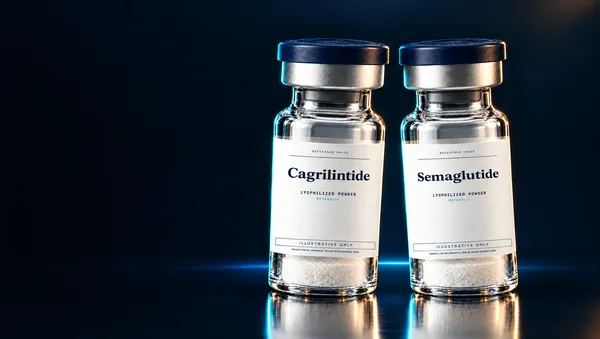 Tested together in humansCagriSema (cagrilintide + semaglutide)aka CagriSema, cagrilintide-semaglutide
CagriSema is Novo Nordisk's once-weekly combination of cagrilintide, a long-acting amylin analogue, with semaglutide, a GLP-1 receptor agonist. Unlike most combinations on Amiravo, it has been given to humans in randomised phase 1b, phase 2 and phase 3 trials (REDEFINE and REIMAGINE programmes) . Cagrilintide itself is not FDA-approved .
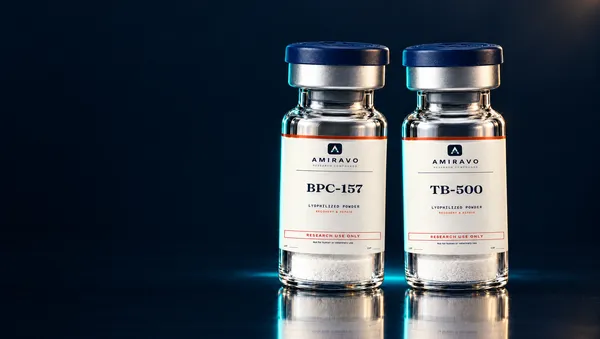 Not studied togetherBPC-157 + TB-500aka Wolverine stack, Wolverine blend, BPC-157/TB-500 blend
BPC-157 and TB-500 are two unapproved synthetic peptides that are marketed together, most often as a pre-mixed blend. No controlled human study of the pair was found; the only direct comparison identified is a rat tendon experiment in which the combination showed no additional effect over either peptide alone . Each component's own evidence comes mainly from animal and cell studies.
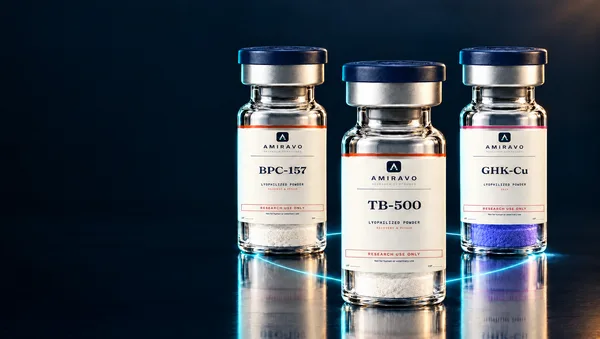 Not studied togetherGLOW (BPC-157 + TB-500 + GHK-Cu)aka GLOW blend, GLOW stack, Glow mix
GLOW is a marketing name for a three-peptide mixture of BPC-157, TB-500 and GHK-Cu, none of which is FDA-approved as a drug. No study of the three-component mixture was found in humans or animals. The only related experiment tested two of the three components in rats and found no additive effect .
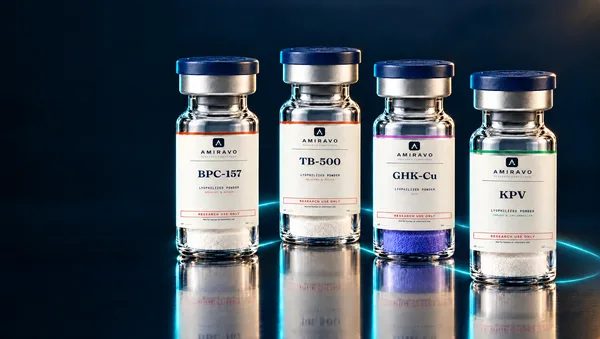 Not studied togetherKLOW (BPC-157 + TB-500 + GHK-Cu + KPV)aka KLOW blend, KLOW stack
KLOW is a marketing name for the GLOW mixture with the tripeptide KPV added. None of the four components is FDA-approved, KPV has been studied only in cells and animals, and no study of the four-component mixture was found . The only related experiment tested two of the components in rats and found no additive effect .
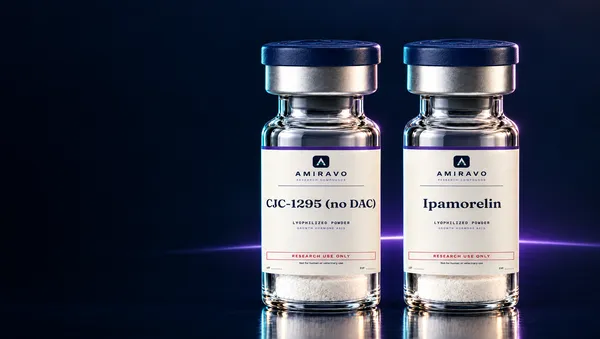 Not studied togetherCJC-1295 (no DAC) + Ipamorelinaka CJC/Ipa, Mod GRF 1-29 + Ipamorelin, CJC-1295 + Ipamorelin stack
This pairing combines a GHRH-receptor analog (CJC-1295 without the DAC group, also called modified GRF 1-29) with ipamorelin, a ghrelin-receptor agonist. Neither is approved anywhere, and no human study of the pair was found. The rationale rests on older human research showing that GHRH and a GH-releasing peptide given together can release more growth hormone than either alone , which involved different molecules.
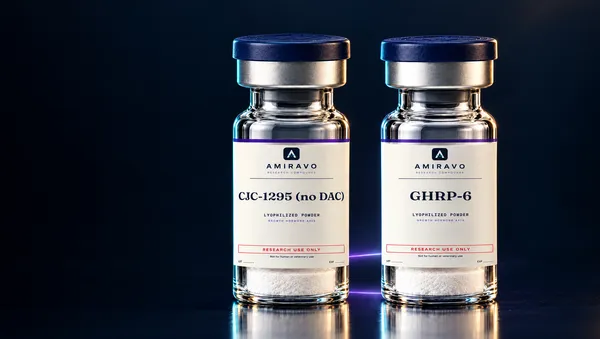 Not studied togetherCJC-1295 (no DAC) + GHRP-6aka CJC-1295 + GHRP-6 stack, Mod GRF 1-29 + GHRP-6
This pairing combines the GHRH-receptor analog CJC-1295 (no DAC) with GHRP-6, a GH-releasing hexapeptide. No human study of this exact pair was found. GHRP-6 has, however, been given to humans together with native GHRH in endocrine research and as a diagnostic test of GH reserve , which is the closest studied analogue.
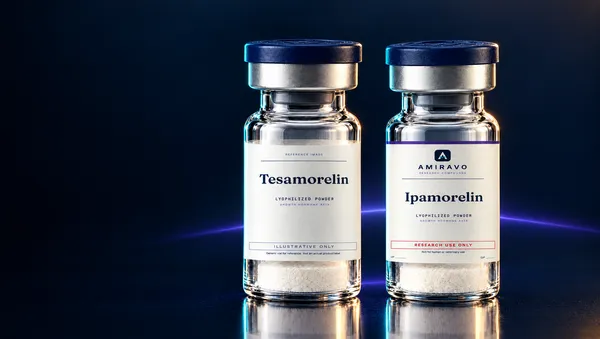 Not studied togetherTesamorelin + Ipamorelinaka Tesa/Ipa, Tesamorelin + Ipamorelin stack
This pairing combines tesamorelin, an FDA-approved GHRH analog labelled for excess abdominal fat in HIV-associated lipodystrophy , with ipamorelin, an unapproved ghrelin-receptor agonist. No human study of the combination was found, and the tesamorelin label does not address co-use with GH secretagogues.
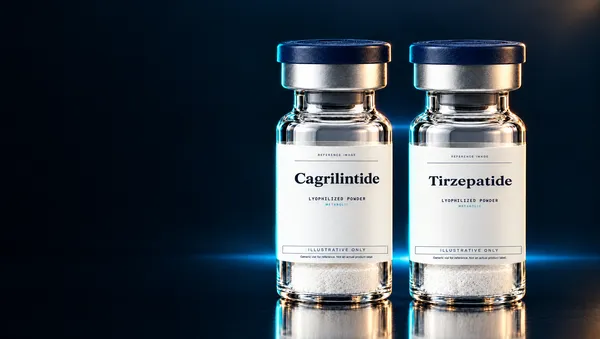 Not studied togetherCagrilintide + Tirzepatideaka Cagri + Tirz, Cagrilintide/Tirzepatide stack
This pairing combines investigational cagrilintide (an amylin analogue) with FDA-approved tirzepatide (a GIP and GLP-1 receptor agonist). No trial giving the two together was found; tirzepatide has appeared in CagriSema trials only as a head-to-head comparator . The pairing is therefore theoretical.
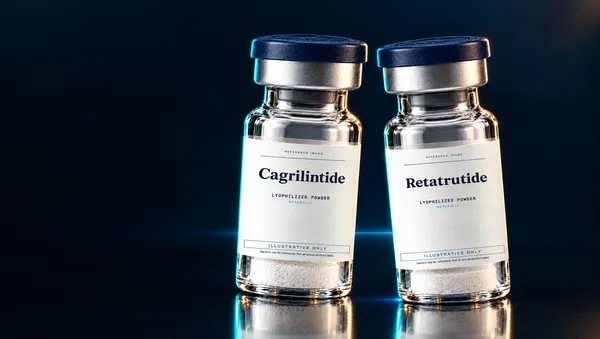 Not studied togetherCagrilintide + Retatrutideaka Cagri + Reta, Cagrilintide/Retatrutide stack
This pairing combines two investigational agents: cagrilintide (an amylin analogue) and retatrutide (a GIP, GLP-1 and glucagon receptor agonist). Neither is FDA-approved, and no human or animal study of the pair was found. Any rationale is theoretical.
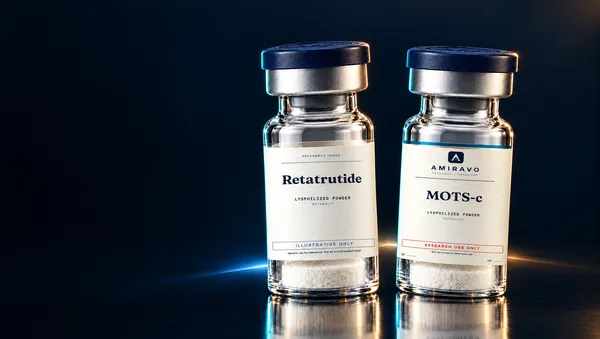 Not studied togetherRetatrutide + MOTS-caka Reta + MOTS-c stack
This pairing combines investigational retatrutide with MOTS-c, a mitochondrially encoded peptide studied mainly in mice. No study of the pair was found, and no published study administering MOTS-c to humans was identified. Any rationale is theoretical.
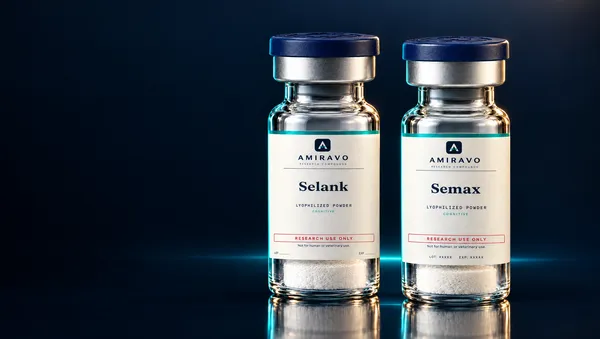 Not studied togetherSelank + Semaxaka Russian nootropic stack, Selank/Semax
Selank and Semax are synthetic heptapeptides developed in Russia, where a peer-reviewed review lists both among registered peptide drugs (Selank as an anxiolytic, Semax as a nootropic) . Neither is FDA-approved. No human study giving them together was found; one fMRI study gave each separately to healthy volunteers .
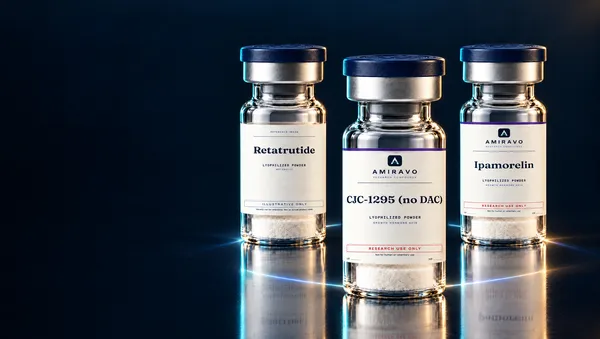 Not studied togetherRetatrutide + CJC-1295 (no DAC) + Ipamorelinaka Advanced Recomp stack, recomp stack
This three-compound combination, marketed for body recomposition, pairs investigational retatrutide with two unapproved GH-axis peptides. No study of the combination or of retatrutide with any GH secretagogue was found. The pairing is discussed in connection with lean-mass loss during incretin-based weight loss , but whether GH-axis peptides change that has not been tested.
We do not publish schedules for any combination. Where a pairing has been tested in registered trials, the amounts are given as facts about those trials. Single-compound dosing references.
Need research peptides? Bundles from our trusted research partner
Add bundles to your supplier list and check out on the supplier's site; free members get 10% off. Bundles are the partner's own groupings, not combinations Amiravo has found to be studied together.
Referral links: Amiravo earns a commission if you buy, at no cost to you. Sold for research use only. Prices as listed by the partner on Oct 23, 2026 and may change.