Sermorelin vs Tesamorelin
Sermorelin and tesamorelin are both synthetic analogues of growth hormone-releasing hormone (GHRH) that stimulate the pituitary to release growth hormone 1,6. Sermorelin is the 29-amino-acid N-terminal fragment of GHRH; it was FDA-approved as GEREF, and both GEREF applications are now listed as discontinued 1,4. Tesamorelin is the full 44-amino-acid GHRH sequence with an added hexenoyl group, and it is FDA-approved (first in 2010) for reducing excess abdominal fat in adults with HIV and lipodystrophy 6. The two were developed for different conditions and have not been compared in a head-to-head trial in the sources reviewed 1,7.
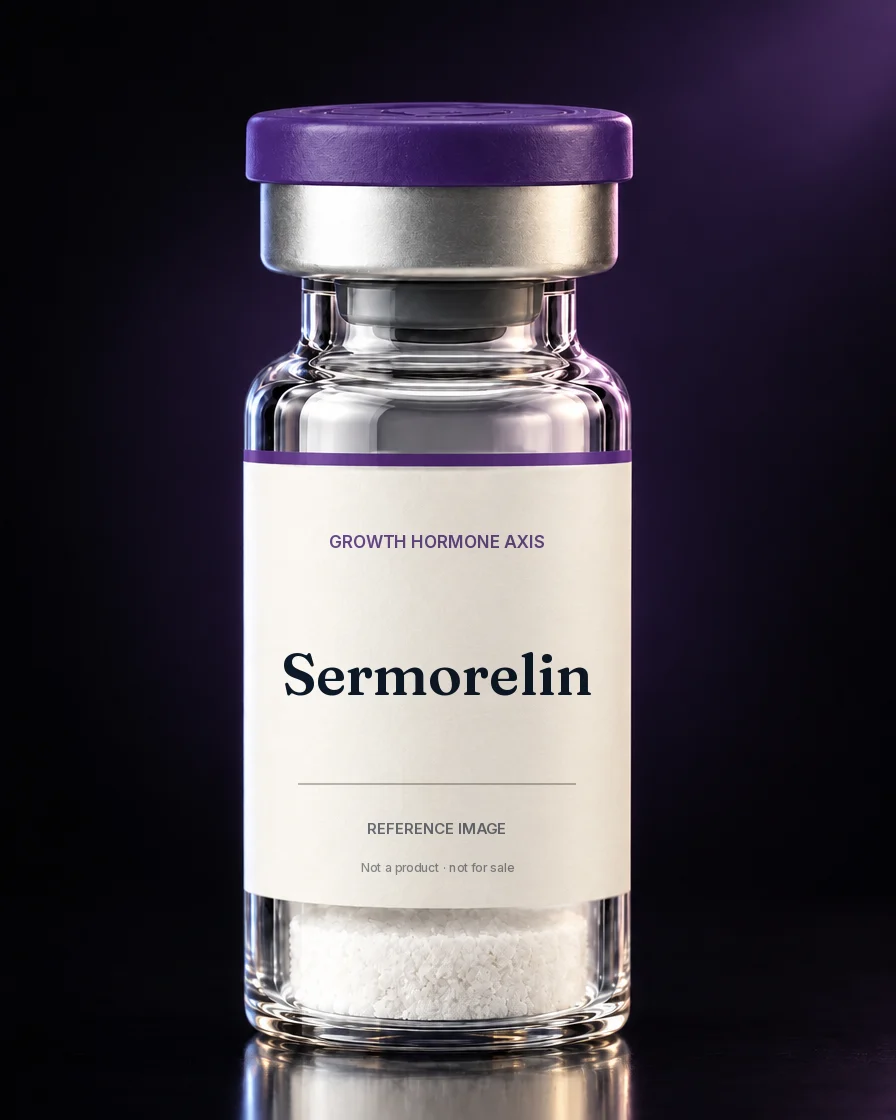
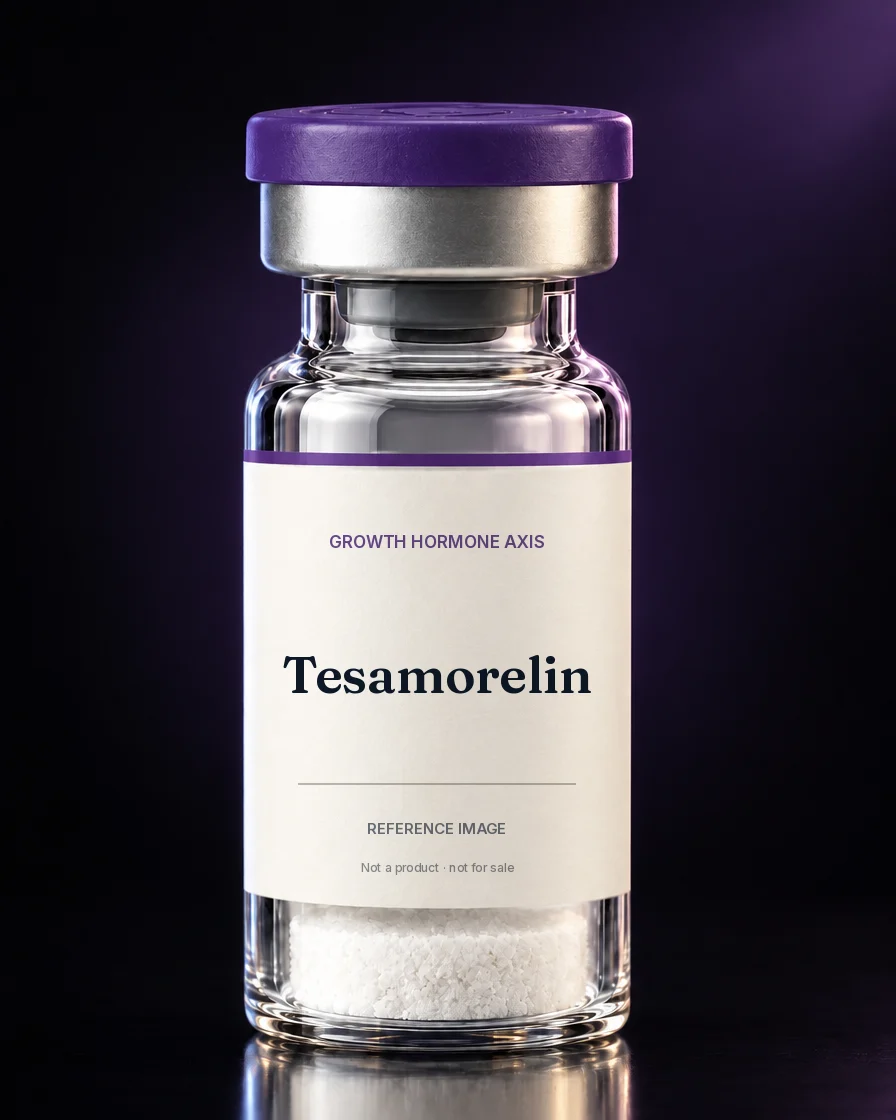
Side by side
| Field | Sermorelin | Tesamorelin |
|---|---|---|
| Class | GHRH analogue 1 | GHRH analogue (growth hormone-releasing factor analogue) 6 |
| Origin and structure | 29-amino-acid analogue of human GHRH, described as the shortest synthetic peptide with the full biological activity of GHRH 1 | The 44-amino-acid sequence of human GRF with a trans-3-hexenoyl group attached at the N-terminal tyrosine 6 |
| Proposed mechanism | Stimulates growth hormone secretion from the anterior pituitary 1 | Binds and stimulates human GRF receptors with potency similar to endogenous GRF, causing pulsatile release of endogenous growth hormone 6 |
| Half-life | Disappearance half-time of about 4 minutes for GHRH(1-29)-NH2 during intravenous infusion in 10 healthy men 3 | About 11 minutes in healthy subjects after subcutaneous administration, per the US label 6 |
| Highest human trial phase | Approved product; pivotal data include a 110-child multicentre open-label study in growth hormone deficiency 2,4 | Approved product; two phase 3 placebo-controlled trials in HIV-associated abdominal fat 6,8 |
| FDA status | Approved as GEREF (NDA 019863, 1990; NDA 020443, 1997); both listed as discontinued in Drugs@FDA as of 24 October 2026 4. In 2013 FDA determined that GEREF was not withdrawn from sale for safety- or efficacy-related reasons 5 | FDA-approved (initial US approval 2010); EGRIFTA WR label revised 03/2025 6 |
| Published human outcomes | In growth hormone-deficient children, mean height velocity rose over 12 months in an open-label study 2; a review notes increases were smaller than with somatropin 1 | In a 412-patient phase 3 trial, visceral fat fell by 15.2% versus a 5.0% rise with placebo 7; a 61-patient trial reported reduced liver fat in HIV with NAFLD 9 |
| Safety signals | No adverse biochemical or hormonal changes, and no change in fasting glucose, were reported in the 110-child study 2 | Label warnings include neoplasm risk, elevated IGF-1, fluid retention, glucose intolerance, hypersensitivity and increased mortality in acute critical illness 6 |
| WADA status | Named under S2.2.4 (GHRH analogues); prohibited at all times (2026 List) 11 | Named under S2.2.4 (GHRH analogues); prohibited at all times (2026 List) 11 |
| Who funded the evidence | The paediatric efficacy study was run by the Geref International Study Group 2; GEREF applications were held by EMD Serono 4 | Phase 3 registration sponsored by Theratechnologies 10; later liver-fat trials funded by the US NIH 9 |
Sermorelin: what the data says
Sermorelin was developed for the diagnosis and treatment of idiopathic growth hormone deficiency in children 1. A review describes intravenous sermorelin as a rapid, relatively specific test of growth hormone secretion, while noting that a normal response cannot exclude deficiency of hypothalamic origin 1.
- In a multicentre open-label study of 110 previously untreated prepubertal children with growth hormone deficiency (humans), mean height velocity increased at 6 and 12 months, and 74% were considered good responders at 6 months 2.
- The review reports smaller height-velocity increases than with somatropin, with long-term effects on adult height not determined 1.
- In healthy men, GHRH(1-29)-NH2 was cleared rapidly, with a disappearance half-time of about 4 minutes 3.
Tesamorelin: what the data says
Tesamorelin is approved in the US for reducing excess abdominal fat in HIV-infected adults with lipodystrophy; the label states that long-term cardiovascular safety has not been established 6.
- In a 412-patient randomized phase 3 trial (humans), visceral adipose tissue decreased by 15.2% with tesamorelin and increased by 5.0% with placebo over 26 weeks, while IGF-I rose by 81% 7.
- A pooled analysis of two phase 3 trials (806 patients) reported a 15.4% treatment effect on visceral fat at 26 weeks, with no significant change in subcutaneous abdominal fat 8.
- In a 61-patient NIH-funded trial in HIV with non-alcoholic fatty liver disease (humans), hepatic fat fraction fell more with tesamorelin than placebo over 12 months 9.
Key research differences
- Structure: sermorelin is the 29-residue N-terminal fragment of GHRH 1, whereas tesamorelin is the full 44-residue sequence with an N-terminal hexenoyl modification 6.
- Current FDA status: tesamorelin is an approved, marketed product 6; sermorelin's GEREF applications are listed as discontinued, although FDA found they were not withdrawn for safety- or efficacy-related reasons 4,5.
- Approved use: sermorelin was studied for growth hormone deficiency in children 1,2, whereas tesamorelin is indicated for excess abdominal fat in adults with HIV and lipodystrophy 6.
- Half-life: about 4 minutes for intravenous GHRH(1-29)-NH2 in healthy men 3 versus about 11 minutes for subcutaneous tesamorelin in healthy subjects 6, measured by different routes and methods.
Where the evidence is limited
No head-to-head trial of sermorelin and tesamorelin was located. Their main trials enrolled different populations (children with growth hormone deficiency versus adults with HIV-associated abdominal fat) and measured different outcomes (height velocity versus visceral fat), so results cannot be compared directly 2,7. The half-life figures come from different routes and study designs 3,6. Much of the sermorelin evidence predates modern trial reporting standards 1,2.
Frequently asked questions
Is sermorelin FDA-approved?
Is tesamorelin the same as sermorelin?
Can sermorelin and tesamorelin be compared directly?
Are sermorelin and tesamorelin banned in sport?
References
- Sermorelin: a review of its use in the diagnosis and treatment of children with idiopathic growth hormone deficiency BioDrugs. 1999
- [...] subcutaneous growth hormone-releasing hormone therapy accelerates growth in growth hormone-deficient children during the first year of therapy. Geref International Study Group Journal of Clinical Endocrinology and Metabolism. 1996
- Incorporation of D-Ala2 in growth hormone-releasing hormone-(1-29)-NH2 increases the half-life and decreases metabolic clearance in normal men Journal of Clinical Endocrinology and Metabolism. 1994
- Drugs@FDA (openFDA) records for GEREF: NDA 019863 and NDA 020443, marketing status discontinued FDA openFDA. 2026
- Federal Register notice 2013-04827: determination that GEREF (sermorelin acetate) injection was not withdrawn from sale for safety- or efficacy-related reasons Federal Register (FDA notice, 4 March 2013). 2013
- EGRIFTA WR (tesamorelin) for injection, prescribing information (revised 03/2025) DailyMed (NLM). 2025
- Metabolic effects of a growth hormone-releasing factor in patients with HIV New England Journal of Medicine. 2007
- Effects of tesamorelin (TH9507), a growth hormone-releasing factor analog, in human immunodeficiency virus-infected patients with excess abdominal fat: a pooled analysis of two multicenter, double-blind placebo-controlled phase 3 trials with safety extension data Journal of Clinical Endocrinology and Metabolism. 2010
- Effects of tesamorelin on non-alcoholic fatty liver disease in HIV: a randomised, double-blind, multicentre trial Lancet HIV. 2019
- TH9507 in Patients With HIV-Associated Lipodystrophy (NCT00123253) ClinicalTrials.gov. 2013
- Prohibited List 2026 (in force 1 January 2026) World Anti-Doping Agency. 2026
For research use only. Not for human or veterinary use. Not a drug, food, or dietary supplement. This page compares published research and is not medical advice or a recommendation.