TB-500 vs GHK-Cu
TB-500 and GHK-Cu are both discussed in tissue-repair research, but they are unrelated molecules with different evidence bases 2,7. TB-500 has been characterised by doping-control laboratories as an N-terminally acetylated seven-amino-acid fragment (Ac-LKKTETQ) of thymosin beta-4 1,2. GHK-Cu is the copper(II) complex of the tripeptide glycyl-L-histidyl-L-lysine, which is found in human plasma, saliva and urine 7,8. The FDA lists both among bulk substances for compounding that may present significant safety risks (GHK-Cu for injectable routes), in the nominated-but-withdrawn section of a page current as of 22 April 2026 13.
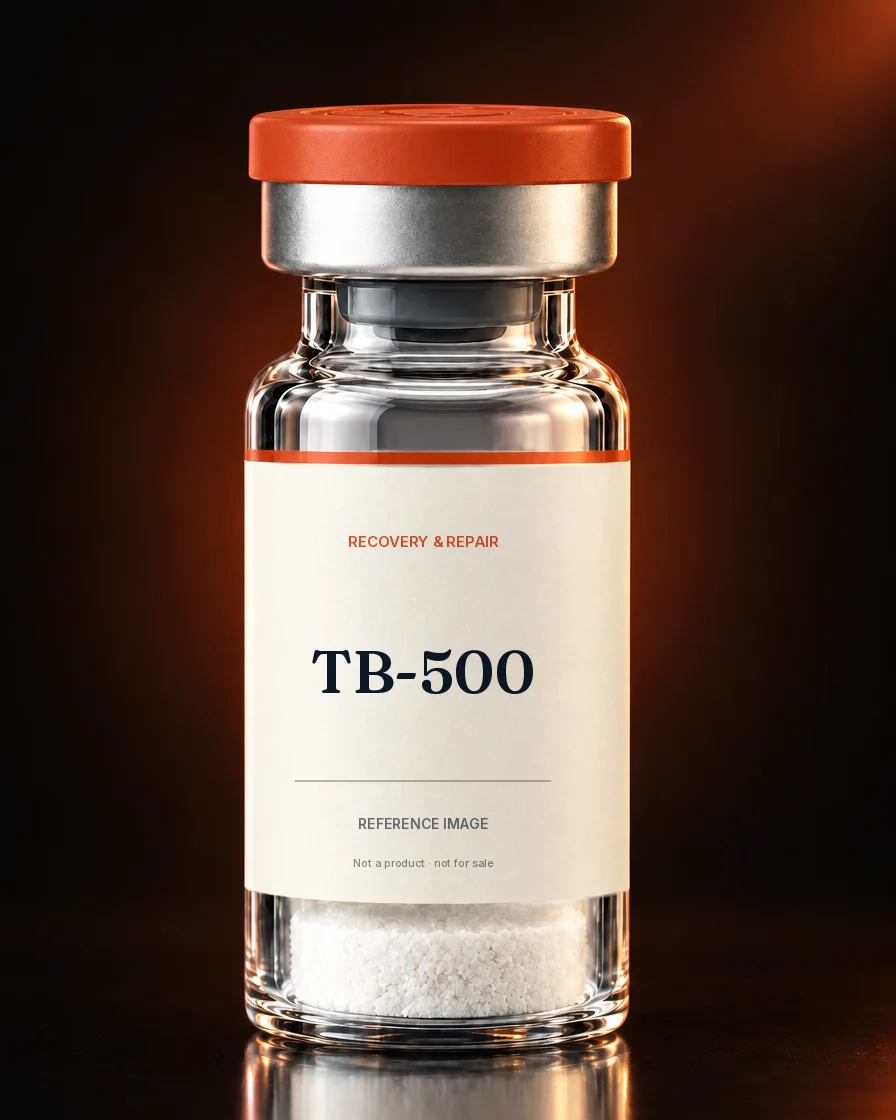
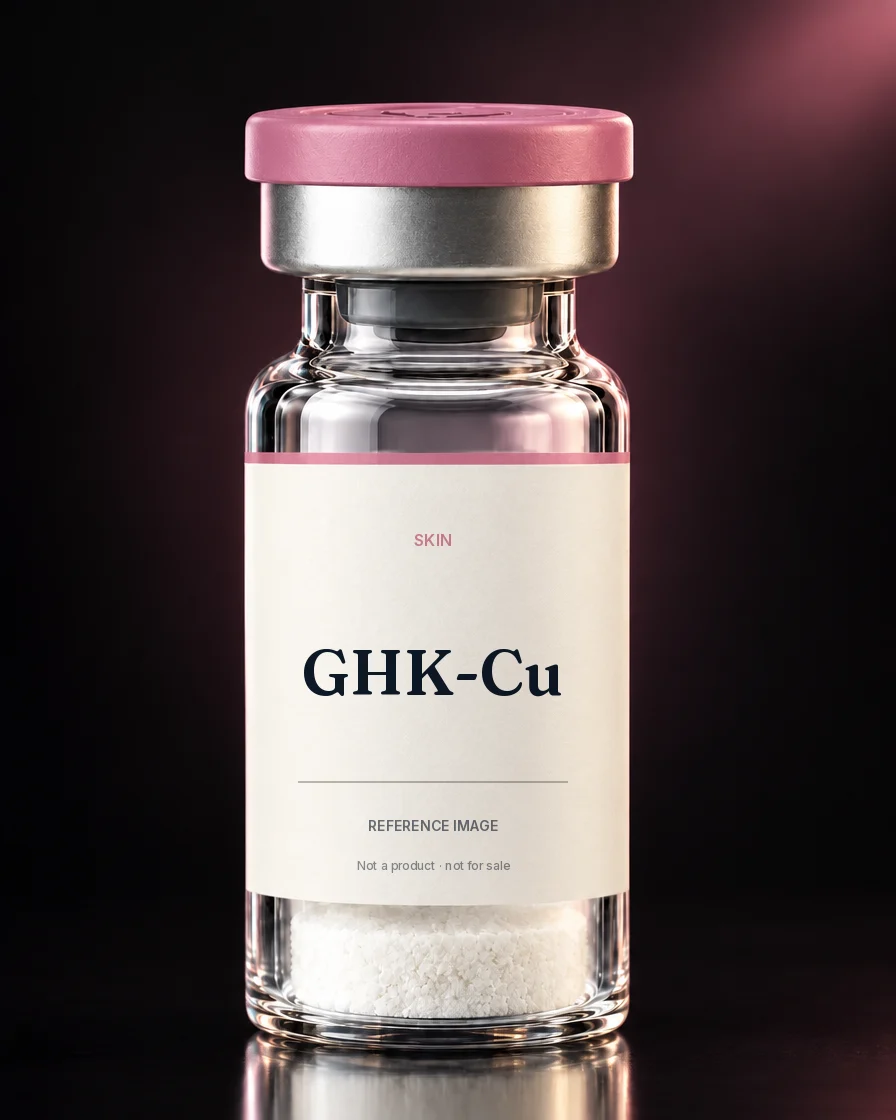
Side by side
| Field | TB-500 | GHK-Cu |
|---|---|---|
| Class | Synthetic acetylated heptapeptide fragment of thymosin beta-4 1,2 | Copper-binding tripeptide (metallopeptide complex) 8 |
| Origin and structure | Ac-LKKTETQ, corresponding to residues 17-23 of the 43-amino-acid protein thymosin beta-4, identified in a product sold as TB-500 1,3 | Gly-His-Lys, a tripeptide present in human plasma, saliva and urine that binds copper(II) with an affinity similar to albumin's copper transport site 7,8 |
| Proposed mechanism | The LKKTETQ region is the central actin-binding domain of thymosin beta-4 and has been linked in cell and animal work to angiogenesis, cell migration and wound repair 2,3 | Reviews describe chemoattraction of repair cells, modulation of collagen and glycosaminoglycan synthesis and breakdown, and broad gene-expression effects, largely from cell and animal work 7,8,9 |
| Half-life | Not located in the sources reviewed for the fragment; in horses, the parent peptide and metabolites were detectable in urine and plasma after administration 2 | Not located in the sources reviewed |
| Highest human trial phase | No published human trial of the fragment located; full-length thymosin beta-4 has reached phase 2 (eye drops) 5 | No phase-numbered drug trial located; small randomized studies of topical cosmetic products 9,10 |
| FDA status | Not FDA-approved; listed among bulk substances that may present significant safety risks (nomination withdrawn), as of 22 April 2026 13 | Not FDA-approved; GHK-Cu for injectable routes is listed among bulk substances that may present significant safety risks (nomination withdrawn), as of 22 April 2026 13 |
| Published human outcomes | None for the fragment. Full-length thymosin beta-4 eye drops missed both primary endpoints versus placebo in a 72-person dry-eye trial 5 | In a 13-patient randomized study after CO2 laser resurfacing, blinded assessment found no difference in erythema or wrinkles; patient-rated satisfaction differed 10 |
| Safety signals | FDA cites immunogenicity and impurity concerns and has not identified human exposure data for the fragment 13 | FDA cites immunogenicity and impurity concerns for injectable use and notes limited human data 13 |
| WADA status | Named under S2.3 as thymosin-beta-4 and its derivatives, e.g. TB-500; prohibited at all times (2026 List) 14 | Not named on the 2026 List; S0 covers unapproved pharmacological substances not addressed elsewhere 14 |
| Who funded the evidence | Characterisation work came from doping-control laboratories (Ghent University; Hong Kong Jockey Club) 1,2; the full-length eye-drop trial used RegeneRx's RGN-259 5 | A 2026 systematic review notes that about 35% of the primary literature includes authors from Skin Biology, a company with long-standing commercial interests in GHK-Cu 9 |
TB-500: what the data says
Published work on TB-500 itself is mostly analytical. A Ghent doping-control laboratory identified Ac-LKKTETQ in a TB-500 product by mass spectrometry 1, and a Hong Kong Jockey Club laboratory developed a method to detect the peptide and its metabolites in horse urine and plasma (animal data) 2. The LKKTETQ sequence is described as the central actin-binding domain of thymosin beta-4, linked in cell and animal studies to angiogenesis, cell migration and wound repair 3.
- In aged mice (animal data), a synthetic LKKTETQ peptide produced dermal wound-repair changes comparable to the full-length protein 4.
- No published human study of the fragment was located. Full-length thymosin beta-4 has been studied in humans: an intravenous phase 1 study in 40 healthy volunteers reported no dose-limiting toxicities or serious adverse events 6, and a 72-person phase 2 dry-eye trial missed both primary endpoints while some secondary endpoints differed from placebo 5.
GHK-Cu: what the data says
GHK-Cu has a large preclinical literature and a thin human one 9. Reviews written largely by the Skin Biology group describe effects on collagen, glycosaminoglycans, metalloproteinases and repair-cell recruitment in cell and animal models 7,8.
- In rabbits (animal data), topical tripeptide-copper complex was associated with smaller unhealed wound areas than no treatment at days 7, 14 and 21 11.
- In a 72-rat ACL reconstruction model (animal data), GHK-Cu groups showed less knee laxity at 6 weeks than saline, but the difference was not present at 12 weeks 12.
- In humans, a randomized study of 13 patients after CO2 laser resurfacing found no objective differences in erythema, wrinkles or skin quality, while patient questionnaires favoured the GHK-Cu regimen 10. A 2026 systematic review describes most human trials as small studies of facial cosmetic creams 9.
Key research differences
- Molecule: TB-500 is a seven-residue acetylated fragment of thymosin beta-4 1, whereas GHK-Cu is a three-residue peptide complexed with copper(II) 8.
- Endogenous status: GHK occurs naturally in human plasma, saliva and urine 7; Ac-LKKTETQ was characterised as the ingredient of a commercial product, with the acetylation described as artificial 2.
- Human data: no human study of the TB-500 fragment was located 13, while GHK-Cu has small randomized studies of topical products 9,10.
- Anti-doping: TB-500 is named under WADA S2.3; GHK-Cu is not named on the 2026 List 14.
- FDA listing scope: the FDA concern for GHK-Cu is limited to injectable routes, whereas the TB-500 entry is not route-limited and notes no human exposure data 13.
Where the evidence is limited
No study has compared TB-500 and GHK-Cu directly in any model, and their evidence comes from different settings: TB-500 mainly from analytical chemistry and animal studies of the LKKTETQ sequence, GHK-Cu mainly from cell, animal and small topical cosmetic studies 1,4,9. Human data that are often cited for TB-500 actually concern full-length thymosin beta-4, a different molecule given by different routes 5,6. A large share of the GHK-Cu literature comes from one commercially connected research group, which a 2026 systematic review flags as a limitation 9.
Frequently asked questions
Are TB-500 and GHK-Cu related?
Has either been tested in human clinical trials?
Can TB-500 and GHK-Cu be compared directly?
References
- Synthesis and characterization of the N-terminal acetylated 17-23 fragment of thymosin beta 4 identified in TB-500, a product suspected to possess doping potential Drug Testing and Analysis. 2012
- Doping control analysis of TB-500, a synthetic version of an active region of thymosin beta-4, in equine urine and plasma by liquid chromatography-mass spectrometry Journal of Chromatography A. 2012
- Biological activities of thymosin beta4 defined by active sites in short peptide sequences FASEB Journal. 2010
- Thymosin beta 4 and a synthetic peptide containing its actin-binding domain promote dermal wound repair in db/db diabetic mice and in aged mice Wound Repair and Regeneration. 2003
- Thymosin beta 4 ophthalmic solution for dry eye: a randomized, placebo-controlled, Phase II clinical trial conducted using the controlled adverse environment (CAE) model Clinical Ophthalmology. 2015
- A randomized, placebo-controlled, single and multiple dose study of intravenous thymosin beta4 in healthy volunteers Annals of the New York Academy of Sciences. 2010
- GHK Peptide as a Natural Modulator of Multiple Cellular Pathways in Skin Regeneration BioMed Research International. 2015
- The human tri-peptide GHK and tissue remodeling Journal of Biomaterials Science, Polymer Edition. 2008
- A Systematic Review of the Mechanisms and Therapeutic Applications of GHK-Cu (Glycyl-L-Histidyl-L-Lysine-Copper Complex) in Topical Microneedle Delivery: A Case for Expanded Clinical Trials Archives of Internal Medicine Research. 2026
- Effects of topical copper tripeptide complex on CO2 laser-resurfaced skin Archives of Facial Plastic Surgery. 2006
- Evaluation of the effects of topical tripeptide-copper complex and zinc oxide on open-wound healing in rabbits Veterinary Dermatology. 2006
- Tripeptide-copper complex GHK-Cu (II) transiently improved healing outcome in a rat model of ACL reconstruction Journal of Orthopaedic Research. 2015
- Certain Bulk Drug Substances for Use in Compounding that May Present Significant Safety Risks (content current as of 04/22/2026) FDA (Human Drug Compounding). 2026
- Prohibited List 2026 (in force 1 January 2026) World Anti-Doping Agency. 2026
For research use only. Not for human or veterinary use. Not a drug, food, or dietary supplement. This page compares published research and is not medical advice or a recommendation.