Thymosin beta-4
Also known as Tβ4 · Thymosin β4 · TMSB4X protein · RGN-259 · RGN-352 · NL005 (recombinant human Tβ4)
Thymosin beta-4 is a naturally occurring 43-amino-acid, N-acetylated actin-binding protein that is under clinical investigation (for example as the RGN-259 eye drop) and is distinct from the seven-residue TB-500 fragment.
- US status
- Investigational
- Evidence
- Grade B
- Half-life
- No numerical human half-life was located in the abstracts reviewed; a phase 1 intravenous study reported that half-life increased with increasing dose 6.
- Class
- Endogenous actin-sequestering beta-thymosin protein (investigational as a drug)
More
Research reference, not advice. Study facts, not instructions. Amiravo sells nothing; some links are referrals.Read the full notice
Key takeaways
- Thymosin beta-4 is the full-length 43-residue, N-acetylated actin-binding protein; TB-500 is a separate synthetic fragment of residues 17-23 and the two should not be treated as interchangeable 1,15.
- Human data come from small phase 1 studies of intravenous formulations and from phase 2 and 3 trials of the RGN-259 eye drop in dry eye and neurotrophic keratopathy, with mixed primary-endpoint results 6,7,8,10.
- Animal work linking Tβ4 to cardiac repair is contested: treatment studies in mice reported improved function after coronary ligation, while knockout mice showed normal cardiac development and function 3,4,5.
- No FDA-approved Tβ4 product was located, and the sponsor of the injectable RGN-352 myocardial-infarction study withdrew it before enrollment 13,17.
- Tβ4 and its derivatives are named in S2.3 of the 2026 Prohibited List, prohibited at all times 16.
Development stage
Where Thymosin beta-4 sits between laboratory work and regulatory approval.
- PreclinicalAnimal and cell work
- Phase 1First human safety studies
- Phase 2Early efficacy signal
- Phase 3 (current)Confirmatory trials
- ApprovedCleared by a regulator
Stage comes from the regulatory record and ClinicalTrials.gov studies naming the compound (for compounds approved nowhere, only completed trials or trials with posted results count) (checked 2026-10-24). A registered trial is not a result.
Mechanism of action
Tβ4 binds monomeric G-actin and inhibits its polymerization; in resting human neutrophils it was reported to be the major G-actin-sequestering protein, present at roughly 149 µM in the cytoplasm 1,2.
Proposed extracellular actions
- Cardiac cells (mice and cultured cells): Tβ4 was reported to form a complex with PINCH and integrin-linked kinase, activating Akt, and to be associated with cardiomyocyte migration and survival 3.
- Epicardium (mice): Tβ4 was reported to stimulate outgrowth of adult epicardial explants and to be linked to the pro-angiogenic cleavage product AcSDKP 4.
- Contested role: global and cardiac-specific Tβ4 knockout mice showed normal heart and coronary vessel development and adult cardiac function, which conflicts with earlier knockdown data 5.
The N-terminal tetrapeptide Ac-SDKP (seraspenide) is a natural cleavage product of Tβ4 1.
Molecular structure
PubChem CID 45382195 ↗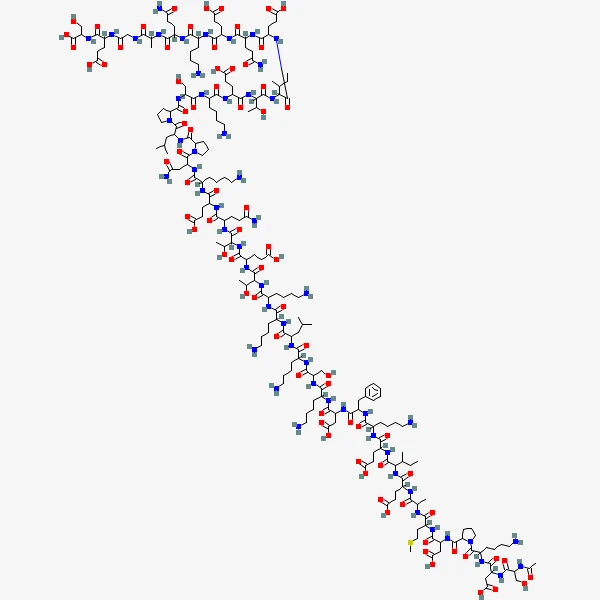
2D depiction generated from the PubChem record. Depictions are schematic and do not show salt form, counter-ions or conformation.
- Formula
- C212H350N56O78S
- Molecular weight
- 4963 g/mol
- InChIKey
- UGPMCIBIHRSCBV-UHFFFAOYSA-N
Doses used in published trials
What investigators administered in the cited studies, recorded as a fact about those studies. Not a protocol and not a recommendation.
Full dosing reference, study durations and vial arithmetic →- In SEER-1 (NCT02600429), people with neurotrophic keratopathy received 0.1% RGN-259 or placebo eye drops five times a day for 4 weeks 10,20.
- In ARISE-3 (NCT03937882), adults with dry eye received RGN-259 or placebo eye drops four times a day for 14 days 11.
- In a phase 2 severe dry-eye trial (NCT01393132), 0.1% RGN-259 or vehicle was instilled 6 times daily for 28 days 9.
- In a phase 1 study, healthy volunteers received single intravenous doses of 42, 140, 420 or 1260 mg synthetic Tβ4 or placebo, then the same dose daily for 14 days 6.
- In the NL005 phase IIb myocardial infarction study (NCT05984134), arms received recombinant human Tβ4 intravenously at 0.5 or 1.0 µg/kg per the arm descriptions, or placebo, for 7 days after PCI 14.
Published adverse-event data
Reported in the cited trials or product labels. Frequencies apply to the stated population and do not transfer to other settings.
- Any non-serious adverse event (registry tally)47 of 350 RGN-259 versus 31 of 349 placebo; no serious adverse events in either arm
- Serious adverse events (registry tally)3 of 299 RGN-259 versus 2 of 302 placebo
- Adverse events after intravenous dosingDescribed as infrequent; no serious events
Emerging safety signals
- No serious adverse events or dose-limiting toxicities were reported in two small intravenous phase 1 studies; these were short studies in healthy volunteers and do not establish long-term safety 6,7. 7 (2021)
- Anti-drug antibodies were measured in the NL005 phase 1 study; the abstract does not report their frequency 7. 7 (2021)
What is not known: Long-term human safety, systemic pharmacokinetics in patients, and whether results from the topical eye-drop trials apply to any other route are not established 6,8,10. The biological necessity of endogenous Tβ4 for cardiac repair is disputed by knockout data 5. Detailed ARISE-2 and ARISE-3 efficacy results were not located in a peer-reviewed publication in the sources reviewed 11,12.
Background viewing
We haven't found a clinician video focused on Thymosin beta-4 yet. Meanwhile, this widely watched talk covers the science of aging in general. It does not discuss Thymosin beta-4.
These creators are not affiliated with Amiravo and do not endorse Amiravo or any product linked on this site. Nothing here is medical advice. Video views counted on YouTube as of Oct 24, 2026.
Regulatory status
- Status
- Not FDA-approved; no Drugs@FDA application was located as of 2026-10-24 17. The RGN-259 eye drop has completed phase 3 dry-eye trials and a second neurotrophic keratopathy phase 3 trial (SEER-2) was listed as recruiting 11,12,19.
Status varies by country and changes over time. How we describe regulatory status.
Quality and testing notes
A certificate of analysis for full-length Tβ4 would be expected to show identity by mass spectrometry against the 43-residue acetylated sequence (PubChem lists a molecular weight of about 4963) and to distinguish it from the 7-residue TB-500 fragment, plus HPLC purity, endotoxin and net peptide content [1, 18].
How purity testing works · Reading a certificate of analysis
Check a Thymosin beta-4 certificate of analysis against its expected mass (4,963 Da)Storage and handling
Follow the documentation for the specific material; lyophilized peptides and proteins are generally kept dry and protected from heat, light and moisture.
Frequently asked questions
Is thymosin beta-4 the same as TB-500?
Is thymosin beta-4 FDA-approved?
What is RGN-259?
What is RGN-352?
Has thymosin beta-4 been tested in people?
Is thymosin beta-4 required for heart repair?
Is thymosin beta-4 allowed in sport?
Latest indexed research
No new studies were filed in the last sweep.
Search all studies on Thymosin beta-4 (PubMed, Europe PMC, ClinicalTrials.gov)Listed by publication type from the index record. Inclusion is not an endorsement; open the source to read the findings.
Revision history
Meaningful changes to this entry, with dates and sources. Last reviewed Oct 24, 2026. Typo and layout fixes are not listed.
- New section· entryOct 24, 2026
New research reference added: Thymosin beta-4.
Last reviewed October 24, 2026 by the Amiravo editorial team.
Need the math?
Laboratory arithmetic with every formula shown.
For research use only. Not for human or veterinary use. Not a drug, food, or dietary supplement. This page is educational and is not medical advice.
Unbranded reference image. Amiravo does not produce, supply or sell this compound.
Specifications
- Molecular formula
- C212H350N56O78S
- Molecular weight
- 4,963 g/mol
- PubChem CID
- 45382195
- Sequence
- Ac-
SDKPDMAEIEKFDKSKLKKTETQEKNPLPSKETIEQEKQAGES - Type
- Single compound
Identifiers from PubChem. Verify against the supplier’s documentation for your lot.
Research stats
How much has been published, not how good it is.
- PubMed records
- 1,132
- Indexed as human research
- 617
- Animal-only research
- 395
- Randomized controlled trials
- 7
- Registered trials
- 17
- Trials with posted results
- 8
- FDA adverse-event reports (FAERS)
- 6
- NIH-funded projects naming it
- 90
Counts from title/abstract searches of PubMed, ClinicalTrials.gov, openFDA and NIH RePORTER, checked 2026-10-24. Names shared with other substances can inflate counts. FAERS reports are spontaneous and do not establish cause. Funding shows interest, not evidence. Method
Follow Thymosin beta-4
See every new citation, evidence-grade or status change and correction in My Research, with optional email alerts. Free account.