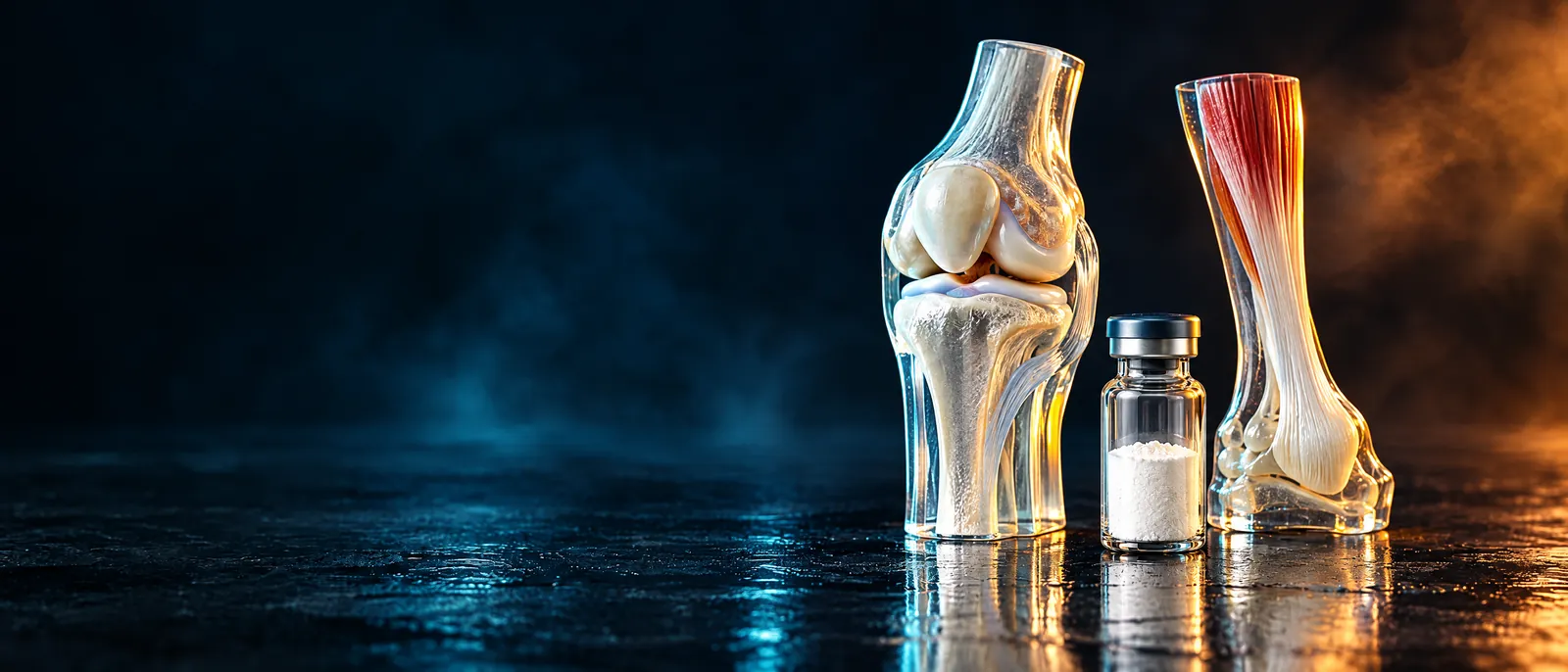
Tendon, ligament & injury repair
This hub covers compounds researched in models of tendon, ligament, wound, nerve and bone injury. Most compounds listed have been studied in animals or cells; the few controlled human trials are in wound or skin settings, and none in tendon or ligament repair has been published.
Limited human data
 LL-37Limited human data · Not approved — research use onlyEndogenous antimicrobial peptide tested topically in a phase IIb placebo-controlled trial of 148 people with venous leg ulcers; the full-population analysis found no healing difference.
 ARA-290Limited human data · InvestigationalIn genetically diabetic mice with incisional wounds, cibinetide was reported to improve re-epithelialisation, angiogenesis and wound breaking strength versus vehicle.
 GHK-CuLimited human data · Not approved — research use onlyIn rats, intra-articular GHK-Cu after ACL reconstruction was associated with lower knee laxity and higher graft stiffness at 6 weeks but not 12 weeks.
 ThymalinLimited human data · Not approved — research use onlyIn a rat mandibular bone defect model, locally given thymalin was reported to increase immune cells in the regenerate and shift macrophages from M1 toward M2.
Animal and laboratory research
 BPC-157Preclinical research · Not approved — research use onlyStudied mainly in rats, including an Achilles tendon transection model; no controlled human tendon or ligament trial has been published, and a hamstring-strain trial is registered.
 TB-500Preclinical research · Not approved — research use onlyFDA found no human exposure data; in a fibroblast scratch assay TB-500 did not differ from vehicle, and aged-mouse wound data used related peptides.
 CortagenPreclinical research · Not approved — research use onlyIn rats with a transected and sutured sciatic nerve, intramuscular Cortagen was associated with faster growth and conduction of regenerating fibres; no controlled human trial.
 DihexaPreclinical research · Not approved — research use onlyTested in a rat sciatic nerve transection-repair model, alone and with stem cells and G-CSF; no human study of Dihexa was identified.
Comparisons in this area
Guides
- BPC-157: Side Effects, Evidence, Legality and More, Answered
- TB-500: Side Effects, Evidence, Legality and More, Answered
- BPC-157 and TB-500 Together: Wolverine Stack Questions, Answered
- The thymosin family: thymosin alpha-1, thymosin beta-4 and TB-500
- Why so much peptide evidence comes from animals, and how to read it
Questions people ask
Which peptides have human trials for tendon repair?
None of the library compounds has a published controlled human trial of tendon or ligament healing. BPC-157's tendon findings come from rats, and a phase 2 trial in hamstring strain is registered and recruiting; GHK-Cu's ligament data come from a rat ACL model.
Is TB-500 the same as thymosin beta-4?
No. FDA states that TB-500 is a synthetic N-acetylated seven-residue fragment of the 43-amino-acid thymosin beta-4 protein, so findings on the full-length protein cannot be assumed to apply to it. FDA found no human exposure data for TB-500 by any route.
Has any peptide been tested in a controlled trial for wound healing?
LL-37 was tested topically in a phase IIb randomized placebo-controlled trial in 148 people with hard-to-heal venous leg ulcers, and the full-population analysis showed no significant healing difference. A positive signal appeared only in a post hoc subgroup with larger wounds.
For research use only. Not for human or veterinary use. Not a drug, food, or dietary supplement. Listing a compound under a research goal describes published research in the stated model. It is not a claim that the compound works, and it is not medical advice.