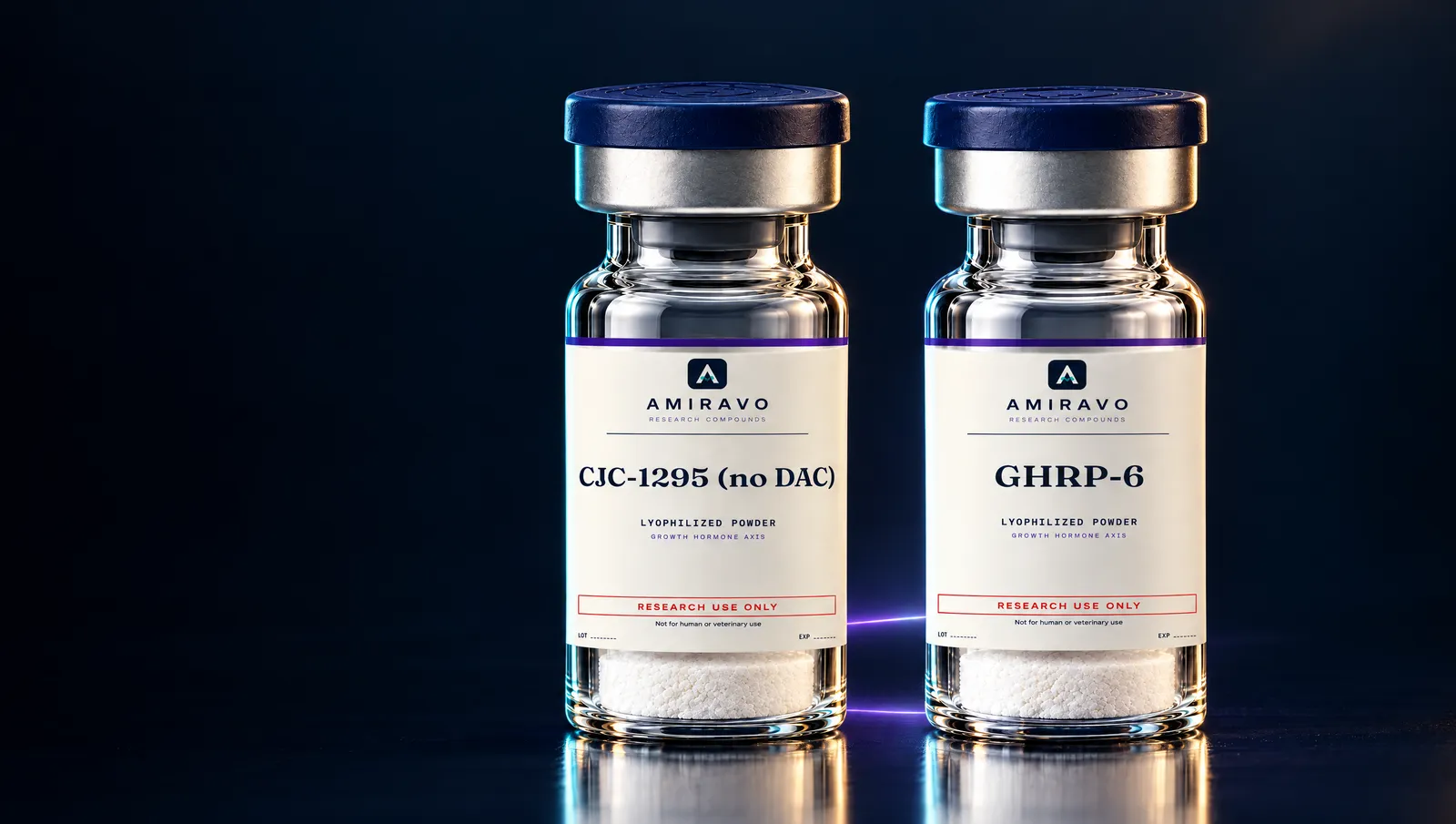
Combination evidence
CJC-1295 (no DAC) + GHRP-6
Also called CJC-1295 + GHRP-6 stack, Mod GRF 1-29 + GHRP-6
This pairing combines the GHRH-receptor analog CJC-1295 (no DAC) with GHRP-6, a GH-releasing hexapeptide. No human study of this exact pair was found. GHRP-6 has, however, been given to humans together with native GHRH in endocrine research and as a diagnostic test of GH reserve 1 2, which is the closest studied analogue.
Not studied together in humans
Components
A pre-mixed product with these contents has its own page: CJC-1295 (no DAC) + GHRP-6 Blend.
What has been studied
- No human study of CJC-1295 (no DAC) given with GHRP-6 was found. Searched: PubMed ((GHRH OR sermorelin OR "GRF 1-29") AND GHRP-6 AND human; CJC-1295 AND GHRP) and ClinicalTrials.gov (CJC-1295; GHRP-6), October 2026.
- Related combination, not this pair: in 18 healthy men, GHRP-6 and GHRH(1-44) given together intravenously stimulated GH release synergistically; serum prolactin and cortisol rose only at the highest GHRP-6 level tested 1.
- Related combination, not this pair: a combined GHRH plus GHRP-6 test has been studied as a diagnostic of GH deficiency in adults, including a study of 349 adults (146 with organic pituitary disease, 203 healthy) assessing whether a single 30-minute GH sample could replace full-curve sampling 2; GH responses to GHRH plus GHRP-6 were almost completely blocked in patients with pituitary stalk transection 3.
Why the pairing is discussed
Mechanistic reasoning drawn from studies of each component. Theoretical unless a study above tested the pair.
- Theoretical: the synergy of GHRH with GHRP-6 in healthy men was interpreted as the two acting through independent mechanisms 1; CJC-1295 is a modified GRF(1-29) analog intended to act at the GHRH receptor 4, so the pairing is discussed by analogy.
- Theoretical: in chronic administration studies in humans with GHRP-2 (a related peptide) and GHRH, responses could shift from additive to synergistic, and desensitisation depended partly on dosage and frequency 5; whether this applies to GHRP-6 with CJC-1295 is unknown.
Concerns and unknowns
- FDA lists GHRP-6 with possible immunogenicity and limited safety data, including concerns about effects on cortisol and on blood glucose through reduced insulin sensitivity, and lists CJC-1295 with reported serious adverse events including increased heart rate 6.
- In healthy men, GHRP-6 raised prolactin and cortisol at the highest level tested 1; GHRP-6 is less selective than ipamorelin, which did not raise ACTH or cortisol beyond the GHRH response in swine 7.
- Combined GH-axis stimulation may compound class effects; the label of the approved GHRH analog tesamorelin warns of glucose intolerance and fluid retention 8.
- WADA's 2026 Prohibited List names CJC-1295 and GHRP-6 in section S2.2.4 (growth hormone releasing factors and secretagogues), prohibited at all times 9.
Status of each component
| Compound | Regulatory status | Evidence | Half-life |
|---|---|---|---|
| CJC-1295 (no DAC) | Not approved — research use only | C | No half-life data specific to the no-DAC form were |
| GHRP-6 | Not approved — research use only | B | — |
Frequently asked questions
Has CJC-1295 + GHRP-6 been studied?
What did the GHRH + GHRP-6 studies show?
How does GHRP-6 differ from ipamorelin?
GHRP-6 raised prolactin and cortisol at higher levels in men 1, whereas ipamorelin was described as GH-selective in animal work 7.
Are there specific risks?
Is it allowed in sport?
References
- Growth hormone (GH)-releasing peptide stimulates GH release in normal men and acts synergistically with GH-releasing hormone J Clin Endocrinol Metab. 1990
- A single growth hormone (GH) determination is sufficient for the diagnosis of GH-deficiency in adult patients using the growth hormone releasing hormone plus growth hormone releasing peptide-6 test Clin Endocrinol (Oxf). 2002
- Growth hormone releasing hexapeptide-6 (GHRP-6) test in the diagnosis of GH-deficiency J Pediatr Endocrinol Metab. 1996
- Human growth hormone-releasing factor (hGRF)1-29-albumin bioconjugates activate the GRF receptor on the anterior pituitary in rats: identification of CJC-1295 as a long-lasting GRF analog Endocrinology. 2005
- GHRP-2, GHRH and SRIF interrelationships during chronic administration of GHRP-2 to humans J Pediatr Endocrinol Metab. 1996
- Certain Bulk Drug Substances for Use in Compounding that May Present Significant Safety Risks (content current as of 04/22/2026) FDA. 2026
- Ipamorelin, the first selective growth hormone secretagogue Eur J Endocrinol. 1998
- EGRIFTA WR (tesamorelin) for injection, prescribing information (revised 03/2025) FDA label (DailyMed). 2025
- International Standard: Prohibited List 2026 World Anti-Doping Agency. 2026