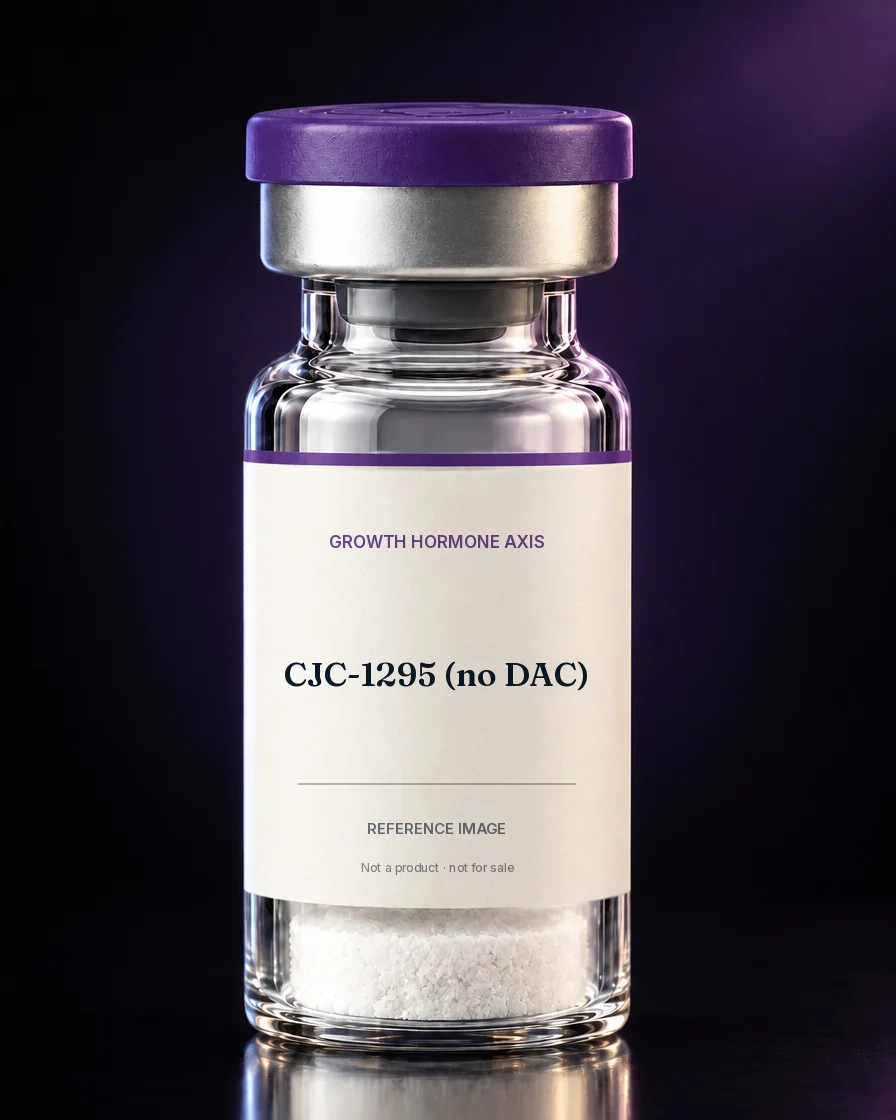
 Growth Hormone Axis · Dosing reference
CJC-1295 (no DAC) dosage
What the human evidence does and does not show, how long studies ran, and the arithmetic for working with vials.
- Regulatory status
- Not approved — research use only
- Human amounts
- None established in humans
- Route studied
- —
- Frequency
- Not established
- Half-life
- No half-life data specific to the no-DAC form were identified; the albumin-binding DAC form had an estimated half-life of 5.8 to 8.1 days in healthy adults, and the DAC group is the feature that extends it 2,3.
- Evidence grade
- Grade C · Preclinical research
- Vial sizes on the market
- 2 mg · 5 mg · 10 mg
- Other forms seen
- —
What CJC-1295 (no DAC) is
CJC-1295 without DAC (also called modified GRF 1-29) is a 29-amino-acid analog of growth hormone-releasing hormone that lacks the albumin-binding group of the long-acting CJC-1295 DAC form. Evidence specific to this form is limited: the published human work concerns the DAC form, and FDA found no safety or effectiveness data for the free base or acetate forms. It has no approved use.
Like other analogs of the first 29 residues of GHRH, the peptide is expected to act on the pituitary GHRH receptor to stimulate growth hormone release, but FDA's 2024 evaluation stated that nonclinical studies were not identified to establish whether the CJC-1295 free base and acetate forms are pharmacologically active 3. Pharmacology described in the literature belongs to the DAC form and to unmodified GRF(1-29)… How it works →
Key evidence
- Jette et al., Endocrinology · 2005 · Animals (rats) and cultured rat pituitary cells
- Teichman et al., Journal of Clinical Endocrinology & Metabolism · 2006 · Humans (healthy adults aged 21 to 61)
- FDA Pharmacy Compounding Advisory Committee evaluation · 2024 · Regulatory review of published literature on CJC-1295-related substances
What the human evidence shows
We searched PubMed and ClinicalTrials.gov and found no human studies that administered CJC-1295 (no DAC). The research described on its page is from cells or animals, and animal amounts do not translate to people.
How long did human studies run?
No human study durations are recorded for CJC-1295 (no DAC).
Cycle-length evidence for CJC-1295 (no DAC)CJC-1295 (no DAC) draw calculator
Pick the vial strength and the water added, enter an amount, and see the concentration, the units to draw and how many draws the vial holds. Arithmetic only.
Computed from your inputs. Not a dose or a recommendation.
Compare water volumes for this vialShow
More water = lower concentration = a larger, easier-to-measure draw. Tap a row to use it.
| Water | mg/mL | Draw |
|---|---|---|
| 0.5 mL | 20 | — |
| 1 mL | 10 | — |
| 1.5 mL | 6.667 | — |
| 2 mL | 5 | — |
| 2.5 mL | 4 | — |
| 3 mL | 3.333 | — |
| 5 mL | 2 | — |
Supplies and handling
- Lyophilized vialSealed vial with the freeze-dried cake. Check the label, lot and the certificate of analysis before opening.
- Sterile diluentThe diluent named on the product documentation. Bacteriostatic water contains benzyl alcohol; sterile water does not.
- Graduated syringesSized to the volume being measured. U-100 insulin syringes are graduated in units where 100 units = 1 mL.
- Alcohol prep padsFor wiping vial stoppers before each puncture.
- Nitrile glovesClean gloves for aseptic handling.
- Sharps containerPuncture-resistant container for used needles.
Storage
Handling of research-grade lyophilized peptide generally follows the supplier's documentation, which should be treated as authoritative. FDA noted that one manufacturer of CJC-1295 acetate bulk substance recommended refrigerated long-term storage, which relates to a bulk specification rather than a regulated product 3.
- Lyophilized (unmixed) vials: typically stored cold and dry, away from light, as the documentation directs. Many are stable longer frozen.
- Reconstituted vials: typically refrigerated (about 2–8 °C), protected from light and not frozen.
- Bacteriostatic water contains benzyl alcohol, which inhibits bacterial growth in multi-use vials; sterile water has no preservative.
Handling mistakes and troubleshooting
- Added the wrong volume of diluent
- The concentration changes, not the amount of compound in the vial. Recalculate with the volume actually added and relabel the vial.
- Shook the vial and it foamed
- Let it settle in the refrigerator. Foam is a sign of agitation; some peptides aggregate when shaken. Note it on the label.
- The solution is cloudy or has particles
- Do not use it. Cloudiness can indicate incomplete dissolution, contamination or degradation. Record the lot and contact the supplier with the certificate of analysis.
- The powder cake looks melted or shrunken before reconstitution
- This can indicate the vial was exposed to heat or moisture. Record the lot and condition on arrival.
- Liquid sprayed back when the needle was removed
- Pressure built up in the vial. Withdraw a small volume of air while adding diluent to keep pressure neutral.
Regulatory status
- Status
- Not approved by the FDA for any use; FDA reviewed the CJC-1295 free base and acetate forms for the compounding bulks list in 2024, found no nonclinical or clinical data to assess their safety and effectiveness, and proposed that they not be included 3,4,7.
- United States (FDA)
- Not FDA-approved; no label for CJC-1295 was found in DailyMed 7. In December 2024, FDA presented its evaluation of CJC-1295-related bulk drug substances, including the free base and acetate forms, to its Pharmacy Compounding Advisory Committee and proposed that these forms not be included on the 503A bulks list 3,4. FDA's public safety summary lists CJC-1295 among nominated-but-withdrawn substances 5.
- Sport (WADA)
- CJC-1295 is named on the WADA Prohibited List 2026 under S2.2.4 (growth hormone releasing factors, GHRH and its analogues), prohibited at all times 6.
Status varies by country and changes over time. How we describe regulatory status.
CJC-1295 (no DAC) compared with related compounds
| Compound | Status | Evidence | Human amounts | Half-life |
|---|---|---|---|---|
| CJC-1295 (no DAC) | Not approved — research use only | C | None established | No half-life data specific to the no-DAC |
| CJC-1295 (with DAC) | Not approved — research use only | B | None established | Estimated half-life of 5.8 to 8.1 days a |
| Ipamorelin | Not approved — research use only | B | None established | Terminal half-life of about 2 hours in h |
| Sermorelin | Not approved — research use only | B | None established | — |
| Tesamorelin | FDA-approved | A | FDA label | Mean elimination half-life about 11 minu |
| GHRP-2 | Approved outside the US | B | None established | In a Japanese package insert, the termin |
Combinations that include CJC-1295 (no DAC)
Frequently asked questions
What doses of CJC-1295 (no DAC) have been studied in humans?
Is there an established CJC-1295 (no DAC) cycle length?
How much bacteriostatic water should be added to a CJC-1295 (no DAC) vial?
How many units is a given amount on an insulin syringe?
What is the half-life of CJC-1295 (no DAC)?
Is CJC-1295 (no DAC) FDA-approved?
References
- Human growth hormone-releasing factor (hGRF)1-29-albumin bioconjugates activate the GRF receptor on the anterior pituitary in rats: identification of CJC-1295 as a long-lasting GRF analog Endocrinology. 2005
- Prolonged stimulation of growth hormone (GH) and insulin-like growth factor I secretion by CJC-1295, a long-acting analog of GH-releasing hormone, in healthy adults. J Clin Endocrinol Metab. 2006
- Pharmacy Compounding Advisory Committee Meeting, December 4, 2024: FDA presentations on CJC-1295-related bulk drug substances FDA. 2024
- Pharmacy Compounding Advisory Committee, December 4, 2024: FDA briefing document and points to consider for CJC-1295-related bulk drug substances FDA. 2024
- Substances in Compounding that May Present Significant Safety Risks FDA. 2024
- WADA Prohibited List US Food and Drug Administration. 2026
- DailyMed drug label search for CJC-1295 (zero labels returned on 22 Oct 2026) DailyMed (NLM). 2026
Last reviewed October 22, 2026 by the Amiravo editorial team. Editorial policy · Report an error