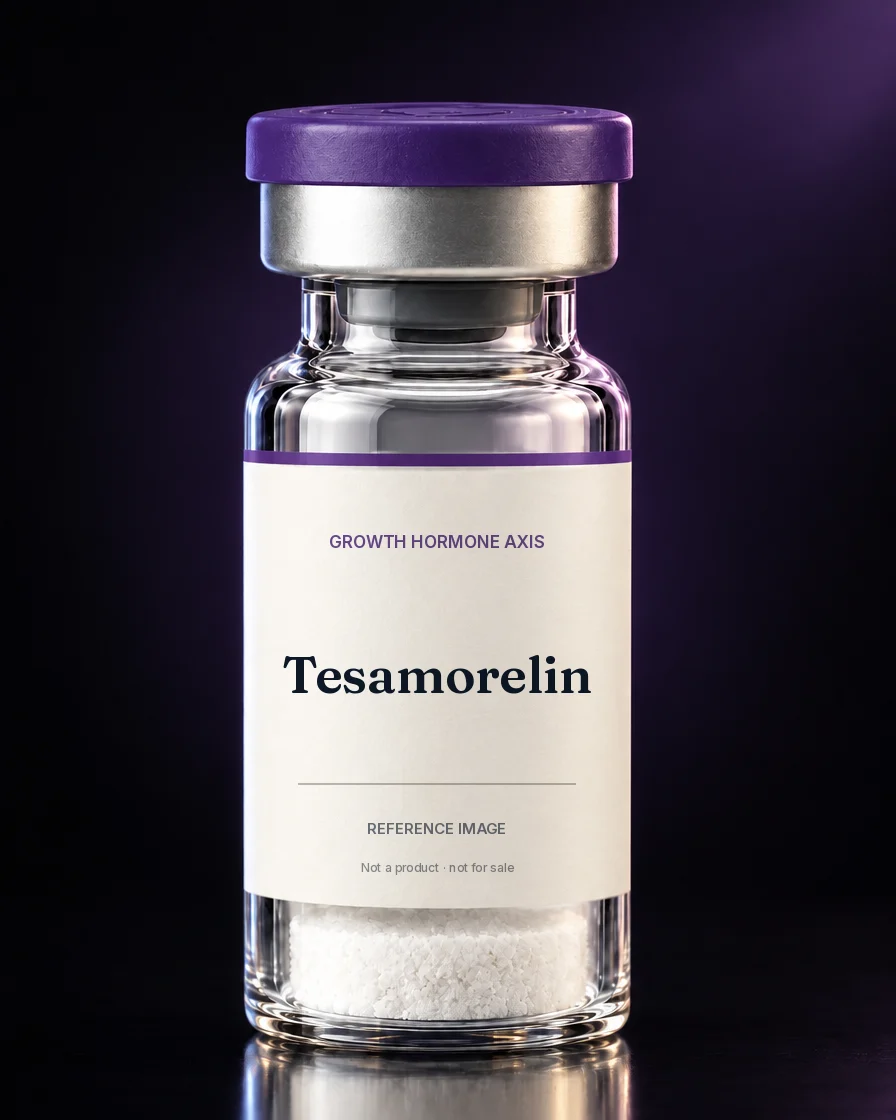
 Growth Hormone Axis · Dosing reference
Tesamorelin dosage
Dosing as the FDA label states it, how long trials ran, and the arithmetic for working with vials.
- Regulatory status
- FDA-approved
- Human amounts
- 1.28 mg once daily (EGRIFTA WR, 11.6 mg/vial) or 1.4 mg once daily (EGRIFTA SV, 2 mg/vial); the formulations are not substitutable
- Route studied
- Subcutaneous injection
- Frequency
- Once daily
- Half-life
- Mean elimination half-life about 11 minutes after a single 1.28 mg EGRIFTA WR dose and about 8 minutes after a single 1.4 mg EGRIFTA SV dose (healthy subjects)
- Evidence grade
- Grade A · Human trial evidence
- Vial sizes on the market
- 2 mg · 5 mg · 10 mg · 20 mg
- Other forms seen
- —
What Tesamorelin is
Tesamorelin is a synthetic analog of human growth hormone-releasing factor that is FDA-approved for reducing excess abdominal fat in HIV-infected adults with lipodystrophy. It has been studied in randomized placebo-controlled trials, mainly in people with HIV. This entry summarizes the label and published trials for research information only.
Tesamorelin binds and stimulates human growth hormone-releasing factor (GRF) receptors in vitro with potency similar to endogenous GRF 1. Growth hormone axis GRF, also called GHRH, is a hypothalamic peptide that acts on pituitary somatotroph cells to stimulate synthesis and pulsatile release of endogenous growth hormone (GH) 1. According to the label, tesamorelin stimulates GH secretion and subsequently increases… How it works →
Key evidence
- Falutz et al., N Engl J Med · 2007 · Humans (412 HIV-infected adults with abdominal fat accumulation)
- Falutz et al., J Clin Endocrinol Metab · 2010 · Humans (806 HIV-infected adults with excess abdominal fat)
- EGRIFTA WR prescribing information, Section 14 (Studies 1 and 2; NCT00123253, NCT00435136) · 2025 · Humans (412 and 404 HIV-infected adults with lipodystrophy)
Schedules by time period
Label regimens and laid out week by week. Each bar is what the label states or what investigators gave participants; none is a recommendation.
EGRIFTA SV and EGRIFTA WR (FDA labels): daily dosing 2
Adults with HIV and lipodystrophy (reduction of excess abdominal fat)
Week-by-week table
| Period | Amount |
|---|---|
| Weeks 0–onward | 1.4 mg (maintenance) |
Single fixed dosage; no escalation in the label.
Week-by-week table
| Period | Amount |
|---|---|
| Weeks 0–onward | 1.28 mg (maintenance) |
Single fixed dosage; no escalation. Cited to the EGRIFTA WR label: https://dailymed.nlm.nih.gov/dailymed/lookup.cfm?setid=839334d3-8c1d-4c26-9036-2ab524a6ea75
The two formulations differ in dosage and are not substitutable (both labels, section 2.1).
Dosing as stated on the FDA label
- For reduction of excess abdominal fat in HIV-infected adult patients with lipodystrophy (EGRIFTA SV, 2 mg/vial): the labeled dose is 1.4 mg injected subcutaneously once daily. 2
- For reduction of excess abdominal fat in HIV-infected adult patients with lipodystrophy (EGRIFTA WR, 11.6 mg/vial): the labeled dose is 1.28 mg injected subcutaneously once daily. 1
- The EGRIFTA WR label states that EGRIFTA WR and EGRIFTA SV are not substitutable because they differ in dosage, number of vials needed to prepare a dose, reconstitution instructions and storage requirements; the EGRIFTA SV label likewise states that its recommendations apply only to the 2 mg/vial formulation and that the formulations differ in these respects. Preparation and administration steps are set out in the prescribing information and are not reproduced here 1,2.
- The label states that tesamorelin is not indicated for weight loss management. 1
- The pivotal trials described on the labels administered 2 mg of the original EGRIFTA formulation (1 mg/vial) subcutaneously once daily; the EGRIFTA WR label states that its approval rests on those studies plus comparable bioavailability between EGRIFTA WR 1.28 mg and the original EGRIFTA 2 mg dose 1.
- Labels' limitations of use: long-term cardiovascular safety has not been established, and the labels advise considering the risk/benefit of continuing treatment in patients who have not had a reduction in visceral adipose tissue 1,2.
How long did human studies run?
- Two multicenter, randomized, double-blind, placebo-controlled trials (412 and 404 participants) each had a 26-week main phase in which participants received 2 mg of the original EGRIFTA formulation or placebo once daily (2:1), followed by a 26-week extension in which tesamorelin-treated completers were re-randomized to tesamorelin or placebo 1.
Contraindications on the label
- The EGRIFTA labels carry no boxed warning. Contraindications: disruption of the hypothalamic-pituitary axis due to hypophysectomy, hypopituitarism, pituitary tumor/surgery, head irradiation or head trauma; active malignancy (pre-existing malignancy should be inactive and its treatment complete); known hypersensitivity to tesamorelin or excipients; pregnancy 1,2.
- Main inclusion criteria in the pivotal trials were age 18 to 65 years, waist circumference of at least 95 cm and a stable antiretroviral regimen for at least 8 weeks before randomization 1.
Side effects reported in studies
- Injection site reaction (composite)17% tesamorelin versus 6% placebo in the label's Table 1; the warnings section reports 25% versus 14% for injection site reactions during the first 26 weeks · HIV-infected adults with lipodystrophy, 26-week phase of combined studies (n=543 vs 263) 1
- Arthralgia13% versus 11% · Same combined 26-week data 1
- Pain in extremity6% versus 5% · Same combined 26-week data 1
- Myalgia6% versus 2% · Same combined 26-week data 1
- Peripheral edema6% versus 2% · Same combined 26-week data 1
- Paresthesia5% versus 2% · Same combined 26-week data 1
- Hypersensitivity reactions (pruritus, erythema, flushing, urticaria, rash)4% of treated patients across clinical trials · HIV-infected adults with lipodystrophy 1
- New HbA1c of 6.5% or higher5% versus 1% (hazard ratio 3.3, 95% CI 1.4-9.6) · Clinical trials, through week 26 1
Tesamorelin draw calculator
Pick the vial strength and the water added, enter an amount, and see the concentration, the units to draw and how many draws the vial holds. Arithmetic only.
Computed from your inputs. Not a dose or a recommendation.
Compare water volumes for this vialShow
More water = lower concentration = a larger, easier-to-measure draw. Tap a row to use it.
| Water | mg/mL | Draw |
|---|---|---|
| 0.5 mL | 20 | — |
| 1 mL | 10 | — |
| 1.5 mL | 6.667 | — |
| 2 mL | 5 | — |
| 2.5 mL | 4 | — |
| 3 mL | 3.333 | — |
| 5 mL | 2 | — |
Supplies and handling
- Lyophilized vialSealed vial with the freeze-dried cake. Check the label, lot and the certificate of analysis before opening.
- Sterile diluentThe diluent named on the product documentation. Bacteriostatic water contains benzyl alcohol; sterile water does not.
- Graduated syringesSized to the volume being measured. U-100 insulin syringes are graduated in units where 100 units = 1 mL.
- Alcohol prep padsFor wiping vial stoppers before each puncture.
- Nitrile glovesClean gloves for aseptic handling.
- Sharps containerPuncture-resistant container for used needles.
Storage
Storage conditions differ between commercial formulations and research materials; follow the supplier's documentation and, for the approved products, the current label. Lyophilized peptides are generally sensitive to heat, light and moisture.
- Lyophilized (unmixed) vials: typically stored cold and dry, away from light, as the documentation directs. Many are stable longer frozen.
- Reconstituted vials: typically refrigerated (about 2–8 °C), protected from light and not frozen.
- Bacteriostatic water contains benzyl alcohol, which inhibits bacterial growth in multi-use vials; sterile water has no preservative.
Handling mistakes and troubleshooting
- Added the wrong volume of diluent
- The concentration changes, not the amount of compound in the vial. Recalculate with the volume actually added and relabel the vial.
- Shook the vial and it foamed
- Let it settle in the refrigerator. Foam is a sign of agitation; some peptides aggregate when shaken. Note it on the label.
- The solution is cloudy or has particles
- Do not use it. Cloudiness can indicate incomplete dissolution, contamination or degradation. Record the lot and contact the supplier with the certificate of analysis.
- The powder cake looks melted or shrunken before reconstitution
- This can indicate the vial was exposed to heat or moisture. Record the lot and condition on arrival.
- Liquid sprayed back when the needle was removed
- Pressure built up in the vial. Withdraw a small volume of air while adding diluent to keep pressure neutral.
Regulatory status
- Status
- FDA-approved (initial U.S. approval 2010) for the reduction of excess abdominal fat in HIV-infected adult patients with lipodystrophy; marketed as Egrifta SV (2 mg/vial) and Egrifta WR (11.6 mg/vial). The labels state it is not indicated for weight loss management and that long-term cardiovascular safety has not been established 1,2.
- United States (FDA)
- Tesamorelin is FDA-approved (initial U.S. approval 2010) as Egrifta SV and Egrifta WR for the reduction of excess abdominal fat in HIV-infected adult patients with lipodystrophy; the labels describe limitations of use, including that it is not indicated for weight loss management 1,2.
- Sport (WADA)
- Tesamorelin is named, together with sermorelin and CJC-1295, as an example of a GHRH analog in the S2 category of WADA's 2026 Prohibited List, which is prohibited at all times 7.
Status varies by country and changes over time. How we describe regulatory status.
Tesamorelin compared with related compounds
| Compound | Status | Evidence | Human amounts | Half-life |
|---|---|---|---|---|
| Tesamorelin | FDA-approved | A | FDA label | Mean elimination half-life about 11 minu |
| PEA | Not approved — research use only | A | None established | — |
| CJC-1295 (no DAC) | Not approved — research use only | C | None established | No half-life data specific to the no-DAC |
| CJC-1295 (with DAC) | Not approved — research use only | B | None established | Estimated half-life of 5.8 to 8.1 days a |
| Ipamorelin | Not approved — research use only | B | None established | Terminal half-life of about 2 hours in h |
| Sermorelin | Not approved — research use only | B | None established | — |
Combinations that include Tesamorelin
Frequently asked questions
What doses of Tesamorelin have been studied in humans?
Is there an established Tesamorelin cycle length?
How much bacteriostatic water should be added to a Tesamorelin vial?
How many units is a given amount on an insulin syringe?
What is the half-life of Tesamorelin?
Is Tesamorelin FDA-approved?
References
- EGRIFTA WR (tesamorelin) for injection, prescribing information (revised 03/2025) FDA label (DailyMed). 2025
- EGRIFTA SV (tesamorelin) for injection, prescribing information (revised 03/2024) FDA label (DailyMed). 2024
- Metabolic effects of a growth hormone-releasing factor in patients with HIV N Engl J Med. 2007
- Effects of tesamorelin (TH9507), a growth hormone-releasing factor analog, in HIV-infected patients with excess abdominal fat: a pooled analysis of two multicenter, double-blind placebo-controlled phase 3 trials with safety extension data J Clin Endocrinol Metab. 2010
- Effect of tesamorelin on visceral fat and liver fat in HIV-infected patients with abdominal fat accumulation: a randomized clinical trial JAMA. 2014
- Effects of tesamorelin on non-alcoholic fatty liver disease in HIV: a randomised, double-blind, multicentre trial Lancet HIV. 2019
- World Anti-Doping Agency International Standard Prohibited List 2026 WADA. 2026
- PubChem compound record for tesamorelin PubChem. 2026
Last reviewed October 23, 2026 by the Amiravo editorial team. Editorial policy · Report an error