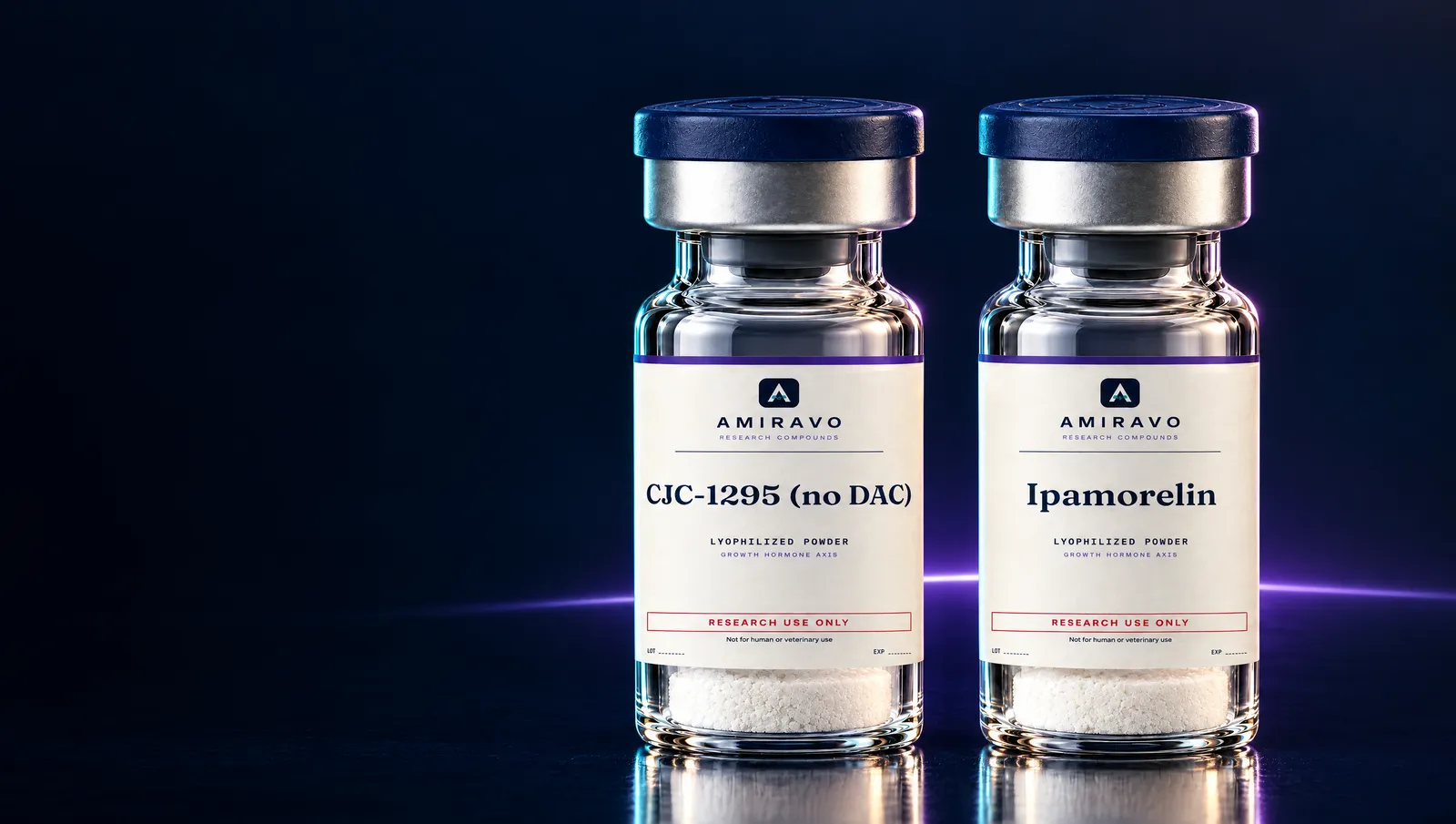
Combination evidence
CJC-1295 (no DAC) + Ipamorelin
Also called CJC/Ipa, Mod GRF 1-29 + Ipamorelin, CJC-1295 + Ipamorelin stack
This pairing combines a GHRH-receptor analog (CJC-1295 without the DAC group, also called modified GRF 1-29) with ipamorelin, a ghrelin-receptor agonist. Neither is approved anywhere, and no human study of the pair was found. The rationale rests on older human research showing that GHRH and a GH-releasing peptide given together can release more growth hormone than either alone 2, which involved different molecules.
Not studied together in humans
Components
A pre-mixed product with these contents has its own page: CJC-1295 (no DAC) + Ipamorelin Blend.
What has been studied
- No human study of CJC-1295 (no DAC) given with ipamorelin was found. Searched: PubMed ((CJC-1295 OR "modified GRF" OR "GRF(1-29)" OR sermorelin) AND ipamorelin; ipamorelin AND GHRH) and ClinicalTrials.gov (CJC-1295; ipamorelin), October 2026. Hits were reviews, doping-control methods and animal work.
- FDA's evaluation found no nonclinical or clinical data to assess the no-DAC form itself; the published human data on CJC-1295 concern the long-acting DAC form 1.
Why the pairing is discussed
Mechanistic reasoning drawn from studies of each component. Theoretical unless a study above tested the pair.
- Theoretical: in healthy men, a GH-releasing hexapeptide (GHRP-6) and GHRH(1-44) given together released growth hormone synergistically, which the authors interpreted as the two acting through independent mechanisms 2. Neither CJC-1295 nor ipamorelin was used in that study.
- Theoretical: ipamorelin releases GH through a GHRP-like receptor and, in swine, did not raise ACTH or cortisol beyond the GHRH response 3; in healthy men it produced a single short episode of GH release 4.
- Theoretical: CJC-1295 is a tetrasubstituted form of hGRF(1-29); the DAC version binds albumin and showed prolonged GH release in rats 5. Whether the no-DAC form behaves similarly has not been established in published studies 5.
Concerns and unknowns
- Both components act on the GH/IGF-1 axis, so effects that are dose-related for GH-axis drugs could add. The FDA label for tesamorelin, an approved GHRH analog, warns of glucose intolerance, fluid retention (edema, arthralgia, carpal tunnel syndrome) and IGF-1 elevation 6; whether these apply to this unstudied pairing is unknown.
- FDA lists CJC-1295 among compounding substances that may present significant safety risks, noting reported serious adverse events including increased heart rate and a systemic vasodilatory reaction, and lists ipamorelin acetate with immunogenicity concerns 7.
- A 2026 endocrinology review describes prolactin and cortisol elevation, dysglycaemia, fluid retention and theoretical mitogenic concerns among issues with self-administered GH-axis peptides and notes uncertainty around stacking practices and product composition 8.
- WADA's 2026 Prohibited List names CJC-1295 (as a GHRH analogue) and ipamorelin (as a GH secretagogue) in section S2.2.4 (growth hormone releasing factors and secretagogues), prohibited at all times 9.
Status of each component
| Compound | Regulatory status | Evidence | Half-life |
|---|---|---|---|
| CJC-1295 (no DAC) | Not approved — research use only | C | No half-life data specific to the no-DAC form were |
| Ipamorelin | Not approved — research use only | B | Terminal half-life of about 2 hours in healthy mal |
Frequently asked questions
Has CJC-1295 with ipamorelin been studied in humans?
No human study of this pair was found. Human data on CJC-1295 relate to the DAC form, not the no-DAC peptide usually sold in this pairing 1.
Why pair a GHRH analog with a ghrelin agonist?
A 1990 study in healthy men showed GHRH and a GH-releasing peptide together released GH synergistically 2. That study used different molecules, so the finding is theoretical for this pair.
What is the difference between CJC-1295 with and without DAC?
The DAC version carries an albumin-binding group that prolonged its action in rats 5; the no-DAC version lacks it and has no published pharmacology of its own.
Are there known risks?
Is it allowed in sport?
References
- Prolonged stimulation of growth hormone (GH) and insulin-like growth factor I secretion by CJC-1295, a long-acting analog of GH-releasing hormone, in healthy adults J Clin Endocrinol Metab. 2006
- Growth hormone (GH)-releasing peptide stimulates GH release in normal men and acts synergistically with GH-releasing hormone J Clin Endocrinol Metab. 1990
- Ipamorelin, the first selective growth hormone secretagogue Eur J Endocrinol. 1998
- Pharmacokinetic-pharmacodynamic modeling of ipamorelin, a growth hormone releasing peptide, in human volunteers Pharm Res. 1999
- Human growth hormone-releasing factor (hGRF)1-29-albumin bioconjugates activate the GRF receptor on the anterior pituitary in rats: identification of CJC-1295 as a long-lasting GRF analog Endocrinology. 2005
- EGRIFTA WR (tesamorelin) for injection, prescribing information (revised 03/2025) FDA label (DailyMed). 2025
- Certain Bulk Drug Substances for Use in Compounding that May Present Significant Safety Risks (content current as of 04/22/2026) FDA. 2026
- The emerging landscape of performance-enhancing peptides modulating GH-IGF1 axis: bridging the gap between clinical evidence and patient self-administration Front Endocrinol (Lausanne). 2026
- International Standard: Prohibited List 2026 World Anti-Doping Agency. 2026