Combination evidence
Retatrutide + MOTS-c
Also called Reta + MOTS-c stack
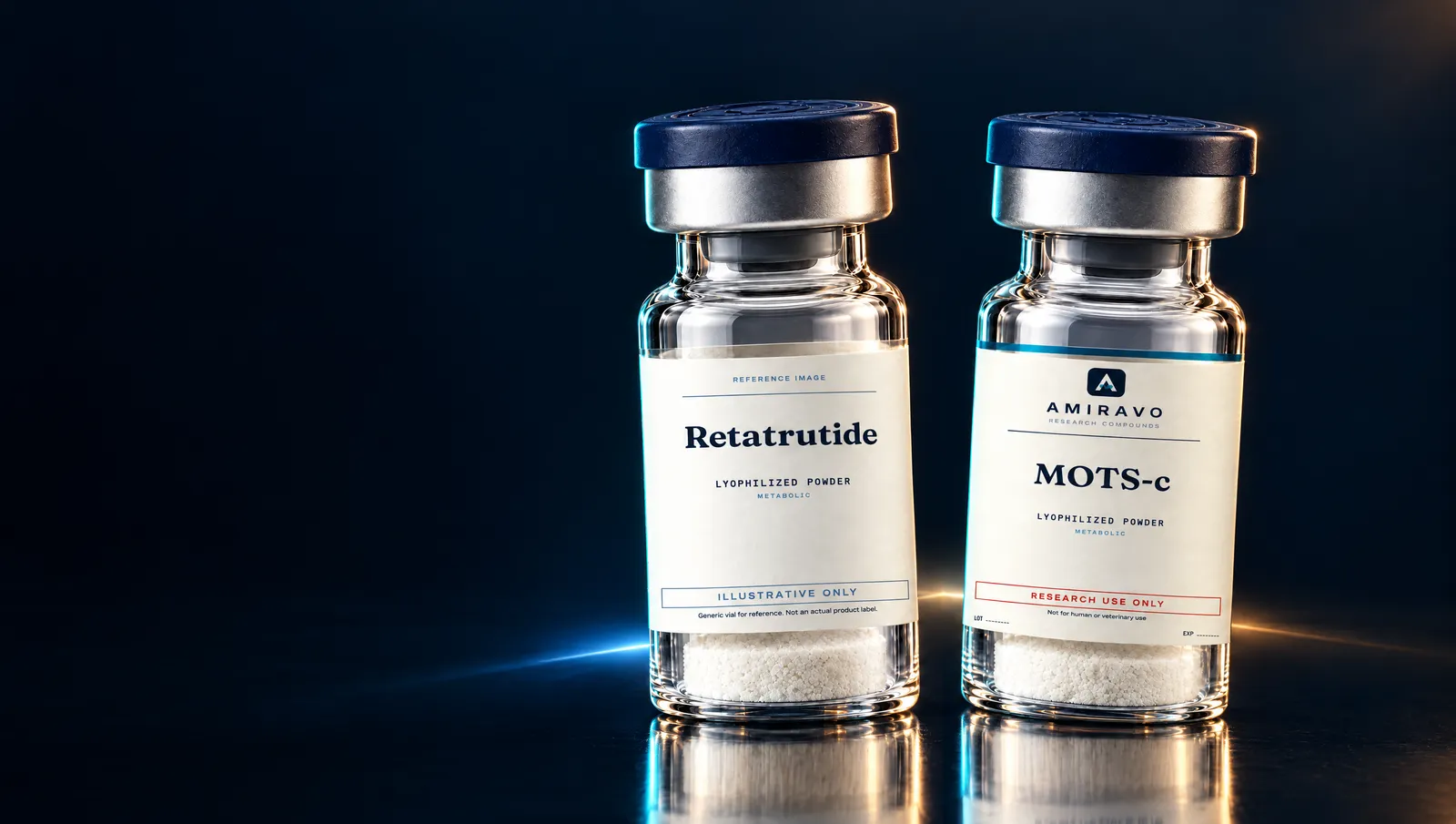
This pairing combines investigational retatrutide with MOTS-c, a mitochondrially encoded peptide studied mainly in mice. No study of the pair was found, and no published study administering MOTS-c to humans was identified. Any rationale is theoretical.
Not studied together in humans
Components
What has been studied
- No study of retatrutide with MOTS-c was found. Searched: PubMed (retatrutide AND MOTS-c: 0 results; MOTS-c AND (GLP-1 OR semaglutide OR incretin)) and ClinicalTrials.gov (retatrutide AND MOTS-c: 0 records), October 2026.
Why the pairing is discussed
Mechanistic reasoning drawn from studies of each component. Theoretical unless a study above tested the pair.
- Theoretical: in cells and mice, MOTS-c inhibited the folate cycle and purine biosynthesis leading to AMPK activation, and treatment prevented diet-induced obesity and insulin resistance in mice 1.
- Theoretical: retatrutide's weight effect in obese mice was attributed partly to glucagon-receptor-mediated increases in energy expenditure 2. Pairing is discussed because both are linked to energy metabolism in animal work; no study shows the effects combine.
Concerns and unknowns
- FDA lists MOTS-c among compounding substances that may present significant safety risks, stating it has no human exposure data and citing possible immunogenicity and characterisation issues 3.
- Retatrutide caused dose-related gastrointestinal events and dose-dependent heart-rate increases in its phase 2 obesity trial 4; whether MOTS-c alters these is unknown.
- No interaction, pharmacokinetic or safety data exist for the pair.
- WADA's 2026 list names MOTS-c in section S4.4.1 (AMPK activators), prohibited at all times; retatrutide is not named but falls under section S0 as a drug under clinical development 5.
Status of each component
| Compound | Regulatory status | Evidence | Half-life |
|---|---|---|---|
| Retatrutide | Investigational | A | Approximately 6 days (phase 1b multiple-ascending- |
| MOTS-c | Not approved — research use only | C | — |
Frequently asked questions
Has retatrutide + MOTS-c been studied?
No study was found in humans or animals.
Has MOTS-c been tested in humans?
No published human administration study was identified.
Why are they paired?
Are they allowed in sport?
MOTS-c is named under WADA S4.4.1 and retatrutide falls under S0; both are prohibited at all times 5.
References
- The mitochondrial-derived peptide MOTS-c promotes metabolic homeostasis and reduces obesity and insulin resistance Cell Metab. 2015
- LY3437943, a novel triple glucagon, GIP, and GLP-1 receptor agonist for glycemic control and weight loss: From discovery to clinical proof of concept Cell Metab. 2022
- Certain Bulk Drug Substances for Use in Compounding that May Present Significant Safety Risks (content current as of 04/22/2026) FDA. 2026
- Triple-Hormone-Receptor Agonist Retatrutide for Obesity: A Phase 2 Trial N Engl J Med. 2023
- International Standard: Prohibited List 2026 World Anti-Doping Agency. 2026