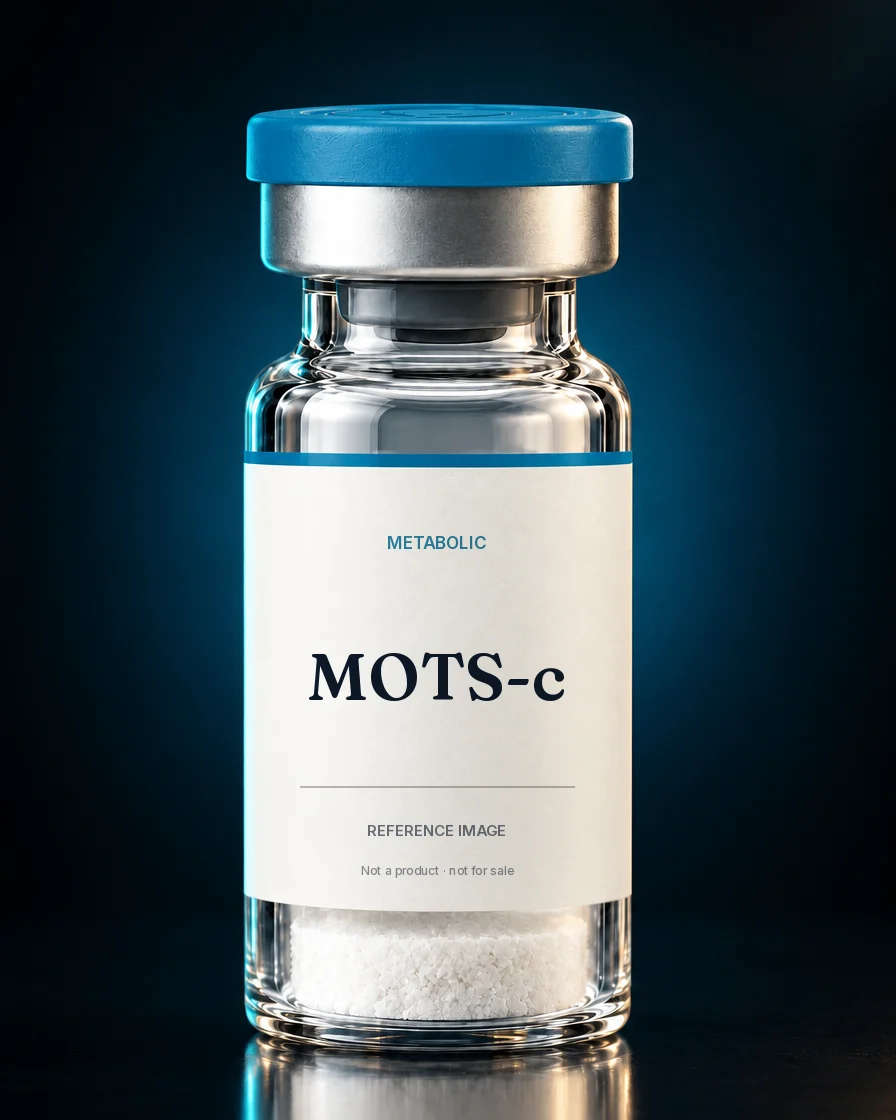
 Metabolic · Dosing reference
MOTS-c dosage
What the human evidence does and does not show, how long studies ran, and the arithmetic for working with vials.
- Regulatory status
- Not approved — research use only
- Human amounts
- None established in humans
- Route studied
- —
- Frequency
- Not established
- Half-life
- Not established
- Evidence grade
- Grade C · Preclinical research
- Vial sizes on the market
- 10 mg · 40 mg
- Other forms seen
- —
What MOTS-c is
MOTS-c is a short peptide encoded in mitochondrial DNA, studied in cellular and animal models of metabolism and stress response.
MOTS-c is translated from a short open reading frame within the mitochondrial 12S rRNA gene, which makes it one of a small group of mitochondrial-encoded signalling peptides alongside humanin 5. Folate cycle and AMPK In the originating report, MOTS-c's cellular actions inhibited the folate cycle and the purine biosynthesis tethered to it, and this led to activation of AMP-activated protein kinase; skeletal muscle… How it works →
Key evidence
- Lee et al., Cell Metab · 2015 · Mice and cellsMOTS-c was identified as a 16-amino-acid mitochondrially encoded peptide whose actions inhibit the folate cycle and purine biosynthesis and activate AMPK; treatment prevented age-dependent and diet-induced insulin resistance and diet-induced obesity in mice. 5
- Reynolds et al., Nat Commun · 2021 · Mice (young, middle-aged and old) plus human skeletal muscle and plasma measurementsMOTS-c enhanced physical performance across mouse age groups and late-life intermittent treatment increased physical capacity; in humans, exercise induced endogenous MOTS-c in muscle and circulation, which is a measurement rather than an administration finding. 7
- Zheng et al., Front Endocrinol (Lausanne) · 2023 · Review of preclinical literatureSummarises MOTS-c biology, including nuclear translocation under metabolic stress and age-related decline in plasma levels, and states that MOTS-c has been used little in disease treatment and that no effective method of applying it in the clinic has been developed. 6
What the human evidence shows
Human studies of MOTS-c are listed below by design, population and duration. None was designed or powered to establish an amount, and Amiravo does not reproduce their amounts for a compound approved nowhere.
- Separately, and as a different molecule, a phase 1a/1b study of CB4211 (an analogue, not MOTS-c itself) enrolled 88 participants: healthy non-obese subjects in single-ascending-dose and 7-day multiple-ascending-dose parts, and a 28-day part in subjects with non-alcoholic fatty liver disease, all by subcutaneous injection with placebo controls (NCT03998514, completed, no posted results) 9.
- Observational human work measures endogenous MOTS-c, not administered MOTS-c: for example, a study reporting that MOTS-c is an exercise-induced mitochondrial-encoded regulator of age-dependent physical decline and muscle homeostasis 7.
How long did human studies run?
- The CB4211 phase 1 study (a different molecule) used single administration in the first part, 7 days in the multiple-dose part and 28 days in the fatty liver disease part 9.
MOTS-c draw calculator
Pick the vial strength and the water added, enter an amount, and see the concentration, the units to draw and how many draws the vial holds. Arithmetic only.
Computed from your inputs. Not a dose or a recommendation.
Compare water volumes for this vialShow
More water = lower concentration = a larger, easier-to-measure draw. Tap a row to use it.
| Water | mg/mL | Draw |
|---|---|---|
| 0.5 mL | 20 | — |
| 1 mL | 10 | — |
| 1.5 mL | 6.667 | — |
| 2 mL | 5 | — |
| 2.5 mL | 4 | — |
| 3 mL | 3.333 | — |
| 5 mL | 2 | — |
Supplies and handling
- Lyophilized vialSealed vial with the freeze-dried cake. Check the label, lot and the certificate of analysis before opening.
- Sterile diluentThe diluent named on the product documentation. Bacteriostatic water contains benzyl alcohol; sterile water does not.
- Graduated syringesSized to the volume being measured. U-100 insulin syringes are graduated in units where 100 units = 1 mL.
- Alcohol prep padsFor wiping vial stoppers before each puncture.
- Nitrile glovesClean gloves for aseptic handling.
- Sharps containerPuncture-resistant container for used needles.
Storage
General research-context handling only. Lyophilised peptide is normally kept cold, dry and protected from light, and methionine- and tryptophan-containing sequences are particularly prone to oxidative degradation once in solution. Defer to the storage temperature, retest date and solvent guidance in the supplier's documentation for the specific lot; nothing here is a preparation or handling instruction.
- Lyophilized (unmixed) vials: typically stored cold and dry, away from light, as the documentation directs. Many are stable longer frozen.
- Reconstituted vials: typically refrigerated (about 2–8 °C), protected from light and not frozen.
- Bacteriostatic water contains benzyl alcohol, which inhibits bacterial growth in multi-use vials; sterile water has no preservative.
Handling mistakes and troubleshooting
- Added the wrong volume of diluent
- The concentration changes, not the amount of compound in the vial. Recalculate with the volume actually added and relabel the vial.
- Shook the vial and it foamed
- Let it settle in the refrigerator. Foam is a sign of agitation; some peptides aggregate when shaken. Note it on the label.
- The solution is cloudy or has particles
- Do not use it. Cloudiness can indicate incomplete dissolution, contamination or degradation. Record the lot and contact the supplier with the certificate of analysis.
- The powder cake looks melted or shrunken before reconstitution
- This can indicate the vial was exposed to heat or moisture. Record the lot and condition on arrival.
- Liquid sprayed back when the needle was removed
- Pressure built up in the vial. Withdraw a small volume of air while adding diluent to keep pressure neutral.
Regulatory status
- Status
- MOTS-c has no approved drug application in the United States; a Drugs@FDA / openFDA search returns no records 1. MOTS-c-related bulk drug substances were on the agenda of FDA's Pharmacy Compounding Advisory Committee meeting of July 23-24, 2026, where FDA proposed that MOTS-c (free base) and MOTS-c acetate NOT be included on the 503A bulk drug substances list 23. MOTS-c is also named in the WADA 2026 Prohibited List, section S4.4.1 4.
- United States (FDA)
- Not approved. Drugs@FDA / openFDA returns no application for MOTS-c 1. The substance was taken to the Pharmacy Compounding Advisory Committee on July 23, 2026 (afternoon session) for a vote on inclusion on the 503A bulks list 2, and FDA's briefing document states "FDA is proposing that MOTS-c (free base) NOT be included on the 503A Bulks List" and the same for MOTS-c acetate; the same document records in a footnote that the nomination (Wells Pharmacy Network) "was withdrawn by the nominator" and that FDA elected to proceed with the presentation anyway 3.
- Sport (WADA)
- Prohibited at all times. Section S4.4.1 (metabolic modulators) lists among activators of AMP-activated protein kinase (AMPK) the "mitochondrial open reading frame of the 12S rRNA-c (MOTS-c)" 4. S4.4 substances are prohibited in- and out-of-competition and are non-Specified.
Status varies by country and changes over time. How we describe regulatory status.
MOTS-c compared with related compounds
| Compound | Status | Evidence | Human amounts | Half-life |
|---|---|---|---|---|
| MOTS-c | Not approved — research use only | C | None established | — |
| PEA | Not approved — research use only | A | None established | — |
| Humanin | Not approved — research use only | C | None established | — |
| Tesofensine | Investigational | B | Trial doses | About 234 hours (M1 metabolite about 374 |
| Mazdutide | Approved outside the US | A | Trial doses | 150.9 to 403.5 hours (phase 1b in overwe |
| Cagrilintide | Investigational | A | Trial doses | 159 to 195 hours (phase 1b, co-administe |
Combinations that include MOTS-c
Frequently asked questions
What doses of MOTS-c have been studied in humans?
Is there an established MOTS-c cycle length?
How much bacteriostatic water should be added to a MOTS-c vial?
How many units is a given amount on an insulin syringe?
Is MOTS-c FDA-approved?
References
- Drugs@FDA application data queried through openFDA for MOTS-c (no matching application record returned on 22 October 2026) openFDA / Drugs@FDA. 2026
- July 23-24, 2026: Meeting of the Pharmacy Compounding Advisory Committee (agenda, questions and briefing documents) FDA Advisory Committee Calendar. 2026
- FDA Briefing Document, Pharmacy Compounding Advisory Committee Meeting, July 23-24, 2026 (covering BPC-157-, KPV-, TB-500-, MOTS-c-, Emideltide-, Epitalon- and Semax-related bulk drug substances) FDA. 2026
- International Standard: Prohibited List 2026 World Anti-Doping Agency. 2026
- The mitochondrial-derived peptide MOTS-c promotes metabolic homeostasis and reduces obesity and insulin resistance Cell Metab. 2015
- MOTS-c: A promising mitochondrial-derived peptide for therapeutic exploitation Front Endocrinol (Lausanne). 2023
- MOTS-c is an exercise-induced mitochondrial-encoded regulator of age-dependent physical decline and muscle homeostasis Nat Commun. 2021
- PubChem compound record for MOTS-c (CID 146675088; CAS 1627580-64-6) PubChem. 2026
- A Phase 1a/1b Study of CB4211 in Healthy Non-obese Subjects and Subjects With Nonalcoholic Fatty Liver Disease (NCT03998514), completed, no posted results ClinicalTrials.gov. 2021
Last reviewed October 23, 2026 by the Amiravo editorial team. Editorial policy · Report an error