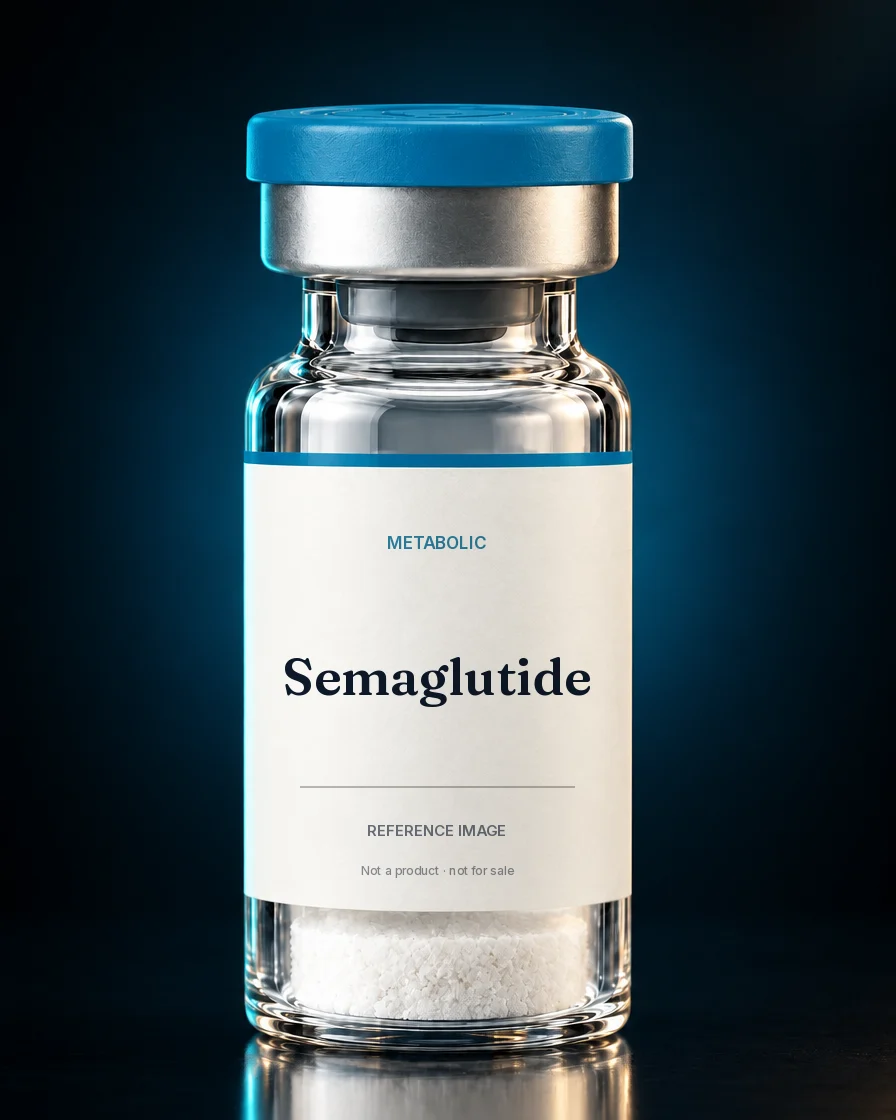
 Metabolic · Dosing reference
Semaglutide dosage
Dosing as the FDA label states it, how long trials ran, and the arithmetic for working with vials.
- Regulatory status
- FDA-approved
- Human amounts
- Injection: 0.25 mg → 0.5, 1 or 2 mg once weekly (Ozempic); 0.25 mg → 1.7 or 2.4 mg once weekly, adult weight-reduction maximum 7.2 mg (Wegovy). Tablets: 3 mg → 7 or 14 mg once daily (Rybelsus); 1.5 mg → 4 or 9 mg once daily (Ozempic tablets); 1.5 mg → 25 mg once daily (Wegovy tablets) 1,2,3
- Route studied
- Subcutaneous injection or oral tablet
- Frequency
- Once weekly (injection); once daily (tablets)
- Half-life
- Approximately 1 week; present in the circulation for about 5 weeks after the last dose (Ozempic label), about 5 to 7 weeks after the last 2.4 mg or 7.2 mg injection or 25 mg tablet (Wegovy label)
- Evidence grade
- Grade A · Human trial evidence
- Vial sizes on the market
- 2 mg · 3 mg · 5 mg · 10 mg · 20 mg · 30 mg · 50 mg
- Other forms seen
- —
What Semaglutide is
Semaglutide is a modified version of the gut hormone GLP-1 that is approved by the FDA, in injectable and oral forms, for type 2 diabetes, chronic weight management, cardiovascular risk reduction and related indications. Large randomized trials have studied its effects on body weight, cardiovascular events and kidney outcomes, and the most frequently reported adverse events are gastrointestinal. This entry summarizes the FDA labels and published trials for research reference only.
Semaglutide is described on the FDA label as a GLP-1 analogue with 94% sequence homology to human GLP-1 that selectively binds to and activates the GLP-1 receptor 1. Glucose-dependent effects According to the label, semaglutide reduces blood glucose by stimulating insulin secretion and lowering glucagon secretion, both in a glucose-dependent manner, and the mechanism also involves a minor delay in gastric emptying… How it works →
Key evidence
- Wilding et al., N Engl J Med (STEP 1) · 2021 · Humans (adults with overweight or obesity, without diabetes)
- Marso et al., N Engl J Med (SUSTAIN-6) · 2016 · Humans (adults with type 2 diabetes at high cardiovascular risk)
- Lincoff et al., N Engl J Med (SELECT) · 2023 · Humans (adults aged 45 or older with established cardiovascular disease and overweight or obesity, without diabetes)
Schedules by time period
Label regimens and laid out week by week. Each bar is what the label states or what investigators gave participants; none is a recommendation.
Ozempic injection (FDA label): type 2 diabetes escalation 1
Adults with type 2 diabetes mellitus
Week-by-week table
| Period | Amount |
|---|---|
| Weeks 0–4 | 0.25 mgInitiation dosage |
| Weeks 4–onward | 0.5 mg (maintenance) |
Week-by-week table
| Period | Amount |
|---|---|
| Weeks 0–4 | 0.25 mgInitiation dosage |
| Weeks 4–8 | 0.5 mg |
| Weeks 8–onward | 1 mg (maintenance) |
The label allows the increase to 1 mg after at least 4 weeks on 0.5 mg if additional glycemic control is needed; week 8 is the earliest point. The same 1 mg maintenance step applies to the label's type 2 diabetes with chronic kidney disease indication.
Week-by-week table
| Period | Amount |
|---|---|
| Weeks 0–4 | 0.25 mgInitiation dosage |
| Weeks 4–8 | 0.5 mg |
| Weeks 8–12 | 1 mg |
| Weeks 12–onward | 2 mg (maintenance) |
Each increase is described as "after at least 4 weeks" on the previous dosage; weeks shown are the earliest points. 2 mg once weekly is the maximum recommended dosage.
Section 2.2 of the label: start 0.25 mg once weekly for 4 weeks, then 0.5 mg; recommended maintenance 0.5 mg, 1 mg or 2 mg once weekly based on glycemic control.
Wegovy injection (FDA label): escalation to maintenance 2
Adults (cardiovascular risk reduction, weight reduction, noncirrhotic MASH with F2-F3 fibrosis) and pediatric patients aged 12 years and older (weight reduction)
Week-by-week table
| Period | Amount |
|---|---|
| Weeks 0–4 | 0.25 mg |
| Weeks 4–8 | 0.5 mg |
| Weeks 8–12 | 1 mg |
| Weeks 12–16 | 1.7 mg |
| Weeks 16–onward | 2.4 mg (maintenance) |
Table 1: weeks 1-4 0.25 mg, 5-8 0.5 mg, 9-12 1 mg, 13-16 1.7 mg, week 17 onward maintenance. 2.4 mg is the recommended maintenance dosage for cardiovascular risk reduction, adult and pediatric weight reduction, and MASH.
Week-by-week table
| Period | Amount |
|---|---|
| Weeks 0–4 | 0.25 mg |
| Weeks 4–8 | 0.5 mg |
| Weeks 8–12 | 1 mg |
| Weeks 12–16 | 1.7 mg |
| Weeks 16–onward | 1.7 mg (maintenance) |
1.7 mg is a labelled maintenance option for cardiovascular risk reduction and weight reduction (adults and pediatric patients 12 years and older); for MASH the label allows a decrease to 1.7 mg if 2.4 mg is not tolerated.
Week-by-week table
| Period | Amount |
|---|---|
| Weeks 0–4 | 0.25 mg |
| Weeks 4–8 | 0.5 mg |
| Weeks 8–12 | 1 mg |
| Weeks 12–16 | 1.7 mg |
| Weeks 16–20 | 2.4 mg |
| Weeks 20–onward | 7.2 mg (maintenance) |
Adult weight reduction only: patients who tolerate 2.4 mg for at least 4 weeks may be increased to a maximum of 7.2 mg once weekly when additional weight reduction is clinically indicated; week 20 is the earliest point.
If a dose is not tolerated during escalation, the label says to consider delaying escalation for 4 weeks.
Wegovy tablets (FDA label): escalation to maintenance 2
Adults (cardiovascular risk reduction or weight reduction)
Week-by-week table
| Period | Amount |
|---|---|
| Days 1-30 | 1.5 mgStarting dosage |
| Days 31-60 | 4 mg |
| Days 61-90 | 9 mg |
| Day 91 onward | 25 mg (maintenance) |
Table 2 of the label is written in days (30-day steps), so no week numbers are given.
Escalation every 30 days per Table 2; if a dose is not tolerated the label says to consider delaying escalation.
Rybelsus and Ozempic tablets (FDA label): type 2 diabetes escalation 3
Adults with type 2 diabetes mellitus
Week-by-week table
| Period | Amount |
|---|---|
| Days 1-30 | 3 mgInitiation; the label states this initiation dosage does not provide glycemic control |
| Day 31 onward | 7 mg (maintenance) |
Week-by-week table
| Period | Amount |
|---|---|
| Days 1-30 | 3 mgInitiation |
| Days 31-60 | 7 mg |
| Day 61 or thereafter | 14 mg (maintenance) |
Increase to 14 mg on day 61 or thereafter if additional glycemic control is needed.
Week-by-week table
| Period | Amount |
|---|---|
| Days 1-30 | 1.5 mgInitiation; the label states this initiation dosage does not provide glycemic control |
| Day 31 onward | 4 mg (maintenance) |
Week-by-week table
| Period | Amount |
|---|---|
| Days 1-30 | 1.5 mgInitiation |
| Days 31-60 | 4 mg |
| Day 61 or thereafter | 9 mg (maintenance) |
Increase to 9 mg on day 61 or thereafter if additional glycemic control is needed.
Rybelsus and Ozempic tablets are not substitutable on a mg-to-mg basis (label section 2). Steps are given in days in the label.
Dosing as stated on the FDA label
- For glycemic control in adults with type 2 diabetes (Ozempic injection): initiate at 0.25 mg injected subcutaneously once weekly for 4 weeks, then increase to 0.5 mg once weekly. The recommended maintenance dosage is 0.5 mg, 1 mg, or 2 mg once weekly. If additional glycemic control is needed after at least 4 weeks on 0.5 mg, the dosage may be increased to 1 mg, and after at least 4 weeks on 1 mg, to 2 mg once weekly. The maximum recommended dosage is 2 mg once weekly. 1
- For adults with type 2 diabetes and chronic kidney disease (Ozempic injection): increase the dosage to the maintenance dosage of 1 mg once weekly after at least 4 weeks on the 0.5 mg dosage. 1
- Administration of Ozempic injection per the label: once weekly, on the same day each week, at any time of day, with or without meals subcutaneously; if a dose is missed, administer it as soon as possible within 5 days, and if more than 5 days have passed, skip the missed dose. 1
- For chronic weight management in adults (Wegovy injection): the starting dosage is 0.25 mg subcutaneously once weekly for weeks 1 through 4, then 0.5 mg (weeks 5 through 8), 1 mg (weeks 9 through 12) and 1.7 mg (weeks 13 through 16). The maintenance dosage is 1.7 mg or 2.4 mg (recommended) once weekly; for patients who tolerate 2.4 mg for at least 4 weeks and in whom additional weight reduction is clinically indicated, the dosage may be increased to a maximum of 7.2 mg once weekly. 2
- For reducing the risk of major adverse cardiovascular events in adults with established cardiovascular disease and obesity or overweight (Wegovy injection): the maintenance dosage is either 2.4 mg (recommended) or 1.7 mg once weekly, after the same escalation schedule. 2
- For weight reduction in pediatric patients aged 12 years and older with obesity (Wegovy injection): the maintenance dosage is either 2.4 mg (recommended) or 1.7 mg once weekly, after the same escalation schedule. 2
- For noncirrhotic MASH with moderate to advanced liver fibrosis in adults (Wegovy injection): the recommended maintenance dosage is 2.4 mg injected subcutaneously once weekly; if not tolerated, the dosage can be decreased to 1.7 mg once weekly, with re-escalation to 2.4 mg to be considered. 2
- For weight reduction or cardiovascular risk reduction in adults (Wegovy tablets): 1.5 mg orally once daily for days 1 through 30, 4 mg for days 31 through 60, 9 mg for days 61 through 90, then the recommended maintenance dosage of 25 mg once daily from day 91. The label also sets out timing requirements relative to food and other oral medications. 2
- For glycemic control in adults with type 2 diabetes (Rybelsus tablets): start at 3 mg orally once daily for days 1 to 30 (this dosage is not effective for glycemic control), increase to 7 mg on days 31 to 60, and from day 61 either maintain 7 mg or, if additional glycemic control is needed, increase to 14 mg once daily. The label states that Rybelsus and Ozempic tablets are not substitutable on a mg-to-mg basis; Ozempic tablets are started at 1.5 mg, then 4 mg, then maintained at 4 mg or increased to 9 mg once daily. 3
- Ozempic injection label: the day of weekly administration can be changed if necessary as long as the time between two doses is at least 2 days (more than 48 hours) 1.
- Wegovy injection label, missed doses: if one dose is missed and the next scheduled dose is more than 2 days away, the missed dose is administered as soon as possible; if it is less than 2 days away, the dose is not administered. If 2 or more consecutive doses are missed, the label directs reinitiating dosage escalation at a lower dosage. For Wegovy tablets, a missed dose is skipped and the next dose taken the following day 2.
- Wegovy label, switching between presentations: patients taking Wegovy 2.4 mg injection for cardiovascular risk reduction or weight reduction in adults may switch to Wegovy 25 mg tablets, starting one week after the last 2.4 mg injection; patients on 25 mg tablets may switch to 2.4 mg injection once weekly starting the day after the last tablet. For patients who do not tolerate the 25 mg tablet, the label advises considering Wegovy 1.7 mg injection 2.
- Wegovy label, limitation of use: concomitant use of Wegovy tablets or injection with other semaglutide-containing products or with any other GLP-1 receptor agonist is not recommended 2.
- Rybelsus and Ozempic tablets are also indicated to reduce the risk of major adverse cardiovascular events in adults with type 2 diabetes at high risk for these events; the label sets one starting, escalation and maintenance schedule for both indications 3.
- Rybelsus/Ozempic tablets label, switching: patients may switch between Rybelsus and Ozempic tablets only after the 30-day initiation phase (Rybelsus 7 mg corresponds to Ozempic tablets 4 mg; Rybelsus 14 mg to Ozempic tablets 9 mg). Patients taking Ozempic 0.5 mg injection may switch to Rybelsus 7 mg or 14 mg, or to Ozempic tablets 4 mg or 9 mg, once daily starting one week after the last injection. A missed tablet dose is skipped and the next dose taken the following day 3.
How long did human studies run?
- Ozempic glycemic-control trials summarised on the label administered once-weekly semaglutide 0.5 mg, 1 mg or 2 mg for 30 to 56 weeks; SUSTAIN 6 (3,297 participants) randomized to 0.5 mg or 1 mg or placebo for a minimum observation time of 2 years, and FLOW (3,533 participants, 1 mg or placebo) followed participants for a median of 41 months 1.
- Wegovy weight-reduction trials on the label: 68-week trials (16-week escalation to 2.4 mg, then 52 weeks maintenance); Studies 8 and 9 escalated to 2.4 mg or 7.2 mg over 20 weeks followed by 52 weeks maintenance (72 weeks in total); the oral 25 mg tablet trial (Study 7) lasted 64 weeks (12-week escalation, 52-week maintenance); the pediatric trial lasted 68 weeks after a 12-week lifestyle run-in 2.
- In the Wegovy cardiovascular outcomes trial (Study 1, NCT03574597; 17,604 participants), patients were titrated to 2.4 mg over 16 weeks and the median follow-up was 41.8 months; the MASH trial (Study 11, NCT04822181) is a 240-week trial with efficacy assessed at week 72 2.
- Oral semaglutide glycemic trials on the Rybelsus label lasted 26 weeks; the cardiovascular outcomes trial of semaglutide tablets 14 mg versus placebo (Trial 7, 9,650 participants) had a median follow-up of 49.6 and 49.4 months in the semaglutide and placebo groups 3.
Contraindications on the label
- Boxed warning (risk of thyroid C-cell tumors): Semaglutide causes thyroid C-cell tumors in rodents at clinically relevant exposures; it is unknown whether Ozempic causes thyroid C-cell tumors, including medullary thyroid carcinoma (MTC), in humans. The boxed warning states that Ozempic is contraindicated in patients with a personal or family history of MTC or with Multiple Endocrine Neoplasia syndrome type 2 (MEN 2) 1.
- Ozempic injection contraindications: personal or family history of MTC or MEN 2; serious hypersensitivity reaction to semaglutide or any excipient (anaphylaxis and angioedema have been reported) 1.
- Wegovy (injection and tablets) carries the same thyroid C-cell tumor boxed warning; contraindications are a personal or family history of MTC or MEN 2 and a prior serious hypersensitivity reaction to semaglutide or any excipient 2.
- Rybelsus and Ozempic tablets carry the same boxed warning; contraindications are a personal or family history of MTC or MEN 2 and a prior serious hypersensitivity reaction to semaglutide or any excipient 3.
Side effects reported in studies
- Nausea44% vs 16% placebo · Pooled weight-management trials, adults with obesity or overweight (injectable) 2
- Diarrhea30% vs 16% placebo · Pooled weight-management trials, adults with obesity or overweight 2
- Vomiting24% vs 6% placebo · Pooled weight-management trials, adults with obesity or overweight 2
- Constipation24% vs 11% placebo · Pooled weight-management trials, adults with obesity or overweight 2
- Abdominal pain20% vs 10% placebo · Pooled weight-management trials, adults with obesity or overweight 2
- Severe gastrointestinal adverse reactions4.1% vs 0.9% placebo (injectable); 2% vs 0% placebo (tablet) · Weight-management trials in adults 2
- Permanent discontinuation due to adverse reactions6.8% vs 3.2% placebo · Pooled weight-management trials, adults 2
- Nausea (type 2 diabetes, injectable)6.1% placebo vs 15.8% to 20.3% across the two injectable dose groups · Pooled placebo-controlled glycemic-control trials, adults with type 2 diabetes (Ozempic) 1
Semaglutide draw calculator
Pick the vial strength and the water added, enter an amount, and see the concentration, the units to draw and how many draws the vial holds. Arithmetic only.
Computed from your inputs. Not a dose or a recommendation.
Compare water volumes for this vialShow
More water = lower concentration = a larger, easier-to-measure draw. Tap a row to use it.
| Water | mg/mL | Draw |
|---|---|---|
| 0.5 mL | 20 | — |
| 1 mL | 10 | — |
| 1.5 mL | 6.667 | — |
| 2 mL | 5 | — |
| 2.5 mL | 4 | — |
| 3 mL | 3.333 | — |
| 5 mL | 2 | — |
Supplies and handling
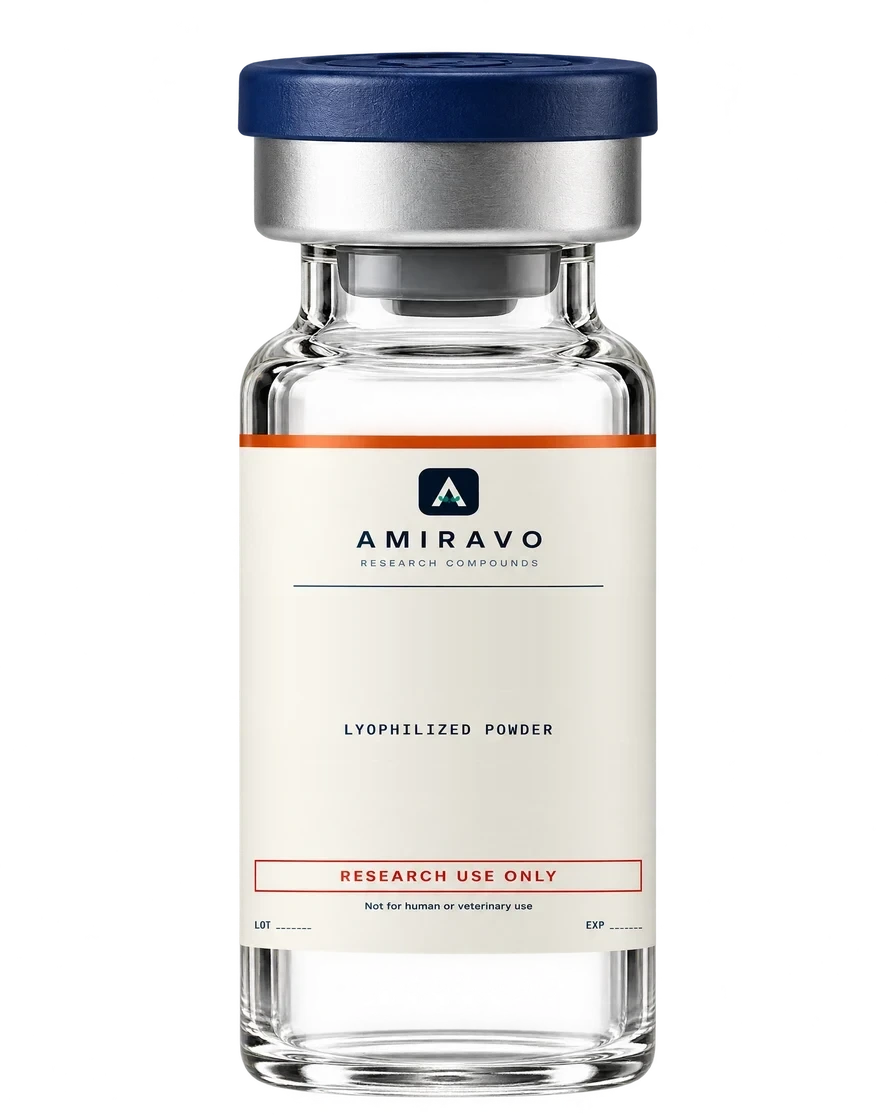
- Lyophilized vialSealed vial with the freeze-dried cake. Check the label, lot and the certificate of analysis before opening.
- Sterile diluentThe diluent named on the product documentation. Bacteriostatic water contains benzyl alcohol; sterile water does not.
- Graduated syringesSized to the volume being measured. U-100 insulin syringes are graduated in units where 100 units = 1 mL.
- Alcohol prep padsFor wiping vial stoppers before each puncture.
- Nitrile glovesClean gloves for aseptic handling.
- Sharps containerPuncture-resistant container for used needles.
Storage
Handling of research material should follow the supplier's documentation and certificate of analysis, including storage temperature, protection from light and freeze-thaw limits. Approved products have their own storage instructions in the 'How supplied/storage and handling' section of the respective FDA labels.
- Lyophilized (unmixed) vials: typically stored cold and dry, away from light, as the documentation directs. Many are stable longer frozen.
- Reconstituted vials: typically refrigerated (about 2–8 °C), protected from light and not frozen.
- Bacteriostatic water contains benzyl alcohol, which inhibits bacterial growth in multi-use vials; sterile water has no preservative.
Handling mistakes and troubleshooting
- Added the wrong volume of diluent
- The concentration changes, not the amount of compound in the vial. Recalculate with the volume actually added and relabel the vial.
- Shook the vial and it foamed
- Let it settle in the refrigerator. Foam is a sign of agitation; some peptides aggregate when shaken. Note it on the label.
- The solution is cloudy or has particles
- Do not use it. Cloudiness can indicate incomplete dissolution, contamination or degradation. Record the lot and contact the supplier with the certificate of analysis.
- The powder cake looks melted or shrunken before reconstitution
- This can indicate the vial was exposed to heat or moisture. Record the lot and condition on arrival.
- Liquid sprayed back when the needle was removed
- Pressure built up in the vial. Withdraw a small volume of air while adding diluent to keep pressure neutral.
Regulatory status
- Status
- Approved by the FDA as injectable Ozempic (original approval 2017) for glycemic control in adults with type 2 diabetes, for reducing major adverse cardiovascular events in adults with type 2 diabetes and established cardiovascular disease, and for reducing the risk of sustained eGFR decline, end-stage kidney disease and cardiovascular death in adults with type 2 diabetes and chronic kidney disease 1,4. Approved as Wegovy (original approval 2021) for cardiovascular risk reduction in adults with established cardiovascular disease and obesity or overweight, for chronic weight management in adults and in pediatric patients aged 12 years and older with obesity, and, under accelerated approval, for noncirrhotic MASH with moderate to advanced liver fibrosis in adults 2,4. An oral form was approved as Rybelsus (original approval 2019) for type 2 diabetes, and the current label also covers Ozempic tablets and Wegovy tablets 2,3,4.
- United States (FDA)
- Approved under NDA 209637 (Ozempic, original approval December 2017), NDA 213051 (Rybelsus, original approval September 2019) and NDA 215256 (Wegovy, original approval June 2021), per Drugs@FDA application records 4. Current FDA labels were reviewed from DailyMed 1,2,3.
- Sport (WADA)
- Semaglutide is not named on the WADA 2026 Prohibited List 10. In its 21 September 2026 announcement of the 2027 List, WADA stated that the status of GLP-1 receptor agonists, including semaglutide and tirzepatide, remains unchanged for 2027 pending further data, and that there was not enough evidence to conclude with confidence that the substances meet the criteria for inclusion 9.
Status varies by country and changes over time. How we describe regulatory status.
Semaglutide compared with related compounds
| Compound | Status | Evidence | Human amounts | Half-life |
|---|---|---|---|---|
| Semaglutide | FDA-approved | A | FDA label | Approximately 1 week; present in the cir |
| Liraglutide | FDA-approved | A | FDA label | Approximately 13 hours after subcutaneou |
| Cagrilintide | Investigational | A | Trial doses | 159 to 195 hours (phase 1b, co-administe |
| Ecnoglutide | Approved outside the US | A | Trial doses | 124 to 138 hours at steady state in heal |
| Orforglipron | FDA-approved | A | FDA label | Approximately 29-49 hours |
| Survodutide | Investigational | A | Trial doses | A numerical human half-life was not loca |
Combinations that include Semaglutide
Frequently asked questions
What doses of Semaglutide have been studied in humans?
Is there an established Semaglutide cycle length?
How much bacteriostatic water should be added to a Semaglutide vial?
How many units is a given amount on an insulin syringe?
What is the half-life of Semaglutide?
Is Semaglutide FDA-approved?
References
- OZEMPIC (semaglutide) injection, prescribing information FDA label (DailyMed). 2026
- WEGOVY (semaglutide) injection and tablets: prescribing information (Novo Nordisk), DailyMed set ID ee06186f-2aa3-4990-a760-757579d8f77b FDA label (DailyMed). 2026
- RYBELSUS and OZEMPIC (semaglutide) tablets: prescribing information (Novo Nordisk), DailyMed set ID 27f15fac-7d98-4114-a2ec-92494a91da98 FDA label (DailyMed). 2026
- Drugs@FDA application records for NDA 209637 (Ozempic), NDA 213051 (Rybelsus) and NDA 215256 (Wegovy): original approval dates Drugs@FDA (via openFDA). 2026
- Once-Weekly Semaglutide in Adults with Overweight or Obesity (STEP 1) N Engl J Med. 2021
- Semaglutide and Cardiovascular Outcomes in Patients with Type 2 Diabetes (SUSTAIN-6) N Engl J Med. 2016
- Semaglutide and Cardiovascular Outcomes in Obesity without Diabetes (SELECT) N Engl J Med. 2023
- Effects of Semaglutide on Chronic Kidney Disease in Patients with Type 2 Diabetes (FLOW) N Engl J Med. 2024
- WADA publishes 2027 Prohibited List (news release, 21 September 2026) WADA. 2026
- International Standard Prohibited List 2026 WADA Prohibited List. 2026
Last reviewed October 23, 2026 by the Amiravo editorial team. Editorial policy · Report an error