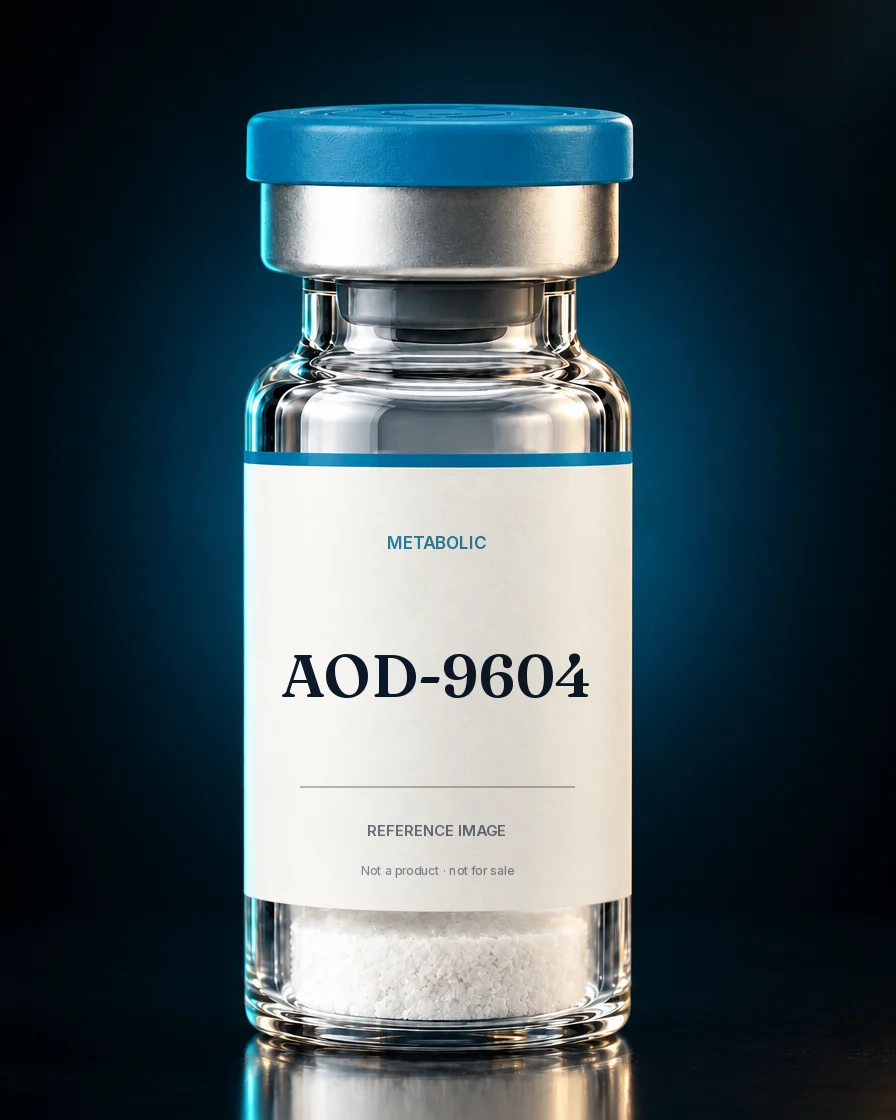
 Metabolic · Dosing reference
AOD-9604 dosage
What the human evidence does and does not show, how long studies ran, and the arithmetic for working with vials.
- Regulatory status
- Not approved — research use only
- Human amounts
- None established in humans
- Route studied
- Oral in the obesity trial programme; intravenous in early single-administration studies, as summarised by a 2026 review
- Frequency
- Not established
- Half-life
- Not established
- Evidence grade
- Grade C · Preclinical research
- Vial sizes on the market
- 2 mg · 5 mg · 10 mg
- Other forms seen
- —
What AOD-9604 is
AOD-9604 is a synthetic peptide modeled on the C-terminal region of human growth hormone that has been studied in animals for effects on fat metabolism. It is not an approved drug, and no controlled human efficacy trials were identified in the sources searched. This entry is for research information only.
AOD-9604 is a peptide made of residues 177-191 of the C-terminus of human growth hormone with an added N-terminal tyrosine 4. It has been described as a synthetic analogue of the lipolytic domain of human growth hormone 2. Beta-3 adrenergic receptor findings (mice) In obese mice, AOD9604 was reported to raise repressed beta(3)-adrenergic receptor RNA levels to levels comparable with lean mice, but in… How it works →
Key evidence
- Heffernan et al., Endocrinology · 2001 · Mice (obese mice and beta(3)-adrenergic receptor knock-out mice)
- Ng et al., Horm Res · 2000 · Rats (obese Zucker rats)
- Kwon and Park, Ann Clin Lab Sci · 2015 · Rabbits (n=32, collagenase-induced knee osteoarthritis)
What the human evidence shows
Human studies of AOD-9604 are listed below by design, population and duration. None was designed or powered to establish an amount, and Amiravo does not reproduce their amounts for a compound approved nowhere.
- A 2026 narrative review of growth hormone axis peptides states that human evidence for AOD9604 is limited and largely short-term, that as an oral anti-obesity candidate a 24-week study (534 participants, 502 randomized) failed to demonstrate a significant benefit on the primary weight-loss endpoint, and that conclusions about the lack of clinical efficacy rest primarily on sponsor-reported data; the review cites a 2013 safety and tolerability paper in the Journal of Endocrinology and Metabolism as the source 10.
- The same review states that AOD9604 produced minimal systemic growth hormone or IGF-1 activation in humans with no meaningful IGF-1 elevation, that its half-life has not been reported in human trials, and that claims about osteoarthritis or joint repair rest mainly on animal work such as intra-articular administration in a rabbit osteoarthritis model 10.
- An earlier metabolic study describes the design of AOD9604 as a synthetic analogue of the lipolytic domain of human growth hormone and reports oral administration experiments in obese mice (not humans), with increased adipose lipolytic activity and no adverse effect on insulin sensitivity by euglycemic clamp 2.
How long did human studies run?
- The review describes the pivotal oral obesity study as running 24 weeks, and characterises the human evidence base overall as short-term 10.
Who was excluded from the studies
- No eligibility criteria could be retrieved: no AOD9604 study is registered on ClinicalTrials.gov under that intervention name, and the primary trial reports were not accessible in this session 9.
AOD-9604 draw calculator
Pick the vial strength and the water added, enter an amount, and see the concentration, the units to draw and how many draws the vial holds. Arithmetic only.
Computed from your inputs. Not a dose or a recommendation.
Compare water volumes for this vialShow
More water = lower concentration = a larger, easier-to-measure draw. Tap a row to use it.
| Water | mg/mL | Draw |
|---|---|---|
| 0.5 mL | 20 | — |
| 1 mL | 10 | — |
| 1.5 mL | 6.667 | — |
| 2 mL | 5 | — |
| 2.5 mL | 4 | — |
| 3 mL | 3.333 | — |
| 5 mL | 2 | — |
Supplies and handling
- Lyophilized vialSealed vial with the freeze-dried cake. Check the label, lot and the certificate of analysis before opening.
- Sterile diluentThe diluent named on the product documentation. Bacteriostatic water contains benzyl alcohol; sterile water does not.
- Graduated syringesSized to the volume being measured. U-100 insulin syringes are graduated in units where 100 units = 1 mL.
- Alcohol prep padsFor wiping vial stoppers before each puncture.
- Nitrile glovesClean gloves for aseptic handling.
- Sharps containerPuncture-resistant container for used needles.
Storage
Storage conditions vary with the supplied form; follow the supplier's documentation and certificate of analysis. Lyophilized peptides are generally sensitive to heat, light and moisture.
- Lyophilized (unmixed) vials: typically stored cold and dry, away from light, as the documentation directs. Many are stable longer frozen.
- Reconstituted vials: typically refrigerated (about 2–8 °C), protected from light and not frozen.
- Bacteriostatic water contains benzyl alcohol, which inhibits bacterial growth in multi-use vials; sterile water has no preservative.
Handling mistakes and troubleshooting
- Added the wrong volume of diluent
- The concentration changes, not the amount of compound in the vial. Recalculate with the volume actually added and relabel the vial.
- Shook the vial and it foamed
- Let it settle in the refrigerator. Foam is a sign of agitation; some peptides aggregate when shaken. Note it on the label.
- The solution is cloudy or has particles
- Do not use it. Cloudiness can indicate incomplete dissolution, contamination or degradation. Record the lot and contact the supplier with the certificate of analysis.
- The powder cake looks melted or shrunken before reconstitution
- This can indicate the vial was exposed to heat or moisture. Record the lot and condition on arrival.
- Liquid sprayed back when the needle was removed
- Pressure built up in the vial. Withdraw a small volume of air while adding diluent to keep pressure neutral.
Regulatory status
- Status
- Not approved by the FDA for any use; an openFDA query of Drugs@FDA application data on 22 October 2026 returned no application record for AOD-9604 9. FDA lists AOD-9604 on its page of bulk drug substances for compounding that may present significant safety risks 5.
- United States (FDA)
- AOD-9604 is not FDA-approved; no Drugs@FDA application record was returned on 22 October 2026 9. FDA lists it on its page of bulk drug substances for compounding that may present significant safety risks 5.
- Sport (WADA)
- AOD-9604 and hGH 176-191 are named as growth hormone fragments in the S2 category of WADA's 2026 Prohibited List, which is prohibited at all times 6.
Status varies by country and changes over time. How we describe regulatory status.
AOD-9604 compared with related compounds
| Compound | Status | Evidence | Human amounts | Half-life |
|---|---|---|---|---|
| AOD-9604 | Not approved — research use only | C | None established | — |
| HGH Fragment 176-191 | Not approved — research use only | C | None established | — |
| Tesofensine | Investigational | B | Trial doses | About 234 hours (M1 metabolite about 374 |
| Mazdutide | Approved outside the US | A | Trial doses | 150.9 to 403.5 hours (phase 1b in overwe |
| Cagrilintide | Investigational | A | Trial doses | 159 to 195 hours (phase 1b, co-administe |
| SLU-PP-332 | Not approved — research use only | C | None established | Unknown in humans |
Frequently asked questions
What doses of AOD-9604 have been studied in humans?
Is there an established AOD-9604 cycle length?
How much bacteriostatic water should be added to a AOD-9604 vial?
How many units is a given amount on an insulin syringe?
Is AOD-9604 FDA-approved?
References
- The effects of human GH and its lipolytic fragment (AOD9604) on lipid metabolism following chronic treatment in obese mice and beta(3)-AR knock-out mice Endocrinology. 2001
- Metabolic studies of a synthetic lipolytic domain (AOD9604) of human growth hormone Horm Res. 2000
- Effect of Intra-articular Injection of AOD9604 with or without Hyaluronic Acid in Rabbit Osteoarthritis Model Ann Clin Lab Sci. 2015
- Detection and in vitro metabolism of AOD9604 Drug Test Anal. 2015
- Certain Bulk Drug Substances for Use in Compounding that May Present Significant Safety Risks (page modified April 2026) FDA. 2026
- World Anti-Doping Agency International Standard Prohibited List 2026 WADA. 2026
- PubChem compound record for AOD-9604 (CID 71300630) PubChem. 2026
- Safety and Efficacy of Approved and Unapproved Peptide Therapies for Musculoskeletal Injuries and Athletic Performance Sports Med. 2026
- Drugs@FDA application data queried through openFDA for AOD-9604 (no matching application record returned on 22 October 2026) openFDA / Drugs@FDA. 2026
- The emerging landscape of performance-enhancing peptides modulating GH-IGF1 axis: bridging the gap between clinical evidence and patient self-administration Front Endocrinol (Lausanne). 2026
Last reviewed October 23, 2026 by the Amiravo editorial team. Editorial policy · Report an error