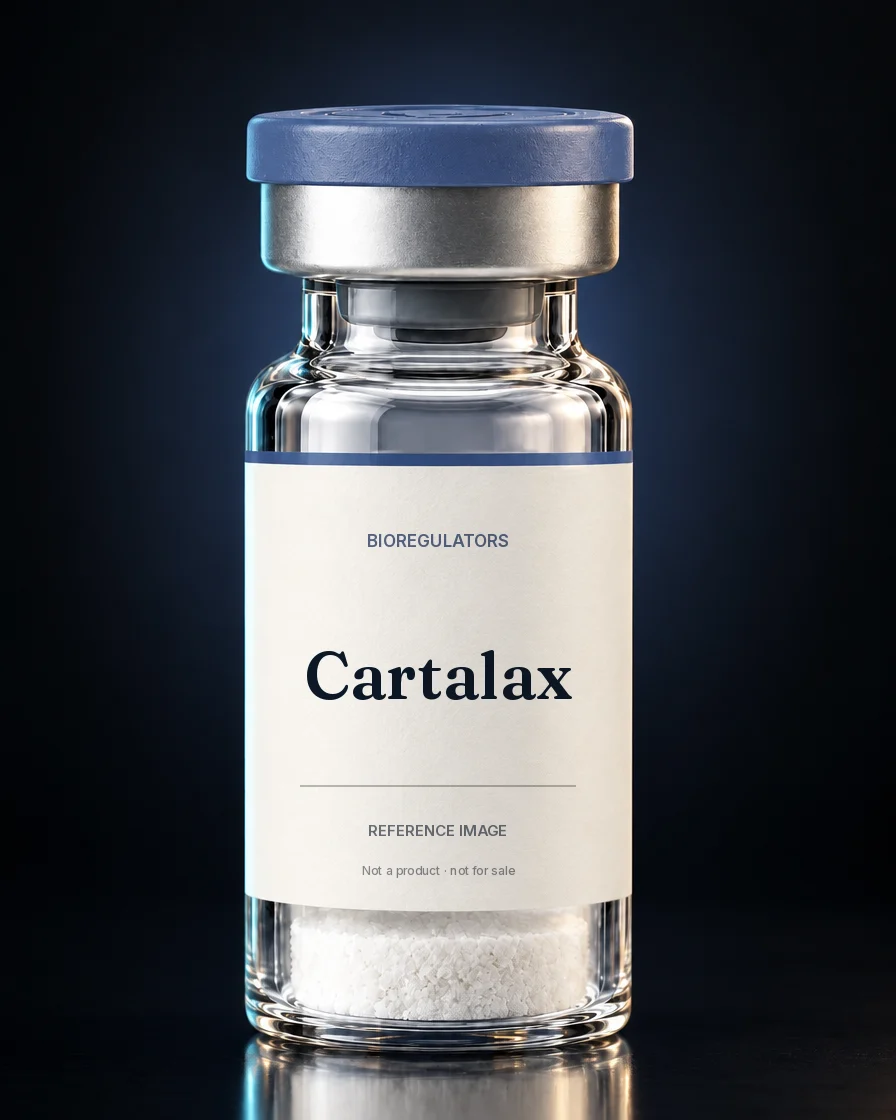
 Bioregulators · Dosing reference
Cartalax dosage
What the human evidence does and does not show, how long studies ran, and the arithmetic for working with vials.
- Regulatory status
- Not approved — research use only
- Human amounts
- None established in humans
- Route studied
- —
- Frequency
- Not established
- Half-life
- Not established
- Evidence grade
- Grade D · Mechanistic only
- Vial sizes on the market
- 20 mg
- Other forms seen
- —
What Cartalax is
Cartalax is a short synthetic tripeptide of the bioregulator class, studied in experimental research on cartilage and connective tissue biology.
The published mechanistic account for this peptide is almost entirely descriptive, and rests on the proposal — advanced by the group that developed these compounds — that very short peptides enter cells and nuclei and modulate transcription by interacting directly with DNA or with histone tails 6. In a Russian-language study in renal cell culture, AED was reported to reduce expression of the senescence-associated… How it works →
Key evidence
- Ashapkin et al., Molecular Biology Reports · 2020 · Cells (human embryonic bone-marrow mesenchymal stem cells, FetMSC line, aged by passage or stationary culture)AED was one of three peptides associated with a 3.5- to 5.6-fold increase in IGF1 expression and with increased NFκB expression in both ageing models; effects on FOXO1, TERT and TNKS2 differed between peptides and between the two ageing models. 3
- Lin'kova et al., Bulletin of Experimental Biology and Medicine · 2016 · Cells (human skin fibroblasts during replicative ageing in culture)
- Chalisova et al., Bulletin of Experimental Biology and Medicine · 2015 · Animal tissue ex vivo (organotypic kidney explants from young and old rats)T-31 (AED) was reported to stimulate proliferation and reduce apoptosis in kidney explants, but less than the polypeptide complex, which raised Ki-67 and lowered p53 expression in explants from both age groups. 5
What the human evidence shows
We searched PubMed and ClinicalTrials.gov and found no human studies that administered Cartalax. The research described on its page is from cells or animals, and animal amounts do not translate to people.
How long did human studies run?
No human study durations are recorded for Cartalax.
Cycle-length evidence for CartalaxCartalax draw calculator
Pick the vial strength and the water added, enter an amount, and see the concentration, the units to draw and how many draws the vial holds. Arithmetic only.
Computed from your inputs. Not a dose or a recommendation.
Compare water volumes for this vialShow
More water = lower concentration = a larger, easier-to-measure draw. Tap a row to use it.
| Water | mg/mL | Draw |
|---|---|---|
| 0.5 mL | 40 | — |
| 1 mL | 20 | — |
| 1.5 mL | 13.33 | — |
| 2 mL | 10 | — |
| 2.5 mL | 8 | — |
| 3 mL | 6.667 | — |
| 5 mL | 4 | — |
Supplies and handling
- Lyophilized vialSealed vial with the freeze-dried cake. Check the label, lot and the certificate of analysis before opening.
- Sterile diluentThe diluent named on the product documentation. Bacteriostatic water contains benzyl alcohol; sterile water does not.
- Graduated syringesSized to the volume being measured. U-100 insulin syringes are graduated in units where 100 units = 1 mL.
- Alcohol prep padsFor wiping vial stoppers before each puncture.
- Nitrile glovesClean gloves for aseptic handling.
- Sharps containerPuncture-resistant container for used needles.
Storage
Handling should follow the certificate of analysis and written documentation supplied with the specific lot; no stability or handling data specific to this compound were identified in the sources reviewed. Short lyophilised peptides are generally treated as hygroscopic, light-sensitive solids whose reconstituted solutions are chemically less stable than the dry material. Amiravo does not provide preparation, reconstitution or administration instructions.
- Lyophilized (unmixed) vials: typically stored cold and dry, away from light, as the documentation directs. Many are stable longer frozen.
- Reconstituted vials: typically refrigerated (about 2–8 °C), protected from light and not frozen.
- Bacteriostatic water contains benzyl alcohol, which inhibits bacterial growth in multi-use vials; sterile water has no preservative.
Handling mistakes and troubleshooting
- Added the wrong volume of diluent
- The concentration changes, not the amount of compound in the vial. Recalculate with the volume actually added and relabel the vial.
- Shook the vial and it foamed
- Let it settle in the refrigerator. Foam is a sign of agitation; some peptides aggregate when shaken. Note it on the label.
- The solution is cloudy or has particles
- Do not use it. Cloudiness can indicate incomplete dissolution, contamination or degradation. Record the lot and contact the supplier with the certificate of analysis.
- The powder cake looks melted or shrunken before reconstitution
- This can indicate the vial was exposed to heat or moisture. Record the lot and condition on arrival.
- Liquid sprayed back when the needle was removed
- Pressure built up in the vial. Withdraw a small volume of air while adding diluent to keep pressure neutral.
Regulatory status
- Status
- Not approved by the FDA for any use; no human drug labeling matching this name was returned by the openFDA Drug Label API 10.
- United States (FDA)
- There is no approved FDA application for this peptide; an openFDA Drug Label API query returned no matching human drug labeling 10. Neither "cartalax" nor "Ala-Glu-Asp" appears in any of the three categories of FDA's list of bulk drug substances nominated for use in compounding under section 503A of the FD&C Act, as updated 14 May 2026 11.
- Sport (WADA)
- Not named in the WADA 2026 Prohibited List 12. That absence is hedged negative evidence and not a clearance. Section S0 prohibits at all times "any pharmacological substance which is not currently approved by any governmental regulatory health authority for human therapeutic use" and states that the class "covers many different substances including but not limited to" its named examples; section S2 prohibits the listed peptide hormones, growth factors and mimetics "and other substances with similar chemical structure or similar biological effect(s)" 12.
Status varies by country and changes over time. How we describe regulatory status.
Cartalax compared with related compounds
| Compound | Status | Evidence | Human amounts | Half-life |
|---|---|---|---|---|
| Cartalax | Not approved — research use only | D | None established | — |
| Chonluten | Not approved — research use only | D | None established | — |
| Epithalon | Not approved — research use only | C | None established | — |
| Cortagen | Not approved — research use only | C | None established | — |
| Cardiogen | Not approved — research use only | C | None established | — |
| P-21 | Not approved — research use only | C | None established | — |
Frequently asked questions
What doses of Cartalax have been studied in humans?
Is there an established Cartalax cycle length?
How much bacteriostatic water should be added to a Cartalax vial?
How many units is a given amount on an insulin syringe?
Is Cartalax FDA-approved?
References
- alanyl-glutamyl-aspartic acid [Supplementary Concept] — entry terms include Ala-Glu-Asp, cartalax and T-31 peptide Medical Subject Headings, U.S. National Library of Medicine. 2026
- Cartalax (CID 87815447) — compound record, C12H19N3O8, 333.29 g/mol, CAS 85806-95-7 PubChem, U.S. National Library of Medicine. 2026
- Gene expression in human mesenchymal stem cell aging cultures: modulation by short peptides Molecular Biology Reports. 2020
- Peptide Regulation of Skin Fibroblast Functions during Their Aging In Vitro Bulletin of Experimental Biology and Medicine. 2016
- Peptide Regulation of Cells Renewal Processes in Kidney Tissue Cultures from Young and Old Animals Bulletin of Experimental Biology and Medicine. 2015
- Tripeptides slow down aging process in renal cell culture (in Russian) Advances in Gerontology (Uspekhi Gerontologii). 2014
- Peptidergic regulation of thymocyte differentiation, proliferation, and apoptosis during aging of the thymus Bulletin of Experimental Biology and Medicine. 2011
- Effect of short peptides on neuronal differentiation of stem cells International Journal of Immunopathology and Pharmacology. 2019
- ClinicalTrials.gov registry query for "cartalax" (the single returned record is an unrelated enteral-nutrition study retrieved by fuzzy matching) ClinicalTrials.gov (U.S. National Library of Medicine). 2026
- openFDA Drug Label API query for "cartalax" (no approved human drug labeling returned) U.S. Food and Drug Administration / openFDA. 2026
- Bulk Drug Substances Nominated for Use in Compounding Under Section 503A of the Federal Food, Drug, and Cosmetic Act (updated May 14, 2026) U.S. Food and Drug Administration. 2026
- World Anti-Doping Code International Standard — Prohibited List 2026 (effective 1 January 2026) World Anti-Doping Agency. 2026
- PubMed query for "cartalax" (6 records, all retrieved through the MeSH mapping of the name to the tripeptide Ala-Glu-Asp) PubMed / NCBI Entrez (U.S. National Library of Medicine). 2026
Last reviewed October 23, 2026 by the Amiravo editorial team. Editorial policy · Report an error