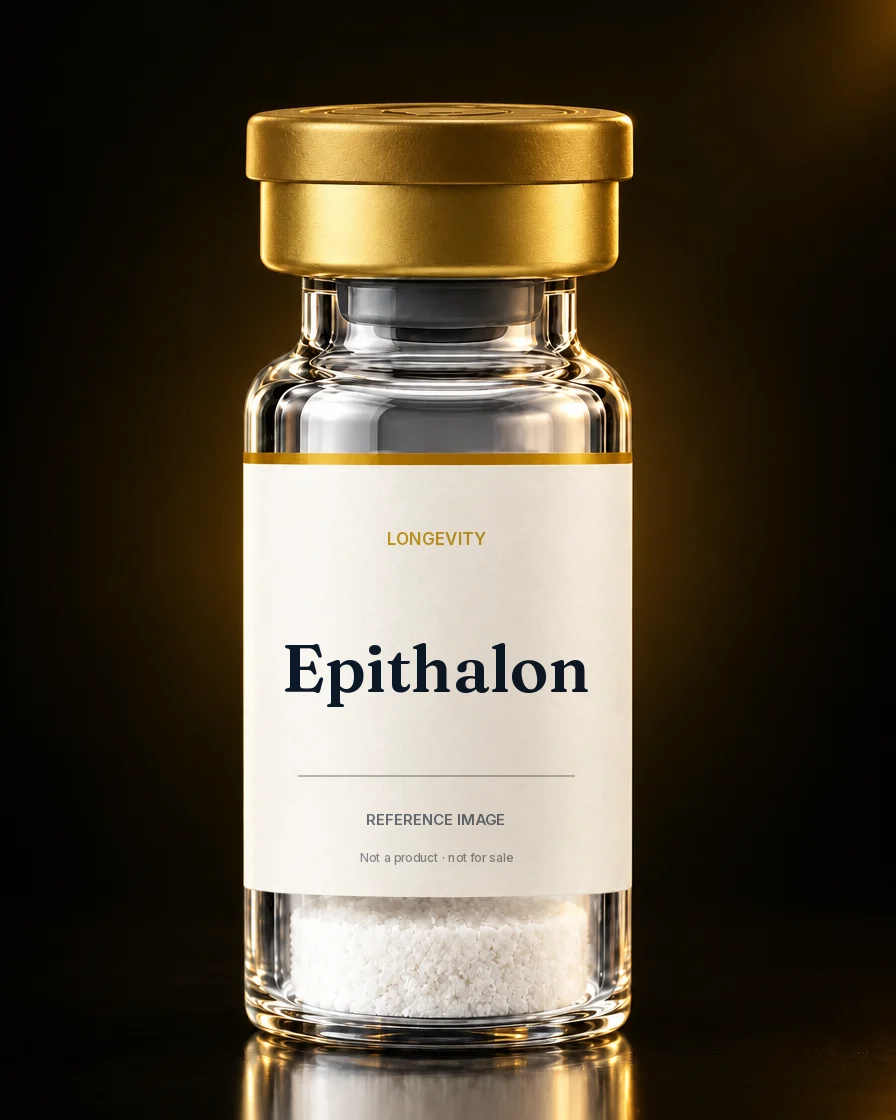
 Longevity · Dosing reference
Epithalon dosage
What the human evidence does and does not show, how long studies ran, and the arithmetic for working with vials.
- Regulatory status
- Not approved — research use only
- Human amounts
- None established in humans
- Route studied
- —
- Frequency
- Not established
- Half-life
- Not established
- Evidence grade
- Grade C · Preclinical research
- Vial sizes on the market
- 10 mg · 40 mg · 50 mg
- Other forms seen
- —
What Epithalon is
Epithalon is a synthetic tetrapeptide modeled on a pineal gland extract and investigated in cell and animal research on telomerase, antioxidant activity and aging. Most of the literature originates from a small number of research groups. It is not an approved medicine in the United States.
Epithalon (also written Epitalon) is the tetrapeptide Ala-Glu-Asp-Gly (AEDG), synthesized from the amino acid composition of Epithalamin, a bovine pineal gland extract 2. Proposed mechanisms Telomerase: In telomerase-negative human fetal fibroblast cultures, it was reported to induce expression of the catalytic subunit of telomerase, telomerase enzymatic activity and telomere elongation 1. Antioxidant and… How it works →
Key evidence
- Khavinson et al., Bull Exp Biol Med · 2003 · Cells (human fetal fibroblast culture)Addition of Epithalon to telomerase-negative fibroblasts was reported to induce telomerase catalytic subunit expression, enzymatic activity and telomere elongation. 1
- Araj et al., Int J Mol Sci · 2025 · Review of in vitro, in vivo and in silico studiesThe review summarizes reported antioxidant, neuroprotective, antimutagenic and neuroendocrine effects and states that the mechanisms remain uncertain and structural data are limited. 2
- Khavinson, Neuro Endocrinol Lett · 2002 · Animals and humans (as reported by the originating group)Reports lifespan extension in mice and fruit flies and restored melatonin and cortisol rhythms in old rhesus monkeys; also describes clinical studies in pigmentary retinal degeneration. 3
What the human evidence shows
We searched PubMed and ClinicalTrials.gov and found no human studies that administered Epithalon. The research described on its page is from cells or animals, and animal amounts do not translate to people.
How long did human studies run?
No human study durations are recorded for Epithalon.
Cycle-length evidence for EpithalonEpithalon draw calculator
Pick the vial strength and the water added, enter an amount, and see the concentration, the units to draw and how many draws the vial holds. Arithmetic only.
Computed from your inputs. Not a dose or a recommendation.
Compare water volumes for this vialShow
More water = lower concentration = a larger, easier-to-measure draw. Tap a row to use it.
| Water | mg/mL | Draw |
|---|---|---|
| 0.5 mL | 20 | — |
| 1 mL | 10 | — |
| 1.5 mL | 6.667 | — |
| 2 mL | 5 | — |
| 2.5 mL | 4 | — |
| 3 mL | 3.333 | — |
| 5 mL | 2 | — |
Supplies and handling
- Lyophilized vialSealed vial with the freeze-dried cake. Check the label, lot and the certificate of analysis before opening.
- Sterile diluentThe diluent named on the product documentation. Bacteriostatic water contains benzyl alcohol; sterile water does not.
- Graduated syringesSized to the volume being measured. U-100 insulin syringes are graduated in units where 100 units = 1 mL.
- Alcohol prep padsFor wiping vial stoppers before each puncture.
- Nitrile glovesClean gloves for aseptic handling.
- Sharps containerPuncture-resistant container for used needles.
Storage
Lyophilized peptides are generally handled according to the supplier's documentation, typically protected from light and moisture; follow the stability data supplied with the specific lot.
- Lyophilized (unmixed) vials: typically stored cold and dry, away from light, as the documentation directs. Many are stable longer frozen.
- Reconstituted vials: typically refrigerated (about 2–8 °C), protected from light and not frozen.
- Bacteriostatic water contains benzyl alcohol, which inhibits bacterial growth in multi-use vials; sterile water has no preservative.
Handling mistakes and troubleshooting
- Added the wrong volume of diluent
- The concentration changes, not the amount of compound in the vial. Recalculate with the volume actually added and relabel the vial.
- Shook the vial and it foamed
- Let it settle in the refrigerator. Foam is a sign of agitation; some peptides aggregate when shaken. Note it on the label.
- The solution is cloudy or has particles
- Do not use it. Cloudiness can indicate incomplete dissolution, contamination or degradation. Record the lot and contact the supplier with the certificate of analysis.
- The powder cake looks melted or shrunken before reconstitution
- This can indicate the vial was exposed to heat or moisture. Record the lot and condition on arrival.
- Liquid sprayed back when the needle was removed
- Pressure built up in the vial. Withdraw a small volume of air while adding diluent to keep pressure neutral.
Regulatory status
- Status
- Not approved by the FDA for any use; no FDA label was identified for this compound. It has been studied in cell and animal research, with limited human reports from its originating institute 2,3.
- United States (FDA)
- No FDA-approved label for Epithalon was identified; it is not approved for any indication 2.
- Sport (WADA)
- Epithalon is not named in the 2026 WADA Prohibited List text reviewed; Section S0 covers pharmacological substances with no approval by any governmental regulatory authority for human therapeutic use, so athletes should confirm status with their anti-doping organization 5.
Status varies by country and changes over time. How we describe regulatory status.
Epithalon compared with related compounds
| Compound | Status | Evidence | Human amounts | Half-life |
|---|---|---|---|---|
| Epithalon | Not approved — research use only | C | None established | — |
| Cartalax | Not approved — research use only | D | None established | — |
| N-Acetyl Epithalon Amidate | Not approved — research use only | — | None established | — |
| Chonluten | Not approved — research use only | D | None established | — |
| Methylene Blue | FDA-approved | A | FDA label | Approximately 24 hours |
| L-Glutathione | Not approved — research use only | B | None established | — |
Frequently asked questions
What doses of Epithalon have been studied in humans?
Is there an established Epithalon cycle length?
How much bacteriostatic water should be added to a Epithalon vial?
How many units is a given amount on an insulin syringe?
References
- Epithalon peptide induces telomerase activity and telomere elongation in human somatic cells Bull Exp Biol Med. 2003
- Overview of Epitalon-Highly Bioactive Pineal Tetrapeptide with Promising Properties Int J Mol Sci. 2025
- Peptides and Ageing Neuro Endocrinol Lett. 2002
- Epitalon protects against post-ovulatory aging-related damage of mouse oocytes in vitro Aging (Albany NY). 2022
- WADA 2026 Prohibited List World Anti-Doping Agency. 2026
Last reviewed October 22, 2026 by the Amiravo editorial team. Editorial policy · Report an error