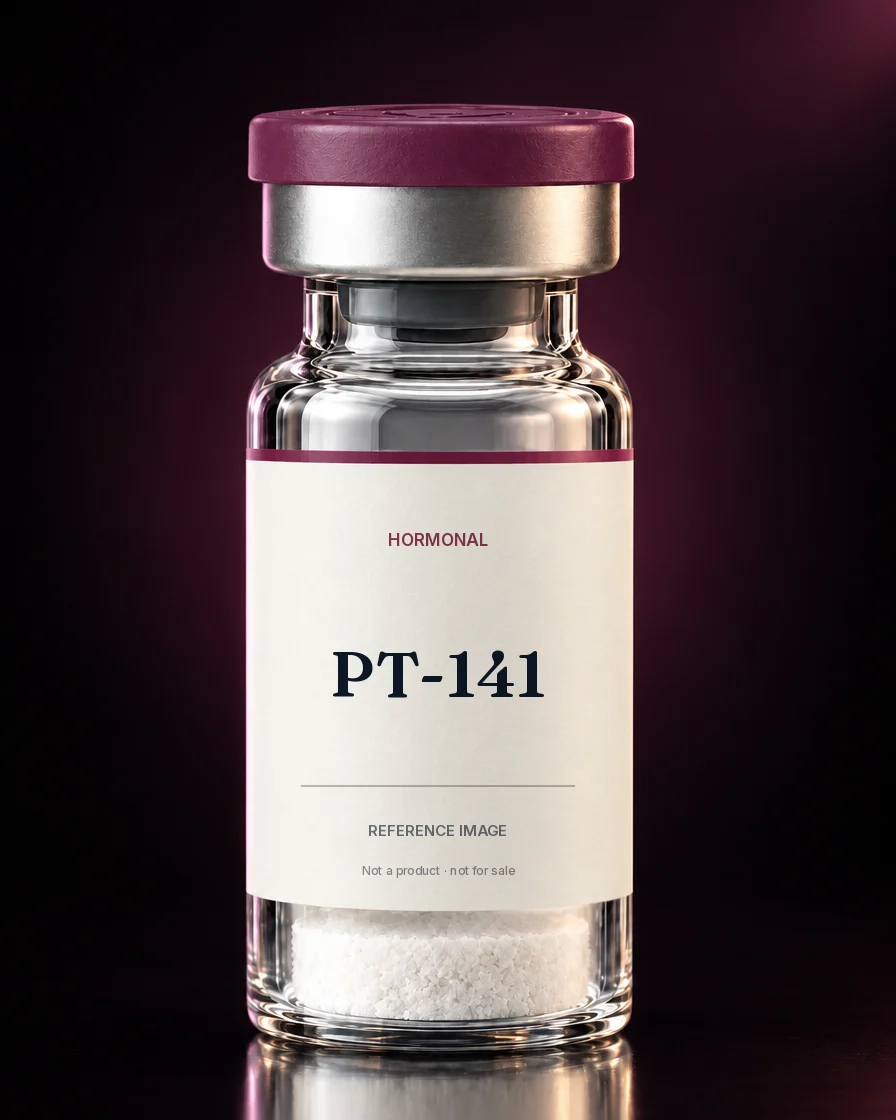
 Hormonal · Dosing reference
PT-141 dosage
Dosing as the FDA label states it, how long trials ran, and the arithmetic for working with vials.
- Regulatory status
- FDA-approved
- Human amounts
- 1.75 mg subcutaneously as needed, at least 45 minutes before anticipated sexual activity; no more than one dose in 24 hours or 8 per month (FDA label) 1
- Route studied
- Subcutaneous (single-dose autoinjector)
- Frequency
- As needed; at most one dose per 24 hours
- Half-life
- Mean terminal half-life of about 2.7 hours (range 1.9 to 4.0 hours) after a single subcutaneous administration, per the FDA label 1.
- Evidence grade
- Grade A · Human trial evidence
- Vial sizes on the market
- 10 mg
- Other forms seen
- Liquid spray 10 mL (10 mg)
What PT-141 is
PT-141 is the research name for bremelanotide, a cyclic melanocortin receptor agonist that the FDA approved in 2019 as Vyleesi for a narrowly defined form of low sexual desire in premenopausal women. Its mechanism in HSDD is not known, and its main documented adverse reactions are nausea, flushing, headache, injection site reactions and transient blood pressure changes. This entry summarizes the FDA label, the pivotal trials and the earlier preclinical and male erectile dysfunction studies.
Bremelanotide is a melanocortin receptor agonist that activates several receptor subtypes without strong selectivity; the label gives an order of potency of MC1R, MC4R, MC3R, MC5R and MC2R, and states that binding at MC1R and MC4R is most relevant at therapeutic dose levels 1. The label also states that the mechanism by which bremelanotide improves HSDD in women is unknown 1. Central nervous system activity… How it works →
Key evidence
- Kingsberg et al., Obstetrics & Gynecology · 2019 · Humans (premenopausal women with acquired, generalized HSDD)Of 1,267 women randomized, bremelanotide was associated with statistically significant increases in desire score (integrated difference 0.35) and reductions in desire-related distress (integrated difference -0.33) compared with placebo; nausea, flushing and headache were reported by 10% or more of treated women 2. 2
- Simon et al., Obstetrics & Gynecology · 2019 · Humans (women who completed the RECONNECT core phase)
- Diamond et al., International Journal of Impotence Research · 2004 · Humans (healthy men and men with mild-to-moderate erectile dysfunction)
Schedules by time period
Label regimens and laid out week by week. Each bar is what the label states or what investigators gave participants; none is a recommendation.
Vyleesi (bremelanotide) (FDA label): as-needed dosing 1
Premenopausal women with acquired, generalized hypoactive sexual desire disorder
- 1.75 mg · As needed, at least 45 minutes before anticipated sexual activity
The label says not more than one dose within 24 hours and that more than 8 doses per month is not recommended; discontinue after 8 weeks if no improvement is reported. Not a time-based schedule.
Dosing as stated on the FDA label
- For premenopausal women with acquired, generalized HSDD (Vyleesi): 1.75 mg administered subcutaneously, as needed, at least 45 minutes before anticipated sexual activity. 1
- For premenopausal women with acquired, generalized HSDD (Vyleesi): do not administer more than one dose within 24 hours; administering more than 8 doses per month is not recommended. 1
- For premenopausal women with acquired, generalized HSDD (Vyleesi): discontinue after 8 weeks if the patient does not report an improvement in symptoms. 1
- For premenopausal women with acquired, generalized HSDD (Vyleesi): supplied as a single-dose prefilled autoinjector containing 1.75 mg/0.3 mL clear solution, self-administered; the label advises discarding the solution if it is cloudy, discolored or contains visible particles. 1
How long did human studies run?
No human study durations are recorded for PT-141.
Cycle-length evidence for PT-141Side effects reported in studies
- Nausea40.0% vs 1.3% placebo · Pooled phase 3 RECONNECT trials, premenopausal women with HSDD (n = 627 vs 620) 1
- Flushing20.3% vs 0.3% placebo · Pooled phase 3 trials 1
- Injection site reactions13.2% vs 8.4% placebo · Pooled phase 3 trials 1
- Headache11.3% vs 1.9% placebo · Pooled phase 3 trials 1
- Vomiting4.8% vs 0.2% placebo · Pooled phase 3 trials 1
- Focal hyperpigmentation1% vs none with placebo (phase 3); 38% after 8 consecutive daily doses in a separate clinical study · Premenopausal women 1
- Any adverse reaction leading to discontinuation18% vs 2% placebo · Pooled phase 3 trials 1
- Acute hepatitis (single case)One case in the open-label extension · Woman with 10 doses over one year 1
PT-141 draw calculator
Pick the vial strength and the water added, enter an amount, and see the concentration, the units to draw and how many draws the vial holds. Arithmetic only.
Computed from your inputs. Not a dose or a recommendation.
Compare water volumes for this vialShow
More water = lower concentration = a larger, easier-to-measure draw. Tap a row to use it.
| Water | mg/mL | Draw |
|---|---|---|
| 0.5 mL | 20 | — |
| 1 mL | 10 | — |
| 1.5 mL | 6.667 | — |
| 2 mL | 5 | — |
| 2.5 mL | 4 | — |
| 3 mL | 3.333 | — |
| 5 mL | 2 | — |
Supplies and handling
- Lyophilized vialSealed vial with the freeze-dried cake. Check the label, lot and the certificate of analysis before opening.
- Sterile diluentThe diluent named on the product documentation. Bacteriostatic water contains benzyl alcohol; sterile water does not.
- Graduated syringesSized to the volume being measured. U-100 insulin syringes are graduated in units where 100 units = 1 mL.
- Alcohol prep padsFor wiping vial stoppers before each puncture.
- Nitrile glovesClean gloves for aseptic handling.
- Sharps containerPuncture-resistant container for used needles.
Storage
Handling of research-grade lyophilized peptide generally follows the supplier's documentation, which should be treated as authoritative. The FDA-approved Vyleesi product is a single-dose autoinjector, and its storage is governed by the prescribing information rather than by research-supplier guidance.
- Lyophilized (unmixed) vials: typically stored cold and dry, away from light, as the documentation directs. Many are stable longer frozen.
- Reconstituted vials: typically refrigerated (about 2–8 °C), protected from light and not frozen.
- Bacteriostatic water contains benzyl alcohol, which inhibits bacterial growth in multi-use vials; sterile water has no preservative.
Handling mistakes and troubleshooting
- Added the wrong volume of diluent
- The concentration changes, not the amount of compound in the vial. Recalculate with the volume actually added and relabel the vial.
- Shook the vial and it foamed
- Let it settle in the refrigerator. Foam is a sign of agitation; some peptides aggregate when shaken. Note it on the label.
- The solution is cloudy or has particles
- Do not use it. Cloudiness can indicate incomplete dissolution, contamination or degradation. Record the lot and contact the supplier with the certificate of analysis.
- The powder cake looks melted or shrunken before reconstitution
- This can indicate the vial was exposed to heat or moisture. Record the lot and condition on arrival.
- Liquid sprayed back when the needle was removed
- Pressure built up in the vial. Withdraw a small volume of air while adding diluent to keep pressure neutral.
Regulatory status
- Status
- Approved by the FDA in 2019 as Vyleesi (bremelanotide injection) for premenopausal women with acquired, generalized hypoactive sexual desire disorder (HSDD); the label states it is not indicated for HSDD in postmenopausal women or in men, and not to enhance sexual performance 1.
- United States (FDA)
- Approved in 2019 as Vyleesi (bremelanotide injection), a prescription product, for premenopausal women with acquired, generalized HSDD 1. A DailyMed search conducted for this entry returned one bremelanotide label, for Vyleesi 1.
- Sport (WADA)
- The 2026 WADA Prohibited List text reviewed does not name bremelanotide 12. Its S0 class covers pharmacological substances with no current approval by any governmental regulatory health authority for human therapeutic use, and bremelanotide holds an FDA approval; athletes subject to anti-doping rules should confirm status with their anti-doping organization 12.
Status varies by country and changes over time. How we describe regulatory status.
PT-141 compared with related compounds
| Compound | Status | Evidence | Human amounts | Half-life |
|---|---|---|---|---|
| PT-141 | FDA-approved | A | FDA label | Mean terminal half-life of about 2.7 hou |
| Melanotan II | Not approved — research use only | B | None established | — |
| Melanotan I | Not approved — research use only | — | None established | — |
| Kisspeptin-54 | Not approved — research use only | B | None established | About 28 minutes (intravenous, healthy m |
| Apelin-13 | Not approved — research use only | B | None established | Not located as a numeric value in the so |
| hCG (human chorionic gonadotropin) | FDA-approved | A | FDA label | About 29 hours (recombinant hCG, subcuta |
Frequently asked questions
What doses of PT-141 have been studied in humans?
Is there an established PT-141 cycle length?
How much bacteriostatic water should be added to a PT-141 vial?
How many units is a given amount on an insulin syringe?
What is the half-life of PT-141?
Is PT-141 FDA-approved?
References
- VYLEESI (bremelanotide injection) prescribing information FDA label (DailyMed). 2024
- Bremelanotide for the Treatment of Hypoactive Sexual Desire Disorder: Two Randomized Phase 3 Trials Obstet Gynecol. 2019
- Long-Term Safety and Efficacy of Bremelanotide for Hypoactive Sexual Desire Disorder Obstet Gynecol. 2019
- Double-blind, placebo-controlled evaluation of the safety, pharmacokinetic properties and pharmacodynamic effects of intranasal PT-141, a melanocortin receptor agonist, in healthy males and patients with mild-to-moderate erectile dysfunction Int J Impot Res. 2004
- Evaluation of the safety, pharmacokinetics and pharmacodynamic effects of subcutaneously administered PT-141, a melanocortin receptor agonist, in healthy male subjects and in patients with an inadequate response to Viagra Int J Impot Res. 2004
- Selective facilitation of sexual solicitation in the female rat by a melanocortin receptor agonist Proc Natl Acad Sci U S A. 2004
- Bremelanotide: an overview of preclinical CNS effects on female sexual function J Sex Med. 2007
- PT-141: a melanocortin agonist for the treatment of sexual dysfunction Ann N Y Acad Sci. 2003
- Melanocortin peptide therapeutics: historical milestones, clinical studies and commercialization Peptides. 2006
- Study to Evaluate the Efficacy/Safety of Bremelanotide in Premenopausal Women With Hypoactive Sexual Desire Disorder (Study 301) ClinicalTrials.gov NCT02333071. 2015
- Study to Evaluate the Efficacy/Safety of Bremelanotide in Premenopausal Women With Hypoactive Sexual Desire Disorder (Study 302) ClinicalTrials.gov NCT02338960. 2015
- WADA Prohibited List US Food and Drug Administration. 2026
- Bremelanotide (CID 9941379) PubChem. 2026
Last reviewed October 22, 2026 by the Amiravo editorial team. Editorial policy · Report an error