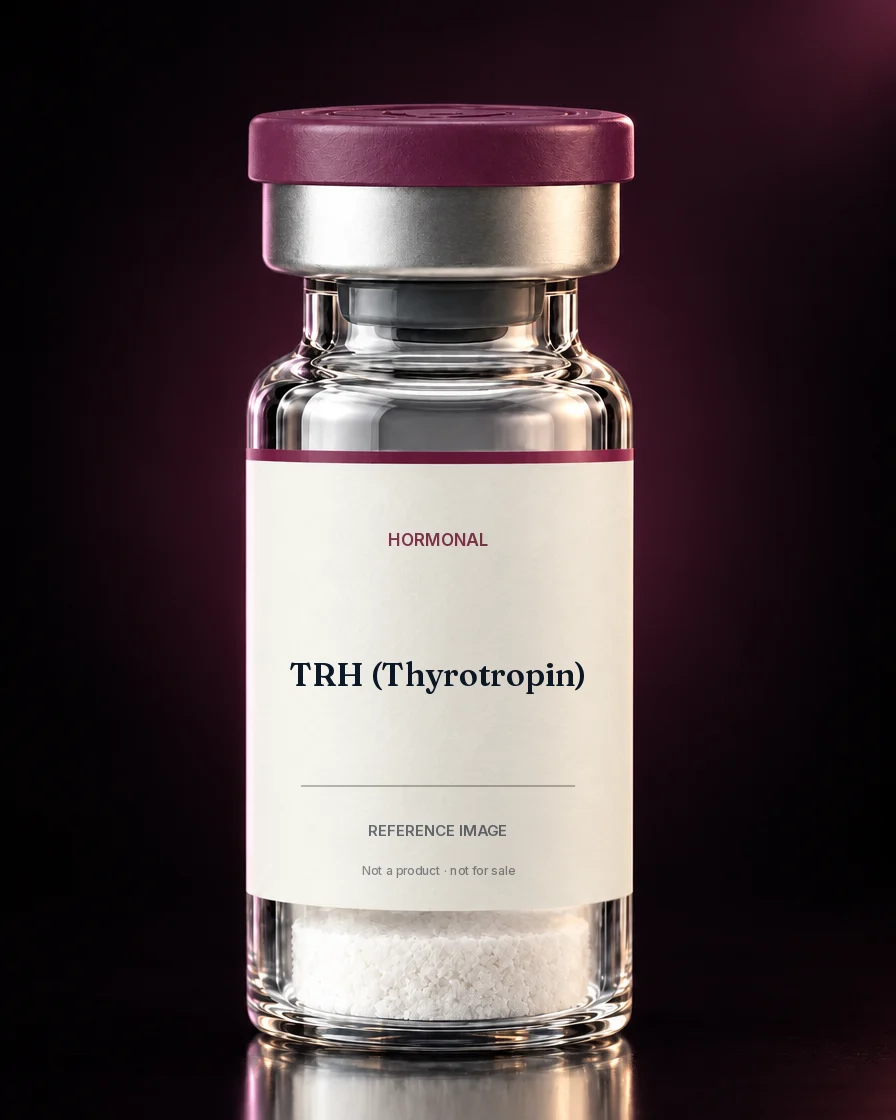
 Hormonal · Dosing reference
TRH (Thyrotropin) dosage
What the human evidence does and does not show, how long studies ran, and the arithmetic for working with vials.
- Regulatory status
- Approved, no longer marketed
- Human amounts
- Approved product discontinued; no current label text retrievable
- Route studied
- —
- Frequency
- —
- Half-life
- A patent and development review states that TRH has a short plasma half-life of about five minutes, which it gives as one reason the native hormone is a poor drug candidate 3.
- Evidence grade
- Grade A · Human trial evidence
- Vial sizes on the market
- Not recorded
- Other forms seen
- —
What TRH (Thyrotropin) is
TRH is the hypothalamic tripeptide thyrotropin-releasing hormone, studied in endocrine and neuropharmacology research.
TRH is the apex hormone of the hypothalamic-pituitary-thyroid axis. Released from the hypothalamus, it acts on thyrotrophs of the anterior pituitary to drive secretion of thyrotropin, which in turn stimulates the thyroid; it also acts on cells of the central and peripheral nervous systems 4. Receptors TRH exerts its effects through class A, rhodopsin-like G-protein coupled receptors 4. Identification of a second… How it works →
Key evidence
- Drugs@FDA application records for NDA 017638 (THYPINONE) and NDA 018087 (THYREL TRH) · 1978 · Regulatory recordProtirelin was approved in the United States under two applications; the product under each is now flagged Discontinued, and no label document is retrievable through Drugs@FDA for either. 1
- Wadman et al., Cochrane Database of Systematic Reviews · 2020 · Humans (children and adults with spinal muscular atrophy types II and III)The small TRH trial did not report effects on motor function, and the certainty of evidence for its other outcomes was rated low or very low. 6
- Ebuchi et al., Journal of Pediatric Endocrinology and Metabolism · 2020 · Humans (203 children starting growth hormone therapy in three diagnostic groups)Two children with isolated growth hormone deficiency developed central hypothyroidism requiring levothyroxine during therapy and had shown delayed or prolonged responses on pre-treatment TRH stimulation testing. 5
What the human evidence shows
We searched PubMed and ClinicalTrials.gov and found no human studies that administered TRH (Thyrotropin). The research described on its page is from cells or animals, and animal amounts do not translate to people.
How long did human studies run?
No human study durations are recorded for TRH (Thyrotropin).
Cycle-length evidence for TRH (Thyrotropin)Side effects reported in studies
- Pituitary apoplexy following provocative pituitary testingSingle reported case; frequency not established · Patient with acromegaly due to a giant pituitary adenoma undergoing combined TRH and gonadotropin-releasing hormone stimulation testing 9
- Unwanted endocrine effects of the native hormone when a central nervous system action is the goalNot quantified · Described generally in a development review of TRH analogues 3
- Side effects after intravenous TRH stimulation testing in cats1 of 6 cats in each of the two lower-exposure arms; 3 of 6 cats in the highest-exposure arm · Six healthy young adult cats in a crossover veterinary diagnostic study 10
TRH (Thyrotropin) draw calculator
Pick the vial strength and the water added, enter an amount, and see the concentration, the units to draw and how many draws the vial holds. Arithmetic only.
Computed from your inputs. Not a dose or a recommendation.
Compare water volumes for this vialShow
More water = lower concentration = a larger, easier-to-measure draw. Tap a row to use it.
| Water | mg/mL | Draw |
|---|---|---|
| 0.5 mL | 20 | — |
| 1 mL | 10 | — |
| 1.5 mL | 6.667 | — |
| 2 mL | 5 | — |
| 2.5 mL | 4 | — |
| 3 mL | 3.333 | — |
| 5 mL | 2 | — |
Supplies and handling
- Lyophilized vialSealed vial with the freeze-dried cake. Check the label, lot and the certificate of analysis before opening.
- Sterile diluentThe diluent named on the product documentation. Bacteriostatic water contains benzyl alcohol; sterile water does not.
- Graduated syringesSized to the volume being measured. U-100 insulin syringes are graduated in units where 100 units = 1 mL.
- Alcohol prep padsFor wiping vial stoppers before each puncture.
- Nitrile glovesClean gloves for aseptic handling.
- Sharps containerPuncture-resistant container for used needles.
Storage
General research-context handling only: the lyophilised peptide is normally kept cold, dry and protected from light, and is less stable in solution than as a dry powder. No approved finished human product label is available to defer to, so handling guidance has to come from the supplier's own documentation and local institutional requirements 1,2. Amiravo gives no preparation or handling instructions.
- Lyophilized (unmixed) vials: typically stored cold and dry, away from light, as the documentation directs. Many are stable longer frozen.
- Reconstituted vials: typically refrigerated (about 2–8 °C), protected from light and not frozen.
- Bacteriostatic water contains benzyl alcohol, which inhibits bacterial growth in multi-use vials; sterile water has no preservative.
Handling mistakes and troubleshooting
- Added the wrong volume of diluent
- The concentration changes, not the amount of compound in the vial. Recalculate with the volume actually added and relabel the vial.
- Shook the vial and it foamed
- Let it settle in the refrigerator. Foam is a sign of agitation; some peptides aggregate when shaken. Note it on the label.
- The solution is cloudy or has particles
- Do not use it. Cloudiness can indicate incomplete dissolution, contamination or degradation. Record the lot and contact the supplier with the certificate of analysis.
- The powder cake looks melted or shrunken before reconstitution
- This can indicate the vial was exposed to heat or moisture. Record the lot and condition on arrival.
- Liquid sprayed back when the needle was removed
- Pressure built up in the vial. Withdraw a small volume of air while adding diluent to keep pressure neutral.
Regulatory status
- Status
- Protirelin has been approved in the United States, but no human product is currently marketed. Two new drug applications exist in Drugs@FDA: NDA 017638 (THYPINONE, Abbott), approved as a new molecular entity on 5 November 1976 under priority review, and NDA 018087 (THYREL TRH, Ferring), approved 18 July 1978. The product under each application is flagged Discontinued, and no label document is retrievable through Drugs@FDA for either 1. DailyMed contains no finished human product label for protirelin; the only protirelin entries are bulk active-ingredient listings from active pharmaceutical ingredient suppliers 2.
- United States (FDA)
- Protirelin has FDA approval history but no currently marketed human product. Drugs@FDA lists two applications: NDA 017638 (THYPINONE, Abbott), approved 5 November 1976 as a Type 1 new molecular entity under priority review, and NDA 018087 (THYREL TRH, Ferring), approved 18 July 1978 as a Type 5 new formulation or new manufacturer, with later labelling and manufacturing supplements through 1992. The product under each application is flagged Discontinued, and no label document is retrievable through Drugs@FDA for either, so the approved labelling could not be read 1. DailyMed holds no finished human product label for protirelin; the protirelin entries there are bulk active-ingredient listings submitted by active pharmaceutical ingredient suppliers, which record a substance offered as a raw material and are not approvals of a finished drug 2. Protirelin does not appear in any of the three categories of FDA's 503A bulk drug substances list as updated May 14, 2026 11.
- Sport (WADA)
- Neither "thyrotropin-releasing hormone", "TRH" nor "protirelin" is named in the WADA 2026 Prohibited List 12. That absence should be read carefully rather than as a clearance. Section S2.2 of the List, "Peptide hormones and their releasing factors", covers named groups of peptide hormones and releasing factors with each list introduced by wording such as "including, but not limited to", which makes those classes open rather than exhaustive; TRH is a hypothalamic releasing hormone and sits in the same pharmacological category as the releasing factors the section addresses 12. Section S0 covers pharmacological substances that are not addressed elsewhere on the List and that have no current approval from a governmental health authority for human therapeutic use, and the discontinued status of both US applications makes current approval status a live question for TRH 1,12. Whether TRH falls within a prohibited class is a determination for anti-doping authorities, not something that can be inferred from the absence of a name.
Status varies by country and changes over time. How we describe regulatory status.
TRH (Thyrotropin) compared with related compounds
| Compound | Status | Evidence | Human amounts | Half-life |
|---|---|---|---|---|
| TRH (Thyrotropin) | Approved, no longer marketed | A | Label not retrievable | A patent and development review states t |
| Kisspeptin-54 | Not approved — research use only | B | None established | About 28 minutes (intravenous, healthy m |
| Apelin-13 | Not approved — research use only | B | None established | Not located as a numeric value in the so |
| hCG (human chorionic gonadotropin) | FDA-approved | A | FDA label | About 29 hours (recombinant hCG, subcuta |
| Octreotide | FDA-approved | A | FDA label | 1.7-1.9 hours (injection) |
| Teduglutide | FDA-approved | A | FDA label | About 2 hours (healthy) and 1.3 hours (S |
Frequently asked questions
What doses of TRH (Thyrotropin) have been studied in humans?
Is there an established TRH (Thyrotropin) cycle length?
How much bacteriostatic water should be added to a TRH (Thyrotropin) vial?
How many units is a given amount on an insulin syringe?
What is the half-life of TRH (Thyrotropin)?
Is TRH (Thyrotropin) FDA-approved?
References
- Drugs@FDA application records for protirelin: NDA 017638 (THYPINONE, Abbott) and NDA 018087 (THYREL TRH, Ferring), both products flagged Discontinued FDA Drugs@FDA / openFDA drug/drugsfda. 2026
- DailyMed label search for protirelin, returning bulk active-ingredient listings only and no finished human product label NLM DailyMed. 2026
- Novel thyrotropin-releasing hormone analogs: a patent review Expert Opin Ther Pat. 2011
- Thyrotropin-releasing hormone analogs Mini Rev Med Chem. 2006
- Effect of growth hormone therapy on thyroid function in isolated growth hormone deficient and short small for gestational age children: a two-year study, including on assessment of the usefulness of the thyrotropin-releasing hormone (TRH) stimulation test J Pediatr Endocrinol Metab. 2020
- Drug treatment for spinal muscular atrophy types II and III Cochrane Database Syst Rev. 2020
- Role of the thyrotropin-releasing hormone of the limbic system in mood and eating regulation J Integr Neurosci. 2022
- Gonadotropin-releasing hormone stimulation test and diagnostic cutoff in precocious puberty: a mini review Ann Pediatr Endocrinol Metab. 2020
- Pituitary apoplexy probably due to TRH and GnRH stimulation tests in a patient with acromegaly J Endocrinol Invest. 1999
- Total thyroxine and thyroid-stimulating hormone responses of healthy cats to different doses of thyrotropin-releasing hormone J Vet Diagn Invest. 2024
- Bulk Drug Substances Nominated for Use in Compounding Under Section 503A of the FD&C Act, updated May 14, 2026 FDA. 2026
- World Anti-Doping Code International Standard: Prohibited List 2026 WADA. 2026
Last reviewed October 22, 2026 by the Amiravo editorial team. Editorial policy · Report an error