Leuprolide
Also known as Leuprorelin · Leuprolide acetate · Lupron Depot · Lupron Depot-PED · Eligard · Camcevi
Leuprolide (leuprorelin) is a synthetic GnRH agonist nonapeptide, FDA-approved in depot and injectable forms (Lupron Depot, Eligard, Camcevi, Fensolvi and generics) for advanced prostate cancer, endometriosis, fibroid-related anemia and central precocious puberty.
- US status
- FDA-approved
- Evidence
- Grade A
- Half-life
- Elimination half-life approximately 3 hours based on a two-compartment model; depot formulations release drug over 1 to 6 months 1,2.
- Class
- Gonadotropin-releasing hormone (GnRH) agonist
More
Research reference, not advice. Label quotes, not a recommendation. Amiravo sells nothing; some links are referrals.Read the full notice
Key takeaways
- Leuprolide is a GnRH agonist approved in multiple depot and injectable formulations for advanced prostate cancer, endometriosis, fibroid-related anemia and central precocious puberty 1,2,3,4.
- Continuous exposure suppresses LH and FSH after an initial surge, lowering testosterone to castrate levels in men within 2 to 4 weeks 1.
- The initial testosterone rise can cause tumor flare in prostate cancer, including bone pain, urinary obstruction and spinal cord compression 1.
- Labeled risks include metabolic changes, cardiovascular disease in men, QT prolongation, convulsions, severe cutaneous reactions and, in women, bone mineral density loss 1,2.
- WADA's 2026 list names leuprorelin among GnRH agonist analogues prohibited at all times in males under S2.2.1 8.
Development stage
Where Leuprolide sits between laboratory work and regulatory approval.
- PreclinicalAnimal and cell work
- Phase 1First human safety studies
- Phase 2Early efficacy signal
- Phase 3Confirmatory trials
- Approved (current)Cleared by a regulator
Stage comes from the regulatory record and ClinicalTrials.gov studies naming the compound (for compounds approved nowhere, only completed trials or trials with posted results count) (checked 2026-10-24). A registered trial is not a result.
Mechanism of action
Leuprolide acetate is a GnRH agonist that acts as an inhibitor of gonadotropin secretion when given continuously 1.
Biphasic effect
- Initial stimulation: administration produces an initial increase in LH and FSH and a transient rise in testosterone and dihydrotestosterone in men, or estrone and estradiol in premenopausal women 1.
- Suppression: continuous administration decreases LH and FSH; testosterone falls to castrate concentrations in men and estrogens to postmenopausal concentrations in premenopausal women within 2 to 4 weeks 1.
Animal findings
In animals, continuous administration suppressed ovarian and testicular steroidogenesis, reversibly on discontinuation, and inhibited growth of certain hormone-dependent tumors 1. Leuprolide is not active orally 1.
Molecular structure
PubChem CID 657181 ↗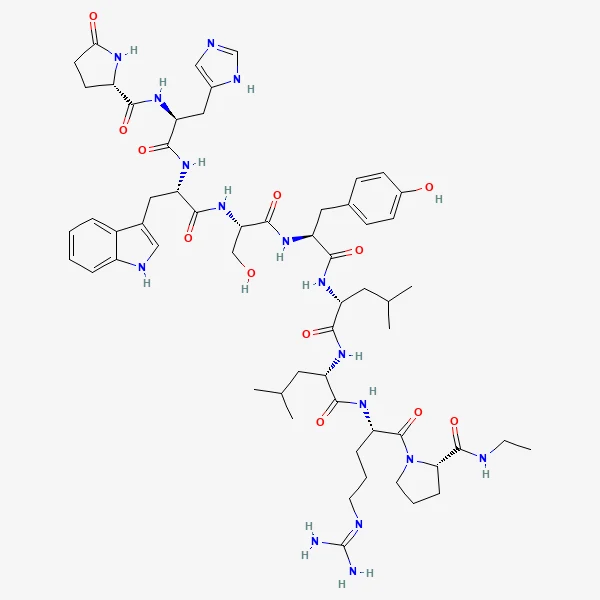
2D depiction generated from the PubChem record. Depictions are schematic and do not show salt form, counter-ions or conformation.
- Formula
- C59H84N16O12
- Molecular weight
- 1209.4 g/mol
- CAS
- 53714-56-0
- InChIKey
- GFIJNRVAKGFPGQ-LIJARHBVSA-N
Research overview
Human research
Approval rests on clinical studies in men with advanced prostate cancer (testosterone suppression and tumor response), women with endometriosis or fibroids, and children with central precocious puberty 1,2,3,4. A 1984 randomized trial compared leuprolide with diethylstilbestrol 6, and HERO used leuprolide as the comparator to oral relugolix 7.
Animal research
In rats, leuprolide inhibited growth of hormone-dependent tumors (prostatic tumors in Noble and Dunning rats, DMBA-induced mammary tumors) and caused reproductive organ atrophy; embryo-fetal toxicity was seen in animal studies 1.
Key studies
- Randomized comparison with diethylstilbestrol, cross-over at progressionModel: Humans (199 men with stage D2 prostate cancer)
Comparable testosterone suppression and objective response (86% versus 85%); 1-year survival 87% versus 78% (not significant); fewer gynecomastia, edema and thromboembolic events, more hot flashes 6.
- Open-label, non-comparative, multicenter studyModel: Humans (56 men with stage D2 prostatic adenocarcinoma)
Testosterone suppressed to castrate range within 30 days in 94% and within 66 days in all 54 evaluable patients; 'no progression' in 84% at week 24 1.
- Randomized phase 3 trial, oral relugolix versus leuprolide, 48 weeksModel: Humans (930 men with advanced prostate cancer)
Sustained castration 88.8% with leuprolide versus 96.7% with relugolix; castrate testosterone on day 4 in 0% versus 56%; MACE 6.2% versus 2.9% 7.
Dosing as stated on the FDA label
Quoted from the prescribing information for reference. Prescribing decisions belong to a licensed clinician; this is not a recommendation or instruction for use.
Full dosing reference, study durations and vial arithmetic →- Advanced prostate cancer (Lupron Depot): one injection of 7.5 mg every 4 weeks, 22.5 mg every 12 weeks, 30 mg every 16 weeks, or 45 mg every 24 weeks, administered by a healthcare provider 1.
- Advanced prostate cancer (Eligard, subcutaneous): 7.5 mg monthly, 22.5 mg every 3 months, 30 mg every 4 months or 45 mg every 6 months 4.
- Endometriosis (Lupron Depot 3.75 mg): 3.75 mg IM monthly for 1 to 6 doses initially, with or without norethindrone acetate 5 mg daily; retreatment requires norethindrone add-back; total treatment should not exceed 12 months. Fibroids: one 3.75 mg injection monthly for up to 3 months 2.
- Central precocious puberty (Lupron Depot-PED 1-month): starting dose by body weight (7.5 mg up to 25 kg, 11.25 mg above 25 to 37.5 kg, 15 mg above 37.5 kg) monthly, adjusted based on hormonal and clinical suppression 3.
- Formulations have different release characteristics; labels state not to substitute or combine fractional doses. Preparation and administration instructions are in the labels and are not reproduced here 1,2.
Background viewing
We haven't found a clinician video focused on Leuprolide yet. Meanwhile, this widely watched talk covers the science of aging in general. It does not discuss Leuprolide.
These creators are not affiliated with Amiravo and do not endorse Amiravo or any product linked on this site. Nothing here is medical advice. Video views counted on YouTube as of Oct 24, 2026.
Regulatory status
- Status
- FDA-approved (Lupron Depot initial U.S. approval 1989; Lupron Depot-PED label lists 1985). As of 2026-10-24, Drugs@FDA lists Lupron Depot, Lupron Depot-PED, Eligard, Camcevi, Fensolvi and multiple generic leuprolide acetate products with prescription marketing status; some older products (Lupron injection, Viadur, Lupaneta Pack) are discontinued 1,3,5.
Status varies by country and changes over time. How we describe regulatory status.
Quality and testing notes
A certificate of analysis for leuprolide acetate material would be expected to show HPLC purity, identity by mass spectrometry against the free-base molecular weight (PubChem 1209.4 g/mol), D-Leu6 stereochemistry and C-terminal ethylamide, acetate and net peptide content, and endotoxin level [1, 9]. Approved depot products are microsphere or polymer formulations whose release characteristics differ and are not interchangeable [1, 2].
How purity testing works · Reading a certificate of analysis
Check a Leuprolide certificate of analysis against its expected mass (1,209.4 Da)Storage and handling
Lupron Depot prostate formulations are stored at controlled room temperature (20-25°C) per the label; other formulations differ, so follow the specific product label [1].
Frequently asked questions
What is it approved for?
Why does testosterone rise at first?
What is tumor flare?
Are the depot products interchangeable?
Does it affect bone?
Is it banned in sport?
Latest indexed research
- Effects of the GnRH agonist leuprorelin on liver volume in premenopausal women with severe polycystic liver disease.RCT · humans · Hepatology communications · 2026-10-19
- Intra-ovarian CAPA-IVM vs Standard IVMRegistered trial · humans · New Hope Fertility Center · 2026-10-05
- Autonomic and Renal Contributions to Hypertension With ADTRegistered trial · humans · Virginia Commonwealth University · 2026-09-30
Listed by publication type from the index record. Inclusion is not an endorsement; open the source to read the findings.
Revision history
Meaningful changes to this entry, with dates and sources. Last reviewed Oct 24, 2026. Typo and layout fixes are not listed.
- New section· entryOct 24, 2026
New research reference added: Leuprolide.
References
- LUPRON DEPOT 7.5 mg, 22.5 mg, 30 mg, 45 mg (leuprolide acetate for depot suspension) prescribing information, advanced prostate cancer (effective 03/2026) FDA label (DailyMed). 2026
- LUPRON DEPOT 3.75 mg (leuprolide acetate for depot suspension) prescribing information, endometriosis and fibroids (effective 09/2025) FDA label (DailyMed). 2025
- LUPRON DEPOT-PED (leuprolide acetate for depot suspension) prescribing information, central precocious puberty (effective 11/2025) FDA label (DailyMed). 2025
- ELIGARD (leuprolide acetate) for injectable suspension prescribing information (effective 04/2026) FDA label (DailyMed). 2026
- Drugs@FDA (openFDA) application records for leuprolide U.S. FDA. 2026
- Leuprolide versus diethylstilbestrol for metastatic prostate cancer N Engl J Med. 1984
- Oral Relugolix for Androgen-Deprivation Therapy in Advanced Prostate Cancer (HERO) N Engl J Med. 2020
- World Anti-Doping Agency Prohibited List 2026 (online version) WADA. 2026
- PubChem compound record for leuprolide PubChem. 2026
Last reviewed October 24, 2026 by the Amiravo editorial team.
Need the math?
Laboratory arithmetic with every formula shown.
For research use only. Not for human or veterinary use. Not a drug, food, or dietary supplement. This page is educational and is not medical advice.
Unbranded reference image. Amiravo does not produce, supply or sell this compound.
Specifications
- Molecular formula
- C59H84N16O12
- Molecular weight
- 1,209.4 g/mol
- CAS number
- 53714-56-0
- PubChem CID
- 657181
- FDA UNII
- EFY6W0M8TG
- ChEMBL
- CHEMBL1201199
- DrugBank
- DB00007
- Sequence
- pGlu-
His- Trp- Ser- Tyr- D- Leu- Leu- Arg- Pro- NHEt - Type
- Single compound
Identifiers from PubChem. Verify against the supplier’s documentation for your lot.
Research stats
How much has been published, not how good it is.
- PubMed records
- 2,984
- Indexed as human research
- 2,183
- Animal-only research
- 312
- Randomized controlled trials
- 443
- Registered trials
- 521
- Trials with posted results
- 173
- FDA adverse-event reports (FAERS)
- 11,143
- NIH-funded projects naming it
- 402
Counts from title/abstract searches of PubMed, ClinicalTrials.gov, openFDA and NIH RePORTER, checked 2026-10-24. Names shared with other substances can inflate counts. FAERS reports are spontaneous and do not establish cause. Funding shows interest, not evidence. Method
Follow Leuprolide
See every new citation, evidence-grade or status change and correction in My Research, with optional email alerts. Free account.