
Dilution calculator (C₁V₁ = C₂V₂)
Enter the stock concentration, the working concentration you want and the final volume. The calculator shows how much stock to draw and how much diluent tops it up.
These tools do not provide dosing guidance and are not for human or veterinary use. They are for research-use laboratory calculations only. Verify every result independently.
Dilution (C1V1 = C2V2)
Volume of stock and diluent for a working solution.
stock volume = working concentration × final volume ÷ stock concentration
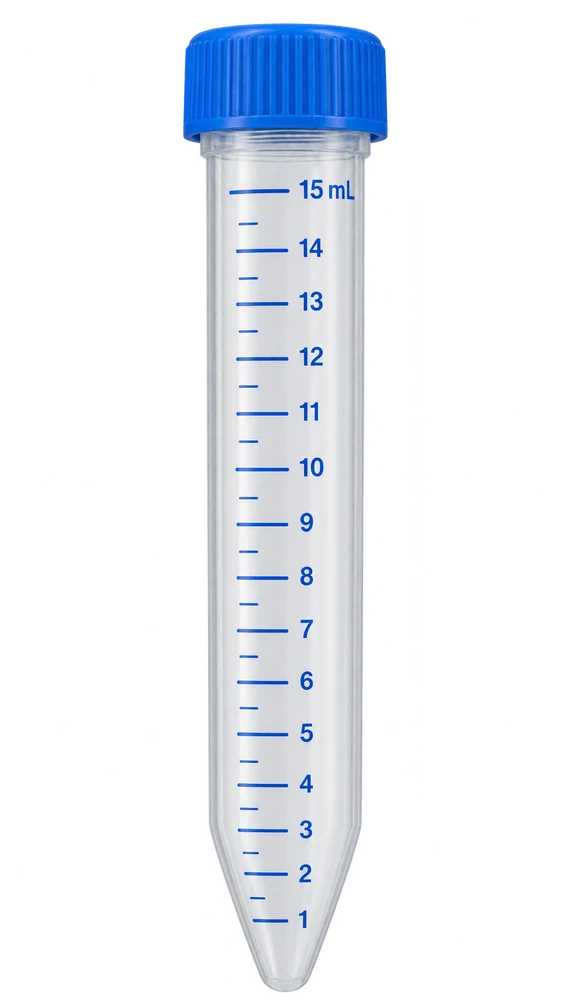
Stock (dark) and diluent (light) in a 15 mL tube
How it works
The dilution equation C₁V₁ = C₂V₂ says the amount of material does not change when you dilute: concentration times volume before equals concentration times volume after. Solve for V₁ and you have the volume of stock to take.
The diluent to add is simply the final volume minus the stock volume. Very large dilution factors (above about 1,000×) are more accurate as two serial dilutions, and the calculator says so.
Step by step
- Note the stock concentration C₁.
- Choose the working concentration C₂ and final volume V₂.
- Stock volume V₁ = C₂ × V₂ ÷ C₁.
- Diluent = V₂ − V₁.
Frequently asked
For 5 mL of working solution: V₁ = 1 × 5 ÷ 10 = 0.5 mL of stock, plus 4.5 mL of diluent. The dilution factor is 10×.
Any units, as long as both concentrations share one unit and both volumes share one unit. The calculator lets you pick mg/mL, µg/mL, µg/µL, mM or µM for concentration and mL or µL for volume.
A dilution performed in steps, for example 1:10 then 1:100 to reach 1:1,000. It avoids pipetting very small volumes that are hard to measure accurately.
Dilution only ever lowers concentration. To go higher you would need to add material or remove solvent, which is a different procedure.