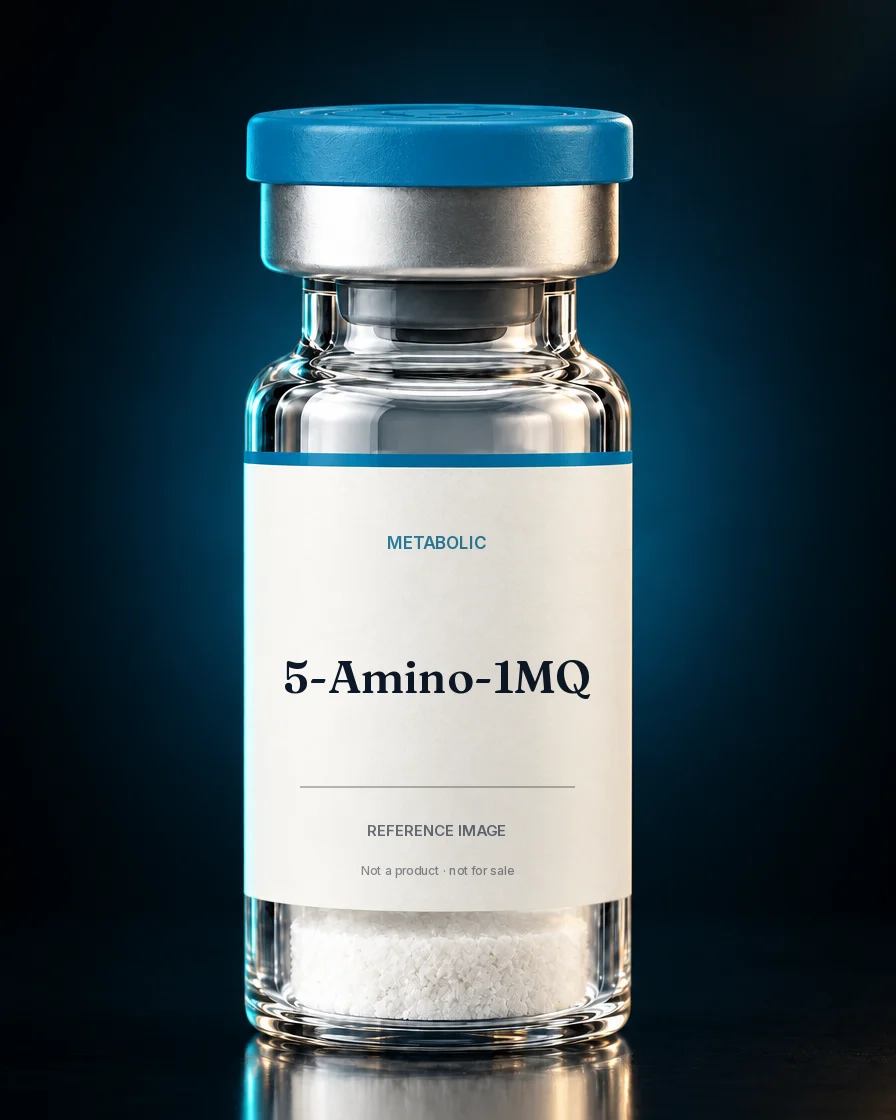
 Metabolic · Dosing reference
5-Amino-1MQ dosage
What the human evidence does and does not show, how long studies ran, and the arithmetic for working with vials.
- Regulatory status
- Not approved — research use only
- Human amounts
- None established in humans
- Route studied
- —
- Frequency
- Not established
- Half-life
- Not established
- Evidence grade
- Grade C · Preclinical research
- Vial sizes on the market
- 10 mg · 20 mg · 50 mg
- Other forms seen
- Oral capsules (strength not stated)
What 5-Amino-1MQ is
A small-molecule inhibitor of the enzyme NNMT, investigated in cell and animal models of adipocyte biology and energy metabolism.
Nicotinamide N-methyltransferase catalyses the methylation of nicotinamide, and the enzyme has been described in review-level work as sitting at the intersection of cellular metabolism and epigenetic regulation; it has also been reported as elevated in a range of human malignancies 3. Inhibition and metabolic effects in mice 5-Amino-1MQ is a small-molecule NNMT inhibitor 1. In diet-induced obese mice, once-daily… How it works →
Key evidence
- Babula et al., Diabetes, Obesity and Metabolism · 2024 · Mice (diet-induced obese)Dose-dependent limitation of body weight and fat mass gains, improved oral glucose tolerance and insulin sensitivity, suppressed hyperinsulinaemia, attenuated hepatic steatosis and macrophage infiltration, and normalised transaminases and ketone bodies; high systemic exposure with distribution to adipose, muscle and liver after subcutaneous administration. 1
- Yang et al., Journal for ImmunoTherapy of Cancer · 2024 · Humans (bladder cancer tissue and two cohorts, observational) and mice (urothelial bladder cancer models)Elevated NNMT in cancer-associated fibroblasts was associated with non-response to PD-L1 blockade and unfavourable prognosis in two independent cohorts; 5-amino-1-methylquinolinium iodide reduced tumour growth and enhanced anti-PD-L1 apoptotic effects in mouse models. 4
- Dimet-Wiley et al., Scientific Reports · 2022 · Mice (diet-induced obese, cecal microbiome)NNMT-inhibitor-treated diet-switched mice showed a distinct microbiome pattern with decreased Erysipelatoclostridium and increased Lactobacillus relative abundances versus vehicle; the authors present the results as a foundation for future investigation. Several authors declare employment or founding interests in a company developing NNMT inhibitors. 2
What the human evidence shows
We searched PubMed and ClinicalTrials.gov and found no human studies that administered 5-Amino-1MQ. The research described on its page is from cells or animals, and animal amounts do not translate to people.
How long did human studies run?
No human study durations are recorded for 5-Amino-1MQ.
Cycle-length evidence for 5-Amino-1MQ5-Amino-1MQ draw calculator
Pick the vial strength and the water added, enter an amount, and see the concentration, the units to draw and how many draws the vial holds. Arithmetic only.
Computed from your inputs. Not a dose or a recommendation.
Compare water volumes for this vialShow
More water = lower concentration = a larger, easier-to-measure draw. Tap a row to use it.
| Water | mg/mL | Draw |
|---|---|---|
| 0.5 mL | 20 | — |
| 1 mL | 10 | — |
| 1.5 mL | 6.667 | — |
| 2 mL | 5 | — |
| 2.5 mL | 4 | — |
| 3 mL | 3.333 | — |
| 5 mL | 2 | — |
Supplies and handling
- Lyophilized vialSealed vial with the freeze-dried cake. Check the label, lot and the certificate of analysis before opening.
- Sterile diluentThe diluent named on the product documentation. Bacteriostatic water contains benzyl alcohol; sterile water does not.
- Graduated syringesSized to the volume being measured. U-100 insulin syringes are graduated in units where 100 units = 1 mL.
- Alcohol prep padsFor wiping vial stoppers before each puncture.
- Nitrile glovesClean gloves for aseptic handling.
- Sharps containerPuncture-resistant container for used needles.
Storage
General research-context handling only. Quinolinium salts are typically stored dry, cold and protected from light, and are hygroscopic enough that moisture ingress is a practical concern for assay accuracy. Defer to the supplier's own documentation for the specific lot; nothing here is a preparation or administration instruction.
- Lyophilized (unmixed) vials: typically stored cold and dry, away from light, as the documentation directs. Many are stable longer frozen.
- Reconstituted vials: typically refrigerated (about 2–8 °C), protected from light and not frozen.
- Bacteriostatic water contains benzyl alcohol, which inhibits bacterial growth in multi-use vials; sterile water has no preservative.
Handling mistakes and troubleshooting
- Added the wrong volume of diluent
- The concentration changes, not the amount of compound in the vial. Recalculate with the volume actually added and relabel the vial.
- Shook the vial and it foamed
- Let it settle in the refrigerator. Foam is a sign of agitation; some peptides aggregate when shaken. Note it on the label.
- The solution is cloudy or has particles
- Do not use it. Cloudiness can indicate incomplete dissolution, contamination or degradation. Record the lot and contact the supplier with the certificate of analysis.
- The powder cake looks melted or shrunken before reconstitution
- This can indicate the vial was exposed to heat or moisture. Record the lot and condition on arrival.
- Liquid sprayed back when the needle was removed
- Pressure built up in the vial. Withdraw a small volume of air while adding diluent to keep pressure neutral.
Regulatory status
- Status
- Not approved by the FDA for any use. No approved application was identified, 5-amino-1-methylquinolinium does not appear in any category of FDA's May 14, 2026 503A bulk drug substances list 5, and searches of ClinicalTrials.gov for 5-amino-1MQ and for “nicotinamide N-methyltransferase inhibitor” as interventions returned no registered studies 6.
- United States (FDA)
- No approved application for 5-amino-1MQ was identified. It does not appear in category 1, category 2 or category 3 of FDA's May 14, 2026 list of bulk drug substances nominated for use in compounding under section 503A, so it has no position in that framework 5. Note that other compounds within NAD+ metabolism do appear on that list — nicotinamide adenine dinucleotide (NAD) is in category 1, under evaluation — but 5-amino-1MQ itself is absent 5.
- Sport (WADA)
- 5-Amino-1MQ, 5-amino-1-methylquinolinium and the term quinolinium are not named anywhere in the WADA 2026 Prohibited List 7. That absence is hedged negative evidence, not a clearance. Section S0, Non-Approved Substances, prohibits at all times “Any pharmacological substance which is not addressed by any of the subsequent sections of the List and with no current approval by any governmental regulatory health authority for human therapeutic use (e.g. drugs under pre-clinical or clinical development or discontinued, designer drugs, substances approved only for veterinary use)”, and states that “this class covers many different substances including but not limited to” the named examples 7. 5-Amino-1MQ has no approval by any governmental regulatory health authority for human therapeutic use, which is the condition S0 describes.
Status varies by country and changes over time. How we describe regulatory status.
5-Amino-1MQ compared with related compounds
| Compound | Status | Evidence | Human amounts | Half-life |
|---|---|---|---|---|
| 5-Amino-1MQ | Not approved — research use only | C | None established | — |
| NAD+ | Not approved — research use only | B | None established | — |
| Vesugen | Not approved — research use only | C | None established | — |
| Tesofensine | Investigational | B | Trial doses | About 234 hours (M1 metabolite about 374 |
| Mazdutide | Approved outside the US | A | Trial doses | 150.9 to 403.5 hours (phase 1b in overwe |
| Cagrilintide | Investigational | A | Trial doses | 159 to 195 hours (phase 1b, co-administe |
Frequently asked questions
What doses of 5-Amino-1MQ have been studied in humans?
Is there an established 5-Amino-1MQ cycle length?
How much bacteriostatic water should be added to a 5-Amino-1MQ vial?
How many units is a given amount on an insulin syringe?
Is 5-Amino-1MQ FDA-approved?
References
- Nicotinamide N-methyltransferase inhibition mitigates obesity-related metabolic dysfunction Diabetes, Obesity and Metabolism. 2024
- Reduced calorie diet combined with NNMT inhibition establishes a distinct microbiome in DIO mice Scientific Reports. 2022
- Small molecule inhibitor of nicotinamide N-methyltransferase shows anti-proliferative activity in HeLa cells Journal of Obstetrics and Gynaecology. 2021
- NAD(+) metabolism enzyme NNMT in cancer-associated fibroblasts drives tumor progression and resistance to immunotherapy by modulating macrophages in urothelial bladder cancer Journal for ImmunoTherapy of Cancer. 2024
- Bulk Drug Substances Nominated for Use in Compounding Under Section 503A of the FD&C Act (updated May 14, 2026) FDA. 2026
- ClinicalTrials.gov searches for 5-amino-1MQ and for nicotinamide N-methyltransferase inhibitor as interventions (0 studies returned each) ClinicalTrials.gov. 2026
- World Anti-Doping Code International Standard: Prohibited List 2026 WADA. 2026
- Emerging opportunities for nicotinamide N-methyltransferase (NNMT) inhibitor clinical translation Trends Pharmacol Sci. 2026
Last reviewed October 23, 2026 by the Amiravo editorial team. Editorial policy · Report an error