 Muscle · Dosing reference
Follistatin 344 dosage
What the human evidence does and does not show, how long studies ran, and the arithmetic for working with vials.
- Regulatory status
- Not approved — research use only
- Human amounts
- None established in humans
- Route studied
- —
- Frequency
- Not established
- Half-life
- Not established
- Evidence grade
- Not yet assessed
- Vial sizes on the market
- 1 mg
- Other forms seen
- —
What Follistatin 344 is
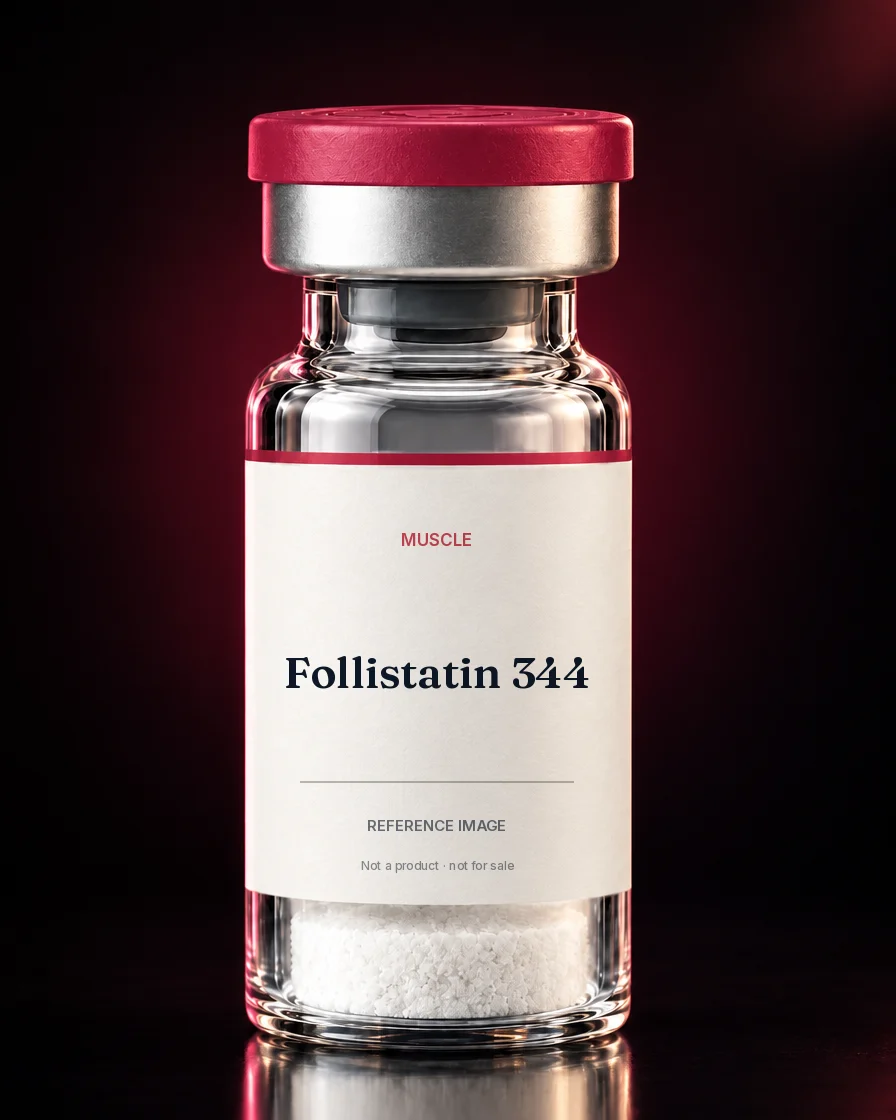
A follistatin isoform protein that binds myostatin and related ligands, studied in research on muscle growth regulation.
Endogenous follistatin biology Follistatin was first isolated from ovarian follicular fluid as an activin-binding protein that suppresses follicle-stimulating hormone, which is where its name comes from 2. In 2001, purified myostatin C-terminal dimer was shown to bind the activin type IIB receptor, and that binding was inhibited by follistatin and, at higher concentrations, by the myostatin propeptide; transgenic… How it works →
Key evidence
- Lee and McPherron, Proceedings of the National Academy of Sciences · 2001 · Cells and animals (purified proteins; transgenic mice)Follistatin inhibited myostatin binding to activin receptor IIB, and mice overexpressing follistatin in skeletal muscle showed increases in muscle mass comparable to myostatin knockout mice. This establishes follistatin as a myostatin antagonist when overexpressed; it does not address injected follistatin protein. 1
- Rodino-Klapac et al., Muscle & Nerve · 2009 · Animals (mice to monkeys) with review of the modalityThe alternatively spliced FS344 cDNA was selected to bypass follistatin's off-target binding, including effects on the hypothalamic-pituitary-gonadal axis; the transgene product is a secreted 315-amino-acid protein. AAV-FS344 delivery increased muscle size and strength across species without reported organ pathology. 2
- Mendell et al., Molecular Therapy · 2015 · Humans (six patients with Becker muscular dystrophy)Four of six patients improved on the six-minute walk test (58, 125, 108 and 29 metres) and two showed no change; no adverse effects were encountered; biopsies showed reduced endomysial fibrosis and more normal fibre-size distribution. 3
What the human evidence shows
We searched PubMed and ClinicalTrials.gov and found no human studies that administered Follistatin 344. The research described on its page is from cells or animals, and animal amounts do not translate to people.
How long did human studies run?
No human study durations are recorded for Follistatin 344.
Cycle-length evidence for Follistatin 344Side effects reported in studies
- No adverse effects related to viral transduction reported0 of 6 treated patients · Phase 1/2a AAV1.CMV.FS344 intramuscular gene transfer in Becker muscular dystrophy 3
Follistatin 344 draw calculator
Pick the vial strength and the water added, enter an amount, and see the concentration, the units to draw and how many draws the vial holds. Arithmetic only.
Computed from your inputs. Not a dose or a recommendation.
Compare water volumes for this vialShow
More water = lower concentration = a larger, easier-to-measure draw. Tap a row to use it.
| Water | mg/mL | Draw |
|---|---|---|
| 0.5 mL | 2 | — |
| 1 mL | 1 | — |
| 1.5 mL | 0.6667 | — |
| 2 mL | 0.5 | — |
| 2.5 mL | 0.4 | — |
| 3 mL | 0.3333 | — |
| 5 mL | 0.2 | — |
Supplies and handling
- Lyophilized vialSealed vial with the freeze-dried cake. Check the label, lot and the certificate of analysis before opening.
- Sterile diluentThe diluent named on the product documentation. Bacteriostatic water contains benzyl alcohol; sterile water does not.
- Graduated syringesSized to the volume being measured. U-100 insulin syringes are graduated in units where 100 units = 1 mL.
- Alcohol prep padsFor wiping vial stoppers before each puncture.
- Nitrile glovesClean gloves for aseptic handling.
- Sharps containerPuncture-resistant container for used needles.
Storage
General research-context handling only. Recombinant protein preparations of this size differ from short synthetic peptides: suppliers typically specify storage of the lyophilised protein frozen with a carrier protein or stabiliser, avoidance of repeated freeze-thaw cycles, and treatment of reconstituted solutions as short-lived, since aggregation and oligomerisation are the principal degradation routes and were already reported as present in commercially obtained material 8. Defer entirely to the supplier's documentation for the specific lot. No temperatures, concentrations, volumes or preparation steps are given here, and nothing in this section is an administration instruction.
- Lyophilized (unmixed) vials: typically stored cold and dry, away from light, as the documentation directs. Many are stable longer frozen.
- Reconstituted vials: typically refrigerated (about 2–8 °C), protected from light and not frozen.
- Bacteriostatic water contains benzyl alcohol, which inhibits bacterial growth in multi-use vials; sterile water has no preservative.
Handling mistakes and troubleshooting
- Added the wrong volume of diluent
- The concentration changes, not the amount of compound in the vial. Recalculate with the volume actually added and relabel the vial.
- Shook the vial and it foamed
- Let it settle in the refrigerator. Foam is a sign of agitation; some peptides aggregate when shaken. Note it on the label.
- The solution is cloudy or has particles
- Do not use it. Cloudiness can indicate incomplete dissolution, contamination or degradation. Record the lot and contact the supplier with the certificate of analysis.
- The powder cake looks melted or shrunken before reconstitution
- This can indicate the vial was exposed to heat or moisture. Record the lot and condition on arrival.
- Liquid sprayed back when the needle was removed
- Pressure built up in the vial. Withdraw a small volume of air while adding diluent to keep pressure neutral.
Regulatory status
- Status
- No follistatin product of any kind is approved by the FDA; there is no openFDA drug label for follistatin and it does not appear in any of the three categories of FDA's 503A bulk drug substances list as updated May 14, 2026 11. Follistatin is named by WADA as an example of a prohibited myostatin-binding protein under section S4.3, prohibited at all times 10. The human clinical evidence that exists concerns an AAV gene-therapy construct delivering the FS344 cDNA by intramuscular injection, not an injectable follistatin peptide; investigators writing on black-market material in 2019 stated plainly that no approved pharmaceutical formulation of follistatin was available 3,4,8.
- United States (FDA)
- No follistatin product is FDA-approved. There is no openFDA drug label listing follistatin as an active substance, and follistatin does not appear in any of the three categories of FDA's 503A bulk drug substances list (Category 1 under evaluation, Category 2 raising significant safety concerns, Category 3 nominated without adequate support) as updated May 14, 2026 11. The AAV1.CMV.huFS344 trials were conducted under investigational status and are registered as completed phase 1 and phase 1/2 studies 5,6; a further phase 1/2a study of intramuscular AAV9-follistatin for age-related muscle decline was registered in 2026 and is listed as recruiting with no results posted 7. Investigators studying black-market material stated in 2019 that no approved pharmaceutical formulation of follistatin was available 8. A 2026 narrative review in sports medicine classes FS-344 among unapproved peptides marketed direct to patients 12.
- Sport (WADA)
- Follistatin is named in the WADA 2026 Prohibited List. The relevant section is S4.3, which in the 2026 List is headed "AGENTS PREVENTING ACTIVIN RECEPTOR IIB ACTIVATION" rather than the older heading "Myostatin inhibitors / agents modifying myostatin function"; readers looking for the older wording should note the renumbering and retitling. The section reads: "S4.3. AGENTS PREVENTING ACTIVIN RECEPTOR IIB ACTIVATION / Including, but not limited to: / Activin A-neutralizing antibodies; Activin receptor IIB competitors such as: Decoy activin receptors (e.g. ACE-031); Anti-activin receptor IIB antibodies (e.g. bimagrumab); Myostatin inhibitors such as: - Agents reducing or ablating myostatin expression - Myostatin-binding proteins (e.g. follistatin, myostatin propeptide) - Myostatin- or precursor-neutralizing antibodies (e.g. apitegromab, domagrozumab, landogrozumab, stamulumab)" 10. Section S4 is prohibited at all times, in and out of competition, and the List states that "Those in classes S4.3 and S4.4 are non-Specified Substances" 10. Follistatin therefore appears as a named example of a myostatin-binding protein within a list introduced "Including, but not limited to", so other follistatin isoforms, transcript variants, tagged recombinant forms and gene-therapy constructs are not excluded by the specific wording. Gene and cell doping is separately addressed under the prohibited methods sections of the List. Analytical methods for detecting black-market follistatin 344 in serum and urine have been published, exploiting the polyhistidine tag present in those products to distinguish them from endogenous follistatin 8.
Status varies by country and changes over time. How we describe regulatory status.
Follistatin 344 compared with related compounds
| Compound | Status | Evidence | Human amounts | Half-life |
|---|---|---|---|---|
| Follistatin 344 | Not approved — research use only | — | None established | — |
| GHRP-2 | Approved outside the US | B | None established | In a Japanese package insert, the termin |
| GHRP-6 | Not approved — research use only | B | None established | — |
| NAD+ | Not approved — research use only | B | None established | — |
| IGF-1 LR3 | Not approved — research use only | C | None established | Unknown in humans |
| PEG-MGF | Not approved — research use only | — | None established | — |
Frequently asked questions
What doses of Follistatin 344 have been studied in humans?
Is there an established Follistatin 344 cycle length?
How much bacteriostatic water should be added to a Follistatin 344 vial?
How many units is a given amount on an insulin syringe?
Is Follistatin 344 FDA-approved?
References
- Regulation of myostatin activity and muscle growth Proceedings of the National Academy of Sciences. 2001
- Inhibition of myostatin with emphasis on follistatin as a therapy for muscle disease Muscle & Nerve. 2009
- A phase 1/2a follistatin gene therapy trial for Becker muscular dystrophy Molecular Therapy. 2015
- Follistatin Gene Therapy for Sporadic Inclusion Body Myositis Improves Functional Outcomes Molecular Therapy. 2017
- Phase I Clinical Intramuscular Gene Transfer of rAAV1.CMV.huFollistatin344 Trial to Patients With Becker Muscular Dystrophy and Sporadic Inclusion Body Myositis (NCT01519349, completed October 2017, 15 participants) ClinicalTrials.gov. 2017
- Phase I/II Clinical Intramuscular Gene Transfer of rAAV1.CMV.huFollistatin344 Trial to Patients With Duchenne Muscular Dystrophy (NCT02354781, completed November 2017, 3 participants) ClinicalTrials.gov. 2017
- CALM-AF-AI: Counteracting Age-related Loss of Muscle With AAV-Follistatin Combined With Angiogenesis-Inducing VEGF Plasmid Gene Therapy (NCT07443826, phase 1/2, recruiting, estimated 12 participants) ClinicalTrials.gov. 2026
- Detection of black market follistatin 344 (erratum: Drug Test Anal 2020;12:1522-1533) Drug Testing and Analysis. 2019
- Erratum: Detection of black market follistatin 344 Drug Testing and Analysis. 2020
- World Anti-Doping Code International Standard Prohibited List 2026 WADA. 2026
- Bulk Drug Substances Nominated for Use in Compounding Under Section 503A of the Federal Food, Drug, and Cosmetic Act (updated May 14, 2026) FDA. 2026
- Safety and Efficacy of Approved and Unapproved Peptide Therapies for Musculoskeletal Injuries and Athletic Performance Sports Medicine. 2026
Last reviewed October 22, 2026 by the Amiravo editorial team. Editorial policy · Report an error