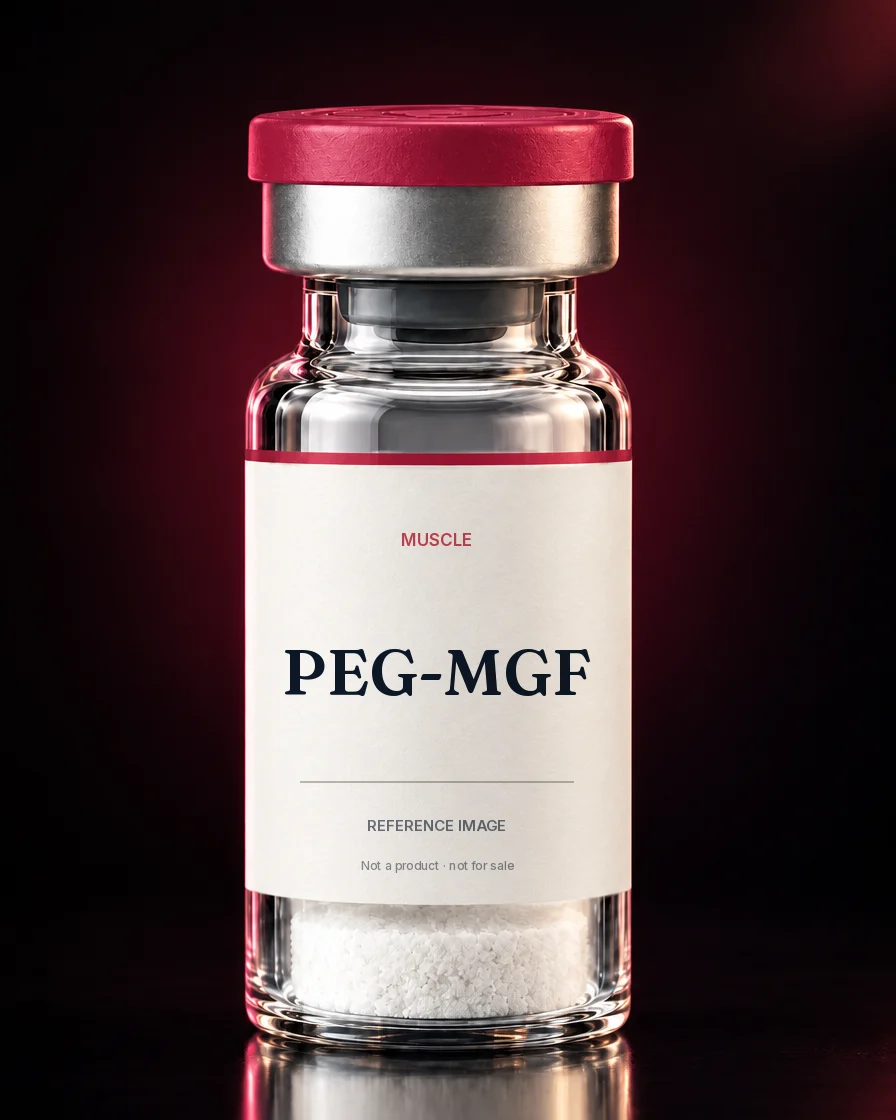
 Muscle · Dosing reference
PEG-MGF dosage
What the human evidence does and does not show, how long studies ran, and the arithmetic for working with vials.
- Regulatory status
- Not approved — research use only
- Human amounts
- None established in humans
- Route studied
- —
- Frequency
- Not established
- Half-life
- Not established
- Evidence grade
- Not yet assessed
- Vial sizes on the market
- 2 mg
- Other forms seen
- —
What PEG-MGF is
PEG-MGF is a PEGylated form of mechano growth factor, an IGF-1 splice variant, investigated in muscle cell and tissue research.
The IGF-1 gene produces several splice variants. IGF-1Ec, also called IGF-1Eb in some papers, carries a distinct C-terminal E-domain, and the 24-amino-acid peptide translated from exons 4-6 of that transcript is what the literature calls mechano growth factor, or MGF 3,4. MGF mRNA is upregulated rapidly and transiently after mechanical loading or muscle damage; in ten healthy men subjected to exercise-induced… How it works →
Key evidence
- Fornaro et al., American Journal of Physiology - Endocrinology and Metabolism · 2014 · Cells (C2C12 myoblasts, primary human skeletal muscle myoblasts, primary muscle stem cells)MGF peptide across the range of concentrations tested did not increase myoblast proliferation and did not inhibit differentiation into myotubes, while mature IGF-1 and full-length IGF-1Eb did produce a proliferative response; the authors concluded the MGF peptide has no apparent effect on myoblasts or primary muscle stem cells. 3
- Philippou et al., In Vivo · 2009 · Humans (ten healthy male volunteers) plus C2C12 cellsMGF mRNA rose rapidly and transiently after muscle damage, followed by prolonged increases in IGF-1Ea and IGF-1Eb; the synthetic MGF E peptide signalled differently from mature IGF-1 in myoblast-like cells. 6
- Thevis et al., Growth Hormone & IGF Research · 2014 · Not applicable (mass spectrometric characterisation of a seized product)A product offered to athletes through illicit channels as "full-length MGF", claimed to be undetectable in doping controls, was characterised by mass spectrometry; the authors note MGF has been prohibited under WADA regulations since 2005. 4
What the human evidence shows
We searched PubMed and ClinicalTrials.gov and found no human studies that administered PEG-MGF. The research described on its page is from cells or animals, and animal amounts do not translate to people.
How long did human studies run?
No human study durations are recorded for PEG-MGF.
Cycle-length evidence for PEG-MGFPEG-MGF draw calculator
Pick the vial strength and the water added, enter an amount, and see the concentration, the units to draw and how many draws the vial holds. Arithmetic only.
Computed from your inputs. Not a dose or a recommendation.
Compare water volumes for this vialShow
More water = lower concentration = a larger, easier-to-measure draw. Tap a row to use it.
| Water | mg/mL | Draw |
|---|---|---|
| 0.5 mL | 4 | — |
| 1 mL | 2 | — |
| 1.5 mL | 1.333 | — |
| 2 mL | 1 | — |
| 2.5 mL | 0.8 | — |
| 3 mL | 0.6667 | — |
| 5 mL | 0.4 | — |
Supplies and handling
- Lyophilized vialSealed vial with the freeze-dried cake. Check the label, lot and the certificate of analysis before opening.
- Sterile diluentThe diluent named on the product documentation. Bacteriostatic water contains benzyl alcohol; sterile water does not.
- Graduated syringesSized to the volume being measured. U-100 insulin syringes are graduated in units where 100 units = 1 mL.
- Alcohol prep padsFor wiping vial stoppers before each puncture.
- Nitrile glovesClean gloves for aseptic handling.
- Sharps containerPuncture-resistant container for used needles.
Storage
General research-context handling only. Lyophilised peptide and pegylated peptide preparations are typically stored dry and frozen, protected from light and moisture, with solutions treated as short-lived and freeze-thaw cycling avoided. Defer to the supplier's documentation for the specific lot. No temperatures, concentrations, volumes or preparation steps are given here, and nothing in this section is an administration instruction.
- Lyophilized (unmixed) vials: typically stored cold and dry, away from light, as the documentation directs. Many are stable longer frozen.
- Reconstituted vials: typically refrigerated (about 2–8 °C), protected from light and not frozen.
- Bacteriostatic water contains benzyl alcohol, which inhibits bacterial growth in multi-use vials; sterile water has no preservative.
Handling mistakes and troubleshooting
- Added the wrong volume of diluent
- The concentration changes, not the amount of compound in the vial. Recalculate with the volume actually added and relabel the vial.
- Shook the vial and it foamed
- Let it settle in the refrigerator. Foam is a sign of agitation; some peptides aggregate when shaken. Note it on the label.
- The solution is cloudy or has particles
- Do not use it. Cloudiness can indicate incomplete dissolution, contamination or degradation. Record the lot and contact the supplier with the certificate of analysis.
- The powder cake looks melted or shrunken before reconstitution
- This can indicate the vial was exposed to heat or moisture. Record the lot and condition on arrival.
- Liquid sprayed back when the needle was removed
- Pressure built up in the vial. Withdraw a small volume of air while adding diluent to keep pressure neutral.
Regulatory status
- Status
- PEG-MGF is not approved by the FDA for any use and has no openFDA drug label. "Mechano growth factor (MGF)" appears in FDA's 503A bulk drug substances list under Category 3, Bulk Drug Substances Nominated Without Adequate Support, as updated May 14, 2026 9. Mechano growth factors are explicitly prohibited by WADA, under S2.3, and have been since 2005 4,10. A PubMed search for PEG-MGF returned a single record, a 2026 review that lists it among unregulated peptides encountered in clinical practice and online self-administration; no primary study of the pegylated compound was identified 7,11. No registered clinical trial was found 11.
- United States (FDA)
- PEG-MGF has no approved FDA application and no openFDA drug label. "Mechano growth factor (MGF)" is listed in FDA's 503A bulk drug substances list under Category 3, Bulk Drug Substances Nominated Without Adequate Support, in the version updated May 14, 2026; that category is FDA's designation for substances nominated for compounding use for which the nomination did not include adequate supporting information 9. The pegylated form is not separately listed.
- Sport (WADA)
- Mechano growth factors are explicitly prohibited. The WADA 2026 Prohibited List, section S2.3 "GROWTH FACTORS AND GROWTH FACTOR MODULATORS", is prefaced "Including, but not limited to:" and names "Mechano growth factors (MGFs)" among its bullet points, closing with "and other growth factors or growth factor modulators affecting muscle, tendon or ligament protein synthesis/degradation, vascularisation, energy utilization, regenerative capacity or fibre type switching" 10. Section S2 is prohibited at all times, in and out of competition, all prohibited substances in the class are non-Specified Substances, and the class is introduced with "The following substances, and other substances with similar chemical structure or similar biological effect(s), are prohibited" 10. The plural "MGFs" and the similar-structure wording cover pegylated and otherwise modified forms. Analytical chemists note that MGF has been prohibited under WADA regulations since 2005, and validated urine methods for mechano growth factor exist with limits of detection in the 5-50 pg/ml range 2,4.
Status varies by country and changes over time. How we describe regulatory status.
PEG-MGF compared with related compounds
| Compound | Status | Evidence | Human amounts | Half-life |
|---|---|---|---|---|
| PEG-MGF | Not approved — research use only | — | None established | — |
| IGF-1 LR3 | Not approved — research use only | C | None established | Unknown in humans |
| Follistatin 344 | Not approved — research use only | — | None established | — |
Frequently asked questions
What doses of PEG-MGF have been studied in humans?
Is there an established PEG-MGF cycle length?
How much bacteriostatic water should be added to a PEG-MGF vial?
How many units is a given amount on an insulin syringe?
Is PEG-MGF FDA-approved?
References
- Research on mechano growth factor: its potential for optimising physical training as well as misuse in doping British Journal of Sports Medicine. 2005
- Detection of insulin analogues and large peptides >2 kDa in urine Drug Testing and Analysis. 2022
- Mechano-growth factor peptide, the COOH terminus of unprocessed insulin-like growth factor 1, has no apparent effect on myoblasts or primary muscle stem cells American Journal of Physiology - Endocrinology and Metabolism. 2014
- Mass spectrometric characterization of a biotechnologically produced full-length mechano growth factor (MGF) relevant for doping controls Growth Hormone & IGF Research. 2014
- Detection and in vitro metabolism of the confiscated peptides BPC 157 and MGF R23H Drug Testing and Analysis. 2017
- Expression of IGF-1 isoforms after exercise-induced muscle damage in humans: characterization of the MGF E peptide actions in vitro In Vivo. 2009
- The emerging landscape of performance-enhancing peptides modulating GH-IGF1 axis: bridging the gap between clinical evidence and patient self-administration Frontiers in Endocrinology. 2026
- Preferential expression of IGF-1Ec (MGF) transcript in cancerous tissues of human prostate: evidence for a novel and autonomous growth factor activity of MGF E peptide in human prostate cancer cells The Prostate. 2010
- Bulk Drug Substances Nominated for Use in Compounding Under Section 503A of the Federal Food, Drug, and Cosmetic Act (updated May 14, 2026) FDA. 2026
- World Anti-Doping Code International Standard Prohibited List 2026 WADA. 2026
- PubMed search for PEG-MGF (one record) and ClinicalTrials.gov search for pegylated mechano growth factor (no registered studies) PubMed / ClinicalTrials.gov. 2026
Last reviewed October 22, 2026 by the Amiravo editorial team. Editorial policy · Report an error