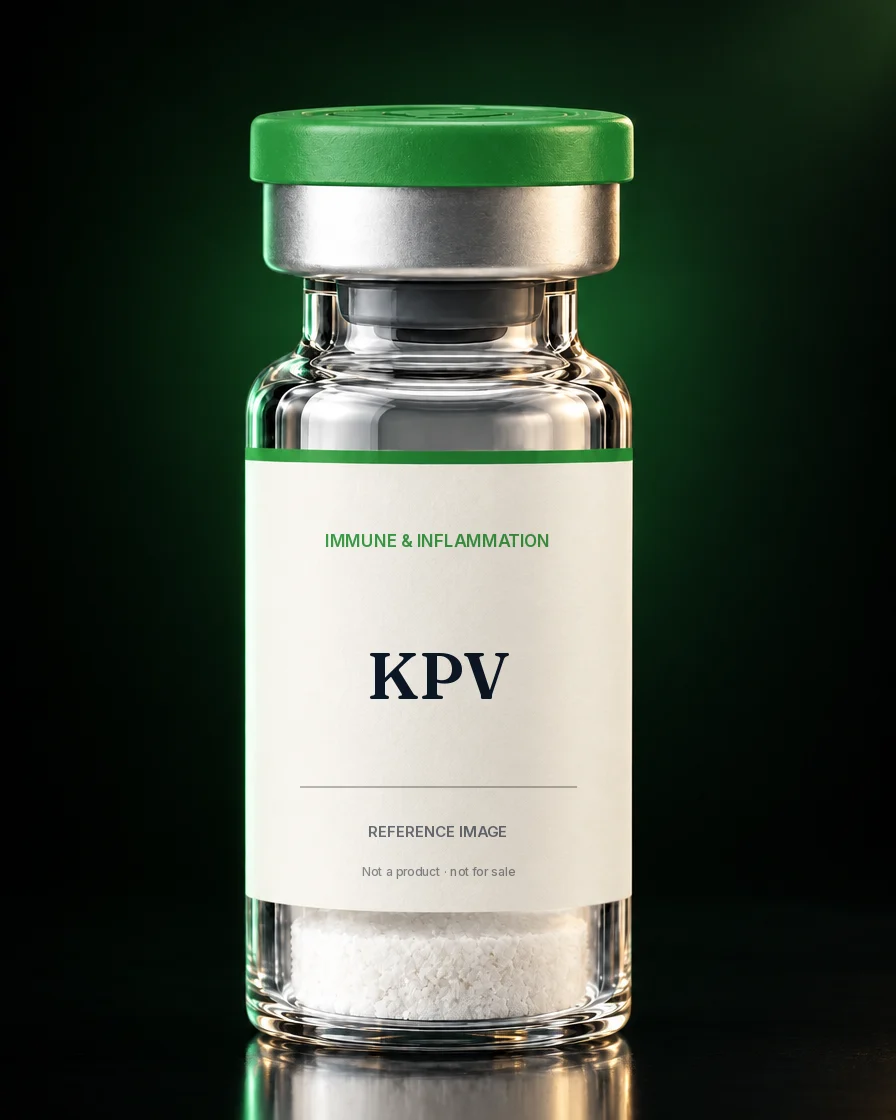
 Immune & Inflammation · Dosing reference
KPV dosage
What the human evidence does and does not show, how long studies ran, and the arithmetic for working with vials.
- Regulatory status
- Not approved — research use only
- Human amounts
- None established in humans
- Route studied
- —
- Frequency
- Not established
- Half-life
- Not established
- Evidence grade
- Grade C · Preclinical research
- Vial sizes on the market
- 5 mg · 10 mg
- Other forms seen
- —
What KPV is
KPV is a short tripeptide fragment derived from alpha-melanocyte-stimulating hormone, studied in cell and mouse models of intestinal inflammation signaling. All evidence cited here is preclinical.
KPV is the tripeptide alpha-MSH(11-13), derived from the melanocortin hormone alpha-MSH 1. Reported mechanisms Inflammatory signaling: In human intestinal epithelial cell lines (Caco2-BBE, HT29-Cl.19A) and Jurkat T cells, nanomolar KPV was reported to inhibit NF-kappaB and MAP kinase activation and reduce pro-inflammatory cytokine secretion 3. Cellular uptake: The same study reported that KPV acts through PepT1,… How it works →
Key evidence
- Kannengiesser et al., Inflamm Bowel Dis · 2008 · Animals (mice)KPV was associated with earlier weight recovery, reduced histological inflammation and reduced myeloperoxidase activity, and with survival in MC1R-nonfunctional mice. 1
- Dalmasso et al., Gastroenterology · 2008 · Cells (human intestinal epithelial and T-cell lines) and animals (mice)Nanomolar KPV was reported to inhibit NF-kappaB and MAP kinase pathways via PepT1, and oral KPV reduced colitis incidence in mice. 3
- Xiao et al., Mol Ther · 2017 · Cells and animals (mouse colitis model)Hyaluronic acid-functionalized nanoparticles carrying KPV were reported to promote mucosal healing and reduce TNF-alpha in mouse colitis. 2
What the human evidence shows
We searched PubMed and ClinicalTrials.gov and found no human studies that administered KPV. The research described on its page is from cells or animals, and animal amounts do not translate to people.
How long did human studies run?
No human study durations are recorded for KPV.
Cycle-length evidence for KPVKPV draw calculator
Pick the vial strength and the water added, enter an amount, and see the concentration, the units to draw and how many draws the vial holds. Arithmetic only.
Computed from your inputs. Not a dose or a recommendation.
Compare water volumes for this vialShow
More water = lower concentration = a larger, easier-to-measure draw. Tap a row to use it.
| Water | mg/mL | Draw |
|---|---|---|
| 0.5 mL | 20 | — |
| 1 mL | 10 | — |
| 1.5 mL | 6.667 | — |
| 2 mL | 5 | — |
| 2.5 mL | 4 | — |
| 3 mL | 3.333 | — |
| 5 mL | 2 | — |
Supplies and handling
- Lyophilized vialSealed vial with the freeze-dried cake. Check the label, lot and the certificate of analysis before opening.
- Sterile diluentThe diluent named on the product documentation. Bacteriostatic water contains benzyl alcohol; sterile water does not.
- Graduated syringesSized to the volume being measured. U-100 insulin syringes are graduated in units where 100 units = 1 mL.
- Alcohol prep padsFor wiping vial stoppers before each puncture.
- Nitrile glovesClean gloves for aseptic handling.
- Sharps containerPuncture-resistant container for used needles.
Storage
Handle according to the supplier's documentation for the specific lot; short peptides are generally kept dry and protected from light and moisture in research settings.
- Lyophilized (unmixed) vials: typically stored cold and dry, away from light, as the documentation directs. Many are stable longer frozen.
- Reconstituted vials: typically refrigerated (about 2–8 °C), protected from light and not frozen.
- Bacteriostatic water contains benzyl alcohol, which inhibits bacterial growth in multi-use vials; sterile water has no preservative.
Handling mistakes and troubleshooting
- Added the wrong volume of diluent
- The concentration changes, not the amount of compound in the vial. Recalculate with the volume actually added and relabel the vial.
- Shook the vial and it foamed
- Let it settle in the refrigerator. Foam is a sign of agitation; some peptides aggregate when shaken. Note it on the label.
- The solution is cloudy or has particles
- Do not use it. Cloudiness can indicate incomplete dissolution, contamination or degradation. Record the lot and contact the supplier with the certificate of analysis.
- The powder cake looks melted or shrunken before reconstitution
- This can indicate the vial was exposed to heat or moisture. Record the lot and condition on arrival.
- Liquid sprayed back when the needle was removed
- Pressure built up in the vial. Withdraw a small volume of air while adding diluent to keep pressure neutral.
Regulatory status
- Status
- Not approved by the FDA for any use; studied only in cell and animal models in the sources reviewed 1,2,3.
- United States (FDA)
- No FDA-approved label for KPV was identified; it is not approved for any indication 1.
- Sport (WADA)
- KPV is not named in the 2026 WADA Prohibited List text reviewed; Section S0 covers substances with no governmental approval for human therapeutic use, so status should be confirmed with the relevant anti-doping organization 4.
Status varies by country and changes over time. How we describe regulatory status.
KPV compared with related compounds
| Compound | Status | Evidence | Human amounts | Half-life |
|---|---|---|---|---|
| KPV | Not approved — research use only | C | None established | — |
| Vesugen | Not approved — research use only | C | None established | — |
| Thymulin | Not approved — research use only | C | None established | Not located in the sources reviewed for |
| Larazotide | Investigational | B | Trial doses | — |
| LL-37 | Not approved — research use only | B | None established | — |
| Thymosin Alpha-1 | Approved outside the US | B | None established | — |
Combinations that include KPV
Frequently asked questions
What doses of KPV have been studied in humans?
Is there an established KPV cycle length?
How much bacteriostatic water should be added to a KPV vial?
How many units is a given amount on an insulin syringe?
References
- Melanocortin-derived tripeptide KPV has anti-inflammatory potential in murine models of inflammatory bowel disease Inflamm Bowel Dis. 2008
- Orally Targeted Delivery of Tripeptide KPV via Hyaluronic Acid-Functionalized Nanoparticles Efficiently Alleviates Ulcerative Colitis Mol Ther. 2017
- PepT1-mediated tripeptide KPV uptake reduces intestinal inflammation Gastroenterology. 2008
- WADA 2026 Prohibited List World Anti-Doping Agency. 2026
- ClinicalTrials.gov intervention-field search for KPV (no studies returned) ClinicalTrials.gov. 2026
Last reviewed October 23, 2026 by the Amiravo editorial team. Editorial policy · Report an error