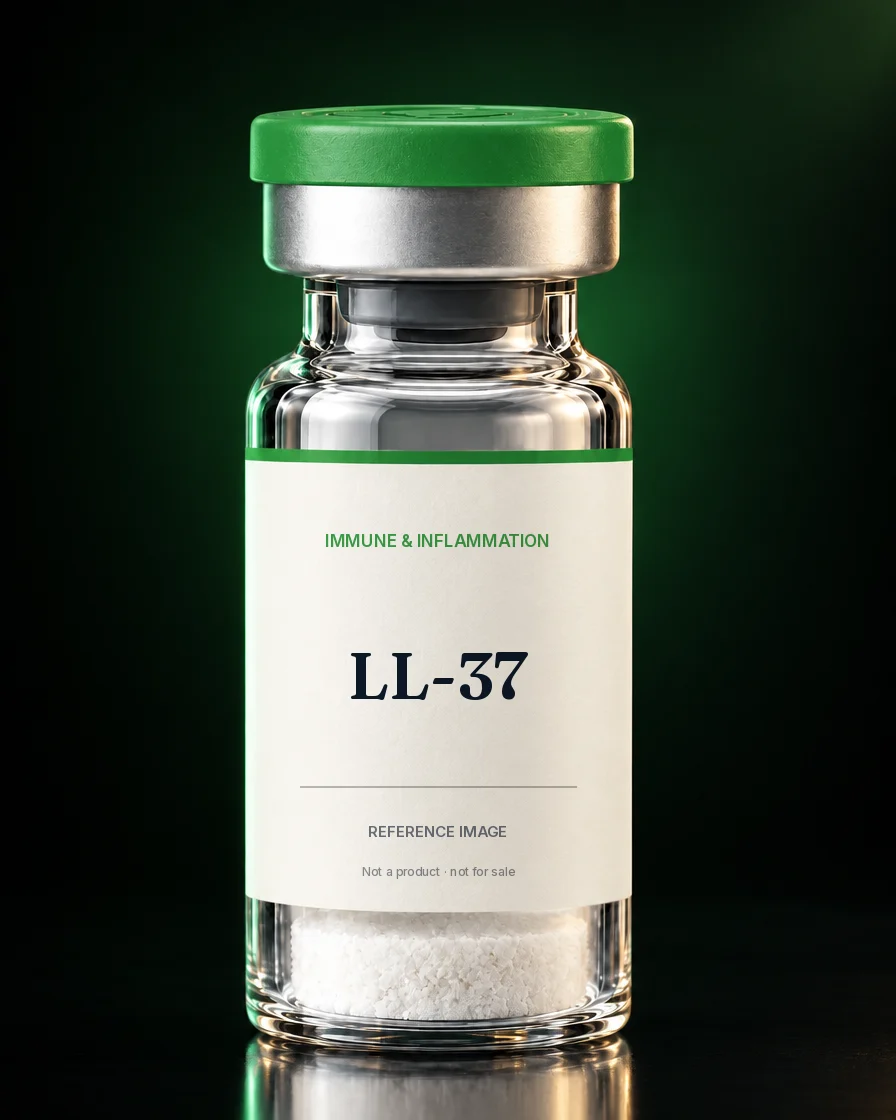
 Immune & Inflammation · Dosing reference
LL-37 dosage
What the human evidence does and does not show, how long studies ran, and the arithmetic for working with vials.
- Regulatory status
- Not approved — research use only
- Human amounts
- None established in humans
- Route studied
- Topical application to ulcers (solution or cream) and intratumoral injection in the published human trials
- Frequency
- Not established
- Half-life
- Not established
- Evidence grade
- Grade B · Limited human data
- Vial sizes on the market
- 5 mg · 10 mg
- Other forms seen
- —
What LL-37 is
A human cathelicidin antimicrobial peptide, cleaved from the precursor hCAP-18, studied in the laboratory for host defense, inflammation and wound biology.
LL-37 is the 37-amino-acid C-terminal fragment of hCAP-18, the product of the single human cathelicidin gene; the fragment is liberated by proteinase 3 at the time of neutrophil degranulation and secretion 4. Direct antimicrobial activity Cathelicidins are described as cationic, amphipathic peptides, and these physicochemical properties — positive net charge and amphipathicity — are the features that the… How it works →
Key evidence
- Mahlapuu et al., Wound Repair and Regeneration · 2021 · Humans (148 patients with hard-to-heal venous leg ulcers)No significant improvement in healing with LL-37 versus placebo in the full study population; a post hoc subgroup analysis of patients with large target wounds reported significant improvement in several interrelated healing parameters. 1
- van Harten et al., Vaccines · 2018 · Review (cells and animals)Cathelicidins are described as having both antimicrobial and immunomodulatory functions, with pro- and anti-inflammatory effects; the review stresses interpreting in-vitro results in an in-vivo context. 3
- Lehrer and Ganz, Current Opinion in Hematology · 2002 · Review (human biology)Humans have a single cathelicidin gene whose product hCAP-18 is stored in neutrophil secondary granules; the C-terminal peptide LL-37 is liberated by proteinase 3 at degranulation, and hCAP-18 is also expressed in several non-myeloid tissues. 4
What the human evidence shows
Human studies of LL-37 are listed below by design, population and duration. None was designed or powered to establish an amount, and Amiravo does not reproduce their amounts for a compound approved nowhere.
- A first-in-man trial in 34 patients with hard-to-heal venous leg ulcers in Sweden comprised a 3-week open-label run-in period on placebo, a 4-week randomized double-blind treatment phase with topical LL-37 at three concentrations or placebo, and a 4-week follow-up; healing rate constants and wound area were the measures 9.
- The phase IIb HEAL LL-37 trial randomized 149 patients in Poland and Sweden (148 treated) with hard-to-heal venous leg ulcers, mean age 67.6 years, median ulcer duration 20.3 months and mean wound area 11.6 cm2, to two topical LL-37 concentrations or placebo alongside compression therapy; the primary endpoint was confirmed complete wound closure, and efficacy analysis on the full population found no significant improvement over placebo, with a post hoc subgroup of patients with wounds of at least 10 cm2 showing improvement in several healing parameters 1.
- A randomized double-blind controlled trial in Jakarta randomized 25 participants with uninfected or mildly infected diabetic foot ulcers (13 to LL-37 cream, 12 to placebo cream) for 4 weeks, measuring wound area by ImageJ on days 7, 14, 21 and 28, wound-fluid IL-1alpha and TNF-alpha by ELISA and aerobic bacterial colony counts; granulation index increased more in the LL-37 group while cytokine levels and colony counts did not differ (registry record NCT04098562) 10.
- A phase 1/2 registry record of intratumoral LL37 injections in melanoma with cutaneous or subcutaneous tumours at least 1 cm in diameter (NCT02225366, completed, 4 participants, with posted results) describes treatment for up to 8 weeks with tumours photographed before treatment and at weeks 4 and 8 11.
- A case report from that melanoma programme describes a 63-year-old woman with stage IIIC melanoma, previously treated with nivolumab and combination chemotherapy, who received intratumoral LL-37 injections over about 8 weeks and developed multiple verrucous papules and a vesiculo-bullous lesion about 45 days after starting therapy; 11 of 12 biopsies showed a lichenoid infiltrate with atypical squamous proliferation, and all lesions resolved within 2 months of stopping the injections 12.
How long did human studies run?
- The first-in-man venous leg ulcer trial treated for 4 weeks after a 3-week placebo run-in, with 4 weeks of follow-up 9.
- The phase IIb trial comprised a 3-week open-label run-in on placebo, a 13-week randomized double-blind treatment period and a 4-month (16-week) observation period; patients whose target wound closed attended four post-closure visits 1.
- The diabetic foot ulcer trial treated participants for 4 consecutive weeks, with no participant withdrawing during that period 10.
- The melanoma registry record describes treatment for up to 8 weeks, with photography at 4 and 8 weeks 11.
Who was excluded from the studies
- The phase IIb venous leg ulcer trial enrolled men aged 18 or over and postmenopausal women with venous or mixed arteriovenous leg ulcers (ankle brachial pressure index above 0.70) of 2 to 40 cm2 that had not healed after 6 weeks of standard therapy, and excluded other predominant ulcer aetiologies such as trauma, malignant disease (other than basal cell carcinoma), topical antibiotic or potassium permanganate treatment of the target ulcer at screening, heavy exudation requiring more frequent dressing changes than twice weekly, and pregnancy or breastfeeding 1.
- The diabetic foot ulcer trial enrolled people aged 18 to 60 with ankle brachial index 0.9 to 1.3, wound area at least 2 cm2 and no deeper than the subcutaneous layer, and excluded gangrene, oral corticosteroid use within 7 days, oral or topical antibiotic use within 2 days, systemic infection, osteomyelitis, septic arthritis, fasciitis and terminal kidney failure 10.
LL-37 draw calculator
Pick the vial strength and the water added, enter an amount, and see the concentration, the units to draw and how many draws the vial holds. Arithmetic only.
Computed from your inputs. Not a dose or a recommendation.
Compare water volumes for this vialShow
More water = lower concentration = a larger, easier-to-measure draw. Tap a row to use it.
| Water | mg/mL | Draw |
|---|---|---|
| 0.5 mL | 20 | — |
| 1 mL | 10 | — |
| 1.5 mL | 6.667 | — |
| 2 mL | 5 | — |
| 2.5 mL | 4 | — |
| 3 mL | 3.333 | — |
| 5 mL | 2 | — |
Supplies and handling
- Lyophilized vialSealed vial with the freeze-dried cake. Check the label, lot and the certificate of analysis before opening.
- Sterile diluentThe diluent named on the product documentation. Bacteriostatic water contains benzyl alcohol; sterile water does not.
- Graduated syringesSized to the volume being measured. U-100 insulin syringes are graduated in units where 100 units = 1 mL.
- Alcohol prep padsFor wiping vial stoppers before each puncture.
- Nitrile glovesClean gloves for aseptic handling.
- Sharps containerPuncture-resistant container for used needles.
Storage
General research-context handling only: lyophilised peptides are usually held cold and protected from light and moisture, and reconstituted material is less stable than lyophilised material. Cationic antimicrobial peptides are known to adsorb to surfaces and are sensitive to repeated freeze-thaw. Defer to the supplier's own documentation for the specific lot; nothing here should be read as a preparation or administration instruction.
- Lyophilized (unmixed) vials: typically stored cold and dry, away from light, as the documentation directs. Many are stable longer frozen.
- Reconstituted vials: typically refrigerated (about 2–8 °C), protected from light and not frozen.
- Bacteriostatic water contains benzyl alcohol, which inhibits bacterial growth in multi-use vials; sterile water has no preservative.
Handling mistakes and troubleshooting
- Added the wrong volume of diluent
- The concentration changes, not the amount of compound in the vial. Recalculate with the volume actually added and relabel the vial.
- Shook the vial and it foamed
- Let it settle in the refrigerator. Foam is a sign of agitation; some peptides aggregate when shaken. Note it on the label.
- The solution is cloudy or has particles
- Do not use it. Cloudiness can indicate incomplete dissolution, contamination or degradation. Record the lot and contact the supplier with the certificate of analysis.
- The powder cake looks melted or shrunken before reconstitution
- This can indicate the vial was exposed to heat or moisture. Record the lot and condition on arrival.
- Liquid sprayed back when the needle was removed
- Pressure built up in the vial. Withdraw a small volume of air while adding diluent to keep pressure neutral.
Regulatory status
- Status
- No FDA-approved application naming LL-37 was identified in the Drugs@FDA or openFDA label datasets, and LL-37 does not appear on FDA's May 14, 2026 list of bulk drug substances nominated for compounding under section 503A 6,7. A topical formulation has been taken into a phase IIb randomized trial under the non-proprietary name ropocamptide by a commercial sponsor, which did not meet its primary endpoint 1.
- United States (FDA)
- No approved application naming LL-37 or cathelicidin was found in the Drugs@FDA or openFDA label datasets. LL-37 does not appear in any of the three categories on FDA's May 14, 2026 list of bulk drug substances nominated for use in compounding under section 503A, so it has no stated position in that framework 7.
- Sport (WADA)
- LL-37 and cathelicidin are not named anywhere in the WADA 2026 Prohibited List 6. That absence is not a clearance. Section S0, Non-Approved Substances, prohibits at all times “Any pharmacological substance which is not addressed by any of the subsequent sections of the List and with no current approval by any governmental regulatory health authority for human therapeutic use (e.g. drugs under pre-clinical or clinical development or discontinued, designer drugs, substances approved only for veterinary use)”, and states that “this class covers many different substances including but not limited to” the examples given 6. LL-37 is an endogenous human peptide, which complicates, rather than resolves, how a non-approved-substance rule would be applied to an exogenously administered preparation; this entry does not attempt to settle that question.
Status varies by country and changes over time. How we describe regulatory status.
LL-37 compared with related compounds
| Compound | Status | Evidence | Human amounts | Half-life |
|---|---|---|---|---|
| LL-37 | Not approved — research use only | B | None established | — |
| Thymulin | Not approved — research use only | C | None established | Not located in the sources reviewed for |
| Larazotide | Investigational | B | Trial doses | — |
| KPV | Not approved — research use only | C | None established | — |
| Thymosin Alpha-1 | Approved outside the US | B | None established | — |
| VIP | Investigational | A | Trial doses | A review of VIP in cardiopulmonary disea |
Frequently asked questions
What doses of LL-37 have been studied in humans?
Is there an established LL-37 cycle length?
How much bacteriostatic water should be added to a LL-37 vial?
How many units is a given amount on an insulin syringe?
Is LL-37 FDA-approved?
References
- Evaluation of LL-37 in healing of hard-to-heal venous leg ulcers: A multicentric prospective randomized placebo-controlled clinical trial Wound Repair and Regeneration. 2021
- LL-37: Cathelicidin-related antimicrobial peptide with pleiotropic activity Pharmacological Reports. 2016
- Cathelicidins: Immunomodulatory Antimicrobials Vaccines. 2018
- Cathelicidins: a family of endogenous antimicrobial peptides Current Opinion in Hematology. 2002
- LL-37 (CID 16198951) — computed properties PubChem. 2026
- World Anti-Doping Code International Standard: Prohibited List 2026 WADA. 2026
- Bulk Drug Substances Nominated for Use in Compounding Under Section 503A of the FD&C Act (updated May 14, 2026) FDA. 2026
- Efficacy of LL-37 Cream on Bacteria Colonization, Inflammation Response and Wound Healing (NCT04098562) ClinicalTrials.gov. 2019
- Treatment with LL-37 is safe and effective in enhancing healing of hard-to-heal venous leg ulcers: a randomized, placebo-controlled clinical trial Wound Repair Regen. 2014
- Efficacy of LL-37 cream in enhancing healing of diabetic foot ulcer: a randomized double-blind controlled trial (registry record NCT04098562) Arch Dermatol Res. 2023
- Intratumoral Injections of LL37 for Melanoma (NCT02225366), completed phase 1/2 registry record with posted results ClinicalTrials.gov. 2020
- Dermatologic toxicity from novel therapy using antimicrobial peptide LL-37 in melanoma: A detailed examination of the clinicopathologic features J Cutan Pathol. 2018
Last reviewed October 23, 2026 by the Amiravo editorial team. Editorial policy · Report an error