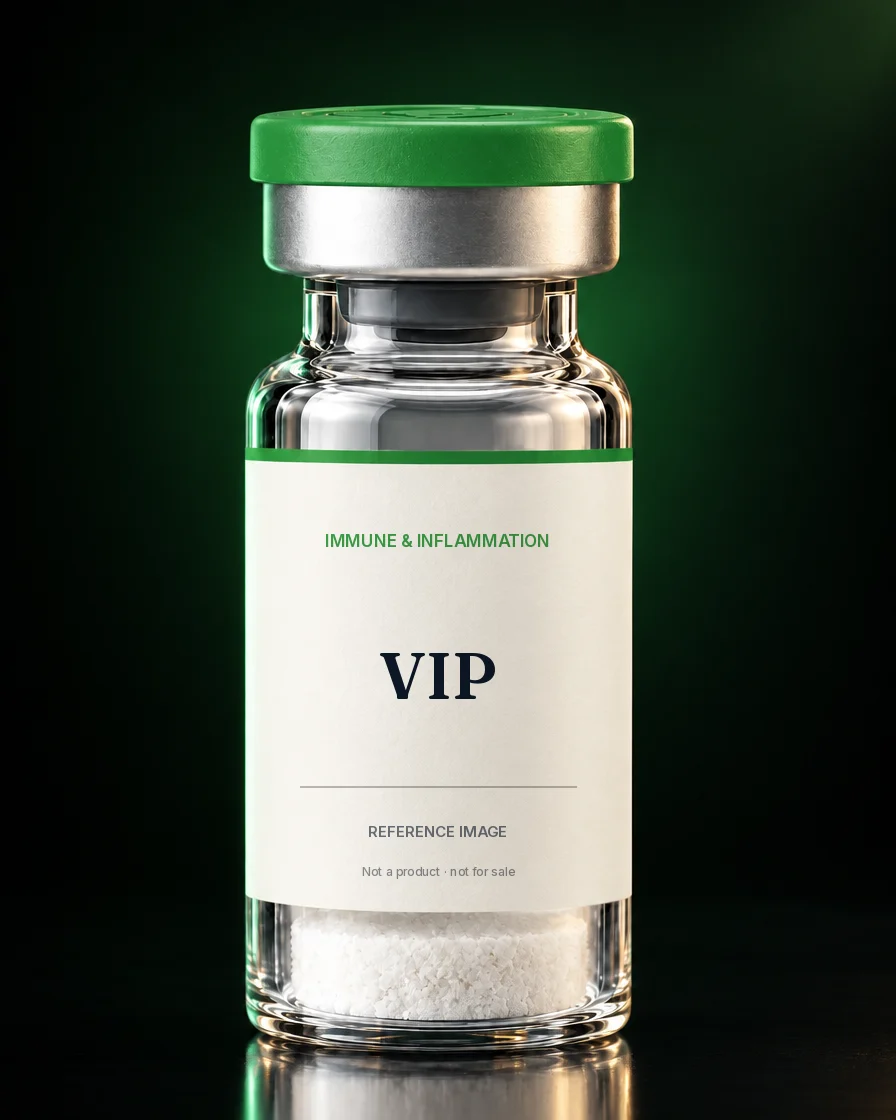
 Immune & Inflammation · Dosing reference
VIP dosage
Doses given in registered human trials, how long they ran, and the arithmetic for working with vials.
- Regulatory status
- Investigational
- Human amounts
- Intravenous aviptadil 50, 100 and 150 pmol/kg/hour on three successive days in a US phase 2b/3 trial, and infusions targeting 600, 1200 and 1800 pmol/kg on days 1 to 3 in TESICO; inhaled aviptadil 2 mL of a 100 microgram/mL solution per day in a COVID-19 trial; a single inhaled 100 microgram dose in pulmonary hypertension
- Route studied
- Intravenous infusion and inhalation (nebulizer) in the human trials
- Frequency
- Daily infusions for 3 days in the COVID-19 intravenous trials; once daily inhalation (as two consecutive doses 30 minutes apart) in the inhaled COVID-19 trial; single inhaled dose in the pulmonary hypertension study
- Half-life
- A review of VIP in cardiopulmonary disease states that clinical application of VIP has been limited by, among other reasons, its short plasma half-life and the difficulty of administration routes; that review does not give a numeric value and none is quoted here 3
- Evidence grade
- Grade A · Human trial evidence
- Vial sizes on the market
- 10 mg
- Other forms seen
- Nasal spray (compounded; strength not stated)
What VIP is
Vasoactive intestinal peptide (VIP) is a naturally occurring neuropeptide studied in neuroimmune signaling, smooth muscle physiology and inflammation models.
VIP is an endogenous neuropeptide that is widely expressed throughout the cardiopulmonary system, and reviews describe it as exerting vascular and airway dilatory actions, anti-inflammatory actions, and modulation of airway secretions 3. Rationale advanced for respiratory use The nonclinical rationale cited in the trial literature for giving synthetic VIP in COVID-19 respiratory failure was that VIP had been shown… How it works →
Key evidence
- Brown et al. (ACTIV-3b/TESICO Study Group), Lancet Respiratory Medicine · 2023 · Humans (461 analysed adults with COVID-19-associated acute hypoxaemic respiratory failure; 94% in intensive care at baseline)Odds ratio 1.11 (95% CI 0.80–1.55; p=0.54) for a better primary outcome category; 90-day mortality 38% versus 36% (hazard ratio 1.04, 95% CI 0.77–1.41; p=0.78). The data and safety monitoring board recommended stopping the aviptadil trial for futility. Primary safety composite to day 5 occurred in 63% versus 56% (odds ratio 1.40, 95% CI 0.94–2.08; p=0.10). 2
- Youssef et al., Critical Care Medicine · 2022 · Humans (196 patients with COVID-19 respiratory failure at ten US hospitals)Primary endpoint not met (odds ratio 1.6; 95% CI 0.86–3.11). Secondary findings reported included two-fold odds of improved 60-day survival (odds ratio 2.0; 95% CI 1.1–3.9; p=0.035), improved respiratory distress ratio and reduced interleukin-6 release by day 3 (p=0.02). 1
- Wu et al., Respiratory Research · 2011 · Review (human physiology)VIP is widely expressed in the cardiopulmonary system with vascular and airway dilatory and anti-inflammatory actions; clinical application has been limited by its short plasma half-life and administration-route difficulties, motivating long-acting analogues. 3
Schedules by time period
study arms from registered trials, laid out week by week. Each bar is what the label states or what investigators gave participants; none is a recommendation.
Phase 2b/3 COVID-AIV (NCT04311697): intravenous aviptadil 1
Adults with critical COVID-19 and respiratory failure at 10 US hospitals (196 patients in the publication)
Week-by-week table
| Period | Amount |
|---|---|
| Day 1 (12-hour infusion) | 50 pmol/kg/hr |
| Day 2 (12-hour infusion) | 100 pmol/kg/hr |
| Day 3 (12-hour infusion) | 150 pmol/kg/hr |
Three 12-hour IV infusions at graduating doses of 50, 100 and 150 pmol/kg/hr on 3 successive days (full text, PMC); randomized 2:1 against normal saline placebo.
Steps are in days, so no week numbers are given.
Week-by-week table
| Period | Amount |
|---|---|
| Day 1 (12-hour infusion) | 50 pmol/kg/hr |
| Day 2 (12-hour infusion) | 100 pmol/kg/hr |
| Day 3 (12-hour infusion) | 150 pmol/kg/hr |
Registry: infusion over 12 hours per day for 3 days at 50, 100 and 150 pmol/kg/hr on days 1, 2 and 3. The publication describes targets of 600, 1200 and 1800 pmol/kg on infusion days 1-3.
Placebo arm received 0.9% sodium chloride on the same schedule. Steps are in days, so no week numbers are given.
Doses given in human trials
- In a multicentre, placebo-controlled trial at ten US hospitals in 196 patients with COVID-19 respiratory failure, participants were randomized 2:1 to three 12-hour intravenous infusions of aviptadil at graduating doses of 50, 100 and 150 pmol/kg/hour on three successive days, or normal saline placebo; the primary endpoint (alive and free from respiratory failure at day 60) did not reach statistical significance 1.
- In the TESICO randomised, placebo-controlled trial at 28 US sites, 471 hospitalised adults with COVID-19-associated acute hypoxaemic respiratory failure were randomly assigned to aviptadil or matched placebo (461 analysed); aviptadil was administered as a daily 12-hour infusion for 3 days, targeting 600 pmol/kg on day 1, 1200 pmol/kg on day 2 and 1800 pmol/kg on day 3, and the day-90 ordinal outcome did not differ from placebo (odds ratio 1.11, 95% CI 0.80 to 1.55; p = 0.54) (NCT04843761) 2.
- In a multicentre, prospective, randomized, double-blind, placebo-controlled trial in 80 hospitalised adults with COVID-19 at 9 centres, participants inhaled 2 mL of aviptadil solution at 100 micrograms/mL (two consecutive 1 mL doses 30 minutes apart, once a day) by mesh nebulizer plus standard care, or saline placebo; mean time to discharge was 7.8 days versus 10 days (p = 0.049) 9.
- In a study of 20 patients with pulmonary hypertension (idiopathic pulmonary arterial hypertension in nine, pulmonary hypertension in lung disease in eight, chronic thromboembolic pulmonary hypertension in three), a single inhaled 100 microgram dose of aviptadil was given during right-heart catheterisation and haemodynamics and blood gases were measured; the report describes a small, temporary selective pulmonary vasodilation with improved stroke volume and mixed venous oxygen saturation 10.
- In an open phase 2 study, 20 patients with histologically proven sarcoidosis and active disease were treated with nebulized vasoactive intestinal peptide for 4 weeks; tumour necrosis factor alpha production by bronchoalveolar lavage cells fell and bronchoalveolar CD4+CD127-CD25+ T cells increased. The abstract does not state the amount inhaled, so none is quoted here 11.
How long did human studies run?
- Both intravenous COVID-19 trials administered aviptadil as 12-hour infusions on three successive days; the first followed participants to day 60 and TESICO assessed the primary outcome at day 90, with mortality followed to day 90 1,2.
- The inhaled COVID-19 trial administered inhalations for a minimum of 7 and a maximum of 14 days, discontinuing at 14 days if symptoms had not improved, with eight scheduled visits and assessment of CT lung damage score to day 28 9.
- The pulmonary hypertension study used a single inhaled dose during catheterisation 10; the sarcoidosis study nebulized VIP for 4 weeks 11.
Who was excluded from the studies
- The US intravenous phase 2b/3 trial enrolled adults aged 18 or over with polymerase-chain-reaction-confirmed critical COVID-19 by the FDA resource-based definition, requiring high-flow nasal cannula above 20 L, non-invasive ventilation or mechanical ventilation; the exclusion criteria are given in the paper's supplementary table rather than the main text 1.
- TESICO enrolled hospitalised adults within 4 days of the onset of acute hypoxaemic respiratory failure due to confirmed SARS-CoV-2 infection; 94% were in intensive care at baseline, and strata were defined by whether remdesivir was contraindicated or already started, or aviptadil was contraindicated 2.
- In the inhaled COVID-19 trial, patients who required intensive care admission after recruitment because of disease progression were withdrawn from the study 9.
Side effects reported in studies
- Composite primary safety outcome (death, serious adverse events, organ failure, serious infection, or grade 3 or 4 adverse events) up to day 5146/231 (63%) aviptadil versus 129/230 (56%) placebo; odds ratio 1.40, 95% CI 0.94–2.08; p=0.10 · ACTIV-3b/TESICO phase 3 trial, adults with COVID-19-associated acute hypoxaemic respiratory failure 2
- Death up to day 90Cumulative 38% aviptadil versus 36% placebo; hazard ratio 1.04, 95% CI 0.77–1.41; p=0.78 · ACTIV-3b/TESICO phase 3 trial, adults with COVID-19-associated acute hypoxaemic respiratory failure 2
VIP draw calculator
Pick the vial strength and the water added, enter an amount, and see the concentration, the units to draw and how many draws the vial holds. Arithmetic only.
Computed from your inputs. Not a dose or a recommendation.
Compare water volumes for this vialShow
More water = lower concentration = a larger, easier-to-measure draw. Tap a row to use it.
| Water | mg/mL | Draw |
|---|---|---|
| 0.5 mL | 20 | — |
| 1 mL | 10 | — |
| 1.5 mL | 6.667 | — |
| 2 mL | 5 | — |
| 2.5 mL | 4 | — |
| 3 mL | 3.333 | — |
| 5 mL | 2 | — |
Supplies and handling
- Lyophilized vialSealed vial with the freeze-dried cake. Check the label, lot and the certificate of analysis before opening.
- Sterile diluentThe diluent named on the product documentation. Bacteriostatic water contains benzyl alcohol; sterile water does not.
- Graduated syringesSized to the volume being measured. U-100 insulin syringes are graduated in units where 100 units = 1 mL.
- Alcohol prep padsFor wiping vial stoppers before each puncture.
- Nitrile glovesClean gloves for aseptic handling.
- Sharps containerPuncture-resistant container for used needles.
Storage
General research-context handling only. Lyophilised peptide is ordinarily held cold, dry and protected from light, and reconstituted material is less stable than lyophilised. VIP is described in the literature as having a short plasma half-life and has historically been difficult to deliver 3, which is a biological rather than a storage property but is a reminder that handling losses matter. Defer to the supplier's documentation for the specific lot; nothing here is a preparation or administration instruction.
- Lyophilized (unmixed) vials: typically stored cold and dry, away from light, as the documentation directs. Many are stable longer frozen.
- Reconstituted vials: typically refrigerated (about 2–8 °C), protected from light and not frozen.
- Bacteriostatic water contains benzyl alcohol, which inhibits bacterial growth in multi-use vials; sterile water has no preservative.
Handling mistakes and troubleshooting
- Added the wrong volume of diluent
- The concentration changes, not the amount of compound in the vial. Recalculate with the volume actually added and relabel the vial.
- Shook the vial and it foamed
- Let it settle in the refrigerator. Foam is a sign of agitation; some peptides aggregate when shaken. Note it on the label.
- The solution is cloudy or has particles
- Do not use it. Cloudiness can indicate incomplete dissolution, contamination or degradation. Record the lot and contact the supplier with the certificate of analysis.
- The powder cake looks melted or shrunken before reconstitution
- This can indicate the vial was exposed to heat or moisture. Record the lot and condition on arrival.
- Liquid sprayed back when the needle was removed
- Pressure built up in the vial. Withdraw a small volume of air while adding diluent to keep pressure neutral.
Regulatory status
- Status
- VIP itself is an endogenous human hormone, not a drug product. Its synthetic form, aviptadil, has no approved FDA application — searches of Drugs@FDA and the openFDA label dataset returned no match for aviptadil, ZYESAMI or vasoactive intestinal peptide, and the only openFDA NDC entries for aviptadil are bulk-ingredient listings for human prescription compounding rather than approved products 5. Aviptadil is nonetheless genuinely investigational: it has completed randomized phase 2 and phase 3 trials, including the NIAID-sponsored ACTIV-3b/TESICO trial of 471 randomized participants (NCT06729606 / NCT04843761) 2,6. FDA's May 14, 2026 503A list places “Vasoactive Intestinal Peptide” in category 1, bulk drug substances under evaluation 7.
- United States (FDA)
- No approved FDA application for aviptadil, ZYESAMI or vasoactive intestinal peptide was found in the Drugs@FDA or openFDA label datasets; the only openFDA NDC records matching aviptadil are bulk-ingredient listings described as bulk ingredient for human prescription compounding, which are not approved drug products 5. FDA's May 14, 2026 list of bulk drug substances nominated for use in compounding under section 503A places “Vasoactive Intestinal Peptide” in category 1, Bulk Drug Substances Under Evaluation — not in category 2 (significant safety risks) and not in category 3 (nominated without adequate support) 7. A separate expanded-access protocol for ZYESAMI (aviptadil) is registered with status no longer available (NCT04453839) 6.
- Sport (WADA)
- Neither vasoactive intestinal peptide nor aviptadil is named anywhere in the WADA 2026 Prohibited List 8. That absence is hedged negative evidence rather than a clearance. Aviptadil has no current approval by any governmental regulatory health authority for human therapeutic use that was identified here, which is the condition described by class S0: that section prohibits at all times “Any pharmacological substance which is not addressed by any of the subsequent sections of the List and with no current approval by any governmental regulatory health authority for human therapeutic use” and notes the class covers substances “including but not limited to” its examples 8. Because aviptadil has been administered by intravenous infusion in the trials cited here 1,2, readers should also note section M2, Chemical and Physical Manipulation, subsection M2.2, which prohibits “Intravenous infusions and/or injections of more than a total of 100 mL per 12-hour period except for those legitimately received in the course of hospital treatments, surgical procedures or clinical diagnostic investigations” 8; that rule concerns infusion volume rather than the substance and would apply to any sufficiently large infusion.
Status varies by country and changes over time. How we describe regulatory status.
VIP compared with related compounds
| Compound | Status | Evidence | Human amounts | Half-life |
|---|---|---|---|---|
| VIP | Investigational | A | Trial doses | A review of VIP in cardiopulmonary disea |
| Thymulin | Not approved — research use only | C | None established | Not located in the sources reviewed for |
| Larazotide | Investigational | B | Trial doses | — |
| LL-37 | Not approved — research use only | B | None established | — |
| KPV | Not approved — research use only | C | None established | — |
| Thymosin Alpha-1 | Approved outside the US | B | None established | — |
Frequently asked questions
What doses of VIP have been studied in humans?
Is there an established VIP cycle length?
How much bacteriostatic water should be added to a VIP vial?
How many units is a given amount on an insulin syringe?
What is the half-life of VIP?
Is VIP FDA-approved?
References
- The Use of IV Vasoactive Intestinal Peptide (Aviptadil) in Patients With Critical COVID-19 Respiratory Failure: Results of a 60-Day Randomized Controlled Trial Critical Care Medicine. 2022
- Intravenous aviptadil and remdesivir for treatment of COVID-19-associated hypoxaemic respiratory failure in the USA (TESICO): a randomised, placebo-controlled trial The Lancet Respiratory Medicine. 2023
- Prospect of vasoactive intestinal peptide therapy for COPD/PAH and asthma: a review Respiratory Research. 2011
- Aviptadil Therapy in Acute Respiratory Distress Syndrome Patients: A Systematic Review and Meta-analysis Indian Journal of Critical Care Medicine. 2025
- openFDA drug label, Drugs@FDA and NDC directory queries for aviptadil, ZYESAMI and vasoactive intestinal peptide openFDA. 2026
- Aviptadil for Severely Ill Inpatients With COVID-19 (An ACTIV-3b/TESICO Treatment Trial) (NCT06729606), with related records NCT04843761, NCT04453839 and NCT03556020 ClinicalTrials.gov. 2022
- Bulk Drug Substances Nominated for Use in Compounding Under Section 503A of the FD&C Act (updated May 14, 2026) FDA. 2026
- World Anti-Doping Code International Standard: Prohibited List 2026 WADA. 2026
- Inhaled Aviptadil Is a New Hope for Recovery of Lung Damage due to COVID-19 Med Princ Pract. 2025
- Inhalation of vasoactive intestinal peptide in pulmonary hypertension Eur Respir J. 2008
- Inhaled vasoactive intestinal peptide exerts immunoregulatory effects in sarcoidosis Am J Respir Crit Care Med. 2010
Last reviewed October 23, 2026 by the Amiravo editorial team. Editorial policy · Report an error