Combination evidence
BPC-157 + TB-500
Also called Wolverine stack, Wolverine blend, BPC-157/TB-500 blend
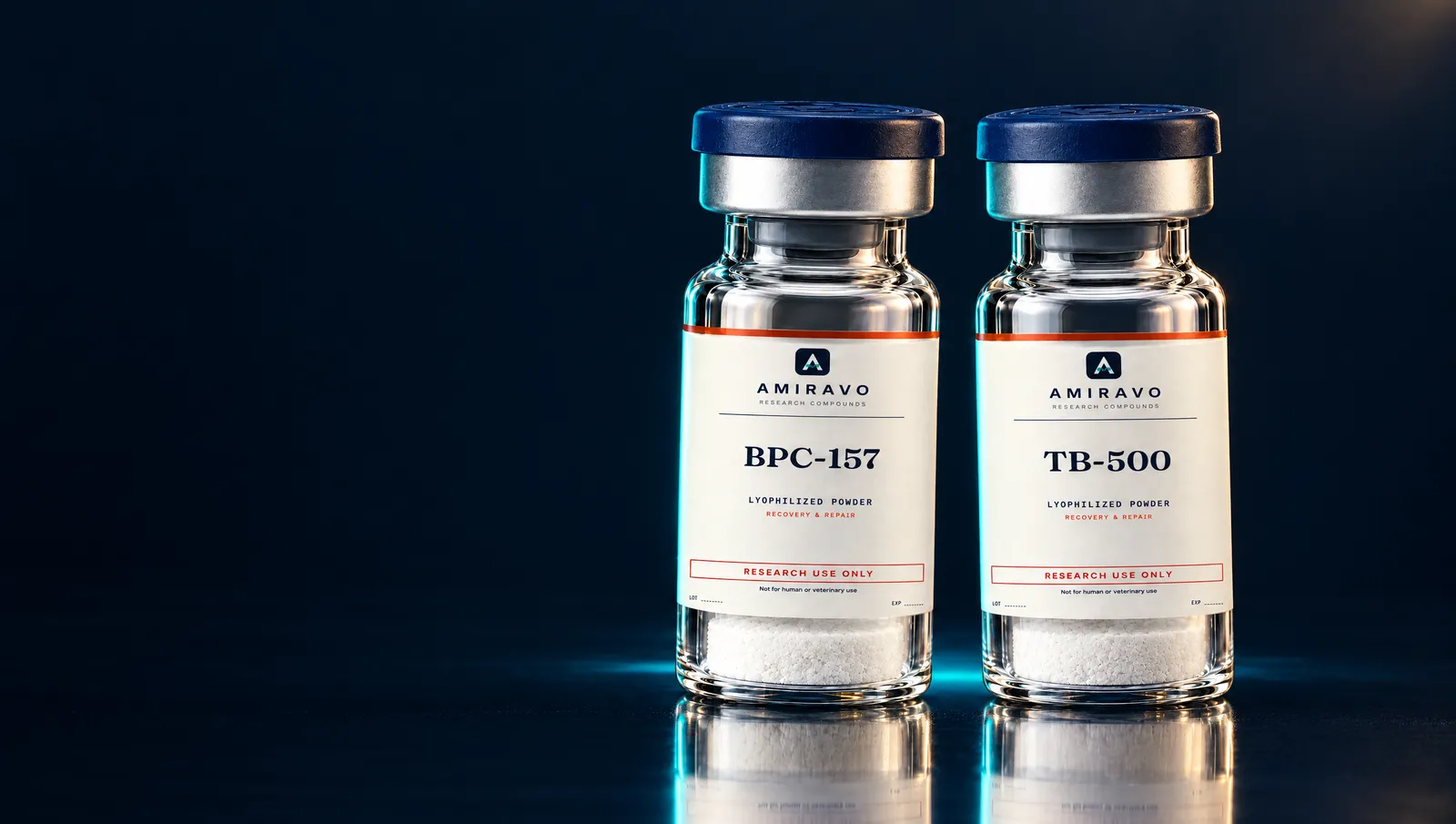
BPC-157 and TB-500 are two unapproved synthetic peptides that are marketed together, most often as a pre-mixed blend. No controlled human study of the pair was found; the only direct comparison identified is a rat tendon experiment in which the combination showed no additional effect over either peptide alone 2. Each component's own evidence comes mainly from animal and cell studies.
Not studied together in humans
Components
A pre-mixed product with these contents has its own page: BPC-157 + TB-500 Blend.
What has been studied
- No controlled human study of BPC-157 given together with TB-500 was found. Searched: PubMed ("BPC 157" AND thymosin / TB-500; BPC-157 AND "thymosin beta 4") and ClinicalTrials.gov (BPC-157), October 2026.
- A 2026 report described three uncontrolled clinical cases of inferior alveolar nerve injury managed with a multimodal approach incorporating peptide agents (the review discusses BPC-157, TB-500 and ARA-290), dexamethasone and local anesthetic; the authors state that spontaneous recovery and confounding cannot be excluded and that causality cannot be established. The abstract does not state which peptides each patient received 1.
- In the only identified experiment comparing the pair with its components (rats, Achilles tendon transection and repair, four randomised groups of eight), combined BPC-157 and TB-500 did not confer additional effect compared with either agent alone; TB-500 alone showed a significant biomechanical difference from controls at four weeks 2. This is an animal finding and does not establish anything about humans.
Why the pairing is discussed
Mechanistic reasoning drawn from studies of each component. Theoretical unless a study above tested the pair.
- Theoretical: in a chick embryo membrane assay, endothelial cell cultures and a rat hind-limb ischemia model, BPC-157 was associated with increased vessel density and activation of the VEGFR2-Akt-eNOS pathway 3, which is why it is discussed for tissue-repair settings.
- Theoretical: full-length thymosin beta-4 and the non-acetylated seven-residue fragment LKKTETQ, which corresponds to TB-500's sequence, were associated with dermal wound repair in diabetic and aged mice 4; marketed TB-500 is N-acetylated, so this finding does not transfer directly.
- Theoretical: the pairing is discussed on the assumption that two different repair-related pathways might add together. The rat tendon study that tested this found no additive effect, and its authors suggested the two peptides may converge on shared downstream pathways, a hypothesis they said needs confirmation 2.
Concerns and unknowns
- No human interaction, pharmacokinetic or safety data exist for the combination, and the one animal comparison found no additive effect 2.
- FDA lists BPC-157 and the thymosin beta-4 fragment LKKTETQ (TB-500) among nominated-but-withdrawn compounding substances that may present significant safety risks, citing possible immunogenicity and impurities; for TB-500 FDA states it has no human exposure data, and for BPC-157 that it has no or limited safety information for the proposed routes. 5
- Neither component is FDA-approved; scoping and narrative reviews in 2026 describe BPC-157 and TB-500 as part of a gray market with mostly animal evidence and scarce rigorous human safety data 6 7.
- A 2026 review lists product contamination, manufacturing impurities, inaccurate labelled content and theoretical pathological angiogenesis among the risks of unregulated injectable peptides including BPC-157 and TB-500 8. Combining two such products multiplies the characterisation uncertainty.
- WADA's 2026 Prohibited List names BPC-157 in section S0 (non-approved substances, prohibited at all times) and 'Thymosin-beta-4 and its derivatives e.g. TB-500' in section S2.3 (growth factors and growth factor modulators). 9
Status of each component
Frequently asked questions
Has BPC-157 + TB-500 been tested in people?
No controlled human trial of the combination was found. One 2026 report describes three uncontrolled clinical cases that involved peptide agents alongside other drugs, and the authors state causality cannot be established 1.
Is the combination stronger than either peptide alone?
That has not been shown. In the only direct comparison found, a rat tendon study, the combination conferred no additional effect over either peptide alone 2.
Why is it called the 'Wolverine' blend?
It is a marketing name. It does not correspond to any approved product or to any studied regimen.
Are BPC-157 and TB-500 approved anywhere?
Neither is FDA-approved. FDA lists both among compounding substances that may present significant safety risks, noting immunogenicity and impurity concerns 5.
References
- Case Report: Regenerative peptides for Inferior alveolar nerve injury: a narrative review with hypothesis-generating three clinical cases Front Oral Health. 2026
- Effects of BPC-157 and TB-500 on Achilles tendon healing in rats: A histopathological and biomechanical study Jt Dis Relat Surg. 2026
- Therapeutic potential of pro-angiogenic BPC157 is associated with VEGFR2 activation and up-regulation J Mol Med (Berl). 2017
- Thymosin beta 4 and a synthetic peptide containing its actin-binding domain promote dermal wound repair in db/db diabetic mice and in aged mice Wound Repair Regen. 2003
- Certain Bulk Drug Substances for Use in Compounding that May Present Significant Safety Risks (content current as of 04/22/2026) FDA. 2026
- Safety and Efficacy of Approved and Unapproved Peptide Therapies for Musculoskeletal Injuries and Athletic Performance Sports Med. 2026
- Peptide Supplements and Their Therapeutic Applications in Sports Medicine Am J Sports Med. 2026
- Dangers of Injectable Peptides and Other Unregulated "Biohacking" Drugs Mo Med. 2026
- International Standard: Prohibited List 2026 World Anti-Doping Agency. 2026