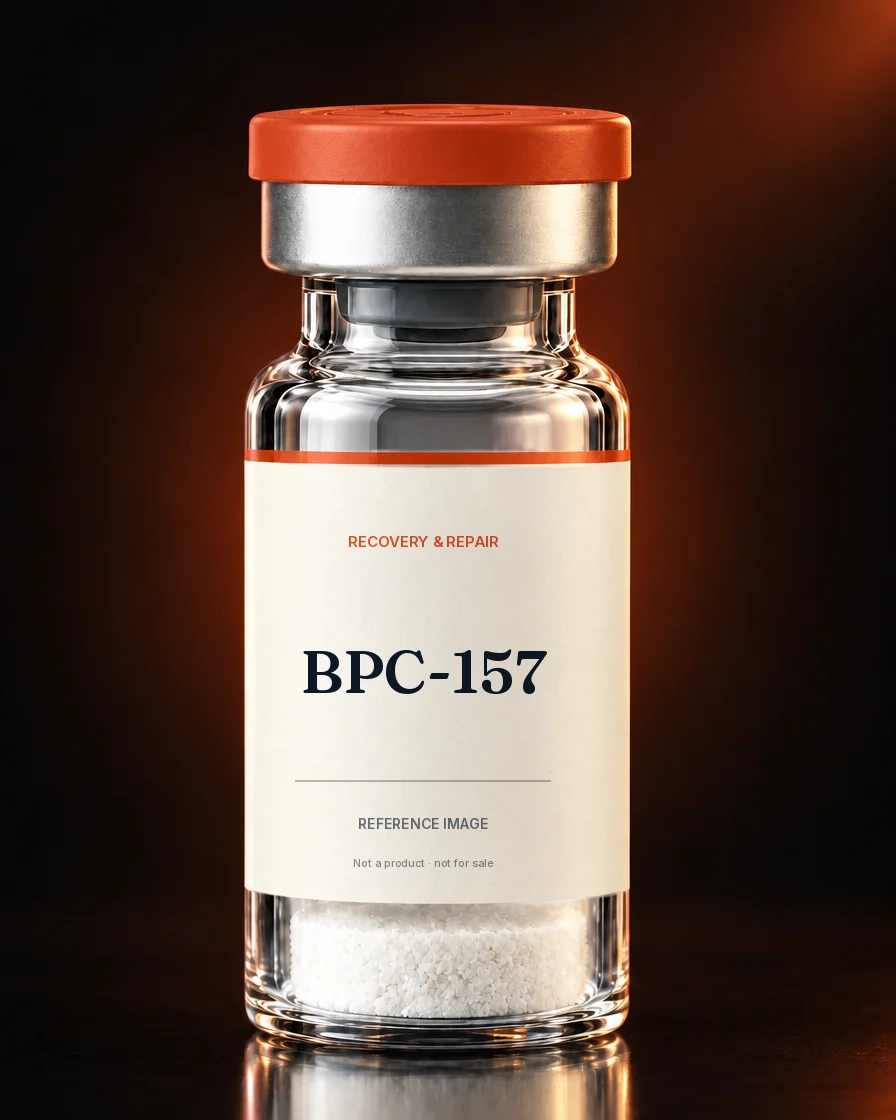
 Recovery & Repair · Dosing reference
BPC-157 dosage
What the human evidence does and does not show, how long studies ran, and the arithmetic for working with vials.
- Regulatory status
- Not approved — research use only
- Human amounts
- None established in humans
- Route studied
- Human reports describe intra-articular injection, injection into the bladder wall at cystoscopy, intravenous infusion and oral administration
- Frequency
- Not established
- Half-life
- Not established
- Evidence grade
- Grade C · Preclinical research
- Vial sizes on the market
- 5 mg · 10 mg · 15 mg
- Other forms seen
- Oral capsules (strength not stated)
What BPC-157 is
BPC-157 is a synthetic 15-amino-acid peptide studied mainly in rodent and cell models of wound, tendon and gastrointestinal injury. Human data are limited to small uncontrolled reports, and no regulator has approved it. It is prohibited in sport under WADA's S0 category.
The mechanism of BPC-157 is not established. FDA's 2026 review noted that researchers have hypothesized involvement of up-regulation of growth factors and their receptors, suppression of inflammatory mediators, induction of angiogenesis and stimulation of nitric oxide synthesis, while stating that molecular targets have not been identified and mechanisms remain poorly understood 4. Angiogenic signaling In a study… How it works →
Key evidence
- Staresinic et al., J Orthop Res · 2003 · Rats (Achilles tendon transection) and cultured tendocytesBPC 157 was associated with better biomechanical, functional and microscopic recovery, including more fibroblasts, reticulin and collagen, and opposed 4-hydroxynonenal growth inhibition in tendocytes. 3
- Hsieh et al., J Mol Med · 2017 · Chick embryo membrane, endothelial cells and rats (hind limb ischemia)BPC 157 was associated with increased vessel density, faster blood flow recovery and VEGFR2-Akt-eNOS pathway activation. 14
- Chang et al., Molecules · 2014 · Rat tendon fibroblasts (in vitro)Growth hormone receptor was among the most up-regulated genes, and growth hormone added to treated cells increased proliferation and JAK2 activation. 15
What the human evidence shows
Human studies of BPC-157 are listed below by design, population and duration. None was designed or powered to establish an amount, and Amiravo does not reproduce their amounts for a compound approved nowhere.
- A retrospective chart review at a private clinic in Orlando, Florida covered 17 patients given intra-articular BPC 157, alone or combined with thymosin beta-4, for knee pain; 16 were reached by telephone and asked to rate pain before injection and the degree and duration of relief, with no standardized function, stiffness or quality-of-life instrument used 9.
- A pilot study at a private clinic enrolled 12 women aged 39 to 76 (mean 58.3 years) with moderate to severe interstitial cystitis who had not responded to pentosan polysulfate; they underwent cystoscopy with injections of compounded BPC-157 around the area of bladder inflammation during a single procedure, and symptoms were assessed with the Global Response Assessment questionnaire 10.
- An IRB-approved pilot study in 2 adults (a 58-year-old man and a 68-year-old woman), both of whom had received intravenous BPC-157 before the trial, administered intravenous infusions of BPC-157 in 250 cc of normal saline over one hour on two consecutive days, with fasting blood work and vital signs before and after each infusion and questioning about side effects at each visit 11.
- A PRISMA-compliant systematic review (PROSPERO CRD420261406325) searching Embase, PubMed, Cochrane Library and ClinicalTrials.gov to 1 June 2026 identified three human studies of BPC-157 totalling 30 participants - the knee-pain chart review (n=16), the interstitial cystitis pilot (n=12) and the intravenous safety pilot (n=2); all were judged of poor methodological quality and overall certainty of evidence was rated very low for serious risk of bias, indirectness and imprecision 18.
- A phase 1 registry record (NCT02637284, PCO-02 safety and pharmacokinetics trial, 42 planned participants, status listed as unknown with no posted results) describes healthy volunteers aged 18 to 35 receiving oral tablets containing the BPC-157-related substance Bepecin, in a single-dose part and a two-week multiple-dose part, with placebo controls 17.
- A phase 2 registry record (NCT07437547, recruiting, 120 planned participants) describes adults aged 18 to 45 with MRI-confirmed grade II hamstring strain randomized to subcutaneous BPC 157 or matching placebo administered by trained study staff alongside standardized rehabilitation; no results are posted 19.
- A phase 1 registry record (NCT07803250, not yet recruiting, 30 planned participants) describes self-administered subcutaneous BPC-157, normal saline or no injection after arthroscopic rotator cuff repair, with standard postoperative rehabilitation in all arms; no results are posted 20.
- A completed single-group registry record (NCT07752381, 40 participants, no posted results) describes physically active adults aged 18 to 65 consuming a commercial peptide gummy containing BPC-157 for 8 weeks, with hs-CRP and IL-6 measured at baseline and week 8 and questionnaires at weeks 2, 4, 6 and 8 21.
How long did human studies run?
- In the interstitial cystitis pilot, the injections were given during a single cystoscopy procedure, with no further treatment reported 10.
- The intravenous pilot study administered infusions on two consecutive days (day 1 and day 2), with follow-up blood work and vital signs on day 3 11.
- In the knee-pain chart review, follow-up varied because the study was retrospective; most patients had been injected 6 months to 1 year before the telephone survey 9.
- The registered hamstring trial runs study injections over 14 days (NCT07437547); the registered rotator cuff study plans injections over 90 days after surgery (NCT07803250); the oral phase 1 record describes a single-dose part and a two-week repeat-dose part (NCT02637284); the completed gummy study ran 8 weeks (NCT07752381) 19.
Who was excluded from the studies
- The registered hamstring trial excludes grade III tears and tendon avulsion, prior index-limb hamstring strain within 6 months, recent systemic corticosteroids, anabolic agents, platelet-rich plasma, stem-cell products or other investigational peptides, bleeding disorders or therapeutic anticoagulation, significant uncontrolled medical illness, and people who are pregnant or breastfeeding 19.
- The oral phase 1 record restricted enrolment to people aged 18 to 35 with a body mass index of 18.5 to 24.9 and normal blood work and excluded pregnant or lactating women, people with a psychiatric history, active systemic infection, any current medical treatment, recent major surgery, or recent alcohol or illegal drug use 17.
- The completed gummy study excluded people with inflammatory or autoimmune conditions, oncological or psychiatric disorders, recent systemic corticosteroids or intra-articular steroid injection, pregnancy, breastfeeding or planned conception, uncontrolled chronic disease, and musculoskeletal injury within the past 8 weeks 21.
- The systematic review states that BPC-157 should not be used clinically in humans outside ethically approved, regulated, high-quality clinical trials 18.
Side effects reported in studies
- Headache and flatulenceDescribed by FDA as the most frequently reported events; rates not given · Healthy subjects given rectal BPC-157 in two meeting abstracts 4
- Injection site reaction, shortness of breath, diffuse hyperpigmentation and gingival darkeningIndividual FAERS reports; causality unclear · Spontaneous reports to FDA 4
- No adverse events reported0 of 12 and 0 of 2 participants · Interstitial cystitis pilot and intravenous infusion pilot (uncontrolled, very small) 10
- No serious adverse events appear to have been reported across the five published human studiesFDA cautioned that the studies were short, small and gave limited safety data · Healthy subjects and patients across five clinical studies reviewed by FDA 4
BPC-157 draw calculator
Pick the vial strength and the water added, enter an amount, and see the concentration, the units to draw and how many draws the vial holds. Arithmetic only.
Computed from your inputs. Not a dose or a recommendation.
Compare water volumes for this vialShow
More water = lower concentration = a larger, easier-to-measure draw. Tap a row to use it.
| Water | mg/mL | Draw |
|---|---|---|
| 0.5 mL | 20 | — |
| 1 mL | 10 | — |
| 1.5 mL | 6.667 | — |
| 2 mL | 5 | — |
| 2.5 mL | 4 | — |
| 3 mL | 3.333 | — |
| 5 mL | 2 | — |
Supplies and handling
- Lyophilized vialSealed vial with the freeze-dried cake. Check the label, lot and the certificate of analysis before opening.
- Sterile diluentThe diluent named on the product documentation. Bacteriostatic water contains benzyl alcohol; sterile water does not.
- Graduated syringesSized to the volume being measured. U-100 insulin syringes are graduated in units where 100 units = 1 mL.
- Alcohol prep padsFor wiping vial stoppers before each puncture.
- Nitrile glovesClean gloves for aseptic handling.
- Sharps containerPuncture-resistant container for used needles.
Storage
General research-context handling for lyophilized peptides: keep cold, dry and protected from light, avoid repeated freeze-thaw of any solution, and follow the supplier's documentation. FDA's review noted that literature reports expect storage below -18 degrees C for the free base, and published stability data for reconstituted material are limited 4.
- Lyophilized (unmixed) vials: typically stored cold and dry, away from light, as the documentation directs. Many are stable longer frozen.
- Reconstituted vials: typically refrigerated (about 2–8 °C), protected from light and not frozen.
- Bacteriostatic water contains benzyl alcohol, which inhibits bacterial growth in multi-use vials; sterile water has no preservative.
Handling mistakes and troubleshooting
- Added the wrong volume of diluent
- The concentration changes, not the amount of compound in the vial. Recalculate with the volume actually added and relabel the vial.
- Shook the vial and it foamed
- Let it settle in the refrigerator. Foam is a sign of agitation; some peptides aggregate when shaken. Note it on the label.
- The solution is cloudy or has particles
- Do not use it. Cloudiness can indicate incomplete dissolution, contamination or degradation. Record the lot and contact the supplier with the certificate of analysis.
- The powder cake looks melted or shrunken before reconstitution
- This can indicate the vial was exposed to heat or moisture. Record the lot and condition on arrival.
- Liquid sprayed back when the needle was removed
- Pressure built up in the vial. Withdraw a small volume of air while adding diluent to keep pressure neutral.
Regulatory status
- Status
- Not approved by the FDA for any use 4. FDA's 2026 briefing document stated that there is no approved product containing BPC-157-related substances in any country, and that BPC-157 is not found in the European, Japanese or International Pharmacopeias 4.
- United States (FDA)
- BPC-157 is not FDA-approved for any use 4. FDA's page on bulk drug substances that may present significant safety risks, current as of April 22, 2026, lists BPC-157 among substances previously in compounding Category 2 whose nominations were withdrawn, and repeats FDA's concerns about immunogenicity, impurities and limited safety information 6. FDA's category document updated May 14, 2026 does not list BPC-157 in Category 1, 2 or 3 5. FDA convened its Pharmacy Compounding Advisory Committee on July 23–24, 2026 to consider BPC-157 (free base and acetate) for the 503A Bulks List, with ulcerative colitis as the use evaluated 7. FDA staff's briefing weighed against adding it, citing characterization, limited safety information and insufficient evidence of effectiveness 4. A law-firm summary reported that the committee voted to recommend inclusion, that FDA is not bound by that advice, and that as of August 18, 2026 FDA had not added BPC-157 to the list 16. The status after that date was not verified.
- Sport (WADA)
- The WADA 2026 Prohibited List names BPC-157 in section S0 (non-approved substances), which covers pharmacological substances with no current governmental approval for human therapeutic use; S0 is prohibited at all times, in and out of competition, and all S0 substances are Specified Substances 8.
Status varies by country and changes over time. How we describe regulatory status.
BPC-157 compared with related compounds
| Compound | Status | Evidence | Human amounts | Half-life |
|---|---|---|---|---|
| BPC-157 | Not approved — research use only | C | None established | — |
| Vesugen | Not approved — research use only | C | None established | — |
| TB-500 | Not approved — research use only | C | None established | — |
| ARA-290 | Investigational | B | Trial doses | — |
| B7-33 | Not approved — research use only | C | None established | — |
| BPC-157 + TB-500 Blend | Not approved — research use only | C | None established | — |
Combinations that include BPC-157
Frequently asked questions
What doses of BPC-157 have been studied in humans?
Is there an established BPC-157 cycle length?
How much bacteriostatic water should be added to a BPC-157 vial?
How many units is a given amount on an insulin syringe?
Is BPC-157 FDA-approved?
References
- Stable Gastric Pentadecapeptide BPC 157 and Wound Healing Front Pharmacol. 2021
- BPC 157 and Standard Angiogenic Growth Factors. Gastrointestinal Tract Healing, Lessons from Tendon, Ligament, Muscle and Bone Healing Curr Pharm Des. 2018
- Gastric pentadecapeptide BPC 157 accelerates healing of transected rat Achilles tendon and in vitro stimulates tendocytes growth J Orthop Res. 2003
- FDA Briefing Document: BPC-157-Related Bulk Drug Substances (BPC-157 free base and BPC-157 acetate), Pharmacy Compounding Advisory Committee, July 23-24, 2026 FDA. 2026
- Bulk Drug Substances Nominated for Use in Compounding Under Section 503A of the FD&C Act (categories 1, 2 and 3; updated May 14, 2026) FDA. 2026
- Certain Bulk Drug Substances for Use in Compounding that May Present Significant Safety Risks (page content current as of 04/22/2026) FDA. 2026
- July 23-24, 2026: Meeting of the Pharmacy Compounding Advisory Committee (agenda, questions and briefing documents) FDA Advisory Committee Calendar. 2026
- International Standard: Prohibited List 2026 (S0 Non-approved substances; S2 Peptide hormones, growth factors, related substances and mimetics) World Anti-Doping Agency. 2026
- Intra-Articular Injection of BPC 157 for Multiple Types of Knee Pain Altern Ther Health Med. 2021
- Effect of BPC-157 on Symptoms in Patients with Interstitial Cystitis: A Pilot Study Altern Ther Health Med. 2024
- Safety of Intravenous Infusion of BPC157 in Humans: A Pilot Study Altern Ther Health Med. 2025
- Regeneration or Risk? A Narrative Review of BPC-157 for Musculoskeletal Healing Curr Rev Musculoskelet Med. 2025
- Emerging Use of BPC-157 in Orthopaedic Sports Medicine: A Systematic Review HSS J. 2025
- Therapeutic potential of pro-angiogenic BPC157 is associated with VEGFR2 activation and up-regulation J Mol Med (Berl). 2017
- Pentadecapeptide BPC 157 enhances the growth hormone receptor expression in tendon fibroblasts Molecules. 2014
- FDA Advisory Committee Voted Yes on Six Peptides. Now What? The Regulatory Road Ahead (law-firm commentary; secondary source) (summary of FDA advisory committee proceedings) US Food and Drug Administration. 2026
- PCO-02 - Safety and Pharmacokinetics Trial (NCT02637284), phase 1, status unknown, no outcome data posted ClinicalTrials.gov. 2015
- Human evidence for BPC-157 in orthopaedic and regenerative medicine: a systematic review of efficacy and safety Acta Orthop Belg. 2026
- BPC 157 for Acute Hamstring Muscle Strain Repair (NCT07437547), phase 2 registry record, recruiting ClinicalTrials.gov. 2026
- Impact of BPC-157 on Recovery Following Rotator Cuff Repair Surgery (NCT07803250), phase 1 registry record, not yet recruiting ClinicalTrials.gov. 2026
- A Clinical Trial to Evaluate the Effects of Peptide Gummies on Markers of Inflammation, Physical Performance, and Recovery (NCT07752381), completed, no posted results ClinicalTrials.gov. 2025
Last reviewed October 23, 2026 by the Amiravo editorial team. Editorial policy · Report an error