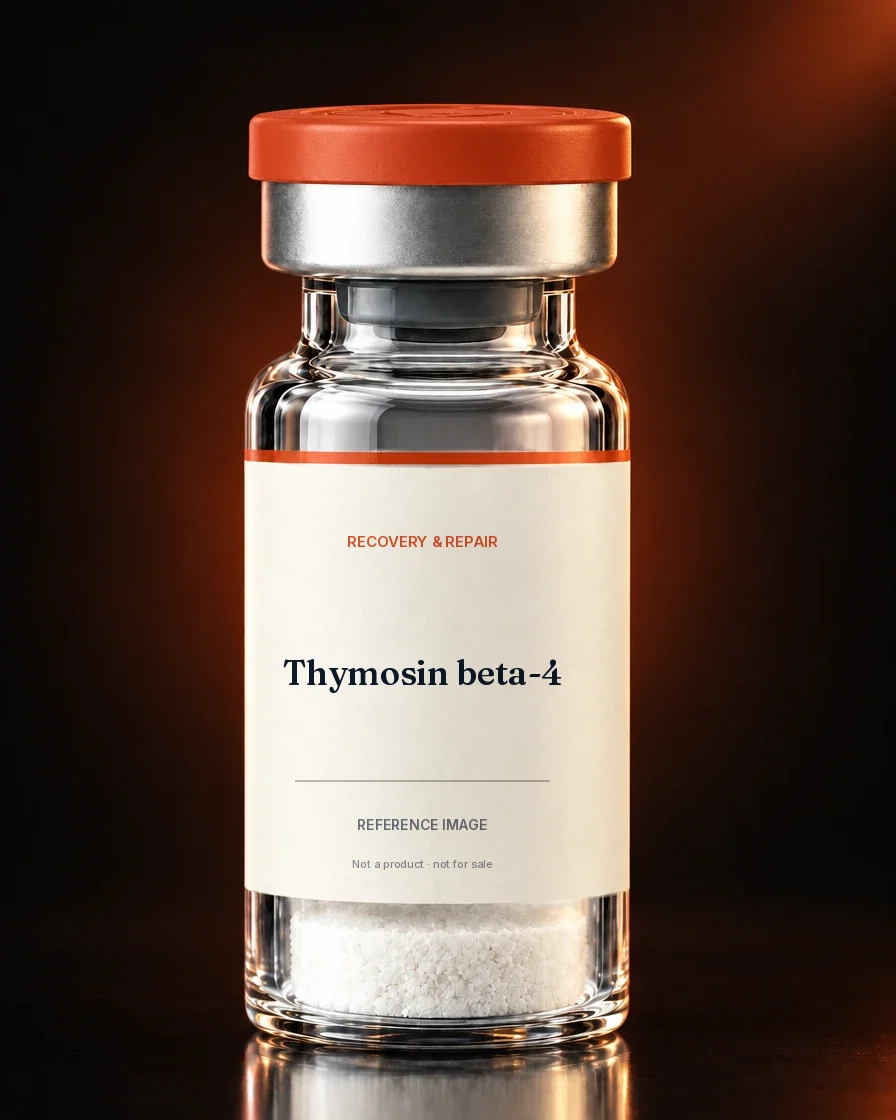
 Recovery & Repair · Dosing reference
Thymosin beta-4 dosage
Doses given in registered human trials, how long they ran, and the arithmetic for working with vials.
- Regulatory status
- Investigational
- Human amounts
- 0.1% RGN-259 eye drop in SEER-1 and dry-eye trials; intravenous synthetic Tβ4 42-1260 mg in a phase 1 healthy-volunteer study
- Route studied
- Topical ophthalmic (RGN-259); intravenous (phase 1 and myocardial infarction studies)
- Frequency
- Five times daily for 4 weeks (SEER-1); four times daily for 14 days (ARISE-3)
- Half-life
- Not reported numerically in the sources reviewed; rose with dose in phase 1
- Evidence grade
- Grade B · Limited human data
- Vial sizes on the market
- Not recorded
- Other forms seen
- —
What Thymosin beta-4 is
Thymosin beta-4 is a naturally occurring 43-amino-acid, N-acetylated actin-binding protein that is under clinical investigation (for example as the RGN-259 eye drop) and is distinct from the seven-residue TB-500 fragment.
Tβ4 binds monomeric G-actin and inhibits its polymerization; in resting human neutrophils it was reported to be the major G-actin-sequestering protein, present at roughly 149 µM in the cytoplasm 1,2. Proposed extracellular actions Cardiac cells (mice and cultured cells): Tβ4 was reported to form a complex with PINCH and integrin-linked kinase, activating Akt, and to be associated with cardiomyocyte migration and… How it works →
Key evidence
- Sosne et al., Int J Mol Sci (SEER-1) · 2022 · Humans (18 people with stage 2-3 neurotrophic keratopathy)
- Sosne and Ousler, Clin Ophthalmol · 2015 · Humans (72 adults with moderate to severe dry eye)
- Ruff et al., Ann N Y Acad Sci · 2010 · Humans (40 healthy volunteers)
Doses given in human trials
- In SEER-1 (NCT02600429), people with neurotrophic keratopathy received 0.1% RGN-259 or placebo eye drops five times a day for 4 weeks 10,20.
- In ARISE-3 (NCT03937882), adults with dry eye received RGN-259 or placebo eye drops four times a day for 14 days 11.
- In a phase 2 severe dry-eye trial (NCT01393132), 0.1% RGN-259 or vehicle was instilled 6 times daily for 28 days 9.
- In a phase 1 study, healthy volunteers received single intravenous doses of 42, 140, 420 or 1260 mg synthetic Tβ4 or placebo, then the same dose daily for 14 days 6.
- In the NL005 phase IIb myocardial infarction study (NCT05984134), arms received recombinant human Tβ4 intravenously at 0.5 or 1.0 µg/kg per the arm descriptions, or placebo, for 7 days after PCI 14.
How long did human studies run?
No human study durations are recorded for Thymosin beta-4.
Cycle-length evidence for Thymosin beta-4Side effects reported in studies
- Any non-serious adverse event (registry tally)47 of 350 RGN-259 versus 31 of 349 placebo; no serious adverse events in either arm · Adults with dry eye, ARISE-3 (NCT03937882) 11
- Serious adverse events (registry tally)3 of 299 RGN-259 versus 2 of 302 placebo · Adults with dry eye, ARISE-2 (NCT02974907) 12
- Adverse events after intravenous dosingDescribed as infrequent; no serious events · 40 healthy volunteers, phase 1 6
Supplies and handling
- Lyophilized vialSealed vial with the freeze-dried cake. Check the label, lot and the certificate of analysis before opening.
- Sterile diluentThe diluent named on the product documentation. Bacteriostatic water contains benzyl alcohol; sterile water does not.
- Graduated syringesSized to the volume being measured. U-100 insulin syringes are graduated in units where 100 units = 1 mL.
- Alcohol prep padsFor wiping vial stoppers before each puncture.
- Nitrile glovesClean gloves for aseptic handling.
- Sharps containerPuncture-resistant container for used needles.
Storage
Follow the documentation for the specific material; lyophilized peptides and proteins are generally kept dry and protected from heat, light and moisture.
- Lyophilized (unmixed) vials: typically stored cold and dry, away from light, as the documentation directs. Many are stable longer frozen.
- Reconstituted vials: typically refrigerated (about 2–8 °C), protected from light and not frozen.
- Bacteriostatic water contains benzyl alcohol, which inhibits bacterial growth in multi-use vials; sterile water has no preservative.
Handling mistakes and troubleshooting
- Added the wrong volume of diluent
- The concentration changes, not the amount of compound in the vial. Recalculate with the volume actually added and relabel the vial.
- Shook the vial and it foamed
- Let it settle in the refrigerator. Foam is a sign of agitation; some peptides aggregate when shaken. Note it on the label.
- The solution is cloudy or has particles
- Do not use it. Cloudiness can indicate incomplete dissolution, contamination or degradation. Record the lot and contact the supplier with the certificate of analysis.
- The powder cake looks melted or shrunken before reconstitution
- This can indicate the vial was exposed to heat or moisture. Record the lot and condition on arrival.
- Liquid sprayed back when the needle was removed
- Pressure built up in the vial. Withdraw a small volume of air while adding diluent to keep pressure neutral.
Regulatory status
- Status
- Not FDA-approved; no Drugs@FDA application was located as of 2026-10-24 17. The RGN-259 eye drop has completed phase 3 dry-eye trials and a second neurotrophic keratopathy phase 3 trial (SEER-2) was listed as recruiting 11,12,19.
Status varies by country and changes over time. How we describe regulatory status.
Thymosin beta-4 compared with related compounds
| Compound | Status | Evidence | Human amounts | Half-life |
|---|---|---|---|---|
| Thymosin beta-4 | Investigational | B | Trial doses | Not reported numerically in the sources |
| TB-500 | Not approved — research use only | C | None established | — |
| Vesugen | Not approved — research use only | C | None established | — |
| BPC-157 | Not approved — research use only | C | None established | — |
| Pentadeca arginate (PDA) | Not approved — research use only | — | None established | — |
| ARA-290 | Investigational | B | Trial doses | — |
Frequently asked questions
What doses of Thymosin beta-4 have been studied in humans?
Is there an established Thymosin beta-4 cycle length?
How much bacteriostatic water should be added to a Thymosin beta-4 vial?
How many units is a given amount on an insulin syringe?
What is the half-life of Thymosin beta-4?
References
- UniProtKB P62328 (TYB4_HUMAN): Thymosin beta-4 UniProt. 2026
- Thymosin beta 4 sequesters the majority of G-actin in resting human polymorphonuclear leukocytes J Cell Biol. 1992
- Thymosin beta4 activates integrin-linked kinase and promotes cardiac cell migration, survival and cardiac repair Nature. 2004
- Thymosin beta4 induces adult epicardial progenitor mobilization and neovascularization Nature. 2007
- Thymosin beta 4 is dispensable for murine cardiac development and function Circ Res. 2012
- A randomized, placebo-controlled, single and multiple dose study of intravenous thymosin beta4 in healthy volunteers Ann N Y Acad Sci. 2010
- A first-in-human, randomized, double-blind, single- and multiple-dose, phase I study of recombinant human thymosin beta4 in healthy Chinese volunteers J Cell Mol Med. 2021
- Thymosin beta 4 ophthalmic solution for dry eye: a randomized, placebo-controlled, Phase II clinical trial conducted using the controlled adverse environment (CAE) model Clin Ophthalmol. 2015
- Thymosin beta4 significantly improves signs and symptoms of severe dry eye in a phase 2 randomized trial Cornea. 2015
- 0.1% RGN-259 (Thymosin beta4) Ophthalmic Solution Promotes Healing and Improves Comfort in Neurotrophic Keratopathy Patients in a Randomized, Placebo-Controlled, Double-Masked Phase III Clinical Trial Int J Mol Sci. 2022
- Assessment of the Safety and Efficacy of RGN-259 Ophthalmic Solutions for Dry Eye Syndrome: ARISE-3 (NCT03937882) ClinicalTrials.gov. 2026
- Assessment of the Safety and Efficacy of RGN-259 Ophthalmic Solutions for Dry Eye Syndrome: ARISE-2 (NCT02974907) ClinicalTrials.gov. 2026
- A Study of the Safety and Efficacy of Injectable Thymosin Beta 4 for Treating Acute Myocardial Infarction (NCT01311518) ClinicalTrials.gov. 2026
- Efficacy and Safety Study of Thymosin Beta 4 in Patients With Acute Myocardial Infarction (NL005 phase IIb; NCT05984134) ClinicalTrials.gov. 2026
- Certain Bulk Drug Substances for Use in Compounding that May Present Significant Safety Risks (content current as of 04/22/2026) FDA. 2026
- Tractatenblad 2026 Nr. 25: Anti-doping convention (ETS No. 135), amendment to the appendix - The 2026 Prohibited List, World Anti-Doping Code (English text; entry into force 1 January 2026) Tractatenblad van het Koninkrijk der Nederlanden (official government publication). 2026
- openFDA Drugs@FDA query for 'thymosin' (no matching applications) FDA (openFDA Drugs@FDA). 2026
- PubChem compound record for thymosin beta 4 (CID 45382195) PubChem. 2026
- Assessment of the Safety and Efficacy of 0.1% RGN-259 Ophthalmic Solution for the Treatment of NK: SEER-2 (NCT05555589) ClinicalTrials.gov. 2026
- Assessment of the Safety and Efficacy Study of RGN-259 Ophthalmic Solutions for Neurotrophic Keratopathy: SEER-1 (NCT02600429) ClinicalTrials.gov. 2026
Last reviewed October 24, 2026 by the Amiravo editorial team. Editorial policy · Report an error