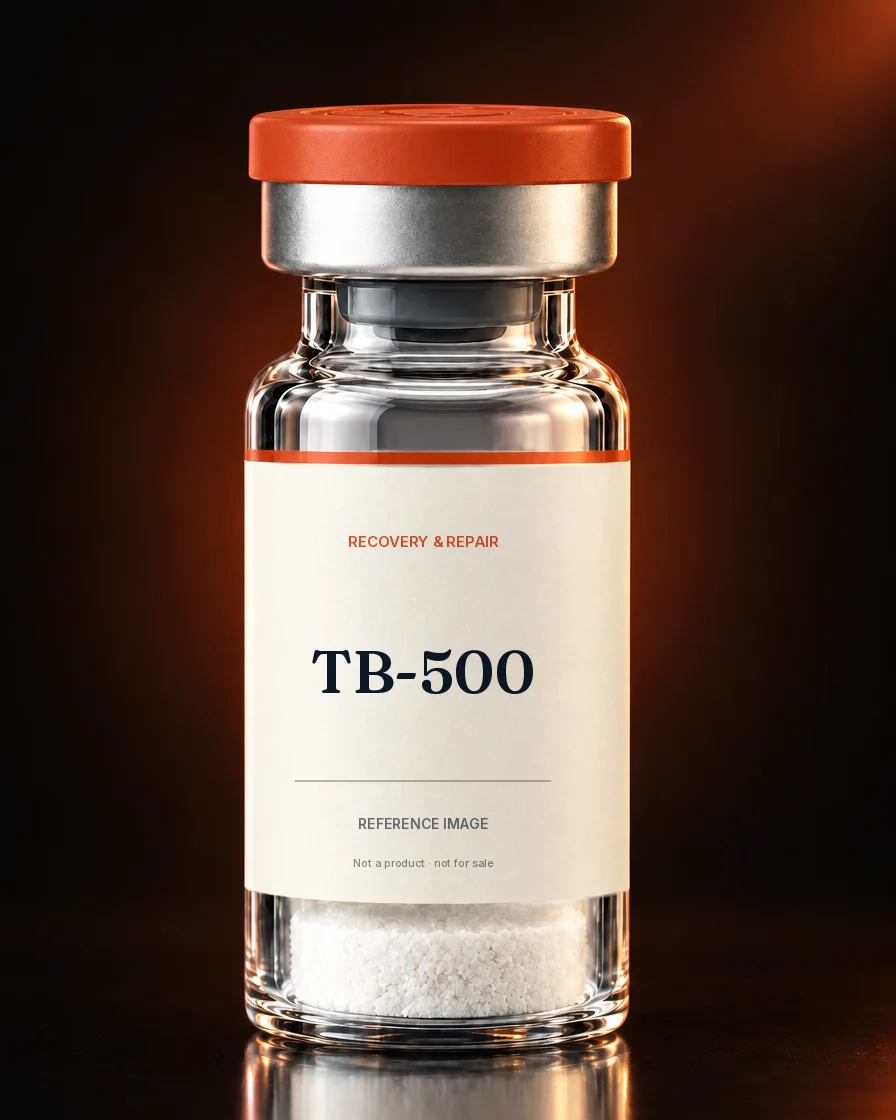
 Recovery & Repair · Dosing reference
TB-500 dosage
What the human evidence does and does not show, how long studies ran, and the arithmetic for working with vials.
- Regulatory status
- Not approved — research use only
- Human amounts
- None established in humans
- Route studied
- Published human studies used full-length thymosin beta-4, given as ophthalmic solution, topical gel, intravenous infusion or intravenous recombinant protein
- Frequency
- Not established
- Half-life
- Not established
- Evidence grade
- Grade C · Preclinical research
- Vial sizes on the market
- 10 mg
- Other forms seen
- —
What TB-500 is
TB-500 is a synthetic, acetylated seven-amino-acid fragment of thymosin beta-4, and it is often described as if it were the full protein, which is inaccurate. Evidence for the full protein comes from cell, animal and a few human studies, whereas FDA found no human data for TB-500 itself. It is not approved and is prohibited in sport.
Thymosin beta-4 was first isolated from calf thymus as a candidate thymic hormone; it was later recognized as a main intracellular G-actin-sequestering peptide in most vertebrate cells, and then as a cytokine-like molecule linked to wound healing, although little is known about the molecular mechanisms of extracellular beta-thymosins 1. Relation of TB-500 to thymosin beta-4 TB-500 is understood to be the… How it works →
Key evidence
- Esposito et al., Drug Test Anal · 2012 · Analytical chemistry (commercial TB-500 product)The N-terminal acetylated 17-23 fragment of thymosin beta-4 (Ac-LKKTETQ) was identified in a product sold as TB-500. 4
- Ho et al., J Chromatogr A · 2012 · Horses (urine and plasma after administration of a veterinary TB-500 preparation)The key ingredient was N-acetylated LKKTETQ, and the parent peptide and its metabolites were detectable in post-administration samples. 5
- Philp et al., Wound Repair Regen · 2003 · Mice (db/db diabetic and 26-month-old aged) and ratsThymosin beta-4 was associated with accelerated dermal wound repair, and the synthetic LKKTETQ peptide produced repair in aged mice comparable to the parent molecule; the peptide was not N-acetylated. 6
What the human evidence shows
Human studies of TB-500 are listed below by design, population and duration. None was designed or powered to establish an amount, and Amiravo does not reproduce their amounts for a compound approved nowhere.
- A randomized, placebo-controlled phase 1 study administered synthetic full-length thymosin beta-4 (not the TB-500 fragment) intravenously to four cohorts of 10 healthy volunteers each, first as a single ascending dose and then, after safety review, as repeated administration over 14 days, with safety, treatment-emergent adverse events and pharmacokinetics as the measures; the report states a dose-proportional single-dose pharmacokinetic profile and an increasing half-life with increasing dose 11.
- A single-centre, double-masked, placebo-controlled phase 2 trial randomized 72 adults with moderate to severe dry eye 1:1 to thymosin beta-4 ophthalmic solution (RGN-259, full-length Tbeta4) or placebo over a 28-day treatment period inside a controlled adverse environment model, with ocular discomfort and inferior corneal staining at day 29 as primary endpoints (neither reached significance) 12.
- A multicentre, randomized, double-masked, placebo-controlled phase 2 trial at two US sites treated 9 patients with severe dry eye, including disease associated with graft-versus-host disease, with RGN-259 (full-length Tbeta4) eye drops or vehicle control over 28 days, assessing ocular discomfort (OSDI) and corneal fluorescein staining 13.
- A randomized, placebo-controlled, double-masked phase 3 trial of RGN-259 ophthalmic solution (full-length Tbeta4) in patients with stage 2 and 3 neurotrophic keratopathy reported complete healing of persistent epithelial defects after 4 weeks in 6 of 10 treated subjects versus 1 of 8 placebo-treated subjects (p = 0.0656), with Mackie classification stage, ocular discomfort, foreign body sensation and dryness as further measures 15.
- A phase 2, double-blind, placebo-controlled, dose-escalation study at eight European sites (five in Italy, three in Poland) enrolled and randomized 73 patients with venous stasis ulcers to topical full-length thymosin beta-4 gel or placebo, assessing safety, tolerability and wound healing; the corresponding registry record (NCT00832091, completed, with posted results) lists 72 participants in three active concentration groups and a placebo group 16.
- A phase 2 registry record (NCT00382174, completed, 72 participants, with posted results) describes topical full-length thymosin beta-4 gel or placebo gel in patients with pressure ulcers 17.
- A randomized, placebo-controlled, double-blind trial in 96 patients with ST-segment elevation myocardial infarction after percutaneous coronary intervention gave recombinant human thymosin beta 4 (full-length rhTB4, first dose within 8 hours after PCI; n = 43) or placebo, with infarcted area at 90-day follow-up as the measure; the overall difference between groups was not significant 18.
- Phase 1 registry records of recombinant human thymosin beta 4 (NL005, full-length) describe a single-dose study in 54 healthy volunteers (NCT04555824, completed) and a repeat-dose study in 30 healthy volunteers (NCT04555850, completed); neither has posted results 19.
- Phase 2 registry records of recombinant human thymosin beta 4 (NL005, full-length) in acute myocardial infarction describe intravenous administration after PCI in 62 participants (NCT05485818, completed) and 90 participants (NCT05984134, completed); neither has posted results 20.
- A phase 2 registry record of RGN-137, a topical gel containing full-length thymosin beta-4, for junctional and dystrophic epidermolysis bullosa (NCT03578029) is listed as terminated 21.
How long did human studies run?
- The intravenous phase 1 study in healthy volunteers gave a single dose and then repeated administration over 14 days 11.
- The controlled adverse environment dry eye trial treated participants for 28 days across six visits over a 32-day period; the severe dry eye phase 2 trial treated for 28 days with assessment continuing to day 56 12.
- The neurotrophic keratopathy phase 3 trial assessed healing after 4 weeks of treatment and again at day 43, two weeks after treatment stopped 15.
- The venous stasis ulcer and pressure ulcer registry records describe topical application for up to 84 days 16.
- The STEMI trials administered recombinant human thymosin beta 4 for 7 days starting after PCI, with imaging follow-up at 90 days 18.
Who was excluded from the studies
- The RGN-259 dry eye phase 3 record excluded people with active ocular infection or inflammation, significant blepharitis or meibomian gland dysfunction, contact lens wear within 7 days, LASIK within 6 months, intraocular pressure above 25 mmHg, planned ocular or lid surgery, and recent use of other prescription dry eye treatments 22.
- The RGN-259 neurotrophic keratopathy phase 3 record excluded people whose persistent epithelial defect was primarily caused by a lid function abnormality, those with ongoing ocular infection or inflammation unrelated to neurotrophic keratopathy, uncontrolled systemic disease, anticipated change in immunosuppressive therapy, and recent contact lens use 23.
- The severe dry eye phase 2 record excluded acute or inflammatory corneal disease, pregnancy or lactation, monocular status, ocular surgery within 3 months, corneal thinning greater than 50%, active corneal infection, history of ocular malignancy and current topical cyclosporin A use 24.
TB-500 draw calculator
Pick the vial strength and the water added, enter an amount, and see the concentration, the units to draw and how many draws the vial holds. Arithmetic only.
Computed from your inputs. Not a dose or a recommendation.
Compare water volumes for this vialShow
More water = lower concentration = a larger, easier-to-measure draw. Tap a row to use it.
| Water | mg/mL | Draw |
|---|---|---|
| 0.5 mL | 20 | — |
| 1 mL | 10 | — |
| 1.5 mL | 6.667 | — |
| 2 mL | 5 | — |
| 2.5 mL | 4 | — |
| 3 mL | 3.333 | — |
| 5 mL | 2 | — |
Supplies and handling
- Lyophilized vialSealed vial with the freeze-dried cake. Check the label, lot and the certificate of analysis before opening.
- Sterile diluentThe diluent named on the product documentation. Bacteriostatic water contains benzyl alcohol; sterile water does not.
- Graduated syringesSized to the volume being measured. U-100 insulin syringes are graduated in units where 100 units = 1 mL.
- Alcohol prep padsFor wiping vial stoppers before each puncture.
- Nitrile glovesClean gloves for aseptic handling.
- Sharps containerPuncture-resistant container for used needles.
Storage
General research-context handling for lyophilized peptides: keep cold, dry and protected from light, avoid repeated freeze-thaw of any solution, and follow the supplier's documentation. Published stability data for reconstituted material are limited.
- Lyophilized (unmixed) vials: typically stored cold and dry, away from light, as the documentation directs. Many are stable longer frozen.
- Reconstituted vials: typically refrigerated (about 2–8 °C), protected from light and not frozen.
- Bacteriostatic water contains benzyl alcohol, which inhibits bacterial growth in multi-use vials; sterile water has no preservative.
Handling mistakes and troubleshooting
- Added the wrong volume of diluent
- The concentration changes, not the amount of compound in the vial. Recalculate with the volume actually added and relabel the vial.
- Shook the vial and it foamed
- Let it settle in the refrigerator. Foam is a sign of agitation; some peptides aggregate when shaken. Note it on the label.
- The solution is cloudy or has particles
- Do not use it. Cloudiness can indicate incomplete dissolution, contamination or degradation. Record the lot and contact the supplier with the certificate of analysis.
- The powder cake looks melted or shrunken before reconstitution
- This can indicate the vial was exposed to heat or moisture. Record the lot and condition on arrival.
- Liquid sprayed back when the needle was removed
- Pressure built up in the vial. Withdraw a small volume of air while adding diluent to keep pressure neutral.
Regulatory status
- Status
- Not approved by the FDA for any use 3. FDA's 2026 briefing stated that it found no information in the medical literature in which TB-500 was administered to patients to treat any disease or condition 3.
- United States (FDA)
- TB-500 is not FDA-approved for any use 3. FDA's page on bulk drug substances that may present significant safety risks, current as of April 22, 2026, lists 'thymosin beta-4, fragment (LKKTETQ), also known as TB-500' among substances previously in compounding Category 2 whose nominations were withdrawn, noting immunogenicity and impurity concerns and the absence of human exposure data 7. FDA's category document updated May 14, 2026 does not list it in Category 1, 2 or 3 8. FDA's Pharmacy Compounding Advisory Committee considered TB-500 (free base and acetate) for the 503A Bulks List on July 23, 2026, with wound healing as the use evaluated 9. FDA staff's briefing proposed not adding it, citing lack of characterization data, historical use and human data 3. A law-firm summary reported that the committee voted to recommend inclusion, that FDA is not bound by that advice, and that as of August 18, 2026 FDA had not added it to the list 14. The status after that date was not verified.
- Sport (WADA)
- The WADA 2026 Prohibited List names 'Thymosin-beta-4 and its derivatives e.g. TB-500' under S2.3 (growth factors and growth factor modulators); S2 substances are prohibited at all times, in and out of competition, and are non-Specified Substances 10.
Status varies by country and changes over time. How we describe regulatory status.
TB-500 compared with related compounds
| Compound | Status | Evidence | Human amounts | Half-life |
|---|---|---|---|---|
| TB-500 | Not approved — research use only | C | None established | — |
| Thymosin beta-4 | Investigational | B | Trial doses | Not reported numerically in the sources |
| Vesugen | Not approved — research use only | C | None established | — |
| BPC-157 | Not approved — research use only | C | None established | — |
| Pentadeca arginate (PDA) | Not approved — research use only | — | None established | — |
| ARA-290 | Investigational | B | Trial doses | — |
Combinations that include TB-500
Frequently asked questions
What doses of TB-500 have been studied in humans?
Is there an established TB-500 cycle length?
How much bacteriostatic water should be added to a TB-500 vial?
How many units is a given amount on an insulin syringe?
References
- beta-Thymosins Ann N Y Acad Sci. 2007
- Thymosin β4 and the vasculature: multiple roles in development, repair and protection against disease Expert Opin Biol Ther. 2018
- FDA Briefing Document: TB-500-Related Bulk Drug Substances (TB-500 free base and TB-500 acetate), Pharmacy Compounding Advisory Committee, July 23-24, 2026 FDA. 2026
- Synthesis and characterization of the N-terminal acetylated 17-23 fragment of thymosin beta 4 identified in TB-500, a product suspected to possess doping potential Drug Test Anal. 2012
- Doping control analysis of TB-500, a synthetic version of an active region of thymosin beta4, in equine urine and plasma by liquid chromatography-mass spectrometry J Chromatogr A. 2012
- Thymosin beta 4 and a synthetic peptide containing its actin-binding domain promote dermal wound repair in db/db diabetic mice and in aged mice Wound Repair Regen. 2003
- Certain Bulk Drug Substances for Use in Compounding that May Present Significant Safety Risks (page content current as of 04/22/2026) FDA. 2026
- Bulk Drug Substances Nominated for Use in Compounding Under Section 503A of the FD&C Act (categories 1, 2 and 3; updated May 14, 2026) FDA. 2026
- July 23-24, 2026: Meeting of the Pharmacy Compounding Advisory Committee (agenda, questions and briefing documents) FDA Advisory Committee Calendar. 2026
- International Standard: Prohibited List 2026 (S0 Non-approved substances; S2 Peptide hormones, growth factors, related substances and mimetics) World Anti-Doping Agency. 2026
- A randomized, placebo-controlled, single and multiple dose study of intravenous thymosin beta4 in healthy volunteers Ann N Y Acad Sci. 2010
- Thymosin beta 4 ophthalmic solution for dry eye: a randomized, placebo-controlled, Phase II clinical trial conducted using the controlled adverse environment (CAE) model Clin Ophthalmol. 2015
- Thymosin beta4 significantly improves signs and symptoms of severe dry eye in a phase 2 randomized trial Cornea. 2015
- FDA Advisory Committee Voted Yes on Six Peptides. Now What? The Regulatory Road Ahead (law-firm commentary; secondary source) (summary of FDA advisory committee proceedings) US Food and Drug Administration. 2026
- 0.1% RGN-259 (Thymosin ss4) Ophthalmic Solution Promotes Healing and Improves Comfort in Neurotrophic Keratopathy Patients in a Randomized, Placebo-Controlled, Double-Masked Phase III Clinical Trial Int J Mol Sci. 2022
- The effect of thymosin treatment of venous ulcers (phase 2 dose-escalation study; registry record NCT00832091) Ann N Y Acad Sci. 2010
- Study of Thymosin Beta 4 in Patients With Pressure Ulcers (NCT00382174), phase 2 registry record with posted results ClinicalTrials.gov. 2008
- Recombinant human thymosin beta 4 improves ischemic cardiac dysfunction in mice and patients with acute ST-segment elevation myocardial infarction after reperfusion Cardiovasc Res. 2025
- A Phase 1a Study of Thymosin Beta 4 in Healthy Volunteers (NCT04555824), completed registry record ClinicalTrials.gov. 2018
- Safety and Efficacy Study of Thymosin Beta 4 in Patients With Acute Myocardial Infarction (NCT05485818), completed phase 2 registry record ClinicalTrials.gov. 2021
- Evaluation of the Safety and Efficacy Study of RGN-137 Topical Gel for Junctional and Dystrophic Epidermolysis Bullosa (NCT03578029), terminated phase 2 registry record ClinicalTrials.gov. 2021
- Assessment of the Safety and Efficacy of RGN-259 Ophthalmic Solutions for Dry Eye Syndrome: ARISE-3 (NCT03937882), completed phase 3 registry record with posted results ClinicalTrials.gov. 2021
- Assessment of the Safety and Efficacy Study of RGN-259 Ophthalmic Solutions for Neurotrophic Keratopathy: SEER-1 (NCT02600429), terminated phase 3 registry record with posted results ClinicalTrials.gov. 2020
- Comparative Study of Thymosin Beta 4 Eye Drops vs. Vehicle in the Treatment of Severe Dry Eye (NCT01393132), completed phase 2 registry record ClinicalTrials.gov. 2013
Last reviewed October 23, 2026 by the Amiravo editorial team. Editorial policy · Report an error