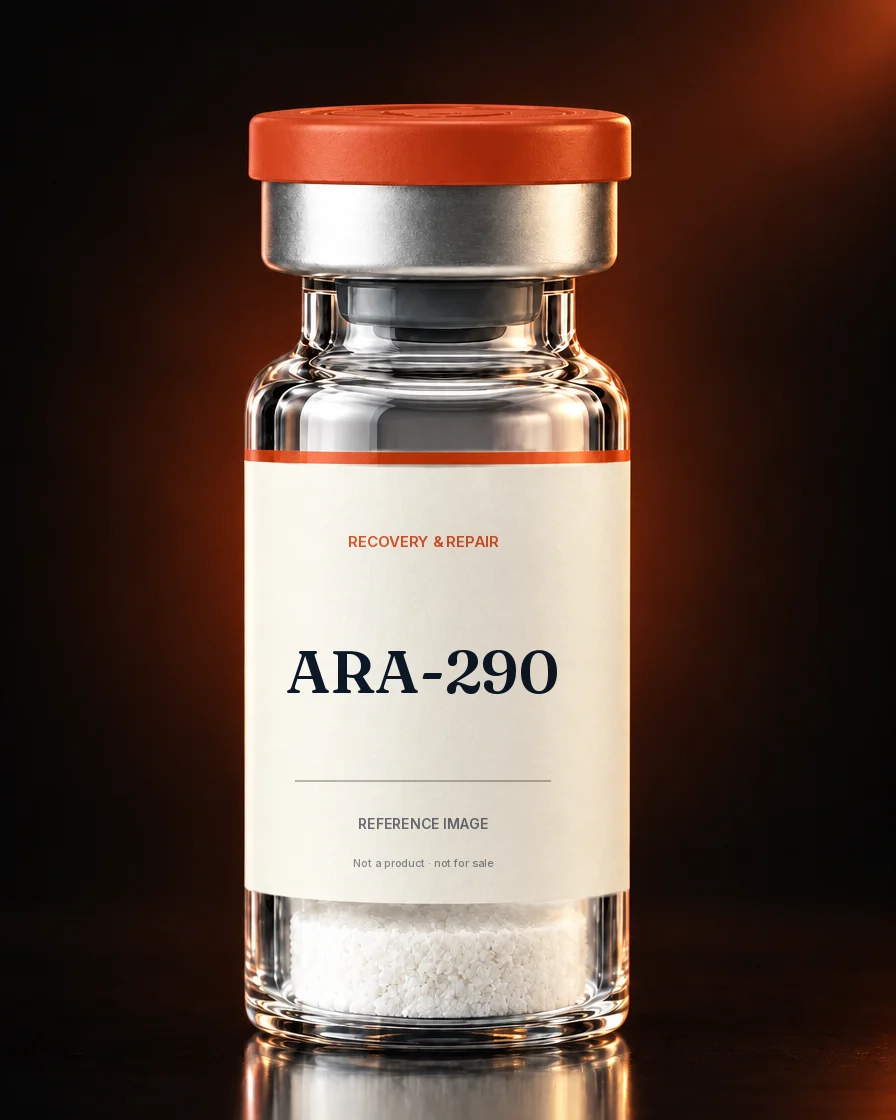
 Recovery & Repair · Dosing reference
ARA-290 dosage
Doses given in registered human trials, how long they ran, and the arithmetic for working with vials.
- Regulatory status
- Investigational
- Human amounts
- 1 mg, 4 mg and 8 mg per day subcutaneously in phase 2 trials; 2 mg intravenously three times weekly in the 2012 sarcoidosis pilot; single 2 mg intravenous dose in a healthy-volunteer study
- Route studied
- Subcutaneous in the phase 2 neuropathy, diabetes and macular oedema trials; intravenous in the sarcoidosis pilot and the healthy-volunteer emotional-processing study
- Frequency
- Once daily in most trials; three times weekly in the 2012 sarcoidosis pilot; single dose in the healthy-volunteer study
- Half-life
- Not established
- Evidence grade
- Grade B · Limited human data
- Vial sizes on the market
- 10 mg · 16 mg
- Other forms seen
- —
What ARA-290 is
A synthetic peptide derived from part of the erythropoietin structure, investigated in research on inflammation, nerve tissue and tissue-protective signaling.
Erythropoietin acts through two distinct receptor arrangements: hematopoiesis is mediated by the erythropoietin receptor homodimer, while tissue-protective effects are attributed to a heterocomplex of the erythropoietin receptor with CD131, the beta common receptor — referred to as the innate repair receptor 1,4. Design Tissue-protective activity was mapped to short sequences within erythropoietin, and helix B… How it works →
Key evidence
- Culver et al., Investigative Ophthalmology & Visual Science · 2017 · Humans (64 subjects with sarcoidosis-associated small nerve fibre loss and neuropathic pain)Placebo-corrected mean change in corneal nerve fibre area at day 28 was significant in the middle cibinetide group only (697, 95% CI 159–1236; P = 0.012); intraepidermal GAP-43-positive fibres increased in that group (P = 0.035); pain improved in all groups including placebo and the placebo-corrected pain reduction in the moderate-to-severe subgroup was not significant (P = 0.157). 3
- Brines et al., Proceedings of the National Academy of Sciences · 2008 · Cells and rodents (ischemic stroke, diabetes-induced retinal edema, peripheral nerve trauma, renal ischemia-reperfusion)Helix B and an 11-amino-acid peptide from its aqueous face were tissue protective across models, and neither was erythropoietic in vitro or in vivo. 1
- Nairz et al., Scientific Reports · 2017 · Mice (C57BL/6N, DSS-induced colitis) and primary macrophagesCibinetide and erythropoietin ameliorated the clinical course with improved weight gain and survival and reduced myeloid infiltration; the anti-inflammatory effect in macrophages depended on CD131 and JAK2 and acted through inhibition of NF-κB p65. 4
Schedules by time period
study arms from registered trials, laid out week by week. Each bar is what the label states or what investigators gave participants; none is a recommendation.
Week-by-week table
| Period | Amount |
|---|---|
| Weeks 0–4 | 1 mg (maintenance) |
28 consecutive days.
Week-by-week table
| Period | Amount |
|---|---|
| Weeks 0–4 | 4 mg (maintenance) |
28 consecutive days.
Week-by-week table
| Period | Amount |
|---|---|
| Weeks 0–4 | 8 mg (maintenance) |
28 consecutive days.
Placebo arm received 1 mL formulation buffer subcutaneously for 28 consecutive days.
Doses given in human trials
- In a double-blind, placebo-controlled exploratory trial in 22 patients with sarcoidosis and symptoms of small fiber neuropathy, participants received intravenous ARA 290 2 mg three times weekly (n = 12) or placebo (n = 10) for 4 weeks 11.
- In a blinded, placebo-controlled trial in patients with sarcoidosis-associated small nerve fiber loss, participants received daily subcutaneous ARA 290 for 28 days, with corneal small nerve fiber density, cutaneous temperature sensitivity, symptom scores and the 6-minute walk test as outcomes 12.
- In a phase 2b 28-day randomized trial in 64 subjects with sarcoid-associated small nerve fiber loss and neuropathic pain, cibinetide 1, 4 or 8 mg per day was compared with placebo, with change in corneal nerve fiber area at day 28 as the primary endpoint; the registry record (NCT02039687, completed, with posted results) states the amounts were given subcutaneously for 28 consecutive days 3.
- In a phase 2 study in subjects with type 2 diabetes and painful neuropathy, participants self-administered ARA 290 4 mg or placebo subcutaneously daily for 28 days and were then followed for a further month without treatment 13.
- In a phase 2 trial in treatment-naive patients with diabetic macular oedema recruited in Belfast (9 recruited, 8 completed), patients self-administered cibinetide 4 mg per day subcutaneously for 12 weeks; the corresponding registry record (NCT06626971) is listed as terminated with 9 participants 14.
- In a double-blind, randomized, parallel-group study in 36 healthy participants, ARA290 2 mg or placebo was given once and neural and cognitive effects were assessed one week after administration; the registry record (NCT02070783, completed) states the 2 mg single dose was given intravenously 15.
- A phase 2 registry record in prediabetes and type 2 diabetes (NCT01933529, 24 planned participants, status listed as unknown) describes ARA 290 4.0 mg or placebo injected subcutaneously once every morning for 28 days 16.
How long did human studies run?
- The 2012 sarcoidosis pilot dosed for 4 weeks 11; the 2013 sarcoidosis trial and the type 2 diabetes trial dosed for 28 days, with the diabetes trial following participants for a further month (56 days of observation in total) 12,13.
- The phase 2b sarcoidosis trial dosed for 28 consecutive days with the primary endpoint measured at day 28 3.
- The diabetic macular oedema trial dosed for 12 weeks (an 84-day period per the registry record), with outcomes measured from baseline to week 12 14.
- The healthy-volunteer study used a single administration with outcomes assessed one week later 15.
Who was excluded from the studies
- The phase 2b sarcoidosis trial record excluded people with clinically relevant abnormal physical or mental health other than sarcoidosis-related conditions, other medical conditions known to cause small nerve fiber loss (except well-controlled diabetes), clinically relevant ECG abnormalities, illicit drug abuse or excessive alcohol consumption, serious malignancy within 5 years, severe allergy or anaphylaxis history, anti-TNF or other biological anti-inflammatory therapy or immunoglobulins within 3 months, and erythropoiesis-stimulating agents within 2 months 3.
- Inclusion in the 2012 sarcoidosis pilot required a diagnosis of neuropathy and a spontaneous pain score of 5 or more on the Brief Pain Inventory 11.
- The diabetic macular oedema trial enrolled only treatment-naive patients with central retinal thickness above 400 microns in one or both eyes 14.
ARA-290 draw calculator
Pick the vial strength and the water added, enter an amount, and see the concentration, the units to draw and how many draws the vial holds. Arithmetic only.
Computed from your inputs. Not a dose or a recommendation.
Compare water volumes for this vialShow
More water = lower concentration = a larger, easier-to-measure draw. Tap a row to use it.
| Water | mg/mL | Draw |
|---|---|---|
| 0.5 mL | 20 | — |
| 1 mL | 10 | — |
| 1.5 mL | 6.667 | — |
| 2 mL | 5 | — |
| 2.5 mL | 4 | — |
| 3 mL | 3.333 | — |
| 5 mL | 2 | — |
Supplies and handling
- Lyophilized vialSealed vial with the freeze-dried cake. Check the label, lot and the certificate of analysis before opening.
- Sterile diluentThe diluent named on the product documentation. Bacteriostatic water contains benzyl alcohol; sterile water does not.
- Graduated syringesSized to the volume being measured. U-100 insulin syringes are graduated in units where 100 units = 1 mL.
- Alcohol prep padsFor wiping vial stoppers before each puncture.
- Nitrile glovesClean gloves for aseptic handling.
- Sharps containerPuncture-resistant container for used needles.
Storage
General research-context handling only. Lyophilised peptide is ordinarily held cold, dry and protected from light, and reconstituted material is less stable than lyophilised. Short peptides are sensitive to repeated freeze-thaw and can adsorb to container surfaces. Defer to the supplier's own documentation for the specific lot; nothing here is a preparation or administration instruction.
- Lyophilized (unmixed) vials: typically stored cold and dry, away from light, as the documentation directs. Many are stable longer frozen.
- Reconstituted vials: typically refrigerated (about 2–8 °C), protected from light and not frozen.
- Bacteriostatic water contains benzyl alcohol, which inhibits bacterial growth in multi-use vials; sterile water has no preservative.
Handling mistakes and troubleshooting
- Added the wrong volume of diluent
- The concentration changes, not the amount of compound in the vial. Recalculate with the volume actually added and relabel the vial.
- Shook the vial and it foamed
- Let it settle in the refrigerator. Foam is a sign of agitation; some peptides aggregate when shaken. Note it on the label.
- The solution is cloudy or has particles
- Do not use it. Cloudiness can indicate incomplete dissolution, contamination or degradation. Record the lot and contact the supplier with the certificate of analysis.
- The powder cake looks melted or shrunken before reconstitution
- This can indicate the vial was exposed to heat or moisture. Record the lot and condition on arrival.
- Liquid sprayed back when the needle was removed
- Pressure built up in the vial. Withdraw a small volume of air while adding diluent to keep pressure neutral.
Regulatory status
- Status
- Not approved by the FDA for any use, but investigational: multiple interventional trials of ARA-290 / cibinetide are registered on ClinicalTrials.gov, including a completed industry-sponsored phase 2 trial in sarcoidosis-associated neuropathy (NCT02039687, 64 participants, completed 2015) 2, a completed academic phase 1/2 study in healthy volunteers (NCT02070783, 36 participants) 7, and a phase 2 study in diabetic macular oedema terminated after 9 participants (NCT06626971) 8. FDA's May 14, 2026 503A list places “Cibinetide (ARA-290)” in category 3, bulk drug substances nominated without adequate support 9.
- United States (FDA)
- There is no approved FDA application for ARA-290 or cibinetide. FDA's May 14, 2026 list of bulk drug substances nominated for use in compounding under section 503A lists “Cibinetide (ARA-290)” in category 3, Bulk Drug Substances Nominated Without Adequate Support 9. It is not in category 1 (under evaluation) or category 2 (raise significant safety concerns). Interventional trials are registered on ClinicalTrials.gov, which is consistent with an investigational rather than unapproved-and-unstudied status 2,7,8.
- Sport (WADA)
- Neither ARA-290 nor cibinetide is named anywhere in the WADA 2026 Prohibited List 10. That absence is hedged negative evidence and emphatically not a clearance, because the class wording in this case is unusually close to the compound. Section S2.1, Erythropoietins (EPO) and Agents Affecting Erythropoiesis, is introduced with “Including, but not limited to”, and subsection S2.1.5 reads in full: “Innate repair receptor agonists, e.g. asialo EPO; carbamylated EPO (CEPO).” 10 ARA-290 is described in its own primary literature as a selective agonist of the innate repair receptor 1,4, which is the exact class S2.1.5 names, and section S2 states that “The following substances, and other substances with similar chemical structure or similar biological effect(s), are prohibited” 10. Separately, class S0 prohibits any pharmacological substance not addressed elsewhere on the List and with no current approval for human therapeutic use 10. This entry reports the wording; it does not render an eligibility determination.
Status varies by country and changes over time. How we describe regulatory status.
ARA-290 compared with related compounds
| Compound | Status | Evidence | Human amounts | Half-life |
|---|---|---|---|---|
| ARA-290 | Investigational | B | Trial doses | — |
| BPC-157 | Not approved — research use only | C | None established | — |
| Thymosin beta-4 | Investigational | B | Trial doses | Not reported numerically in the sources |
| Pentadeca arginate (PDA) | Not approved — research use only | — | None established | — |
| TB-500 | Not approved — research use only | C | None established | — |
| B7-33 | Not approved — research use only | C | None established | — |
Frequently asked questions
What doses of ARA-290 have been studied in humans?
Is there an established ARA-290 cycle length?
How much bacteriostatic water should be added to a ARA-290 vial?
How many units is a given amount on an insulin syringe?
Is ARA-290 FDA-approved?
References
- Nonerythropoietic, tissue-protective peptides derived from the tertiary structure of erythropoietin Proceedings of the National Academy of Sciences. 2008
- A Double Blind, Placebo Controlled Phase 2 Dose Ranging Study of the Effects of ARA 290 on Corneal Nerve Fiber Density and Neuropathic Symptoms of Subjects With Sarcoidosis (NCT02039687) ClinicalTrials.gov. 2015
- Cibinetide Improves Corneal Nerve Fiber Abundance in Patients With Sarcoidosis-Associated Small Nerve Fiber Loss and Neuropathic Pain Investigative Ophthalmology & Visual Science. 2017
- Cibinetide dampens innate immune cell functions thus ameliorating the course of experimental colitis Scientific Reports. 2017
- Activation of the EPOR-β common receptor complex by cibinetide ameliorates impaired wound healing in mice with genetic diabetes Biochimica et Biophysica Acta — Molecular Basis of Disease. 2018
- ARA 290 for treatment of small fiber neuropathy in sarcoidosis Expert Opinion on Investigational Drugs. 2014
- The Effects of ARA290 on the Cognitive and Neural Processing of Emotions in Healthy Volunteers (NCT02070783) ClinicalTrials.gov. 2013
- The Use of ARA290 for the Treatment of Diabetic Macular Oedema (NCT06626971) ClinicalTrials.gov. 2026
- Bulk Drug Substances Nominated for Use in Compounding Under Section 503A of the FD&C Act (updated May 14, 2026) FDA. 2026
- World Anti-Doping Code International Standard: Prohibited List 2026 WADA. 2026
- Safety and efficacy of ARA 290 in sarcoidosis patients with symptoms of small fiber neuropathy: a randomized, double-blind pilot study Mol Med. 2012
- ARA 290 improves symptoms in patients with sarcoidosis-associated small nerve fiber loss and increases corneal nerve fiber density Mol Med. 2013
- ARA 290, a nonerythropoietic peptide engineered from erythropoietin, improves metabolic control and neuropathic symptoms in patients with type 2 diabetes Mol Med. 2015
- A Phase 2 Clinical Trial on the Use of Cibinetide for the Treatment of Diabetic Macular Edema (registry record NCT06626971) J Clin Med. 2020
- Testing the antidepressant properties of the peptide ARA290 in a human neuropsychological model of drug action (registry record NCT02070783) Eur Neuropsychopharmacol. 2015
- ARA290 in T2D (Effects of ARA 290, an Erythropoietin Analogue) in Prediabetes and Type 2 Diabetes (NCT01933529), phase 2 registry record, status unknown ClinicalTrials.gov. 2015
Last reviewed October 23, 2026 by the Amiravo editorial team. Editorial policy · Report an error