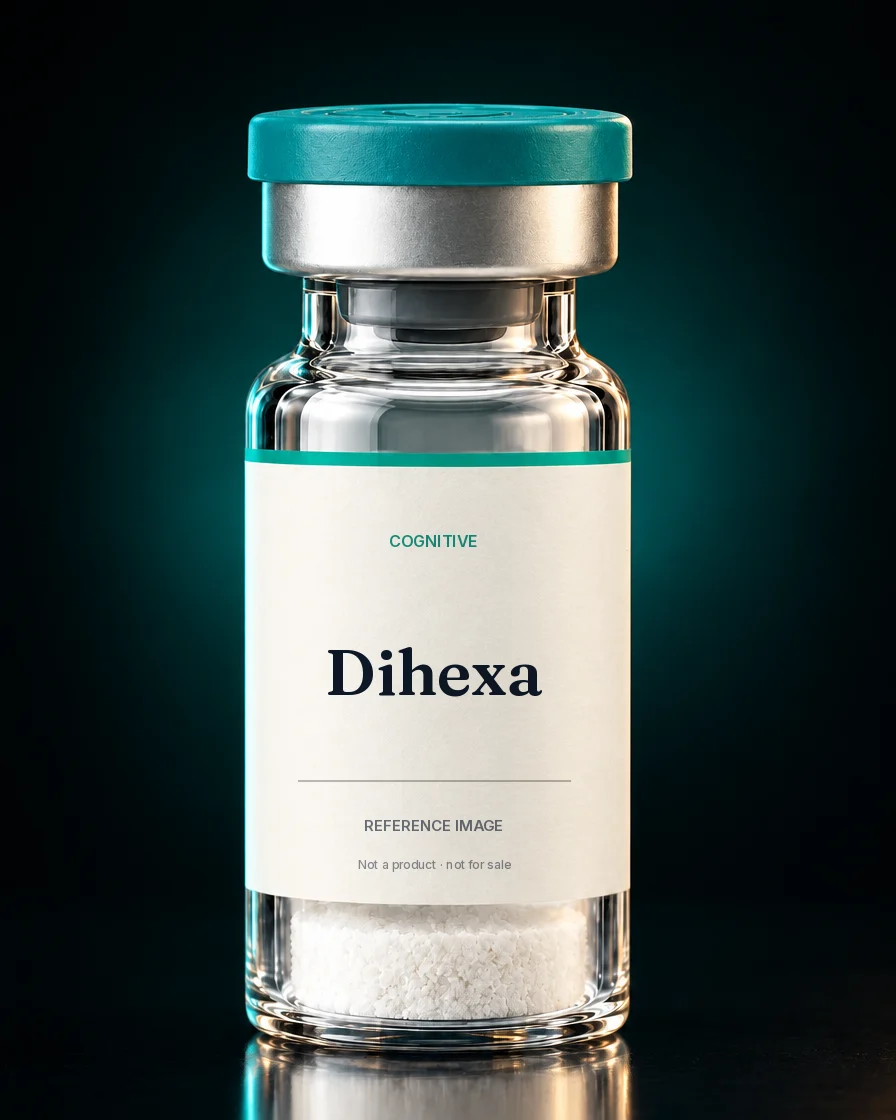
 Cognitive · Dosing reference
Dihexa dosage
What the human evidence does and does not show, how long studies ran, and the arithmetic for working with vials.
- Regulatory status
- Not approved — research use only
- Human amounts
- None established in humans
- Route studied
- —
- Frequency
- Not established
- Half-life
- Not established
- Evidence grade
- Grade C · Preclinical research
- Vial sizes on the market
- Not recorded
- Other forms seen
- Capsules 5 mg (60 count, 300 mg total)
What Dihexa is
A small angiotensin IV-derived peptide analog investigated in animal and cell models of synaptic connectivity and neurotrophic signaling.
Angiotensin IV and related peptides have long been described as procognitive in animal models, with development limited by metabolic instability and poor gut and blood-brain-barrier permeability 1,6. A 2013 paper reported that the structural information required for the procognitive activity of norleucine1-angiotensin IV resides in its three N-terminal residues Nle-Tyr-Ile, and that N- and C-terminal modification… How it works →
Key evidence
- McCoy et al., Journal of Pharmacology and Experimental Therapeutics (Expression of Concern published 2021) · 2013 · Animals (rodents)N- and C-terminal modification of the angiotensin IV tripeptide Nle-Tyr-Ile produced an orally active, blood-brain-barrier-permeant compound that reversed scopolamine-induced water maze deficits; the journal published an Expression of Concern about this paper in 2021. 1
- Benoist et al., Journal of Pharmacology and Experimental Therapeutics - RETRACTED · 2014 · Cells and animalsThis paper reported that the procognitive and synaptogenic effects of angiotensin IV-derived peptides depend on HGF/c-Met activation. It received an Expression of Concern in 2021 and was retracted in 2025, so it cannot support the mechanism. 2
- Uribe et al., Frontiers in Cellular Neuroscience · 2015 · Animals (larval zebrafish lateral line)Dihexa was reported to protect lateral line hair cells from aminoglycoside toxicity, with an optimal protective concentration identified; the paper describes Dihexa as acting by dimerising with endogenous HGF, a premise taken from work later retracted. 4
What the human evidence shows
We searched PubMed and ClinicalTrials.gov and found no human studies that administered Dihexa. The research described on its page is from cells or animals, and animal amounts do not translate to people.
How long did human studies run?
No human study durations are recorded for Dihexa.
Cycle-length evidence for DihexaDihexa draw calculator
Pick the vial strength and the water added, enter an amount, and see the concentration, the units to draw and how many draws the vial holds. Arithmetic only.
Computed from your inputs. Not a dose or a recommendation.
Compare water volumes for this vialShow
More water = lower concentration = a larger, easier-to-measure draw. Tap a row to use it.
| Water | mg/mL | Draw |
|---|---|---|
| 0.5 mL | 20 | — |
| 1 mL | 10 | — |
| 1.5 mL | 6.667 | — |
| 2 mL | 5 | — |
| 2.5 mL | 4 | — |
| 3 mL | 3.333 | — |
| 5 mL | 2 | — |
Supplies and handling
- Lyophilized vialSealed vial with the freeze-dried cake. Check the label, lot and the certificate of analysis before opening.
- Sterile diluentThe diluent named on the product documentation. Bacteriostatic water contains benzyl alcohol; sterile water does not.
- Graduated syringesSized to the volume being measured. U-100 insulin syringes are graduated in units where 100 units = 1 mL.
- Alcohol prep padsFor wiping vial stoppers before each puncture.
- Nitrile glovesClean gloves for aseptic handling.
- Sharps containerPuncture-resistant container for used needles.
Storage
General research-context handling only. Lipophilic small molecules of this type are typically stored as a dry solid, frozen, protected from light and moisture, with stock solutions in organic solvent treated as short-lived and freeze-thaw cycling minimised. Defer to the supplier's documentation for the specific lot. No temperatures, concentrations, volumes or preparation steps are given here, and nothing in this section is an administration instruction.
- Lyophilized (unmixed) vials: typically stored cold and dry, away from light, as the documentation directs. Many are stable longer frozen.
- Reconstituted vials: typically refrigerated (about 2–8 °C), protected from light and not frozen.
- Bacteriostatic water contains benzyl alcohol, which inhibits bacterial growth in multi-use vials; sterile water has no preservative.
Handling mistakes and troubleshooting
- Added the wrong volume of diluent
- The concentration changes, not the amount of compound in the vial. Recalculate with the volume actually added and relabel the vial.
- Shook the vial and it foamed
- Let it settle in the refrigerator. Foam is a sign of agitation; some peptides aggregate when shaken. Note it on the label.
- The solution is cloudy or has particles
- Do not use it. Cloudiness can indicate incomplete dissolution, contamination or degradation. Record the lot and contact the supplier with the certificate of analysis.
- The powder cake looks melted or shrunken before reconstitution
- This can indicate the vial was exposed to heat or moisture. Record the lot and condition on arrival.
- Liquid sprayed back when the needle was removed
- Pressure built up in the vial. Withdraw a small volume of air while adding diluent to keep pressure neutral.
Regulatory status
- Status
- Dihexa is not approved by the FDA for any use, has no openFDA drug label, and does not appear in any of the three categories of FDA's 503A bulk drug substances list as updated May 14, 2026 13. No registered clinical trial of Dihexa, PNB-0408 or ATH-1001 was identified on ClinicalTrials.gov 14. Readers should note that two foundational papers in this literature have been formally flagged: the 2013 design paper carries a 2021 Expression of Concern 1, and the 2014 paper that established the HGF/c-Met mechanism was retracted in 2025 2,3.
- United States (FDA)
- Dihexa has no approved FDA application and no openFDA drug label. It does not appear in any of the three categories of FDA's 503A bulk drug substances list (Category 1 under evaluation, Category 2 raising significant safety concerns, Category 3 nominated without adequate support) as updated May 14, 2026 13.
- Sport (WADA)
- Dihexa is not named in the WADA 2026 Prohibited List, and neither angiotensin nor c-Met appears in it 15. Hepatocyte growth factor itself is named, under S2.3 Growth Factors and Growth Factor Modulators, whose list is prefaced "Including, but not limited to" and closes with "and other growth factors or growth factor modulators affecting muscle, tendon or ligament protein synthesis/degradation, vascularisation, energy utilization, regenerative capacity or fibre type switching"; the S2 class as a whole is introduced with "The following substances, and other substances with similar chemical structure or similar biological effect(s), are prohibited" 15. Separately, S0 Non-Approved Substances provides that "Any pharmacological substance which is not addressed by any of the subsequent sections of the List and with no current approval by any governmental regulatory health authority for human therapeutic use (e.g. drugs under pre-clinical or clinical development or discontinued, designer drugs, substances approved only for veterinary use) is prohibited at all times" 15. A compound presented as a hepatocyte growth factor modulator therefore cannot be assumed permitted merely because its own name is absent; athletes should obtain a ruling from their anti-doping organisation.
Status varies by country and changes over time. How we describe regulatory status.
Dihexa compared with related compounds
| Compound | Status | Evidence | Human amounts | Half-life |
|---|---|---|---|---|
| Dihexa | Not approved — research use only | C | None established | — |
| PEA | Not approved — research use only | A | None established | — |
| Cerebrolysin | Approved outside the US | A | Ex-US label | Not directly measurable (peptide mixture |
| Selank | Approved outside the US | B | None established | — |
| Semax | Approved outside the US | B | None established | — |
| DSIP | Not approved — research use only | B | None established | — |
Frequently asked questions
What doses of Dihexa have been studied in humans?
Is there an established Dihexa cycle length?
How much bacteriostatic water should be added to a Dihexa vial?
How many units is a given amount on an insulin syringe?
Is Dihexa FDA-approved?
References
- Evaluation of metabolically stabilized angiotensin IV analogs as procognitive/antidementia agents (Expression of Concern: J Pharmacol Exp Ther 2021;378:313) Journal of Pharmacology and Experimental Therapeutics. 2013
- RETRACTED: The procognitive and synaptogenic effects of angiotensin IV-derived peptides are dependent on activation of the hepatocyte growth factor/c-Met system Journal of Pharmacology and Experimental Therapeutics. 2014
- Retraction notice to "The Procognitive and Synaptogenic Effects of Angiotensin IV-Derived Peptides Are Dependent on Activation of the Hepatocyte Growth Factor/c-Met System" [J Pharmacol Exp Ther 351 (2014) 390-402] Journal of Pharmacology and Experimental Therapeutics. 2025
- Hepatocyte growth factor mimetic protects lateral line hair cells from aminoglycoside exposure Frontiers in Cellular Neuroscience. 2015
- The Brain Hepatocyte Growth Factor/c-Met Receptor System: A New Target for the Treatment of Alzheimer's Disease Journal of Alzheimer's Disease. 2015
- The development of small molecule angiotensin IV analogs to treat Alzheimer's and Parkinson's diseases Progress in Neurobiology. 2015
- Cognitive benefits of angiotensin IV and angiotensin-(1-7): A systematic review of experimental studies Neuroscience & Biobehavioral Reviews. 2018
- AngIV-Analog Dihexa Rescues Cognitive Impairment and Recovers Memory in the APP/PS1 Mouse via the PI3K/AKT Signaling Pathway Brain Sciences. 2021
- Stem cell, Granulocyte-Colony Stimulating Factor and/or Dihexa to promote limb function recovery in a rat sciatic nerve damage-repair model: Experimental animal studies Annals of Medicine and Surgery. 2021
- Effects of an Angiotensin IV Analog on 3-Nitropropionic Acid-Induced Huntington's Disease-Like Symptoms in Rats Journal of Huntington's Disease. 2024
- Dihexa (CID 129010512): compound summary, synonyms (PNB-0408, ATH-1001) and computed properties PubChem. 2026
- Therapeutic Peptides in Orthopaedics: Applications, Challenges, and Future Directions JAAOS Global Research & Reviews. 2026
- Bulk Drug Substances Nominated for Use in Compounding Under Section 503A of the Federal Food, Drug, and Cosmetic Act (updated May 14, 2026) FDA. 2026
- ClinicalTrials.gov search for Dihexa, PNB-0408 and ATH-1001 (no registered studies identified) ClinicalTrials.gov. 2026
- World Anti-Doping Code International Standard Prohibited List 2026 WADA. 2026
Last reviewed October 22, 2026 by the Amiravo editorial team. Editorial policy · Report an error