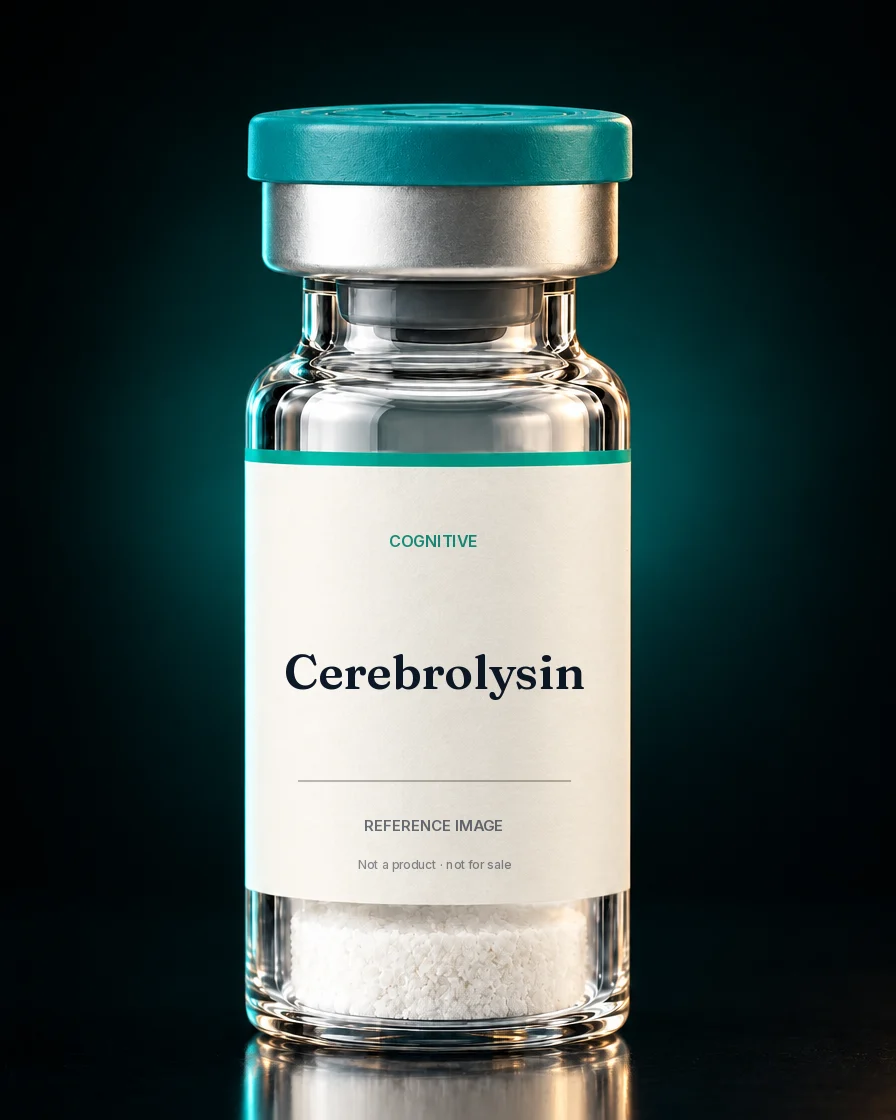
 Cognitive · Dosing reference
Cerebrolysin dosage
Dosing as quoted from non-US labeling, study durations and vial arithmetic.
- Regulatory status
- Approved outside the US
- Human amounts
- Austrian label: 10 to 50 mL daily depending on indication; trials used 10 to 60 mL per administration
- Route studied
- Intravenous infusion or injection; intramuscular up to 5 mL (Austrian label)
- Frequency
- Daily courses of 7 to 30 days; dementia cycles 5 administrations per week for 4 weeks (Austrian label)
- Half-life
- Not directly measurable (peptide mixture)
- Evidence grade
- Grade A · Human trial evidence
- Vial sizes on the market
- 60 mg
- Other forms seen
- Liquid ampoules/vials 215.2 mg/mL (clinical product)
What Cerebrolysin is
Cerebrolysin is a porcine brain-derived preparation of low-molecular-weight peptides and amino acids given by intravenous infusion or injection. It is authorised in Austria and used in Russia, Eastern Europe, China and other Asian countries for supportive treatment after stroke and head injury and in dementia, but it is not approved by the FDA. Randomized trials and Cochrane reviews report mixed results, including no clear effect on death after acute ischaemic stroke; this entry summarizes them for research reference only.
Cerebrolysin is described as a mixture of low-molecular-weight peptides and amino acids derived from porcine brain with potential neuroprotective properties 3, and as a preparation said to have neurotrophic and neuroprotective activity 4. Pharmacology The Austrian SmPC states that direct pharmacokinetic measurement is not possible because the product is a mixture of short-chain peptides similar or identical to… How it works →
Key evidence
- Ziganshina et al., Cochrane Database Syst Rev (acute ischaemic stroke) · 2023 · Humans (adults with acute ischaemic stroke)
- Heiss et al., Stroke (CASTA) · 2012 · Humans (patients with acute ischaemic hemispheric stroke in Asia)
- Muresanu et al., Stroke (CARS) · 2016 · Humans (patients after ischaemic stroke in early rehabilitation)
Dosing as stated on non-US labeling
- Austrian SmPC (Zulassungsnummer 1-21380, March 2021) posology: daily doses of 10 to 30 mL for 4 weeks in dementia; 20 to 50 mL for 10 to 21 days in ischaemic stroke; 30 to 50 mL for 10 to 21 days in haemorrhagic stroke; 20 to 50 mL for 7 to 30 days in craniocerebral trauma; given intramuscularly (up to 5 mL), intravenously (up to 10 mL) or, from 10 mL, by slow infusion after dilution; one treatment cycle is 4 weeks with 5 administrations per week, and in dementia cycles may be repeated after 2 months 1. Not recommended under 18 years 1.
- In CASTA (NCT00868283), patients with acute ischaemic stroke were randomized within 12 hours of onset to Cerebrolysin 30 mL daily or saline placebo by intravenous infusion for 10 days, in addition to aspirin 100 mg daily, with 90-day follow-up 6.
- In CARS, patients received Cerebrolysin 30 mL/day or saline placebo once daily for 21 days, starting 24 to 72 hours after stroke onset, alongside a standardized 21-day rehabilitation programme 5.
- In the Alzheimer's disease trial, 279 patients received intravenous infusions of Cerebrolysin 10, 30 or 60 mL or placebo 5 days per week for 4 weeks, then two infusions per week for 8 weeks, with assessment to week 24 7.
- In CAPTAIN I, patients with traumatic brain injury received 50 mL of Cerebrolysin or saline daily for 10 days, followed by two further treatment cycles of 10 mL daily for 10 days, added to standard care 8.
How long did human studies run?
- Austrian label: courses of 4 weeks in dementia (repeatable after 2 months), 10 to 21 days after stroke, 7 to 30 days after head trauma 1.
- Trials: 10 days (CASTA), 21 days (CARS), 12 weeks of infusions with assessment to 24 weeks (Alzheimer's disease) 5,6,7.
Who was excluded from the studies
Side effects reported in studies
- Non-fatal serious adverse eventsRR 2.39 (95% CI 1.10 to 5.23) vs placebo; RR 2.87 in the subgroup with 10-day courses · Acute ischaemic stroke, 3 trials, 1,335 participants (Cochrane) 3
- Any adverse eventRR 1.03 (95% CI 0.92 to 1.14) vs placebo · Acute ischaemic stroke, 4 trials, 1,607 participants (Cochrane) 3
- Allergic or hypersensitivity reactions (skin and local vascular reactions, fever, dyspnoea, chills, shock-like states)Very rare (label category) · Austrian SmPC 1
- Isolated grand mal seizuresVery rare (label category) · Austrian SmPC 1
- Palpitations or arrhythmia with rapid administrationVery rare (label category) · Austrian SmPC 1
- Agitation, insomnia or confusion; dizziness, warmth, sweating or itching with rapid administration; loss of appetiteRare (label category) · Austrian SmPC 1
Cerebrolysin draw calculator
Pick the vial strength and the water added, enter an amount, and see the concentration, the units to draw and how many draws the vial holds. Arithmetic only.
Computed from your inputs. Not a dose or a recommendation.
Compare water volumes for this vialShow
More water = lower concentration = a larger, easier-to-measure draw. Tap a row to use it.
| Water | mg/mL | Draw |
|---|---|---|
| 0.5 mL | 120 | — |
| 1 mL | 60 | — |
| 1.5 mL | 40 | — |
| 2 mL | 30 | — |
| 2.5 mL | 24 | — |
| 3 mL | 20 | — |
| 5 mL | 12 | — |
Supplies and handling
- Lyophilized vialSealed vial with the freeze-dried cake. Check the label, lot and the certificate of analysis before opening.
- Sterile diluentThe diluent named on the product documentation. Bacteriostatic water contains benzyl alcohol; sterile water does not.
- Graduated syringesSized to the volume being measured. U-100 insulin syringes are graduated in units where 100 units = 1 mL.
- Alcohol prep padsFor wiping vial stoppers before each puncture.
- Nitrile glovesClean gloves for aseptic handling.
- Sharps containerPuncture-resistant container for used needles.
Storage
The Austrian SmPC states: store below 25 degrees C, do not refrigerate or freeze, and keep in the original packaging to protect from light 1.
- Lyophilized (unmixed) vials: typically stored cold and dry, away from light, as the documentation directs. Many are stable longer frozen.
- Reconstituted vials: typically refrigerated (about 2–8 °C), protected from light and not frozen.
- Bacteriostatic water contains benzyl alcohol, which inhibits bacterial growth in multi-use vials; sterile water has no preservative.
Handling mistakes and troubleshooting
- Added the wrong volume of diluent
- The concentration changes, not the amount of compound in the vial. Recalculate with the volume actually added and relabel the vial.
- Shook the vial and it foamed
- Let it settle in the refrigerator. Foam is a sign of agitation; some peptides aggregate when shaken. Note it on the label.
- The solution is cloudy or has particles
- Do not use it. Cloudiness can indicate incomplete dissolution, contamination or degradation. Record the lot and contact the supplier with the certificate of analysis.
- The powder cake looks melted or shrunken before reconstitution
- This can indicate the vial was exposed to heat or moisture. Record the lot and condition on arrival.
- Liquid sprayed back when the needle was removed
- Pressure built up in the vial. Withdraw a small volume of air while adding diluent to keep pressure neutral.
Regulatory status
- Status
- Authorised in Austria (Zulassungsnummer 1-21380, EVER Neuro Pharma GmbH) as a prescription-only parenteral solution for supportive treatment of cerebrovascular disorders, including Alzheimer-type senile dementia, vascular dementia, post-stroke deficits and craniocerebral trauma, in adults and patients over 65 1. A 2023 Cochrane review states that it is widely used for acute ischaemic stroke in Russia, Eastern Europe, China and other Asian and post-Soviet countries 3. Not approved by the FDA; an openFDA query returned no application record 9.
Status varies by country and changes over time. How we describe regulatory status.
Cerebrolysin compared with related compounds
| Compound | Status | Evidence | Human amounts | Half-life |
|---|---|---|---|---|
| Cerebrolysin | Approved outside the US | A | Ex-US label | Not directly measurable (peptide mixture |
| Semax | Approved outside the US | B | None established | — |
| Selank | Approved outside the US | B | None established | — |
| Dihexa | Not approved — research use only | C | None established | — |
| DSIP | Not approved — research use only | B | None established | — |
| Oxytocin | FDA-approved | A | FDA label | The Pitocin label states a plasma half-l |
Frequently asked questions
What doses of Cerebrolysin have been studied in humans?
Is there an established Cerebrolysin cycle length?
How much bacteriostatic water should be added to a Cerebrolysin vial?
How many units is a given amount on an insulin syringe?
What is the half-life of Cerebrolysin?
Is Cerebrolysin FDA-approved?
References
- Cerebrolysin parenterale Loesung, Fachinformation (summary of product characteristics), Zulassungsnummer 1-21380, EVER Neuro Pharma GmbH, Stand Maerz 2021 BASG (Austrian Federal Office for Safety in Health Care). 2021
- Cerebrolysin parenterale Loesung, Gebrauchsinformation (patient leaflet), EVER Neuro Pharma GmbH, Stand Maerz 2021 BASG (Austrian Federal Office for Safety in Health Care). 2021
- Cerebrolysin for acute ischaemic stroke Cochrane Database Syst Rev. 2023
- Cerebrolysin for vascular dementia Cochrane Database Syst Rev. 2019
- Cerebrolysin and Recovery After Stroke (CARS): A Randomized, Placebo-Controlled, Double-Blind, Multicenter Trial Stroke. 2016
- Cerebrolysin in patients with acute ischemic stroke in Asia: results of a double-blind, placebo-controlled randomized trial Stroke. 2012
- A 24-week, double-blind, placebo-controlled study of three dosages of Cerebrolysin in patients with mild to moderate Alzheimer's disease Eur J Neurol. 2006
- Safety and efficacy of Cerebrolysin in acute brain injury and neurorecovery: CAPTAIN I-a randomized, placebo-controlled, double-blind, Asian-Pacific trial Neurol Sci. 2020
- Drugs@FDA application data queried through openFDA for cerebrolysin (no matching application record returned on 23 October 2026) openFDA / Drugs@FDA. 2026
- Bulk Drug Substances Nominated for Use in Compounding Under Section 503A of the FD&C Act (categories 1, 2 and 3; updated May 14, 2026) FDA. 2026
- International Standard: Prohibited List 2026 World Anti-Doping Agency. 2026
Last reviewed October 23, 2026 by the Amiravo editorial team. Editorial policy · Report an error