 Bioregulators · Dosing reference
Testagen dosage
What the human evidence does and does not show, how long studies ran, and the arithmetic for working with vials.
- Regulatory status
- Not approved — research use only
- Human amounts
- None established in humans
- Route studied
- —
- Frequency
- Not established
- Half-life
- Not established
- Evidence grade
- Grade D · Mechanistic only
- Vial sizes on the market
- 20 mg
- Other forms seen
- —
What Testagen is
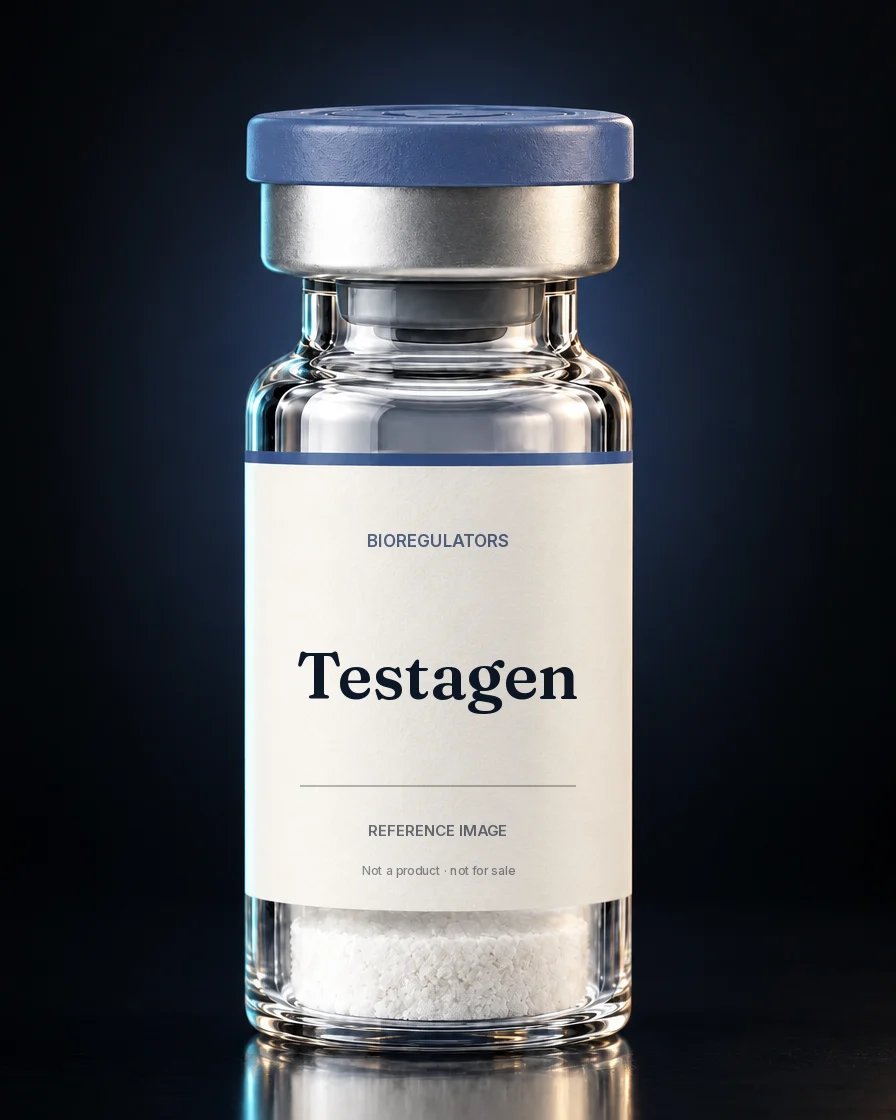
A short synthetic tetrapeptide of the Khavinson bioregulator class, studied in laboratory research on testicular tissue and gene expression.
No receptor, target or physiological mechanism for testagen has been established. The only mechanistic data identified are in vitro observations of cell entry and nucleic-acid interaction 1. What was actually measured In HeLa cells incubated with fluorescein-isothiocyanate-labelled peptides, including testagen, fluorescence was reported in the cytoplasm, nucleus and nucleolus, which the authors took as evidence… How it works →
Key evidence
- Fedoreyeva et al., Biochemistry (Moscow) · 2011 · HeLa cells and labelled oligonucleotides (in vitro)Labelled testagen was reported to reach the cytoplasm, nucleus and nucleolus of HeLa cells, and quenching constants indicated preferential interaction with CAG-containing oligonucleotide sequences. 1
- Dobritescu et al., Molecules · 2025 · Copper surfaces in sodium chloride solution (not a biological model)The tetrapeptide was reported to adsorb spontaneously on copper, fitting a Freundlich isotherm, with an inhibition efficiency of around 86% calculated from electrochemical measurements. 2
What the human evidence shows
We searched PubMed and ClinicalTrials.gov and found no human studies that administered Testagen. The research described on its page is from cells or animals, and animal amounts do not translate to people.
How long did human studies run?
No human study durations are recorded for Testagen.
Cycle-length evidence for TestagenTestagen draw calculator
Pick the vial strength and the water added, enter an amount, and see the concentration, the units to draw and how many draws the vial holds. Arithmetic only.
Computed from your inputs. Not a dose or a recommendation.
Compare water volumes for this vialShow
More water = lower concentration = a larger, easier-to-measure draw. Tap a row to use it.
| Water | mg/mL | Draw |
|---|---|---|
| 0.5 mL | 40 | — |
| 1 mL | 20 | — |
| 1.5 mL | 13.33 | — |
| 2 mL | 10 | — |
| 2.5 mL | 8 | — |
| 3 mL | 6.667 | — |
| 5 mL | 4 | — |
Supplies and handling
- Lyophilized vialSealed vial with the freeze-dried cake. Check the label, lot and the certificate of analysis before opening.
- Sterile diluentThe diluent named on the product documentation. Bacteriostatic water contains benzyl alcohol; sterile water does not.
- Graduated syringesSized to the volume being measured. U-100 insulin syringes are graduated in units where 100 units = 1 mL.
- Alcohol prep padsFor wiping vial stoppers before each puncture.
- Nitrile glovesClean gloves for aseptic handling.
- Sharps containerPuncture-resistant container for used needles.
Storage
General research-context handling only: lyophilised short peptides are normally kept cold, dry and protected from light, and reconstituted material is far less stable than the dry powder. Amiravo gives no preparation, reconstitution or handling instructions; defer to the supplier's own documentation and to local institutional requirements for research materials.
- Lyophilized (unmixed) vials: typically stored cold and dry, away from light, as the documentation directs. Many are stable longer frozen.
- Reconstituted vials: typically refrigerated (about 2–8 °C), protected from light and not frozen.
- Bacteriostatic water contains benzyl alcohol, which inhibits bacterial growth in multi-use vials; sterile water has no preservative.
Handling mistakes and troubleshooting
- Added the wrong volume of diluent
- The concentration changes, not the amount of compound in the vial. Recalculate with the volume actually added and relabel the vial.
- Shook the vial and it foamed
- Let it settle in the refrigerator. Foam is a sign of agitation; some peptides aggregate when shaken. Note it on the label.
- The solution is cloudy or has particles
- Do not use it. Cloudiness can indicate incomplete dissolution, contamination or degradation. Record the lot and contact the supplier with the certificate of analysis.
- The powder cake looks melted or shrunken before reconstitution
- This can indicate the vial was exposed to heat or moisture. Record the lot and condition on arrival.
- Liquid sprayed back when the needle was removed
- Pressure built up in the vial. Withdraw a small volume of air while adding diluent to keep pressure neutral.
Regulatory status
- Status
- Not approved by the FDA for any use; no approved application and no structured product label were identified 3,4.
- United States (FDA)
- No approved application for this substance was identified in Drugs@FDA, and no structured product label for it was identified in DailyMed 3,4. It does not appear in any of the three categories of FDA's 503A bulk drug substances list as updated May 14, 2026 (Category 1, substances under evaluation; Category 2, substances raising significant safety risks; Category 3, substances nominated without adequate support) 5.
- Sport (WADA)
- The substance is not named anywhere in the WADA 2026 Prohibited List 6. Absence of a name is not a clearance: several classes on the List are written as open categories using wording such as "including, but not limited to", and section S0 (Non-Approved Substances) is written to cover pharmacological substances that are not addressed elsewhere on the List and that have no current approval from a governmental health authority for human therapeutic use, a description that fits an unapproved research peptide 6. Whether any particular substance falls inside S0 or inside an open class is a determination for anti-doping authorities, not something that can be read off the absence of a name.
Status varies by country and changes over time. How we describe regulatory status.
Testagen compared with related compounds
| Compound | Status | Evidence | Human amounts | Half-life |
|---|---|---|---|---|
| Testagen | Not approved — research use only | D | None established | — |
| Vesugen | Not approved — research use only | C | None established | — |
| Pinealon | Not approved — research use only | C | None established | — |
| Prostamax | Not approved — research use only | D | None established | — |
| Bronchogen | Not approved — research use only | C | None established | — |
| Vilon | Not approved — research use only | C | None established | — |
Frequently asked questions
What doses of Testagen have been studied in humans?
Is there an established Testagen cycle length?
How much bacteriostatic water should be added to a Testagen vial?
How many units is a given amount on an insulin syringe?
References
- Penetration of short fluorescence-labeled peptides into the nucleus in HeLa cells and in vitro specific interaction of the peptides with deoxyribooligonucleotides and DNA Biochemistry (Mosc). 2011
- The Inhibitory Effect and Adsorption Properties of Testagen Peptide on Copper Surfaces in Saline Environments: An Experimental and Computational Study Molecules. 2025
- Drugs@FDA: FDA-Approved Drugs (search of approved applications) FDA Drugs@FDA / openFDA drug/drugsfda. 2026
- DailyMed label search (structured product labels) NLM DailyMed. 2026
- Bulk Drug Substances Nominated for Use in Compounding Under Section 503A of the FD&C Act, updated May 14, 2026 FDA. 2026
- World Anti-Doping Code International Standard: Prohibited List 2026 WADA. 2026
Last reviewed October 23, 2026 by the Amiravo editorial team. Editorial policy · Report an error