Exenatide
Also known as Byetta · Bydureon · Bydureon BCise · Exendin-4 · AC2993 · LY2148568
Exenatide is a synthetic 39-amino-acid GLP-1 receptor agonist originally identified in Gila monster venom, FDA-approved (initial U.S. approval 2005) as a twice-daily injection for glycemic control in adults with type 2 diabetes.
- US status
- FDA-approved
- Evidence
- Grade A
- Half-life
- Mean terminal half-life 2.4 hours after subcutaneous injection; concentrations measurable for about 10 hours post-dose in most individuals 1.
- Class
- GLP-1 receptor agonist (exendin-4 peptide)
More
Research reference, not advice. Label quotes, not a recommendation. Amiravo sells nothing; some links are referrals.Read the full notice
Key takeaways
- Exenatide is a synthetic exendin-4 peptide and GLP-1 receptor agonist approved for glycemic control in adults with type 2 diabetes 1,7.
- In a 30-week trial in metformin-treated adults, HbA1c changed by -0.78% (10 micrograms twice daily) versus +0.08% with placebo 4.
- Once-weekly exenatide was noninferior but not superior to placebo for cardiovascular events in EXSCEL 5.
- Labeled contraindications include prior severe hypersensitivity and a history of drug-induced immune-mediated thrombocytopenia from exenatide products 1.
- Brand products are listed as discontinued in Drugs@FDA; a generic label remains on DailyMed 2,3.
Development stage
Where Exenatide sits between laboratory work and regulatory approval.
- PreclinicalAnimal and cell work
- Phase 1First human safety studies
- Phase 2Early efficacy signal
- Phase 3Confirmatory trials
- Approved (current)Cleared by a regulator
Stage comes from the regulatory record and ClinicalTrials.gov studies naming the compound (for compounds approved nowhere, only completed trials or trials with posted results count) (checked 2026-10-24). A registered trial is not a result.
Mechanism of action
Exenatide binds and activates the human GLP-1 receptor in vitro, increasing glucose-dependent insulin synthesis and secretion through cAMP and other intracellular pathways 1.
Pharmacodynamics
- It enhances glucose-dependent insulin secretion, suppresses inappropriately elevated glucagon secretion and slows gastric emptying 1.
Pharmacokinetics
After subcutaneous injection, median time to peak is 2.1 hours; clearance is 9.1 L/hour and terminal half-life 2.4 hours, mainly by glomerular filtration followed by proteolysis 1.
Origin
Exendin-4 was isolated from Heloderma suspectum venom in 1992 7.
Molecular structure
PubChem CID 45588096 ↗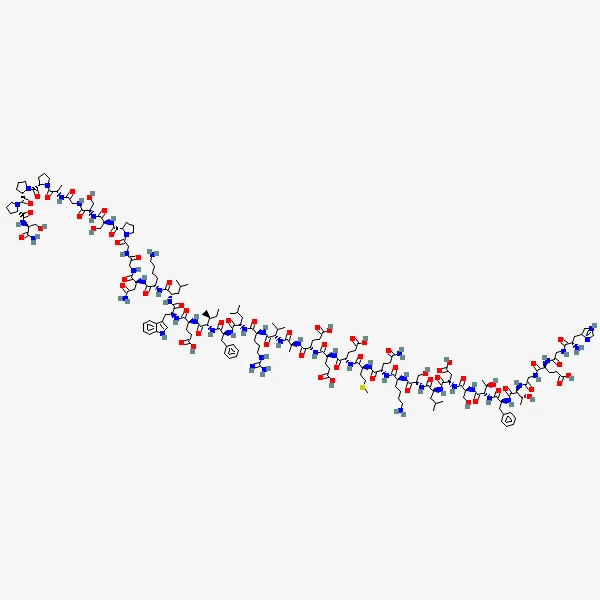
2D depiction generated from the PubChem record. Depictions are schematic and do not show salt form, counter-ions or conformation.
- Formula
- C184H282N50O60S
- Molecular weight
- 4186.6 g/mol
- CAS
- 141758-74-9
- InChIKey
- HTQBXNHDCUEHJF-XWLPCZSASA-N
Research overview
Human research
Randomized placebo-controlled trials in adults with type 2 diabetes (monotherapy and add-on to metformin, sulfonylurea, thiazolidinedione or insulin glargine) support the glycemic indication 1,4. EXSCEL tested the once-weekly formulation for cardiovascular outcomes 5, and a phase 3 Parkinson's disease trial found no difference from placebo 6. Effectiveness was not demonstrated in a 120-patient pediatric trial 1.
Animal research
In a 104-week rat study, benign thyroid C-cell adenomas were observed in female rats at all exenatide doses; no tumors were seen in a 104-week mouse study 1.
In-vitro research
Exenatide binds and activates the human GLP-1 receptor in vitro, and was not mutagenic or clastogenic in Ames and chromosomal aberration assays 1.
Dosing as stated on the FDA label
Quoted from the prescribing information for reference. Prescribing decisions belong to a licensed clinician; this is not a recommendation or instruction for use.
Full dosing reference, study durations and vial arithmetic →- Initiate at 5 micrograms subcutaneously twice daily at any time within the 60-minute period before the morning and evening meals (or before the two main meals of the day, about 6 hours or more apart); do not administer after a meal 1.
- Based on clinical response, the dose can be increased to 10 micrograms twice daily after 1 month of therapy, to reduce the risk of GI adverse reactions 1.
- Coadministration with other exenatide-containing products is not recommended. Administration instructions are set out in the label and are not reproduced here 1.
Background viewing
We haven't found a clinician video focused on Exenatide yet. Meanwhile, this widely watched talk covers the science of aging in general. It does not discuss Exenatide.
These creators are not affiliated with Amiravo and do not endorse Amiravo or any product linked on this site. Nothing here is medical advice. Video views counted on YouTube as of Oct 24, 2026.
Regulatory status
- Status
- FDA-approved (initial U.S. approval 2005). As of 2026-10-24, Drugs@FDA lists Byetta (NDA 021773), Bydureon (NDA 022200) and Bydureon BCise (NDA 209210) as discontinued, while a generic exenatide injection label (Amneal) was updated on DailyMed in 2026; the openFDA record lists that ANDA's marketing status as discontinued, so current U.S. availability should be confirmed 1,2,3.
- United States (FDA)
- FDA-approved (initial U.S. approval 2005). Drugs@FDA (openFDA, data updated 2026-10-23) lists Byetta, Bydureon and Bydureon BCise as discontinued; a generic exenatide injection label (Amneal, ANDA 206697) was updated on DailyMed in 2026 1,2,3.
- Sport (WADA)
- GLP-1 receptor agonists were not mentioned on the WADA 2026 Prohibited List page reviewed 8.
Status varies by country and changes over time. How we describe regulatory status.
Quality and testing notes
A certificate of analysis for exenatide material would be expected to show HPLC purity, identity by mass spectrometry against the label's molecular weight of 4186.6 Da, the C-terminal amide, acetate and net peptide content, and endotoxin level [1, 9].
How purity testing works · Reading a certificate of analysis
Check a Exenatide certificate of analysis against its expected mass (4,186.6 Da)Storage and handling
Follow the current label for approved products; peptide solutions of this kind are generally refrigerated and protected from light. Research materials should be handled per the supplier's documentation.
Frequently asked questions
What is exenatide?
What is it approved for?
Is Byetta still marketed?
Did exenatide reduce cardiovascular events?
Has it been tested in Parkinson's disease?
What are the most common adverse reactions?
How long does it last?
Latest indexed research
- Occult Abdominal Para-Aortic Ectopic Insulinoma Localized by 18F-NOTA-Exendin-4 PET/CT.Other · Clinical nuclear medicine · 2026-10-20
- Efficacy of low-dose pioglitazone in combination with exenatide on glucose control in patients with T2DM.Other · BMJ open diabetes research & care · 2026-10-13
- A Dicyanocobinamide Conjugate of the GLP-1R Agonist Exendin-4 Improves Glucose Homeostasis in Tumor-Bearing Rats without Exacerbating Anorexia and Weight Loss.Other · humans · Molecular pharmaceutics · 2026-10-05
- Harmine Plus Exendin-4 Enhances Remission of Recent-Onset Type 1 Diabetes Following Anti-CD3 Therapy.Other · bioRxiv : the preprint server for biology · 2026-09-22
Listed by publication type from the index record. Inclusion is not an endorsement; open the source to read the findings.
Revision history
Meaningful changes to this entry, with dates and sources. Last reviewed Oct 24, 2026. Typo and layout fixes are not listed.
- New section· entryOct 24, 2026
New research reference added: Exenatide.
References
- BYETTA (exenatide) injection, for subcutaneous use, prescribing information (DailyMed, effective 09/2025) FDA label (DailyMed). 2025
- Exenatide injection (Amneal), prescribing information (DailyMed, effective 05/2026) FDA label (DailyMed). 2026
- Drugs@FDA (openFDA) application records for exenatide (NDA 021773, NDA 022200, NDA 209210, ANDA 206697) U.S. FDA. 2026
- Effects of exenatide (exendin-4) on glycemic control and weight over 30 weeks in metformin-treated patients with type 2 diabetes Diabetes Care. 2005
- Effects of Once-Weekly Exenatide on Cardiovascular Outcomes in Type 2 Diabetes (EXSCEL) N Engl J Med. 2017
- Exenatide once a week versus placebo as a potential disease-modifying treatment for people with Parkinson's disease in the UK: a phase 3, multicentre, double-blind, parallel-group, randomised, placebo-controlled trial Lancet. 2025
- Isolation and characterization of exendin-4, an exendin-3 analogue, from Heloderma suspectum venom J Biol Chem. 1992
- World Anti-Doping Agency Prohibited List 2026 (online version) WADA. 2026
- PubChem compound record for exenatide PubChem. 2026
Last reviewed October 24, 2026 by the Amiravo editorial team.
Need the math?
Laboratory arithmetic with every formula shown.
For research use only. Not for human or veterinary use. Not a drug, food, or dietary supplement. This page is educational and is not medical advice.
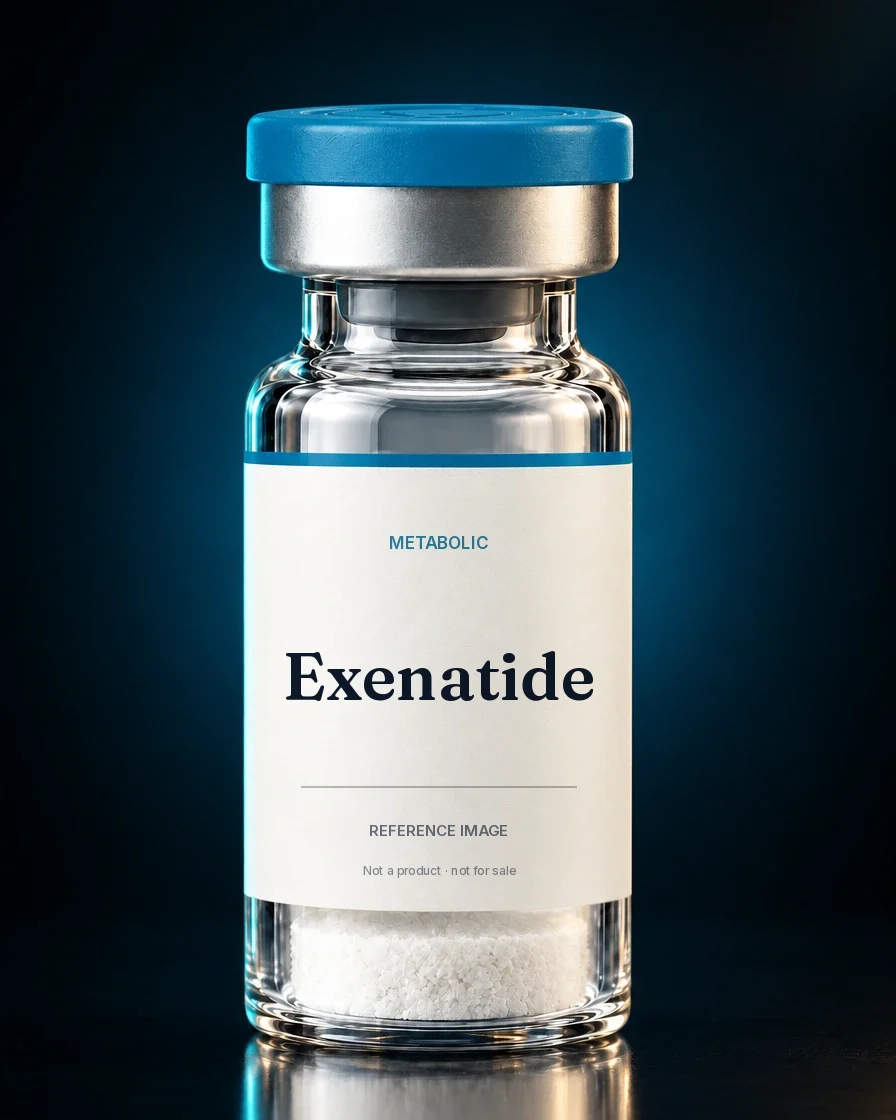
Unbranded reference image. Amiravo does not produce, supply or sell this compound.
Specifications
- Molecular formula
- C184H282N50O60S
- Molecular weight
- 4,186.6 g/mol
- CAS number
- 141758-74-9
- PubChem CID
- 45588096
- FDA UNII
- 9P1872D4OL
- Sequence
- His-
Gly- Glu- Gly- Thr- Phe- Thr- Ser- Asp- Leu- Ser- Lys- Gln- Met- Glu- Glu- Glu- Ala- Val- Arg- Leu- Phe- Ile- Glu- Trp- Leu- Lys- Asn- Gly- Gly- Pro- Ser- Ser- Gly- Ala- Pro- Pro- Pro- Ser- NH2 - Type
- Single compound
Identifiers from PubChem. Verify against the supplier’s documentation for your lot.
Research stats
How much has been published, not how good it is.
- PubMed records
- 4,916
- Indexed as human research
- 2,665
- Animal-only research
- 1,385
- Randomized controlled trials
- 392
- Registered trials
- 379
- Trials with posted results
- 128
- FDA adverse-event reports (FAERS)
- 4,948
- NIH-funded projects naming it
- 676
Counts from title/abstract searches of PubMed, ClinicalTrials.gov, openFDA and NIH RePORTER, checked 2026-10-24. Names shared with other substances can inflate counts. FAERS reports are spontaneous and do not establish cause. Funding shows interest, not evidence. Method
Follow Exenatide
See every new citation, evidence-grade or status change and correction in My Research, with optional email alerts. Free account.