Tesofensine
Also known as NS2330 · NS-2330 · Tesomet (fixed combination with metoprolol)
Tesofensine is an investigational small-molecule inhibitor of noradrenaline, dopamine and serotonin reuptake, not a peptide, originally developed for Parkinson's and Alzheimer's disease and then studied for obesity. A 24-week phase 2 obesity trial reported dose-related body-weight change with increases in heart rate, and that trial report later received an expression of concern from The Lancet. It is not FDA-approved and is named as a prohibited stimulant by WADA; this entry is for research reference only.
- US status
- Investigational
- Evidence
- Grade B
- Half-life
- About 234 hours (M1 metabolite about 374 hours), population PK in Alzheimer patients 8
- Class
- Small molecule (not a peptide); triple monoamine (noradrenaline, dopamine, serotonin) reuptake inhibitor; phenyltropane
More
Research reference, not advice. Study facts, not instructions. Amiravo sells nothing; some links are referrals.Read the full notice
Key takeaways
- Tesofensine is an investigational small molecule that inhibits presynaptic reuptake of noradrenaline, dopamine and serotonin; it is not a peptide and not FDA-approved 1,10.
- In a 24-week phase 2 trial in 203 adults with obesity on an energy-restricted diet, mean weight loss was 4.5%, 9.2% and 10.6% across three doses versus 2.0% with placebo 1.
- Heart rate rose by 7.4 beats per minute with the 0.5 mg dose in that trial, and by up to 6.8 beats per minute in pooled Parkinson's and Alzheimer's trials 1,4.
- The Lancet published an expression of concern about the phase 2 obesity report in 2013, followed by correspondence titled 'Under-reporting of adverse effects of tesofensine' 2,3.
- WADA's 2026 List names tesofensine among specified stimulants (S6.B) 13.
Development stage
Where Tesofensine sits between laboratory work and regulatory approval.
- PreclinicalAnimal and cell work
- Phase 1First human safety studies
- Phase 2 (current)Early efficacy signal
- Phase 3Confirmatory trials
- ApprovedCleared by a regulator
Stage comes from the regulatory record and ClinicalTrials.gov studies naming the compound (for compounds approved nowhere, only completed trials or trials with posted results count) (checked 2026-10-24). A registered trial is not a result.
Mechanism of action
Tesofensine inhibits presynaptic reuptake of noradrenaline, dopamine and serotonin 1.
Pharmacokinetics
A population model from 320 patients with Alzheimer's disease described low apparent clearance and large apparent volumes of distribution, giving half-lives of about 234 hours for tesofensine and 374 hours for its main metabolite M1; creatinine clearance and sex had the largest effects on steady-state exposure 8.
Abuse-liability testing
In recreational stimulant users, single doses of tesofensine produced subjective effects not different from placebo and lower than d-amphetamine on primary measures 7.
Molecular structure
PubChem CID 11370864 ↗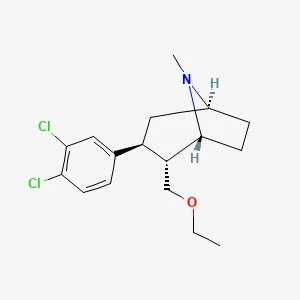
2D depiction generated from the PubChem record. Depictions are schematic and do not show salt form, counter-ions or conformation.
- Formula
- C17H23Cl2NO
- Molecular weight
- 328.3 g/mol
- CAS
- 195875-84-4
- InChIKey
- VCVWXKKWDOJNIT-ZOMKSWQUSA-N
Doses used in published trials
What investigators administered in the cited studies, recorded as a fact about those studies. Not a protocol and not a recommendation.
Full dosing reference, study durations and vial arithmetic →- In the phase 2 obesity trial (NCT00394667), after a 2-week run-in, 203 adults on an energy-restricted diet were randomized to tesofensine 0.25 mg, 0.5 mg or 1.0 mg, or placebo, once daily for 24 weeks 1.
- In the four pooled Parkinson's and Alzheimer's trials, patients received oral tesofensine 0.125, 0.25, 0.5 or 1.0 mg or placebo once daily for 14 weeks without a weight-loss programme 4.
- In ADVANS (NCT00148512), patients with advanced Parkinson's disease received tesofensine 0.125, 0.25, 0.5 or 1 mg or placebo tablets once daily for 14 weeks 5.
- In the hypothalamic obesity trial, 21 adults were randomized to Tesomet (tesofensine 0.5 mg with metoprolol 50 mg) or placebo for 24 weeks with diet and lifestyle counselling 6.
- In NCT02737891, 60 adults with type 2 diabetes received oral tesofensine 0.5 mg plus metoprolol 100 mg or matching placebo; outcomes were assessed from baseline to day 90 9.
Tesofensine draw calculator
Pick the vial strength and how much water is added, then enter an amount to see the units to draw. Arithmetic only, not a recommendation.
Computed from your inputs. Not a dose or a recommendation.
Compare water volumes for this vialShow
More water = lower concentration = a larger, easier-to-measure draw. Tap a row to use it.
| Water | mg/mL | Draw |
|---|---|---|
| 0.5 mL | 20 | — |
| 1 mL | 10 | — |
| 1.5 mL | 6.667 | — |
| 2 mL | 5 | — |
| 2.5 mL | 4 | — |
| 3 mL | 3.333 | — |
| 5 mL | 2 | — |
Background viewing
We haven't found a clinician video focused on Tesofensine yet. Meanwhile, this widely watched talk covers the science of aging in general. It does not discuss Tesofensine.
These creators are not affiliated with Amiravo and do not endorse Amiravo or any product linked on this site. Nothing here is medical advice. Video views counted on YouTube as of Oct 24, 2026.
Regulatory status
- Status
- Not approved by the FDA; an openFDA Drugs@FDA query returned no application record 10. Phase 2 trials have been completed and registered on ClinicalTrials.gov, including Tesomet trials with posted results 9. No phase 3 results or national approvals were confirmed in the allowed sources reviewed.
- United States (FDA)
- Not approved; an openFDA Drugs@FDA query for tesofensine returned no application record 10. Tesofensine does not appear in any category of FDA's May 14, 2026 503A bulk drug substances list 11.
- Sport (WADA)
- Prohibited in competition. Tesofensine is named in section S6.B, specified stimulants, of the WADA 2026 Prohibited List 13.
Status varies by country and changes over time. How we describe regulatory status.
Quality and testing notes
This is a small molecule, not a peptide. Appropriate characterisation includes identity by mass spectrometry and NMR against the PubChem structure (C17H23Cl2NO, molecular weight 328.3, defined (1R,2R,3S,5S) stereochemistry), chiral purity, HPLC purity with chromatogram, salt form (for example citrate), residual solvents and water content [12]. Stereoisomeric purity matters because the compound has four stereocentres.
How purity testing works · Reading a certificate of analysis
Check a Tesofensine certificate of analysis against its expected mass (328.3 Da)Storage and handling
No approved-product storage instructions exist. Research material should be handled according to the supplier's documentation.
Frequently asked questions
Is tesofensine a peptide?
Is tesofensine FDA-approved?
How does it work?
What weight change was reported?
Why is there an expression of concern?
Is it banned in sport?
What is its half-life?
Latest indexed research
No new studies were filed in the last sweep.
Search all studies on Tesofensine (PubMed, Europe PMC, ClinicalTrials.gov)Listed by publication type from the index record. Inclusion is not an endorsement; open the source to read the findings.
Revision history
Meaningful changes to this entry, with dates and sources. Last reviewed Oct 23, 2026. Typo and layout fixes are not listed.
- Correction· regulatory.wadaOct 24, 2026
WADA class corrected: tesofensine is listed under S6.B (specified stimulants), not S6.A.
Source: WADA 2026 Prohibited List (Tractatenblad 2026, 25) - New section· Schedules by time periodOct 23, 2026
Added week-by-week schedules from registered trials (1 group, 3 arms).
Source: Effect of tesofensine on bodyweight loss, body composition, and quality of life in obese patients: a randomised, double-blind, placebo-controlled trial - Correction· Quick reference: half-lifeOct 23, 2026
Re-cited the half-life to the population pharmacokinetic study that measured it (Alzheimer patients).
Source: PubMed 17324246
Last reviewed October 23, 2026 by the Amiravo editorial team.
Need the math?
Laboratory arithmetic with every formula shown.
For research use only. Not for human or veterinary use. Not a drug, food, or dietary supplement. This page is educational and is not medical advice.
Unbranded reference image. Amiravo does not produce, supply or sell this compound.
Specifications
- Molecular formula
- C17H23Cl2NO
- Molecular weight
- 328.3 g/mol
- CAS number
- 195875-84-4
- PubChem CID
- 11370864
- FDA UNII
- BLH9UKX9V1
- ChEMBL
- CHEMBL3989690
- DrugBank
- DB06156
- Format
- Lyophilized vial
- Other forms seen
- Oral tablets 0.5 mg (500 mcg)
- Type
- Single compound
Identifiers from PubChem. Verify against the supplier’s documentation for your lot.
Research stats
How much has been published, not how good it is.
- PubMed records
- 59
- Indexed as human research
- 47
- Animal-only research
- 9
- Randomized controlled trials
- 12
- Registered trials
- 14
- Trials with posted results
- 5
- FDA adverse-event reports (FAERS)
- 3
- NIH-funded projects naming it
- 1
Counts from title/abstract searches of PubMed, ClinicalTrials.gov, openFDA and NIH RePORTER, checked 2026-10-24. Names shared with other substances can inflate counts. FAERS reports are spontaneous and do not establish cause. Funding shows interest, not evidence. Method
Follow Tesofensine
See every new citation, evidence-grade or status change and correction in My Research, with optional email alerts. Free account.