Octreotide
Also known as Sandostatin · Sandostatin LAR Depot · Mycapssa · Bynfezia Pen · Octreotide acetate · SMS 201-995
Octreotide is a synthetic eight-residue somatostatin analog, FDA-approved since 1988 (Sandostatin, Sandostatin LAR Depot, and oral Mycapssa) for acromegaly and for diarrhea and flushing from carcinoid tumors and VIPomas.
- US status
- FDA-approved
- Evidence
- Grade A
- Half-life
- Apparent elimination half-life 1.7 to 1.9 hours after Sandostatin Injection (versus 1 to 3 minutes for natural somatostatin); increased about 46% in the elderly and prolonged in severe renal failure and cirrhosis 1.
- Class
- Synthetic somatostatin analog (cyclic octapeptide)
More
Research reference, not advice. Label quotes, not a recommendation. Amiravo sells nothing; some links are referrals.Read the full notice
Key takeaways
- Octreotide is a synthetic eight-residue somatostatin analog with a much longer half-life than somatostatin (1.7-1.9 hours versus 1-3 minutes) 1.
- FDA-approved uses are acromegaly and symptom control for metastatic carcinoid tumors and VIPomas, in injectable, monthly depot and oral capsule forms 1,2,3.
- In the PROMID trial in humans, octreotide LAR lengthened median time to progression of metastatic midgut neuroendocrine tumors (14.3 vs 6 months) 4.
- Label warnings include gallbladder abnormalities (63% in trials), bradycardia and conduction changes, hypo- and hyperglycemia, and hypothyroidism 1.
- Octreotide is not named in the 2026 Prohibited List text reviewed 6.
Development stage
Where Octreotide sits between laboratory work and regulatory approval.
- PreclinicalAnimal and cell work
- Phase 1First human safety studies
- Phase 2Early efficacy signal
- Phase 3Confirmatory trials
- Approved (current)Cleared by a regulator
Stage comes from the regulatory record and ClinicalTrials.gov studies naming the compound (for compounds approved nowhere, only completed trials or trials with posted results count) (checked 2026-10-24). A registered trial is not a result.
Mechanism of action
Octreotide mimics natural somatostatin, inhibiting secretion of growth hormone and, per the label, suppressing TSH; it alters the balance of insulin, glucagon and GH, which can cause hypo- or hyperglycemia 1.
Gastrointestinal effects
Single doses inhibit gallbladder contractility and reduce bile secretion in healthy volunteers, which underlies the increased gallstone and sludge formation seen in trials 1.
Pharmacokinetics
After subcutaneous injection it is absorbed rapidly and completely, with peak concentrations about 0.4 hours after dosing; about 65% is plasma-protein bound and about 32% is excreted unchanged in urine 1.
Molecular structure
PubChem CID 448601 ↗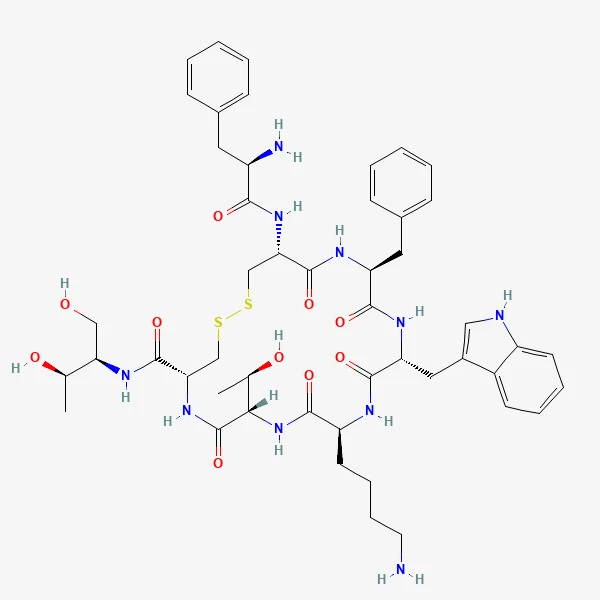
2D depiction generated from the PubChem record. Depictions are schematic and do not show salt form, counter-ions or conformation.
- Formula
- C49H66N10O10S2
- Molecular weight
- 1019.2 g/mol
- CAS
- 83150-76-9
- InChIKey
- DEQANNDTNATYII-OULOTJBUSA-N
Research overview
Human research
Octreotide has been studied for decades under FDA labels in acromegaly, carcinoid tumors and VIPomas 1. PROMID randomized treatment-naive people with metastatic midgut NETs to octreotide LAR or placebo 4, and CHIASMA OPTIMAL randomized 56 adults with acromegaly previously controlled on injectable SRLs to oral octreotide or placebo for 36 weeks 5.
Animal research
In a 116-week rat study, injection-site sarcomas or squamous cell carcinomas occurred at the highest subcutaneous dose level (10 times human exposure), while no carcinogenic potential was shown in mice treated for 85 to 99 weeks 1.
In-vitro research
Not reviewed separately for this entry; the label's pharmacology section describes somatostatin-like hormone suppression 1.
Key studies
- Placebo-controlled, double-blind, randomized phase IIIB, interim analysisModel: Humans (85 people with treatment-naive well-differentiated metastatic midgut NETs)
Median time to progression 14.3 versus 6 months (HR 0.34; 95% CI 0.20-0.59); stable disease at 6 months 66.7% versus 37.2%; survival analysis not confirmatory (HR 0.81) 4.
- Phase 3, double-blind, placebo-controlled, 36 weeksModel: Humans (56 adults with acromegaly controlled on injectable SRLs)
IGF-1 normalization maintained in 58.2% versus 19.4% (P = .008); median time to loss of response 16 weeks with placebo, not reached with oral octreotide 5.
- Pooled clinical-trial safety dataModel: Humans (mainly acromegaly and psoriasis trials)
Biliary tract abnormalities 63% (27% gallstones, 24% sludge, 12% duct dilatation); in acromegaly, sinus bradycardia 25% and hyperglycemia 16% 1.
Dosing as stated on the FDA label
Quoted from the prescribing information for reference. Prescribing decisions belong to a licensed clinician; this is not a recommendation or instruction for use.
Full dosing reference, study durations and vial arithmetic →- Acromegaly (Sandostatin Injection): initial 50 mcg three times daily subcutaneously, titrated to GH or IGF-1; most common dosage 100 mcg three times daily, with some patients requiring up to 500 mcg three times daily 1.
- Carcinoid tumors (Sandostatin Injection): 100 to 600 mcg/day in two to four divided doses during the first 2 weeks; experience above 750 mcg/day is limited 1.
- VIPomas (Sandostatin Injection): 200 to 300 mcg/day in two to four divided doses during the first 2 weeks (range 150 to 750 mcg) 1.
- Sandostatin LAR Depot: acromegaly, 20 mg intragluteally every 4 weeks for 3 months after 2 weeks of the injection; carcinoid tumors and VIPomas, 20 mg every 4 weeks for 2 months; dosages above 30 mg are not recommended 2.
- Mycapssa: 40 mg daily as 20 mg twice daily on an empty stomach, titrated in 20 mg increments to a maximum of 80 mg daily; 20 mg once daily to start in end-stage renal disease 3.
Background viewing
We haven't found a clinician video focused on Octreotide yet. Meanwhile, this widely watched talk covers the science of aging in general. It does not discuss Octreotide.
These creators are not affiliated with Amiravo and do not endorse Amiravo or any product linked on this site. Nothing here is medical advice. Video views counted on YouTube as of Oct 24, 2026.
Regulatory status
- Status
- FDA-approved (initial U.S. approval 1988) as Sandostatin Injection (subcutaneous or intravenous) for acromegaly, metastatic carcinoid tumors and VIPomas; Sandostatin LAR Depot (intramuscular, every 4 weeks) for patients who responded to and tolerated the injection; and Mycapssa (oral) for long-term acromegaly maintenance after response to octreotide or lanreotide. The Sandostatin label states that trials did not show improvement in tumor size or growth rate 1,2,3.
- United States (FDA)
- FDA-approved (initial U.S. approval 1988) as Sandostatin Injection, Sandostatin LAR Depot and Mycapssa; labels reviewed from DailyMed versions dated July 2026, December 2025 and July 2025 1,2,3.
- Sport (WADA)
- Octreotide is not named in the 2026 Prohibited List text reviewed; as an approved drug it falls outside S0, but the list's classes include substances with similar biological effects, so status should be confirmed with the relevant anti-doping organization 6.
Status varies by country and changes over time. How we describe regulatory status.
Quality and testing notes
Identity can be checked by mass spectrometry against the free peptide C49H66N10O10S2 (MW about 1019.3) with the D-Phe and D-Trp residues and the Cys2-Cys7 disulfide; HPLC purity, acetate content and endotoxin would also be expected [1, 7].
How purity testing works · Reading a certificate of analysis
Check a Octreotide certificate of analysis against its expected mass (1,019.2 Da)Storage and handling
Follow the current label for each approved product (injection, depot kit, capsules), which differ in storage requirements; research material per supplier documentation.
Frequently asked questions
What is octreotide approved for?
How is octreotide related to somatostatin?
Does octreotide slow neuroendocrine tumor growth?
Is there an oral form?
Why does octreotide cause gallstones?
Is octreotide banned in sport?
Latest indexed research
- Octreotide Plus Proton pump inhibitor (PPI) versus PPI alone in Non-Variceal Upper gastrointestinal (GI) Bleeding in intensive care unit (ICU): A Multi-Center Randomized Trial.Other · The American journal of the medical sciences · 2026-10-17
- Octreotide attenuates pancreatic fibrosis through modulation of the HMGB1-Wnt/β-catenin axis in experimental chronic pancreatitis.Other · Molecular and cellular biochemistry · 2026-10-15
- Correction: Co-delivery of doxorubicin and siRNA using octreotide-conjugated gold nanorods for targeted neuroendocrine cancer therapy.Other · Nanoscale · 2026-10-06
- A case of congenital hyperinsulinism with ABCC8 variants treated with octreotide long-acting release for four years.Case report · Clinical pediatric endocrinology : case reports and clinical investigations : official journal of the Japanese Society for Pediatric Endocrinology · 2026-10-01
- Somatostatin Analogues vs. Observation After Peptide Receptor Radionuclide Therapy (PRRT) in Nonfunctional Neuroendocrine NeoplasmsRegistered trial · humans · Washington University School of Medicine · 2026-09-25
Listed by publication type from the index record. Inclusion is not an endorsement; open the source to read the findings.
Revision history
Meaningful changes to this entry, with dates and sources. Last reviewed Oct 24, 2026. Typo and layout fixes are not listed.
- New section· entryOct 24, 2026
New research reference added: Octreotide.
References
- SANDOSTATIN (octreotide acetate) injection, prescribing information (DailyMed SPL version 23, published Jul 24, 2026) FDA label (DailyMed). 2026
- SANDOSTATIN LAR DEPOT (octreotide acetate) for injectable suspension, prescribing information (DailyMed SPL version 29, published Dec 23, 2025) FDA label (DailyMed). 2025
- MYCAPSSA (octreotide) delayed-release capsules, prescribing information (DailyMed SPL version 6, published Jul 28, 2025) FDA label (DailyMed). 2025
- Placebo-controlled, double-blind, prospective, randomized study on the effect of octreotide LAR in the control of tumor growth in patients with metastatic neuroendocrine midgut tumors: a report from the PROMID Study Group J Clin Oncol. 2009
- Maintenance of Acromegaly Control in Patients Switching From Injectable Somatostatin Receptor Ligands to Oral Octreotide J Clin Endocrinol Metab. 2020
- Tractatenblad 2026 Nr. 25: Anti-doping convention (ETS No. 135), amendment to the appendix - The 2026 Prohibited List, World Anti-Doping Code (English text; entry into force 1 January 2026) Tractatenblad van het Koninkrijk der Nederlanden (official government publication). 2026
- PubChem compound record for octreotide (CID 448601) PubChem. 2026
Last reviewed October 24, 2026 by the Amiravo editorial team.
Need the math?
Laboratory arithmetic with every formula shown.
For research use only. Not for human or veterinary use. Not a drug, food, or dietary supplement. This page is educational and is not medical advice.
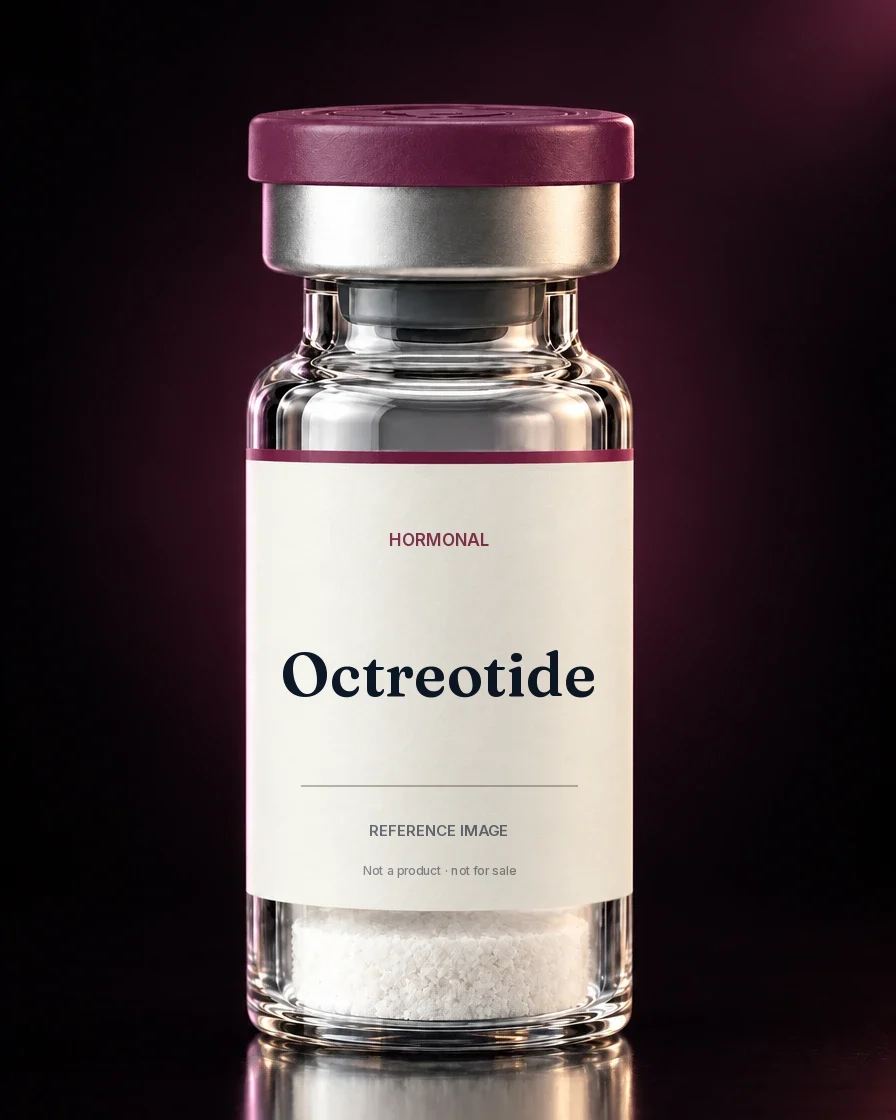
Unbranded reference image. Amiravo does not produce, supply or sell this compound.
Specifications
- Molecular formula
- C49H66N10O10S2
- Molecular weight
- 1,019.2 g/mol
- CAS number
- 83150-76-9
- PubChem CID
- 448601
- FDA UNII
- RWM8CCW8GP
- ChEMBL
- CHEMBL1680
- DrugBank
- DB00104
- Sequence
- D-
Phe- Cys- Phe- D- Trp- Lys- Thr- Cys- Thr- ol (disulfide Cys2- Cys7) - Type
- Single compound
Identifiers from PubChem. Verify against the supplier’s documentation for your lot.
Research stats
How much has been published, not how good it is.
- PubMed records
- 9,380
- Indexed as human research
- 6,999
- Animal-only research
- 950
- Randomized controlled trials
- 479
- Registered trials
- 327
- Trials with posted results
- 67
- FDA adverse-event reports (FAERS)
- 8,004
- NIH-funded projects naming it
- 564
Counts from title/abstract searches of PubMed, ClinicalTrials.gov, openFDA and NIH RePORTER, checked 2026-10-24. Names shared with other substances can inflate counts. FAERS reports are spontaneous and do not establish cause. Funding shows interest, not evidence. Method
Follow Octreotide
See every new citation, evidence-grade or status change and correction in My Research, with optional email alerts. Free account.