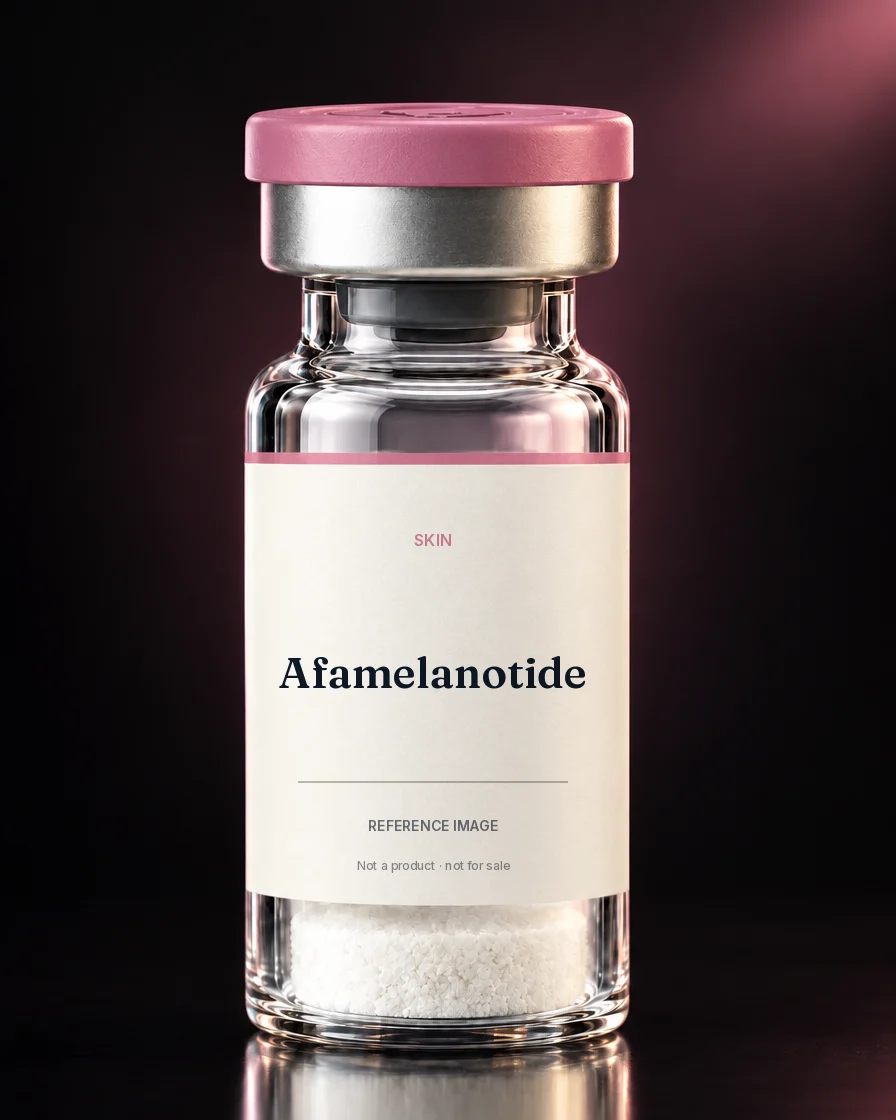
 Skin · Dosing reference
Afamelanotide dosage
Dosing as the FDA label states it, how long trials ran, and the arithmetic for working with vials.
- Regulatory status
- FDA-approved
- Human amounts
- 16 mg afamelanotide per implant (FDA label)
- Route studied
- Subcutaneous implant inserted by a trained health care professional
- Frequency
- One implant every 2 months (FDA label)
- Half-life
- Approximately 15 hours (apparent, from the implant)
- Evidence grade
- Grade A · Human trial evidence
- Vial sizes on the market
- Not recorded
- Other forms seen
- —
What Afamelanotide is
Afamelanotide is a synthetic 13-amino-acid analogue of alpha-melanocyte-stimulating hormone that acts mainly at the melanocortin 1 receptor. It is approved by the FDA as SCENESSE, a 16 mg bioresorbable subcutaneous implant, to increase pain-free light exposure in adults with a history of phototoxic reactions from erythropoietic protoporphyria, and is authorised in the EU for prevention of phototoxicity in the same condition. This entry summarizes the FDA label and published trials for research reference only.
Afamelanotide is a synthetic tridecapeptide and structural analogue of alpha-melanocyte-stimulating hormone (alpha-MSH) that acts as a melanocortin receptor agonist, binding predominantly to MC1-R 1. Pigmentation The FDA label states that afamelanotide increases production of eumelanin in the skin independently of exposure to sunlight or artificial UV light 1. A pharmacology review describes MC1-R signalling as… How it works →
Key evidence
- Langendonk et al., N Engl J Med (CUV039, US) · 2015 · Humans (adults with erythropoietic protoporphyria)After 6 months, median pain-free time in direct sunlight was 69.4 hours with afamelanotide versus 40.8 hours with placebo (P=0.04); adverse events were mostly mild and serious adverse events were not judged related to the study drug 4. 4
- Langendonk et al., N Engl J Med (CUV029, EU) · 2015 · Humans (adults with erythropoietic protoporphyria)After 9 months, median pain-free time in direct sunlight was 6.0 hours with afamelanotide versus 0.8 hours with placebo (P=0.005), and phototoxic reactions numbered 77 versus 146 (P=0.04) 4. 4
- Lim et al., JAMA Dermatol · 2015 · Humans (adults with nonsegmental vitiligo, Fitzpatrick skin phototypes III to VI)
Schedules by time period
Label regimens and laid out week by week. Each bar is what the label states or what investigators gave participants; none is a recommendation.
Scenesse implant (FDA label) 1
Adults with erythropoietic protoporphyria and a history of phototoxic reactions
Week-by-week table
| Period | Amount |
|---|---|
| Weeks 0–onward | 16 mg (one implant) (maintenance) |
The label specifies one implant containing 16 mg afamelanotide every 2 months, inserted by a trained health care professional; no escalation.
Dosing as stated on the FDA label
- SCENESSE (afamelanotide) implant 16 mg: insert a single implant subcutaneously every 2 months; the label directs that it be administered by a health care professional who is proficient in the subcutaneous implantation procedure and has completed the training program provided by CLINUVEL. 1
- Per the label, sun and light protection measures should be maintained during treatment with SCENESSE to prevent phototoxic reactions related to EPP, and patients should be monitored for 30 minutes after implant administration. 1
- Dosage form per the label: each implant contains 16 mg of afamelanotide (equivalent to 18 mg of afamelanotide acetate) as a solid, bioresorbable, sterile rod approximately 1.7 cm long and 1.45 mm in diameter. 1
- In study CUV039 (US, NCT01605136), 48 of 93 adults with EPP received a subcutaneous implant containing 16 mg afamelanotide every 2 months (three implants) and 45 received vehicle, with follow-up for 180 days 1,4.
- In study CUV029 (EU, NCT00979745), 38 of 74 adults with EPP received a subcutaneous implant containing 16 mg afamelanotide every 2 months (five implants) and 36 received vehicle, with follow-up for 270 days 1,4.
- In the vitiligo trial (NCT01430195), after 1 month of narrowband UV-B phototherapy, the combination group received 16 mg afamelanotide subcutaneously monthly for 4 months while phototherapy continued (28 participants), versus phototherapy alone (27 participants) 5.
How long did human studies run?
- Label: one implant every 2 months; the label does not state a maximum treatment duration 1.
- EMA overview: three implants per year recommended, maximum of four, before and during periods of high sunlight exposure 3.
- Pivotal trials: 180 days (CUV039, three implants) and 270 days (CUV029, five implants) 1.
Contraindications on the label
- Contraindicated in patients with a history of severe hypersensitivity to afamelanotide or any excipient 1.
- Safety and effectiveness not established in pediatric patients; no data in pregnancy or lactation 1.
- Label trials enrolled adults with EPP without significant liver involvement 1.
Side effects reported in studies
- Implant site reaction26 of 125 (21%) vs 12 of 119 (10%) vehicle · Adults with EPP in studies CUV039, CUV030 and CUV029, through month 6 1
- Nausea24 of 125 (19%) vs 17 of 119 (14%) vehicle · Adults with EPP, through month 6 1
- Oropharyngeal pain9 (7%) vs 6 (5%) vehicle · Adults with EPP, through month 6 1
- Cough8 (6%) vs 4 (3%) vehicle · Adults with EPP, through month 6 1
- Fatigue7 (6%) vs 3 (3%) vehicle · Adults with EPP, through month 6 1
- Skin hyperpigmentation5 (4%) vs 0 (0%) vehicle · Adults with EPP, through month 6 1
- Melanocytic nevus5 (4%) vs 2 (2%) vehicle · Adults with EPP, through month 6 1
- Dizziness5 (4%) vs 4 (3%) vehicle · Adults with EPP, through month 6 1
Afamelanotide draw calculator
Pick the vial strength and the water added, enter an amount, and see the concentration, the units to draw and how many draws the vial holds. Arithmetic only.
Computed from your inputs. Not a dose or a recommendation.
Compare water volumes for this vialShow
More water = lower concentration = a larger, easier-to-measure draw. Tap a row to use it.
| Water | mg/mL | Draw |
|---|---|---|
| 0.5 mL | 20 | — |
| 1 mL | 10 | — |
| 1.5 mL | 6.667 | — |
| 2 mL | 5 | — |
| 2.5 mL | 4 | — |
| 3 mL | 3.333 | — |
| 5 mL | 2 | — |
Supplies and handling
- Lyophilized vialSealed vial with the freeze-dried cake. Check the label, lot and the certificate of analysis before opening.
- Sterile diluentThe diluent named on the product documentation. Bacteriostatic water contains benzyl alcohol; sterile water does not.
- Graduated syringesSized to the volume being measured. U-100 insulin syringes are graduated in units where 100 units = 1 mL.
- Alcohol prep padsFor wiping vial stoppers before each puncture.
- Nitrile glovesClean gloves for aseptic handling.
- Sharps containerPuncture-resistant container for used needles.
Storage
Per the FDA label, SCENESSE implants are stored in a refrigerator at 2 to 8 degrees C (36 to 46 degrees F) and protected from light 1. Research material should be handled according to the supplier's documentation.
- Lyophilized (unmixed) vials: typically stored cold and dry, away from light, as the documentation directs. Many are stable longer frozen.
- Reconstituted vials: typically refrigerated (about 2–8 °C), protected from light and not frozen.
- Bacteriostatic water contains benzyl alcohol, which inhibits bacterial growth in multi-use vials; sterile water has no preservative.
Handling mistakes and troubleshooting
- Added the wrong volume of diluent
- The concentration changes, not the amount of compound in the vial. Recalculate with the volume actually added and relabel the vial.
- Shook the vial and it foamed
- Let it settle in the refrigerator. Foam is a sign of agitation; some peptides aggregate when shaken. Note it on the label.
- The solution is cloudy or has particles
- Do not use it. Cloudiness can indicate incomplete dissolution, contamination or degradation. Record the lot and contact the supplier with the certificate of analysis.
- The powder cake looks melted or shrunken before reconstitution
- This can indicate the vial was exposed to heat or moisture. Record the lot and condition on arrival.
- Liquid sprayed back when the needle was removed
- Pressure built up in the vial. Withdraw a small volume of air while adding diluent to keep pressure neutral.
Regulatory status
- Status
- Approved by the FDA as SCENESSE (afamelanotide) implant, NDA 210797, original approval 8 October 2019, to increase pain-free light exposure in adult patients with a history of phototoxic reactions from erythropoietic protoporphyria (EPP) 1,2. In the EU it was authorised on 22 December 2014, under exceptional circumstances, for prevention of phototoxicity in adults with EPP 3.
- United States (FDA)
- Approved under NDA 210797 (SCENESSE, original approval 8 October 2019) per the Drugs@FDA application record 2; the current label was reviewed from DailyMed 1.
- Sport (WADA)
- Afamelanotide is not named on the WADA 2026 Prohibited List 9. Because it holds governmental approval for human therapeutic use, the S0 non-approved-substances class, which covers substances without such approval, does not describe it 9.
Status varies by country and changes over time. How we describe regulatory status.
Afamelanotide compared with related compounds
| Compound | Status | Evidence | Human amounts | Half-life |
|---|---|---|---|---|
| Afamelanotide | FDA-approved | A | FDA label | Approximately 15 hours (apparent, from t |
| Melanotan I | Not approved — research use only | — | None established | — |
| Vesugen | Not approved — research use only | C | None established | — |
| Matrixyl | Not approved — research use only | B | None established | Not located in the sources reviewed. In |
| Argireline | Not approved — research use only | B | None established | Not located in the sources reviewed. Rel |
| GHK-Cu | Not approved — research use only | B | None established | — |
Frequently asked questions
What doses of Afamelanotide have been studied in humans?
Is there an established Afamelanotide cycle length?
How much bacteriostatic water should be added to a Afamelanotide vial?
How many units is a given amount on an insulin syringe?
What is the half-life of Afamelanotide?
Is Afamelanotide FDA-approved?
References
- SCENESSE (afamelanotide) implant, for subcutaneous use. Prescribing information, CLINUVEL Inc. (SPL published May 13, 2026) DailyMed (FDA label). 2026
- Drugs@FDA application record for SCENESSE (afamelanotide), NDA 210797, original approval 8 October 2019 openFDA / Drugs@FDA. 2026
- Scenesse (afamelanotide): EPAR, medicine overview (authorised 22 December 2014 under exceptional circumstances) European Medicines Agency. 2026
- Afamelanotide for Erythropoietic Protoporphyria N Engl J Med. 2015
- Afamelanotide and narrowband UV-B phototherapy for the treatment of vitiligo: a randomized multicenter trial JAMA Dermatol. 2015
- Pharmacokinetics and Pharmacodynamics of Afamelanotide and its Clinical Use in Treating Dermatologic Disorders Clin Pharmacokinet. 2017
- Evaluation of the immunogenicity of the synthetic alpha-melanocyte-stimulating hormone (alpha-MSH) analogue afamelanotide ([Nle4-D-Phe7]-alpha-MSH, Scenesse) in erythropoietic protoporphyria patients by ELISA detecting both anti-afamelanotide and anti-alpha-MSH antibodies Skin Pharmacol Physiol. 2015
- PubChem compound record for afamelanotide (CID 16197727; CAS 75921-69-6) PubChem. 2026
- International Standard: Prohibited List 2026 World Anti-Doping Agency. 2026
Last reviewed October 23, 2026 by the Amiravo editorial team. Editorial policy · Report an error