Afamelanotide
Also known as SCENESSE · [Nle4, D-Phe7]-alpha-MSH · NDP-MSH · CUV1647 · Melanotan I (historical research name)
Afamelanotide is a synthetic 13-amino-acid analogue of alpha-melanocyte-stimulating hormone that acts mainly at the melanocortin 1 receptor. It is approved by the FDA as SCENESSE, a 16 mg bioresorbable subcutaneous implant, to increase pain-free light exposure in adults with a history of phototoxic reactions from erythropoietic protoporphyria, and is authorised in the EU for prevention of phototoxicity in the same condition. This entry summarizes the FDA label and published trials for research reference only.
- US status
- FDA-approved
- Evidence
- Grade A
- Half-life
- Apparent half-life of approximately 15 hours when administered subcutaneously in the controlled-release implant; median Tmax 36 hours; in most subjects the last measurable concentration was at 96 hours after a single implant 1
- Class
- Melanocortin 1 receptor (MC1-R) agonist; synthetic alpha-MSH analogue peptide (13 amino acids)
More
Research reference, not advice. Label quotes, not a recommendation. Amiravo sells nothing; some links are referrals.Read the full notice
Key takeaways
- Afamelanotide is an FDA-approved alpha-MSH analogue that binds predominantly to the melanocortin 1 receptor and increases eumelanin production in the skin independently of sunlight exposure 1.
- The FDA label covers one indication: increasing pain-free light exposure in adults with a history of phototoxic reactions from erythropoietic protoporphyria 1.
- In the US vehicle-controlled trial CUV039 (93 adults with EPP), median total hours in direct sunlight on pain-free days over 180 days were 64.1 with afamelanotide versus 40.5 with vehicle, per the label 1.
- Implant-site reactions (21% vs 10%), nausea (19% vs 14%) and skin hyperpigmentation (4% vs 0%) were among the adverse reactions more frequent than with vehicle through month 6 1.
- The label recommends a twice-yearly full-body skin examination because pre-existing nevi and ephelides may darken, and lists serious hypersensitivity, including anaphylaxis, from postmarketing use 1.
Development stage
Where Afamelanotide sits between laboratory work and regulatory approval.
- PreclinicalAnimal and cell work
- Phase 1First human safety studies
- Phase 2Early efficacy signal
- Phase 3Confirmatory trials
- Approved (current)Cleared by a regulator
Stage comes from the regulatory record and ClinicalTrials.gov studies naming the compound (for compounds approved nowhere, only completed trials or trials with posted results count) (checked 2026-10-24). A registered trial is not a result.
Mechanism of action
Afamelanotide is a synthetic tridecapeptide and structural analogue of alpha-melanocyte-stimulating hormone (alpha-MSH) that acts as a melanocortin receptor agonist, binding predominantly to MC1-R 1.
Pigmentation
The FDA label states that afamelanotide increases production of eumelanin in the skin independently of exposure to sunlight or artificial UV light 1. A pharmacology review describes MC1-R signalling as increasing melanin synthesis and also being linked to antioxidant activity, DNA repair processes and modulation of inflammation 6.
Formulation
The approved product is a solid bioresorbable rod in which the peptide is admixed with poly(DL-lactide-co-glycolide), providing controlled release after subcutaneous insertion 1. A review reports that subcutaneous administration had full bioavailability in early volunteer work, whereas oral and transdermal administration did not produce measurable plasma concentrations or pigmentation 6.
Molecular structure
PubChem CID 16197727 ↗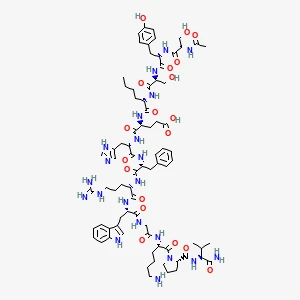
2D depiction generated from the PubChem record. Depictions are schematic and do not show salt form, counter-ions or conformation.
- Formula
- C78H111N21O19
- Molecular weight
- 1646.8 g/mol
- CAS
- 75921-69-6
- InChIKey
- UAHFGYDRQSXQEB-LEBBXHLNSA-N
Dosing as stated on the FDA label
Quoted from the prescribing information for reference. Prescribing decisions belong to a licensed clinician; this is not a recommendation or instruction for use.
Full dosing reference, study durations and vial arithmetic →- SCENESSE (afamelanotide) implant 16 mg: insert a single implant subcutaneously every 2 months; the label directs that it be administered by a health care professional who is proficient in the subcutaneous implantation procedure and has completed the training program provided by CLINUVEL. 1
- Per the label, sun and light protection measures should be maintained during treatment with SCENESSE to prevent phototoxic reactions related to EPP, and patients should be monitored for 30 minutes after implant administration. 1
- Dosage form per the label: each implant contains 16 mg of afamelanotide (equivalent to 18 mg of afamelanotide acetate) as a solid, bioresorbable, sterile rod approximately 1.7 cm long and 1.45 mm in diameter. 1
- In study CUV039 (US, NCT01605136), 48 of 93 adults with EPP received a subcutaneous implant containing 16 mg afamelanotide every 2 months (three implants) and 45 received vehicle, with follow-up for 180 days 1,4.
- In study CUV029 (EU, NCT00979745), 38 of 74 adults with EPP received a subcutaneous implant containing 16 mg afamelanotide every 2 months (five implants) and 36 received vehicle, with follow-up for 270 days 1,4.
- In the vitiligo trial (NCT01430195), after 1 month of narrowband UV-B phototherapy, the combination group received 16 mg afamelanotide subcutaneously monthly for 4 months while phototherapy continued (28 participants), versus phototherapy alone (27 participants) 5.
Afamelanotide draw calculator
Pick the vial strength and how much water is added, then enter an amount to see the units to draw. Arithmetic only, not a recommendation.
Computed from your inputs. Not a dose or a recommendation.
Compare water volumes for this vialShow
More water = lower concentration = a larger, easier-to-measure draw. Tap a row to use it.
| Water | mg/mL | Draw |
|---|---|---|
| 0.5 mL | 20 | — |
| 1 mL | 10 | — |
| 1.5 mL | 6.667 | — |
| 2 mL | 5 | — |
| 2.5 mL | 4 | — |
| 3 mL | 3.333 | — |
| 5 mL | 2 | — |
Background viewing
We haven't found a clinician video focused on Afamelanotide yet. Meanwhile, this widely watched talk covers the science of aging in general. It does not discuss Afamelanotide.
These creators are not affiliated with Amiravo and do not endorse Amiravo or any product linked on this site. Nothing here is medical advice. Video views counted on YouTube as of Oct 24, 2026.
Regulatory status
- Status
- Approved by the FDA as SCENESSE (afamelanotide) implant, NDA 210797, original approval 8 October 2019, to increase pain-free light exposure in adult patients with a history of phototoxic reactions from erythropoietic protoporphyria (EPP) 1,2. In the EU it was authorised on 22 December 2014, under exceptional circumstances, for prevention of phototoxicity in adults with EPP 3.
- United States (FDA)
- Approved under NDA 210797 (SCENESSE, original approval 8 October 2019) per the Drugs@FDA application record 2; the current label was reviewed from DailyMed 1.
- Sport (WADA)
- Afamelanotide is not named on the WADA 2026 Prohibited List 9. Because it holds governmental approval for human therapeutic use, the S0 non-approved-substances class, which covers substances without such approval, does not describe it 9.
Status varies by country and changes over time. How we describe regulatory status.
Quality and testing notes
The approved product is a finished implant, not a powder: afamelanotide acetate admixed with poly(DL-lactide-co-glycolide) in a sterile bioresorbable rod, with the peptide content stated as 16 mg afamelanotide (equivalent to 18 mg afamelanotide acetate) [1]. For any afamelanotide reference material, a certificate of analysis would typically show HPLC purity with chromatogram, identity by mass spectrometry against the anhydrous free-base molecular weight of 1646.85 stated in the label, acetate counter-ion content (the label gives 3 to 4 acetate equivalents), net peptide content and, for material intended for sterile handling, endotoxin and sterility testing [1]. Because the D-Phe7 and Nle4 substitutions do not change nominal mass relative to some isomers, chiral or orthogonal methods add confidence in identity.
How purity testing works · Reading a certificate of analysis
Check a Afamelanotide certificate of analysis against its expected mass (1,646.8 Da)Storage and handling
Per the FDA label, SCENESSE implants are stored in a refrigerator at 2 to 8 degrees C (36 to 46 degrees F) and protected from light [1]. Research material should be handled according to the supplier's documentation.
Frequently asked questions
Is afamelanotide FDA-approved?
Is afamelanotide the same as Melanotan I?
How does afamelanotide work?
What did the pivotal trials measure?
What adverse reactions are listed on the label?
What is its half-life?
Is afamelanotide approved in Europe?
Latest indexed research
No new studies were filed in the last sweep.
Search all studies on Afamelanotide (PubMed, Europe PMC, ClinicalTrials.gov)Listed by publication type from the index record. Inclusion is not an endorsement; open the source to read the findings.
Revision history
Meaningful changes to this entry, with dates and sources. Last reviewed Oct 23, 2026. Typo and layout fixes are not listed.
- New section· Schedules by time periodOct 23, 2026
Added week-by-week schedules from the FDA label (1 group, 1 arms).
Source: SCENESSE (afamelanotide) implant, for subcutaneous use - prescribing information
References
- SCENESSE (afamelanotide) implant, for subcutaneous use. Prescribing information, CLINUVEL Inc. (SPL published May 13, 2026) DailyMed (FDA label). 2026
- Drugs@FDA application record for SCENESSE (afamelanotide), NDA 210797, original approval 8 October 2019 openFDA / Drugs@FDA. 2026
- Scenesse (afamelanotide): EPAR, medicine overview (authorised 22 December 2014 under exceptional circumstances) European Medicines Agency. 2026
- Afamelanotide for Erythropoietic Protoporphyria N Engl J Med. 2015
- Afamelanotide and narrowband UV-B phototherapy for the treatment of vitiligo: a randomized multicenter trial JAMA Dermatol. 2015
- Pharmacokinetics and Pharmacodynamics of Afamelanotide and its Clinical Use in Treating Dermatologic Disorders Clin Pharmacokinet. 2017
- Evaluation of the immunogenicity of the synthetic alpha-melanocyte-stimulating hormone (alpha-MSH) analogue afamelanotide ([Nle4-D-Phe7]-alpha-MSH, Scenesse) in erythropoietic protoporphyria patients by ELISA detecting both anti-afamelanotide and anti-alpha-MSH antibodies Skin Pharmacol Physiol. 2015
- PubChem compound record for afamelanotide (CID 16197727; CAS 75921-69-6) PubChem. 2026
- International Standard: Prohibited List 2026 World Anti-Doping Agency. 2026
Last reviewed October 23, 2026 by the Amiravo editorial team.
Need the math?
Laboratory arithmetic with every formula shown.
For research use only. Not for human or veterinary use. Not a drug, food, or dietary supplement. This page is educational and is not medical advice.
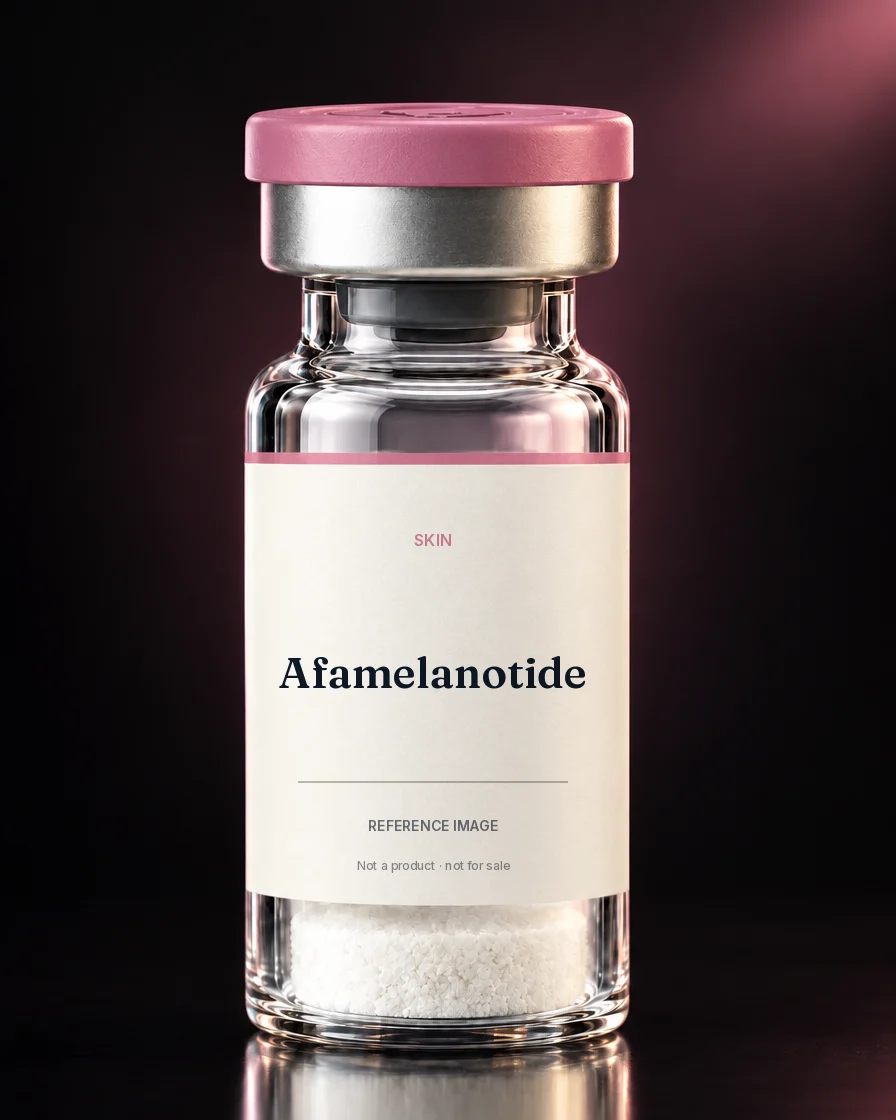
Unbranded reference image. Amiravo does not produce, supply or sell this compound.
Specifications
- Molecular formula
- C78H111N21O19
- Molecular weight
- 1,646.8 g/mol
- CAS number
- 75921-69-6
- PubChem CID
- 16197727
- DrugBank
- DB04931
- Sequence
- Ac-
Ser- Tyr- Ser- Nle- Glu- His- D- Phe- Arg- Trp- Gly- Lys- Pro- Val- NH2 - Format
- Lyophilized vial
- Type
- Single compound
Identifiers from PubChem. Verify against the supplier’s documentation for your lot.
Research stats
How much has been published, not how good it is.
- PubMed records
- 297
- Indexed as human research
- 172
- Animal-only research
- 84
- Randomized controlled trials
- 5
- Registered trials
- 23
- Trials with posted results
- 12
- FDA adverse-event reports (FAERS)
- 19
- NIH-funded projects naming it
- 22
Counts from title/abstract searches of PubMed, ClinicalTrials.gov, openFDA and NIH RePORTER, checked 2026-10-24. Names shared with other substances can inflate counts. FAERS reports are spontaneous and do not establish cause. Funding shows interest, not evidence. Method
Follow Afamelanotide
See every new citation, evidence-grade or status change and correction in My Research, with optional email alerts. Free account.