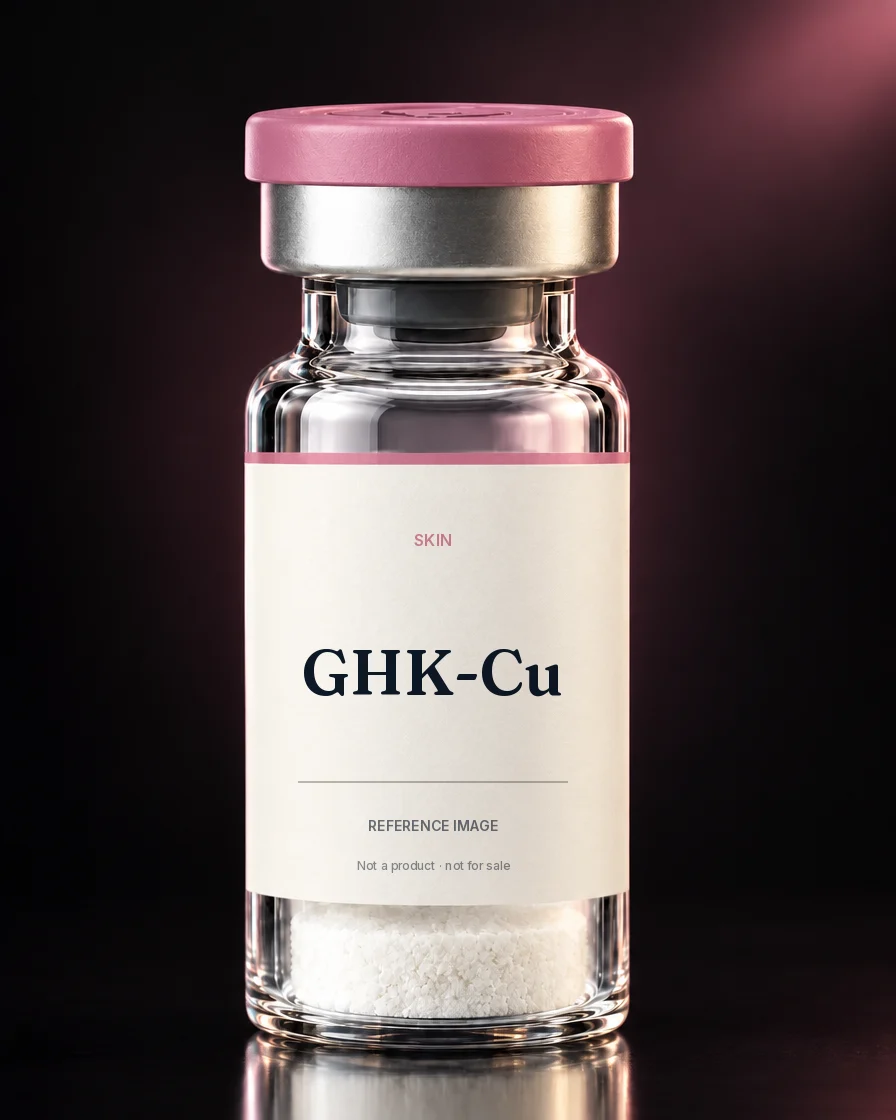
 Skin · Dosing reference
GHK-Cu dosage
What the human evidence does and does not show, how long studies ran, and the arithmetic for working with vials.
- Regulatory status
- Not approved — research use only
- Human amounts
- None established in humans
- Route studied
- —
- Frequency
- Not established
- Half-life
- Not established
- Evidence grade
- Grade B · Limited human data
- Vial sizes on the market
- 50 mg · 100 mg
- Other forms seen
- Topical sheet mask 25 mL (with HLA)
What GHK-Cu is
GHK-Cu is the copper(II) complex of the naturally occurring tripeptide glycyl-histidyl-lysine. It has been examined in cell, tissue and animal models of wound repair and gene expression, with only small human studies of topical cosmetic products. It is not an approved drug.
GHK is a tripeptide that binds copper(II); it has been proposed to act as the GHK-Cu complex in tissue repair and skin remodeling 2. Plasma levels of GHK have been reported to decline with age 2. Matrix remodeling and cell signaling (cells and animals) In cell and tissue models, GHK was reported to stimulate collagen, decorin and glycosaminoglycan synthesis and to modulate metalloproteinases and their inhibitors… How it works →
Key evidence
- Miller et al., Archives of Facial Plastic Surgery · 2006 · Humans (13 patients, topical skin-care products)No significant between-group difference in erythema resolution or objective wrinkle and skin-quality scores; patient questionnaire scores for skin quality were higher with GHK-Cu (P = .04). 5
- Wang et al., Skin Research and Technology · 2026 · Cells, human skin explants and humans (topical face cream)The combination reduced inflammatory cytokine secretion in stimulated macrophages and was reported to decrease wrinkles in the clinical component; effects of GHK-Cu alone in the clinical component were not isolated. 6
- Fu et al., Journal of Orthopaedic Research · 2015 · Rats (ACL reconstruction)Smaller knee laxity at 6 weeks in GHK-Cu groups, with no significant difference at 12 weeks; ultimate load and histology did not differ. 7
What the human evidence shows
We searched PubMed and ClinicalTrials.gov and found no human studies that administered GHK-Cu. The research described on its page is from cells or animals, and animal amounts do not translate to people.
How long did human studies run?
No human study durations are recorded for GHK-Cu.
Cycle-length evidence for GHK-CuGHK-Cu draw calculator
Pick the vial strength and the water added, enter an amount, and see the concentration, the units to draw and how many draws the vial holds. Arithmetic only.
Computed from your inputs. Not a dose or a recommendation.
Compare water volumes for this vialShow
More water = lower concentration = a larger, easier-to-measure draw. Tap a row to use it.
| Water | mg/mL | Draw |
|---|---|---|
| 0.5 mL | 200 | — |
| 1 mL | 100 | — |
| 1.5 mL | 66.67 | — |
| 2 mL | 50 | — |
| 2.5 mL | 40 | — |
| 3 mL | 33.33 | — |
| 5 mL | 20 | — |
Supplies and handling
- Lyophilized vialSealed vial with the freeze-dried cake. Check the label, lot and the certificate of analysis before opening.
- Sterile diluentThe diluent named on the product documentation. Bacteriostatic water contains benzyl alcohol; sterile water does not.
- Graduated syringesSized to the volume being measured. U-100 insulin syringes are graduated in units where 100 units = 1 mL.
- Alcohol prep padsFor wiping vial stoppers before each puncture.
- Nitrile glovesClean gloves for aseptic handling.
- Sharps containerPuncture-resistant container for used needles.
Storage
Handling depends on the supplier's form (lyophilized powder or solution). Follow the supplier's documentation for temperature, light and moisture protection, and avoid repeated freeze-thaw cycles. Metal-chelating buffers can alter the copper complex, so check compatibility with the supplier's data.
- Lyophilized (unmixed) vials: typically stored cold and dry, away from light, as the documentation directs. Many are stable longer frozen.
- Reconstituted vials: typically refrigerated (about 2–8 °C), protected from light and not frozen.
- Bacteriostatic water contains benzyl alcohol, which inhibits bacterial growth in multi-use vials; sterile water has no preservative.
Handling mistakes and troubleshooting
- Added the wrong volume of diluent
- The concentration changes, not the amount of compound in the vial. Recalculate with the volume actually added and relabel the vial.
- Shook the vial and it foamed
- Let it settle in the refrigerator. Foam is a sign of agitation; some peptides aggregate when shaken. Note it on the label.
- The solution is cloudy or has particles
- Do not use it. Cloudiness can indicate incomplete dissolution, contamination or degradation. Record the lot and contact the supplier with the certificate of analysis.
- The powder cake looks melted or shrunken before reconstitution
- This can indicate the vial was exposed to heat or moisture. Record the lot and condition on arrival.
- Liquid sprayed back when the needle was removed
- Pressure built up in the vial. Withdraw a small volume of air while adding diluent to keep pressure neutral.
Regulatory status
- Status
- Not approved by the FDA as a drug for any indication; a DailyMed name search for this entry returned no dedicated GHK-Cu drug label 9. It appears as an ingredient in cosmetic products 2. No regulator-approved therapeutic use was identified in the sources reviewed 3.
Status varies by country and changes over time. How we describe regulatory status.
GHK-Cu compared with related compounds
| Compound | Status | Evidence | Human amounts | Half-life |
|---|---|---|---|---|
| GHK-Cu | Not approved — research use only | B | None established | — |
| Afamelanotide | FDA-approved | A | FDA label | Approximately 15 hours (apparent, from t |
| Matrixyl | Not approved — research use only | B | None established | Not located in the sources reviewed. In |
| Argireline | Not approved — research use only | B | None established | Not located in the sources reviewed. Rel |
| SNAP-8 | Not approved — research use only | — | None established | — |
| Melanotan I | Not approved — research use only | — | None established | — |
Combinations that include GHK-Cu
Frequently asked questions
What doses of GHK-Cu have been studied in humans?
Is there an established GHK-Cu cycle length?
How much bacteriostatic water should be added to a GHK-Cu vial?
How many units is a given amount on an insulin syringe?
Is GHK-Cu FDA-approved?
References
- Regenerative and Protective Actions of the GHK-Cu Peptide in the Light of the New Gene Data Int J Mol Sci. 2018
- GHK Peptide as a Natural Modulator of Multiple Cellular Pathways in Skin Regeneration Biomed Res Int. 2015
- GHK-Cu as a Bioactive Metallopeptide and Drug-Delivery Cargo: Coordination Chemistry, Formulation Science, Therapeutic Evidence, and a Translational Roadmap Pharmaceutics. 2026
- A Systematic Review of the Mechanisms and Therapeutic Applications of GHK-Cu in Topical Microneedle Delivery: A Case for Expanded Clinical Trials Arch Intern Med Res. 2026
- Effects of topical copper tripeptide complex on CO2 laser-resurfaced skin Arch Facial Plast Surg. 2006
- Augmented Skin Beneficial Effects of Thermus Thermophilus and Bacillus Subtilis Mixed-Culture Ferment Extract by Tripeptide GHK-Cu Skin Res Technol. 2026
- Tripeptide-copper complex GHK-Cu (II) transiently improved healing outcome in a rat model of ACL reconstruction J Orthop Res. 2015
- Evaluation of the effects of topical tripeptide-copper complex and zinc oxide on open-wound healing in rabbits Vet Dermatol. 2006
- DailyMed drug-label search for GHK (conducted for this entry) FDA DailyMed. 2026
- WADA International Standard: Prohibited List 2026 (S0 and S2.2) WADA Prohibited List. 2026
- PubChem CID 71587328 (prezatide copper) PubChem. 2026
- The human tri-peptide GHK and tissue remodeling J Biomater Sci Polym Ed. 2008
- The effects of topical tripeptide copper complex and helium-neon laser on wound healing in rabbits Vet Dermatol. 2008
Last reviewed October 22, 2026 by the Amiravo editorial team. Editorial policy · Report an error