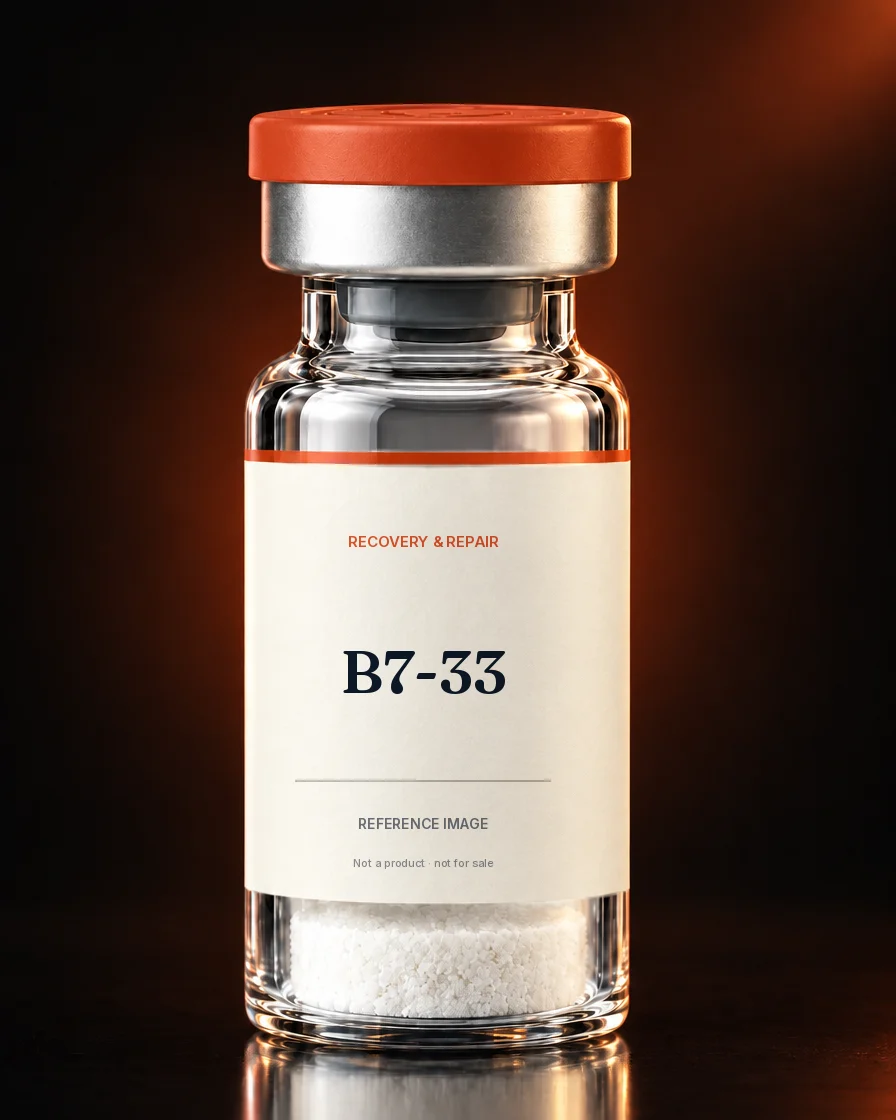
 Recovery & Repair · Dosing reference
B7-33 dosage
What the human evidence does and does not show, how long studies ran, and the arithmetic for working with vials.
- Regulatory status
- Not approved — research use only
- Human amounts
- None established in humans
- Route studied
- —
- Frequency
- Not established
- Half-life
- Not established
- Evidence grade
- Grade C · Preclinical research
- Vial sizes on the market
- 5 mg · 10 mg
- Other forms seen
- —
What B7-33 is
B7-33 is a synthetic single-chain analog of the relaxin-2 B-chain, investigated in preclinical models of fibrosis and cardiovascular tissue remodeling.
Human gene-2 relaxin acts through the G protein-coupled relaxin family peptide receptor 1 (RXFP1), stimulating a combination of pathways that includes cyclic AMP and ERK1/2 1. B7-33 was designed as a B-chain-only analogue and was reported to bind RXFP1 while preferentially activating ERK1/2 phosphorylation over cAMP in cells that endogenously express the receptor, which the authors described as the first… How it works →
Key evidence
- Hossain et al., Chemical Science · 2016 · Cells (RXFP1-expressing) and rodents (three heart or lung disease models; prostate tumour model)B7-33 bound RXFP1 and preferentially activated ERK1/2 over cAMP; it prevented or reversed fibrosis and organ dysfunction in three rodent models with potency similar to relaxin and, unlike relaxin, did not promote prostate tumour growth in vivo. 1
- Devarakonda et al., Journal of the American Heart Association · 2020 · Mice (CD1, myocardial ischemia-reperfusion) and primary adult mouse cardiomyocytesB7-33 reduced infarct size (21.99% versus 45.32%; P=0.02) and preserved fractional shortening (29% versus 23%; P=0.02) compared with vehicle, with a larger fractional-shortening difference at 7 days; in vitro it improved cardiomyocyte survival and reduced GRP78 in an ERK1/2-dependent manner. 3
- Alam et al., Biomedicine & Pharmacotherapy · 2023 · Mice (129sv, isoprenaline-induced cardiomyopathy)B7-33 and relaxin equivalently reduced left ventricular fibrosis and normalised inflammation and cardiomyocyte hypertrophy, restoring vessel density and aortic contractility; perindopril lowered blood pressure, inflammation and vascular rarefaction but not fibrosis or hypertrophy. 4
What the human evidence shows
We searched PubMed and ClinicalTrials.gov and found no human studies that administered B7-33. The research described on its page is from cells or animals, and animal amounts do not translate to people.
How long did human studies run?
No human study durations are recorded for B7-33.
Cycle-length evidence for B7-33B7-33 draw calculator
Pick the vial strength and the water added, enter an amount, and see the concentration, the units to draw and how many draws the vial holds. Arithmetic only.
Computed from your inputs. Not a dose or a recommendation.
Compare water volumes for this vialShow
More water = lower concentration = a larger, easier-to-measure draw. Tap a row to use it.
| Water | mg/mL | Draw |
|---|---|---|
| 0.5 mL | 20 | — |
| 1 mL | 10 | — |
| 1.5 mL | 6.667 | — |
| 2 mL | 5 | — |
| 2.5 mL | 4 | — |
| 3 mL | 3.333 | — |
| 5 mL | 2 | — |
Supplies and handling
- Lyophilized vialSealed vial with the freeze-dried cake. Check the label, lot and the certificate of analysis before opening.
- Sterile diluentThe diluent named on the product documentation. Bacteriostatic water contains benzyl alcohol; sterile water does not.
- Graduated syringesSized to the volume being measured. U-100 insulin syringes are graduated in units where 100 units = 1 mL.
- Alcohol prep padsFor wiping vial stoppers before each puncture.
- Nitrile glovesClean gloves for aseptic handling.
- Sharps containerPuncture-resistant container for used needles.
Storage
General research-context handling only. Lyophilised peptide is ordinarily kept cold, dry and protected from light, and reconstituted material is less stable than lyophilised. Repeated freeze-thaw and adsorption to container surfaces are the usual practical concerns for small synthetic peptides. Defer to the supplier's documentation for the specific lot; nothing here is a preparation or administration instruction.
- Lyophilized (unmixed) vials: typically stored cold and dry, away from light, as the documentation directs. Many are stable longer frozen.
- Reconstituted vials: typically refrigerated (about 2–8 °C), protected from light and not frozen.
- Bacteriostatic water contains benzyl alcohol, which inhibits bacterial growth in multi-use vials; sterile water has no preservative.
Handling mistakes and troubleshooting
- Added the wrong volume of diluent
- The concentration changes, not the amount of compound in the vial. Recalculate with the volume actually added and relabel the vial.
- Shook the vial and it foamed
- Let it settle in the refrigerator. Foam is a sign of agitation; some peptides aggregate when shaken. Note it on the label.
- The solution is cloudy or has particles
- Do not use it. Cloudiness can indicate incomplete dissolution, contamination or degradation. Record the lot and contact the supplier with the certificate of analysis.
- The powder cake looks melted or shrunken before reconstitution
- This can indicate the vial was exposed to heat or moisture. Record the lot and condition on arrival.
- Liquid sprayed back when the needle was removed
- Pressure built up in the vial. Withdraw a small volume of air while adding diluent to keep pressure neutral.
Regulatory status
- Status
- Not approved by the FDA for any use. No approved application naming B7-33 was identified, B7-33 does not appear in any category of FDA's May 14, 2026 503A bulk drug substances list 6, and a search of ClinicalTrials.gov using B7-33 as the intervention returned no registered studies 7.
- United States (FDA)
- No approved application naming B7-33 was identified. B7-33 does not appear in category 1, category 2 or category 3 of FDA's May 14, 2026 list of bulk drug substances nominated for use in compounding under section 503A 6. The parent hormone it derives from is a separate matter: the originating report describes human gene-2 relaxin as having reached clinical evaluation and provisional FDA approval for acute heart failure 1, and that statement concerns relaxin, not B7-33.
- Sport (WADA)
- B7-33 and relaxin are not named anywhere in the WADA 2026 Prohibited List 8. That absence is hedged negative evidence and not a clearance. Section S0, Non-Approved Substances, prohibits at all times “Any pharmacological substance which is not addressed by any of the subsequent sections of the List and with no current approval by any governmental regulatory health authority for human therapeutic use (e.g. drugs under pre-clinical or clinical development or discontinued, designer drugs, substances approved only for veterinary use)”, and states that “this class covers many different substances including but not limited to” the named examples 8. B7-33 has no approval by any governmental regulatory health authority for human therapeutic use, which is the condition S0 describes. Readers should also note that section S2.3 prohibits growth factors and growth factor modulators “including, but not limited to” a named list, and extends to “other growth factors or growth factor modulators affecting muscle, tendon or ligament protein synthesis/degradation, vascularisation, energy utilization, regenerative capacity or fibre type switching” 8; whether a relaxin-derived RXFP1 agonist falls within that wording is not something this entry can resolve.
Status varies by country and changes over time. How we describe regulatory status.
B7-33 compared with related compounds
| Compound | Status | Evidence | Human amounts | Half-life |
|---|---|---|---|---|
| B7-33 | Not approved — research use only | C | None established | — |
| Vesugen | Not approved — research use only | C | None established | — |
| BPC-157 | Not approved — research use only | C | None established | — |
| Thymosin beta-4 | Investigational | B | Trial doses | Not reported numerically in the sources |
| Pentadeca arginate (PDA) | Not approved — research use only | — | None established | — |
| TB-500 | Not approved — research use only | C | None established | — |
Frequently asked questions
What doses of B7-33 have been studied in humans?
Is there an established B7-33 cycle length?
How much bacteriostatic water should be added to a B7-33 vial?
How many units is a given amount on an insulin syringe?
Is B7-33 FDA-approved?
References
- A single-chain derivative of the relaxin hormone is a functionally selective agonist of the G protein-coupled receptor, RXFP1 Chemical Science. 2016
- Single chain peptide agonists of relaxin receptors Molecular and Cellular Endocrinology. 2019
- B7-33, a Functionally Selective Relaxin Receptor 1 Agonist, Attenuates Myocardial Infarction-Related Adverse Cardiac Remodeling in Mice Journal of the American Heart Association. 2020
- The single-chain relaxin mimetic, B7-33, maintains the cardioprotective effects of relaxin and more rapidly reduces left ventricular fibrosis compared to perindopril in an experimental model of cardiomyopathy Biomedicine & Pharmacotherapy. 2023
- B7-33 replicates the vasoprotective functions of human relaxin-2 (serelaxin) European Journal of Pharmacology. 2017
- Bulk Drug Substances Nominated for Use in Compounding Under Section 503A of the FD&C Act (updated May 14, 2026) FDA. 2026
- ClinicalTrials.gov search for B7-33 as intervention (0 studies returned) ClinicalTrials.gov. 2026
- World Anti-Doping Code International Standard: Prohibited List 2026 WADA. 2026
Last reviewed October 23, 2026 by the Amiravo editorial team. Editorial policy · Report an error