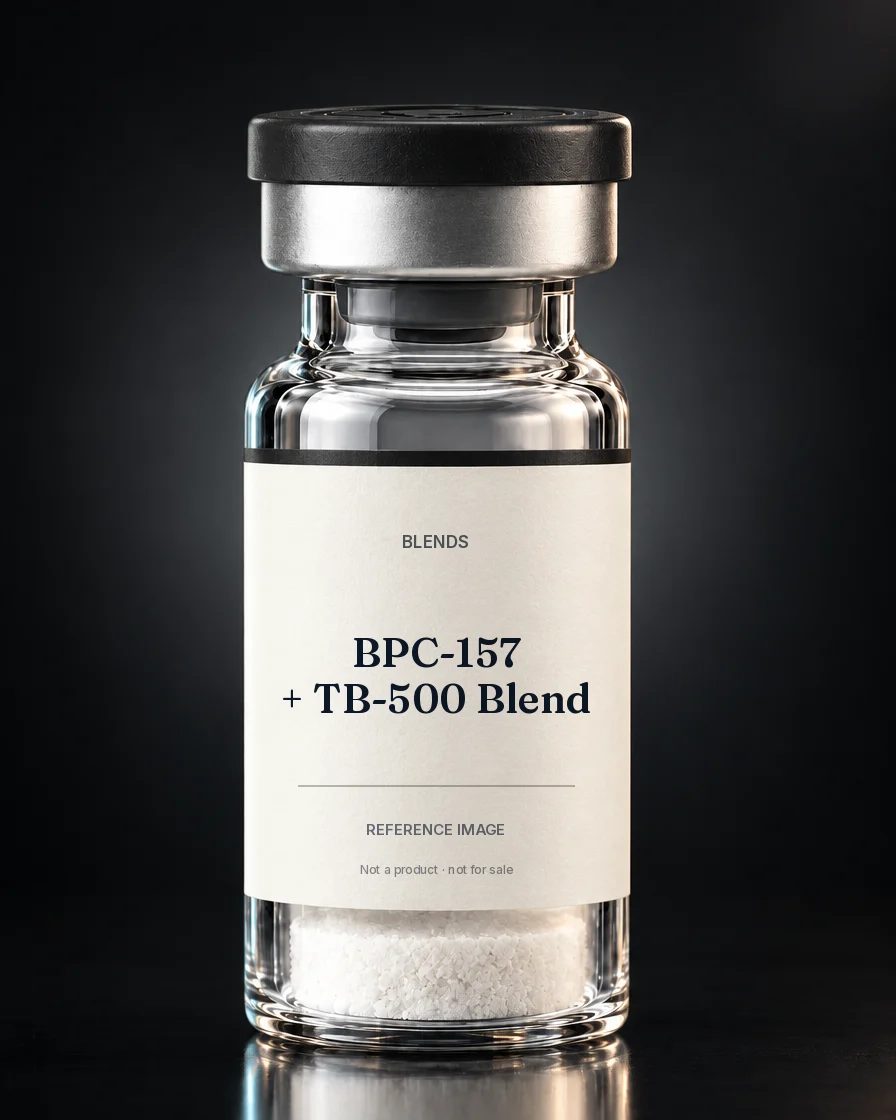
 Blends · Dosing reference
BPC-157 + TB-500 Blend dosage
What the human evidence does and does not show, how long studies ran, and the arithmetic for working with vials.
- Regulatory status
- Not approved — research use only
- Human amounts
- None established in humans
- Route studied
- —
- Frequency
- Not established
- Half-life
- Not established
- Evidence grade
- Grade C · Preclinical research
- Vial sizes on the market
- 10 mg · 20 mg
- Other forms seen
- —
What BPC-157 + TB-500 Blend is
A combination of two synthetic peptides, BPC-157 and TB-500, studied together in preclinical models of tissue repair and cell migration.
This entry does not propose a mechanism for the mixture, because no mechanistic study of the two peptides acting together was identified 9,12. What follows describes the components separately, each of which has its own page. Components BPC-157 ( /library/bpc-157 ) is a pentadecapeptide described as corresponding to a partial sequence of a protein in human gastric juice; reviews report effects in rodent soft-tissue… How it works →
Key evidence
- Bicer et al., Jt Dis Relat Surg · 2026 · Rats (Achilles tendon transection and repair, 32 male Sprague-Dawley animals)
- Lee & Padgett, Altern Ther Health Med · 2021 · Humans (16 private-clinic patients with knee pain, 4 of whom received both peptides)Three of the four patients who received BPC-157 with thymosin beta-4 were recorded as improved and one as not improved; the design does not permit any inference about the combination. 10
- Tewari et al., Am J Sports Med · 2026 · Literature (animal and human studies of six marketed peptides)Reported that roughly two-thirds of publications were preclinical, that human studies were few and mostly uncontrolled, and that claimed musculoskeletal effects remain unsubstantiated by current human trials. 4
What the human evidence shows
We searched PubMed and ClinicalTrials.gov and found no human studies that administered BPC-157 + TB-500 Blend. The research described on its page is from cells or animals, and animal amounts do not translate to people.
How long did human studies run?
No human study durations are recorded for BPC-157 + TB-500 Blend.
Cycle-length evidence for BPC-157 + TB-500 BlendBPC-157 + TB-500 Blend draw calculator
Pick the vial strength and the water added, enter an amount, and see the concentration, the units to draw and how many draws the vial holds. Arithmetic only.
Computed from your inputs. Not a dose or a recommendation.
Compare water volumes for this vialShow
More water = lower concentration = a larger, easier-to-measure draw. Tap a row to use it.
| Water | mg/mL | Draw |
|---|---|---|
| 0.5 mL | 20 | — |
| 1 mL | 10 | — |
| 1.5 mL | 6.667 | — |
| 2 mL | 5 | — |
| 2.5 mL | 4 | — |
| 3 mL | 3.333 | — |
| 5 mL | 2 | — |
Supplies and handling
- Lyophilized vialSealed vial with the freeze-dried cake. Check the label, lot and the certificate of analysis before opening.
- Sterile diluentThe diluent named on the product documentation. Bacteriostatic water contains benzyl alcohol; sterile water does not.
- Graduated syringesSized to the volume being measured. U-100 insulin syringes are graduated in units where 100 units = 1 mL.
- Alcohol prep padsFor wiping vial stoppers before each puncture.
- Nitrile glovesClean gloves for aseptic handling.
- Sharps containerPuncture-resistant container for used needles.
Storage
General research-context handling only, and there is an added consideration for a multi-component vial: the two components are separate molecules with separate stability and solubility behaviour, and no published stability data for them combined in one container were identified. Defer to the supplier's own stability and handling documentation for the specific lot. No preparation or administration instructions are given on this page.
- Lyophilized (unmixed) vials: typically stored cold and dry, away from light, as the documentation directs. Many are stable longer frozen.
- Reconstituted vials: typically refrigerated (about 2–8 °C), protected from light and not frozen.
- Bacteriostatic water contains benzyl alcohol, which inhibits bacterial growth in multi-use vials; sterile water has no preservative.
Handling mistakes and troubleshooting
- Added the wrong volume of diluent
- The concentration changes, not the amount of compound in the vial. Recalculate with the volume actually added and relabel the vial.
- Shook the vial and it foamed
- Let it settle in the refrigerator. Foam is a sign of agitation; some peptides aggregate when shaken. Note it on the label.
- The solution is cloudy or has particles
- Do not use it. Cloudiness can indicate incomplete dissolution, contamination or degradation. Record the lot and contact the supplier with the certificate of analysis.
- The powder cake looks melted or shrunken before reconstitution
- This can indicate the vial was exposed to heat or moisture. Record the lot and condition on arrival.
- Liquid sprayed back when the needle was removed
- Pressure built up in the vial. Withdraw a small volume of air while adding diluent to keep pressure neutral.
Regulatory status
- Status
- Neither component is approved by the FDA for any indication, and no approved product combining them exists 5,6. BPC-157 is named by WADA as an example of a non-approved substance prohibited at all times, and thymosin beta-4 and its derivatives including TB-500 are listed as prohibited growth factors 7. Neither BPC-157 nor TB-500 appears on FDA's May 14, 2026 list of bulk drug substances nominated for compounding under section 503A, in any of its three categories 8.
- United States (FDA)
- No FDA-approved application exists for BPC-157, for TB-500, or for any product combining them, and a DailyMed name search for BPC-157 returned no drug label 5,6. Neither substance appears on FDA's May 14, 2026 503A bulk drug substances list in category 1, 2 or 3 8. A 2026 analysis of Pharmacy Compounding Advisory Committee recommendations discusses the compounded-peptide category to which these products belong 6.
- Sport (WADA)
- The WADA 2026 Prohibited List names BPC-157 in section S0, Non-Approved Substances, which prohibits at all times any pharmacological substance not addressed by a later section and with no current approval by any governmental regulatory health authority for human therapeutic use, and introduces its examples with "including but not limited to" 7. Section S2.3, Growth Factors and Growth Factor Modulators, lists thymosin-beta-4 and its derivatives, naming TB-500, and is likewise introduced with "including, but not limited to" 7. Both components of this blend are therefore named, directly or as a derivative, and the class wording means that a substance's absence from the list would not amount to permission 7. Analytical methods for detecting N-acetylated LKKTETQ, the active ingredient of TB-500, in plasma have been published 14.
Status varies by country and changes over time. How we describe regulatory status.
BPC-157 + TB-500 Blend compared with related compounds
| Compound | Status | Evidence | Human amounts | Half-life |
|---|---|---|---|---|
| BPC-157 + TB-500 Blend | Not approved — research use only | C | None established | — |
| BPC-157 | Not approved — research use only | C | None established | — |
| Thymosin beta-4 | Investigational | B | Trial doses | Not reported numerically in the sources |
| TB-500 | Not approved — research use only | C | None established | — |
| CJC-1295 (no DAC) + Ipamorelin Blend | Not approved — research use only | — | None established | — |
| CJC-1295 (no DAC) + GHRP-6 Blend | Not approved — research use only | — | None established | — |
Frequently asked questions
What doses of BPC-157 + TB-500 Blend have been studied in humans?
Is there an established BPC-157 + TB-500 Blend cycle length?
How much bacteriostatic water should be added to a BPC-157 + TB-500 Blend vial?
How many units is a given amount on an insulin syringe?
Is BPC-157 + TB-500 Blend FDA-approved?
References
- Gastric pentadecapeptide body protection compound BPC 157 and its role in accelerating musculoskeletal soft tissue healing Cell Tissue Res. 2019
- Multifunctionality and Possible Medical Application of the BPC 157 Peptide-Literature and Patent Review Pharmaceuticals (Basel). 2025
- Thymosin beta-4: a multi-functional regenerative peptide. Basic properties and clinical applications Expert Opin Biol Ther. 2012
- Peptide Supplements and Their Therapeutic Applications in Sports Medicine Am J Sports Med. 2026
- Safety and Efficacy of Approved and Unapproved Peptide Therapies for Musculoskeletal Injuries and Athletic Performance Sports Med. 2026
- Synthetic Peptides in Pharmacy Compounding: Analysis of PCAC Recommendations and Industry Safety Standards Int J Pharm Compd. 2026
- World Anti-Doping Code International Standard: Prohibited List 2026 WADA. 2026
- Bulk Drug Substances Nominated for Use in Compounding Under Section 503A of the Federal Food, Drug, and Cosmetic Act (updated May 14, 2026) FDA. 2026
- Effects of BPC-157 and TB-500 on Achilles tendon healing in rats: A histopathological and biomechanical study Jt Dis Relat Surg. 2026
- Intra-Articular Injection of BPC 157 for Multiple Types of Knee Pain Altern Ther Health Med. 2021
- Injectable Peptide Therapy: A Primer for Orthopaedic and Sports Medicine Physicians Am J Sports Med. 2026
- Dangers of Injectable Peptides and Other Unregulated "Biohacking" Drugs Mo Med. 2026
- Injectable Peptides in Sports Medicine: A Structured Narrative Review of Evidence, Safety, and Antidoping Implications JBJS Rev. 2026
- Doping control analysis of seven bioactive peptides in horse plasma by liquid chromatography-mass spectrometry Anal Bioanal Chem. 2013
Last reviewed October 22, 2026 by the Amiravo editorial team. Editorial policy · Report an error