 Metabolic · Dosing reference
Ecnoglutide dosage
Doses given in registered human trials, how long they ran, and the arithmetic for working with vials.
- Regulatory status
- Approved outside the US
- Human amounts
- Not quoted: approved in China only, and the Chinese national register document was not opened for this entry
- Route studied
- Subcutaneous injection in the trials reviewed; an oral tablet formulation is in development 1,2
- Half-life
- 124 to 138 hours at steady state in healthy participants 6
- Evidence grade
- Grade A · Human trial evidence
- Vial sizes on the market
- Not recorded
- Other forms seen
- —
What Ecnoglutide is
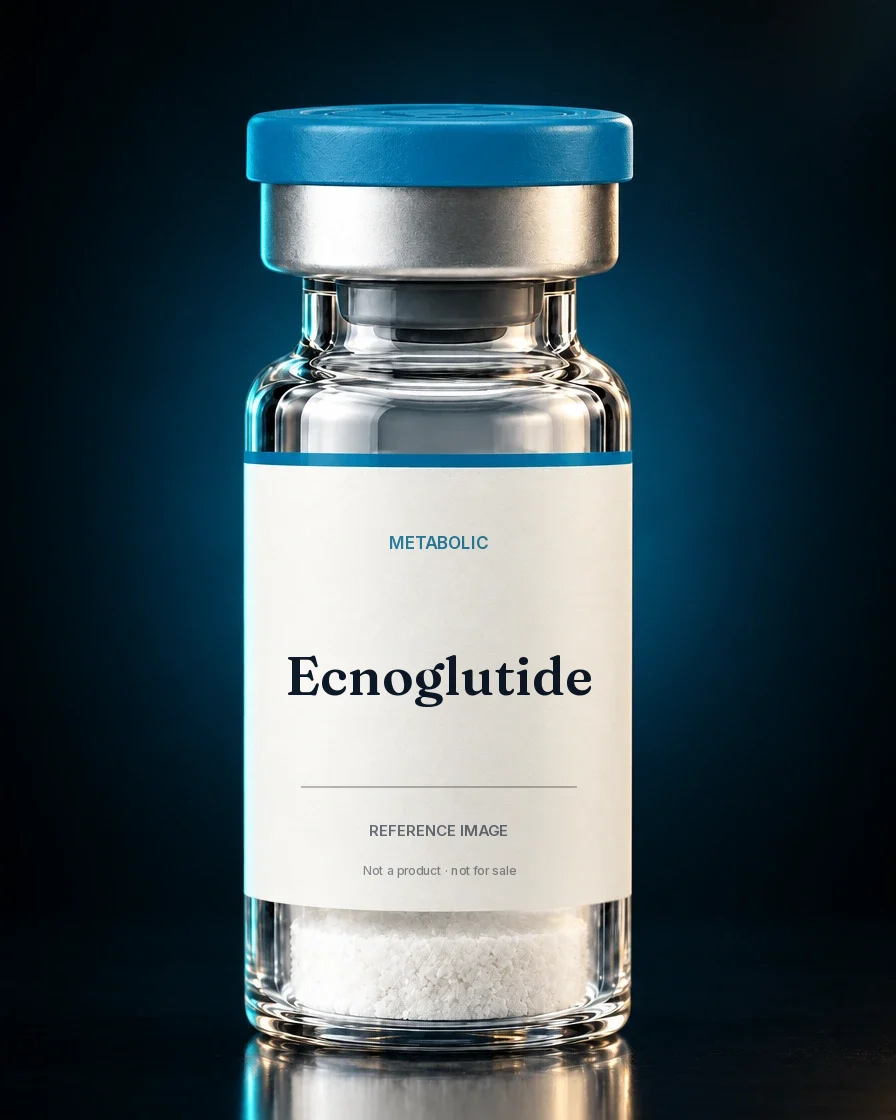
Ecnoglutide (XW003) is a long-acting, cAMP-biased GLP-1 receptor agonist developed by Sciwind Biosciences that received its first approvals in China in 2026, for glycaemic control in type 2 diabetes and then for long-term weight management; it is not approved in the United States.
Ecnoglutide is a GLP-1 analogue built from a GLP-1 backbone with an Ala8Val substitution, which protects against dipeptidyl peptidase cleavage, and a gamma-Glu-2xAEEA-linked C18 diacid fatty acid that supports albumin binding and a long circulating half-life 6. Signalling bias In receptor assays, ecnoglutide potently induced cAMP (EC50 0.018 nM) but did not drive GLP-1 receptor internalisation (EC50 above 10… How it works →
Key evidence
- Ji et al., Lancet Diabetes Endocrinol (NCT05813795) · 2025 · Humans (664 Chinese adults with overweight or obesity, without diabetes)Least-squares mean body-weight change was -9.1%, -10.9% and -13.2% across three ascending once-weekly groups versus +0.1% with placebo; 77% to 87% versus 16% achieved at least 5% reduction; treatment-emergent adverse events occurred in 93% of each active group versus 84% with placebo. 2
- EECOH-1, Nat Commun (NCT05680155) · 2026 · Humans (211 Chinese adults with type 2 diabetes)HbA1c fell by 1.96% and 2.43% in the two ecnoglutide groups versus 0.87% with placebo; estimated treatment differences were -1.09% and -1.56%. 3
- EECOH-2, Lancet Diabetes Endocrinol (NCT05680129) · 2025 · Humans (623 Chinese adults with type 2 diabetes on metformin)HbA1c reductions at week 32 were 1.91% and 1.89% versus 1.65% with dulaglutide, meeting non-inferiority; the authors judged the statistically greater reduction in the higher ecnoglutide group not clinically relevant. 4
Doses given in human trials
- No amounts are reproduced here. The phase 3 obesity trial (NCT05813795) randomised participants to three ascending once-weekly subcutaneous ecnoglutide groups or volume-matched placebo for 40 weeks 2.
- EECOH-1 (NCT05680155) randomised participants to two ascending once-weekly subcutaneous ecnoglutide groups or volume-matched placebo for 24 weeks 3.
- EECOH-2 (NCT05680129) randomised participants to two ascending once-weekly subcutaneous ecnoglutide groups or once-weekly dulaglutide, open-label, for 52 weeks 4.
- The first-in-human study (NCT04389775) used single and multiple ascending once-weekly subcutaneous administration in healthy participants for up to 6 weeks 6.
How long did human studies run?
No human study durations are recorded for Ecnoglutide.
Cycle-length evidence for EcnoglutideSide effects reported in studies
- Treatment-emergent adverse events (any)93% in each of the three ecnoglutide groups versus 84% with placebo · Phase 3 obesity trial, 664 adults, 40 weeks 2
- Discontinuation due to adverse events10 ecnoglutide-treated participants · Phase 3 obesity trial, 40 weeks 2
- Discontinuation due to adverse events3% (6 of 206) and 4% (8 of 208) in ecnoglutide groups versus 3% (6 of 207) with dulaglutide · EECOH-2, type 2 diabetes on metformin, 52 weeks 4
- Decreased appetite, nausea, headacheReported among adverse events in the first-in-human study · Phase 1, healthy participants, up to 6 weeks of once-weekly administration 6
Supplies and handling
- Lyophilized vialSealed vial with the freeze-dried cake. Check the label, lot and the certificate of analysis before opening.
- Sterile diluentThe diluent named on the product documentation. Bacteriostatic water contains benzyl alcohol; sterile water does not.
- Graduated syringesSized to the volume being measured. U-100 insulin syringes are graduated in units where 100 units = 1 mL.
- Alcohol prep padsFor wiping vial stoppers before each puncture.
- Nitrile glovesClean gloves for aseptic handling.
- Sharps containerPuncture-resistant container for used needles.
Storage
Follow the approved product's own labelling where the approved product is involved, and the supplier's documentation for research material. Acylated GLP-1 analogues are generally handled cold and protected from freezing, agitation and light in research settings. No temperatures or preparation steps are given here.
- Lyophilized (unmixed) vials: typically stored cold and dry, away from light, as the documentation directs. Many are stable longer frozen.
- Reconstituted vials: typically refrigerated (about 2–8 °C), protected from light and not frozen.
- Bacteriostatic water contains benzyl alcohol, which inhibits bacterial growth in multi-use vials; sterile water has no preservative.
Handling mistakes and troubleshooting
- Added the wrong volume of diluent
- The concentration changes, not the amount of compound in the vial. Recalculate with the volume actually added and relabel the vial.
- Shook the vial and it foamed
- Let it settle in the refrigerator. Foam is a sign of agitation; some peptides aggregate when shaken. Note it on the label.
- The solution is cloudy or has particles
- Do not use it. Cloudiness can indicate incomplete dissolution, contamination or degradation. Record the lot and contact the supplier with the certificate of analysis.
- The powder cake looks melted or shrunken before reconstitution
- This can indicate the vial was exposed to heat or moisture. Record the lot and condition on arrival.
- Liquid sprayed back when the needle was removed
- Pressure built up in the vial. Withdraw a small volume of air while adding diluent to keep pressure neutral.
Regulatory status
- Status
- Approved outside the United States. A 2026 review of its development reports first approval in China in January 2026 for glycaemic control in adults with type 2 diabetes, followed in March 2026 by approval in China for long-term weight management in adults with obesity, or with overweight plus at least one weight-related comorbidity, in combination with diet control and increased physical activity 1. No Drugs@FDA application record was returned on 24 October 2026 8. No amounts are quoted anywhere in this entry because the Chinese national register document was not opened for this review.
- United States (FDA)
- Not approved in the United States; an openFDA Drugs@FDA query for ecnoglutide returned no application record on 24 October 2026 8.
- Sport (WADA)
- Not named individually in the sources reviewed 13. Because approval status bears on the S0 class, and because this compound now has governmental approval in at least one jurisdiction, athletes should seek a ruling from their anti-doping organisation rather than inferring status from absence of a name 13.
Status varies by country and changes over time. How we describe regulatory status.
Ecnoglutide compared with related compounds
| Compound | Status | Evidence | Human amounts | Half-life |
|---|---|---|---|---|
| Ecnoglutide | Approved outside the US | A | Trial doses | 124 to 138 hours at steady state in heal |
| Dulaglutide | FDA-approved | A | FDA label | Approximately 5 days |
| Semaglutide | FDA-approved | A | FDA label | Approximately 1 week; present in the cir |
| Vesugen | Not approved — research use only | C | None established | — |
| Tesofensine | Investigational | B | Trial doses | About 234 hours (M1 metabolite about 374 |
| Mazdutide | Approved outside the US | A | Trial doses | 150.9 to 403.5 hours (phase 1b in overwe |
Frequently asked questions
What doses of Ecnoglutide have been studied in humans?
Is there an established Ecnoglutide cycle length?
How much bacteriostatic water should be added to a Ecnoglutide vial?
How many units is a given amount on an insulin syringe?
What is the half-life of Ecnoglutide?
Is Ecnoglutide FDA-approved?
References
- Ecnoglutide: First Approvals Drugs. 2026
- Efficacy and safety of a biased GLP-1 receptor agonist ecnoglutide in adults with overweight or obesity: a multicentre, randomised, double-blind, placebo-controlled, phase 3 trial Lancet Diabetes Endocrinol. 2025
- Efficacy and safety of cAMP signalling-biased GLP-1 analogue ecnoglutide monotherapy versus placebo in patients with type 2 diabetes (EECOH-1): a multi-centre, randomised, double-blind, placebo-controlled, phase 3 trial Nat Commun. 2026
- Efficacy and safety of cAMP-biased GLP-1 receptor agonist ecnoglutide versus dulaglutide in patients with type 2 diabetes and elevated glucose concentrations on metformin monotherapy (EECOH-2): a 52-week, multicentre, open-label, non-inferiority, randomised, phase 3 trial Lancet Diabetes Endocrinol. 2025
- Efficacy and safety of GLP-1 analog ecnoglutide in adults with type 2 diabetes: a randomized, double-blind, placebo-controlled phase 2 trial Nat Commun. 2024
- Discovery of ecnoglutide - A novel, long-acting, cAMP-biased glucagon-like peptide-1 (GLP-1) analog Mol Metab. 2023
- Ecnoglutide (CID 162625103) PubChem. 2026
- Drugs@FDA application data queried through openFDA for ecnoglutide (no matching application record returned on 24 October 2026) openFDA / Drugs@FDA. 2026
- A Phase 3 Study to Evaluate the Efficacy of XW003 in Adults With Overweight or Obesity (NCT05813795) ClinicalTrials.gov. 2026
- A Study to Compare XW003 Injection and Semaglutide Injection in Chinese Adults With Obesity (NCT07073417) ClinicalTrials.gov. 2026
- A Study of XW003 Injection in Chinese Adolescents With Obesity (NCT07143227) ClinicalTrials.gov. 2026
- No dose adjustment required for warfarin or metformin when coadministered with the novel GLP-1 receptor agonist ecnoglutide: an open-label, fixed-sequence, crossover study Front Pharmacol. 2026
- International Standard: Prohibited List 2026 World Anti-Doping Agency. 2026
Last reviewed October 24, 2026 by the Amiravo editorial team. Editorial policy · Report an error