Skip to content
For research use only. Not for human or veterinary use. Not a drug, food, or dietary supplement.
Metabolic

Ecnoglutide

Also known as XW003 · XW-003 · Ecnoglutide injection · cAMP-biased GLP-1 analogue (Sciwind) · VRB-101 (oral tablet programme) · XW004 (oral tablet)

Ecnoglutide (XW003) is a long-acting, cAMP-biased GLP-1 receptor agonist developed by Sciwind Biosciences that received its first approvals in China in 2026, for glycaemic control in type 2 diabetes and then for long-term weight management; it is not approved in the United States.

US status
Approved outside the US
Evidence
Grade A
Half-life
Steady-state half-life of 124 to 138 hours in healthy participants in the first-in-human phase 1 study, which the authors said supports once-weekly administration 6.
Class
Long-acting, cAMP signalling-biased GLP-1 receptor agonist (fatty-acylated GLP-1 analogue)
More
Log a sample
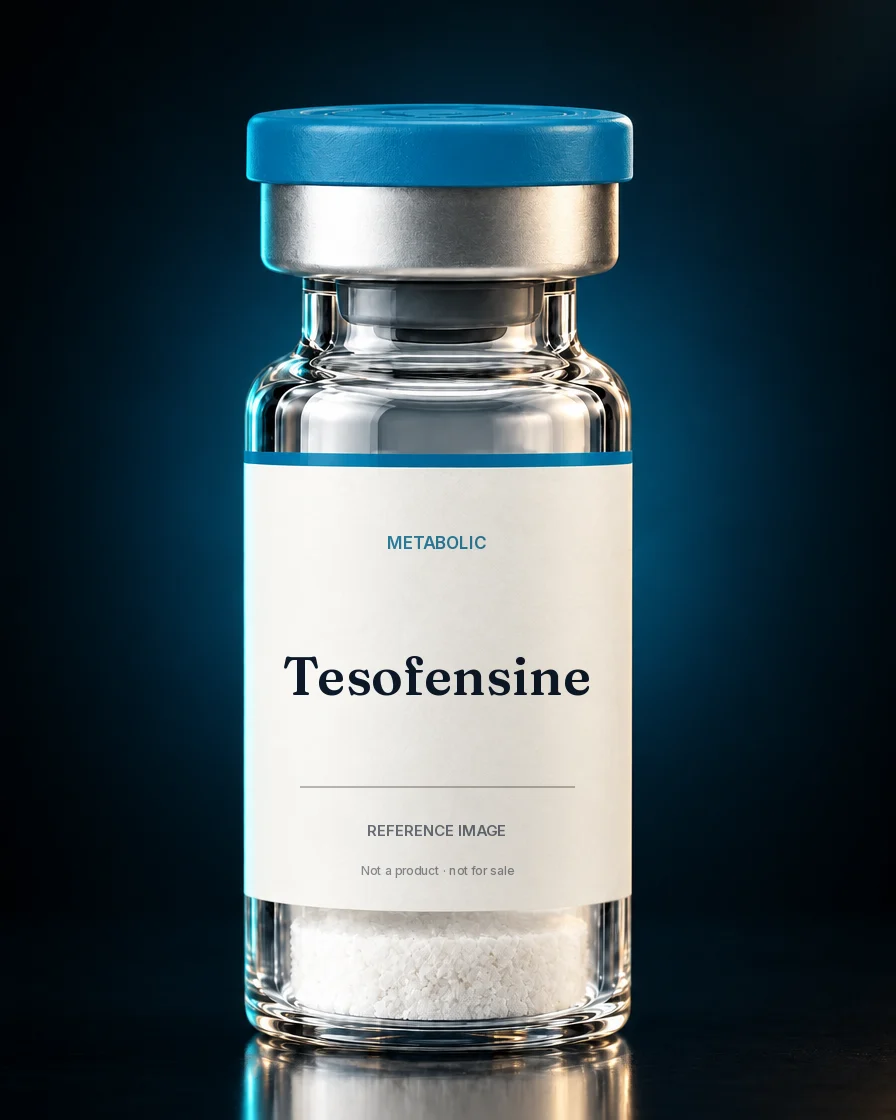
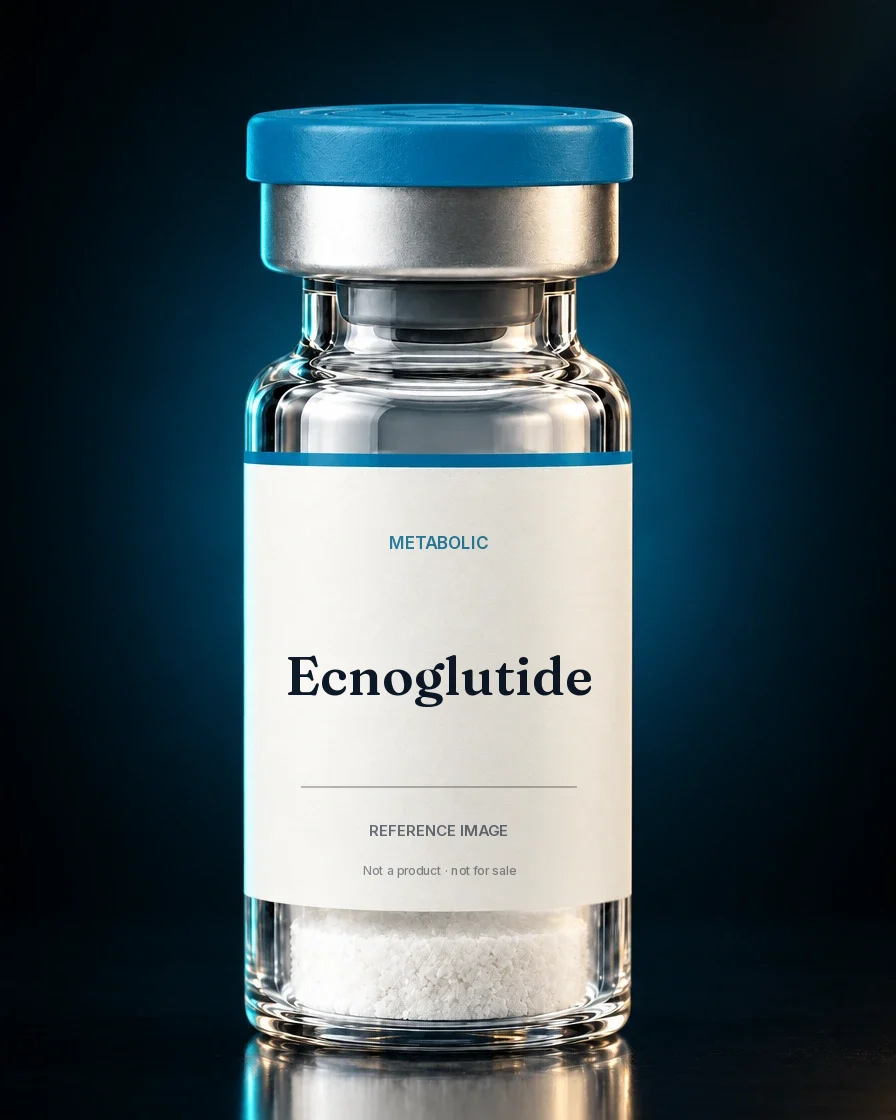
Unbranded reference vial illustrating Ecnoglutide; not an actual product
Research reference, not advice. Amiravo sells nothing; some links are referrals.Read the full notice

Key takeaways

  • Ecnoglutide received its first approvals in China in 2026: January for glycaemic control in type 2 diabetes and March for long-term weight management; it has no Drugs@FDA application record 1,8.
  • It is described as a cAMP-biased GLP-1 receptor agonist, inducing cAMP potently in vitro while not driving GLP-1 receptor internalisation 6.
  • In a 40-week phase 3 trial in 664 Chinese adults with overweight or obesity, least-squares mean body-weight change ranged from -9.1% to -13.2% across three ascending groups versus +0.1% with placebo 2.
  • In type 2 diabetes, phase 3 trials reported HbA1c reductions of 1.96% and 2.43% versus 0.87% with placebo over 24 weeks, and non-inferiority to dulaglutide at week 32 over a 52-week trial 3,4.
  • All pivotal trials located were conducted in China and funded by Hangzhou Sciwind Biosciences; gastrointestinal adverse events were the most common finding 2,3,4.

Development stage

Where Ecnoglutide sits between laboratory work and regulatory approval.

  1. Preclinical
  2. Phase 1
  3. Phase 2
  4. Phase 3
  5. Approved (current)

Stage comes from the regulatory record and ClinicalTrials.gov studies naming the compound (for compounds approved nowhere, only completed trials or trials with posted results count) (checked 2026-10-24). A registered trial is not a result.

Mechanism of action

Ecnoglutide is a GLP-1 analogue built from a GLP-1 backbone with an Ala8Val substitution, which protects against dipeptidyl peptidase cleavage, and a gamma-Glu-2xAEEA-linked C18 diacid fatty acid that supports albumin binding and a long circulating half-life 6.

Signalling bias

In receptor assays, ecnoglutide potently induced cAMP (EC50 0.018 nM) but did not drive GLP-1 receptor internalisation (EC50 above 10 micromolar), which the developers describe as a signalling bias toward the cAMP pathway rather than beta-arrestin recruitment 6. A commentary in Lancet Diabetes and Endocrinology discusses this bias as the drug's distinguishing feature while noting that its clinical consequences relative to established GLP-1 receptor agonists remain to be established 4.

Downstream effects

As with other GLP-1 receptor agonists, the reported effects are glucose-dependent insulin secretion, slowed gastric emptying and reduced appetite; in db/db mice and diet-induced obese rats ecnoglutide reduced blood glucose and body weight, with the developers reporting a greater body-weight effect than semaglutide in those models 6.

Pharmacokinetics and interactions

Steady-state half-life in healthy participants was 124 to 138 hours 6. Open-label crossover interaction studies in healthy participants reported no need for dose adjustment of warfarin or metformin when given with ecnoglutide 12.

Molecular structure

PubChem CID 162625103 ↗
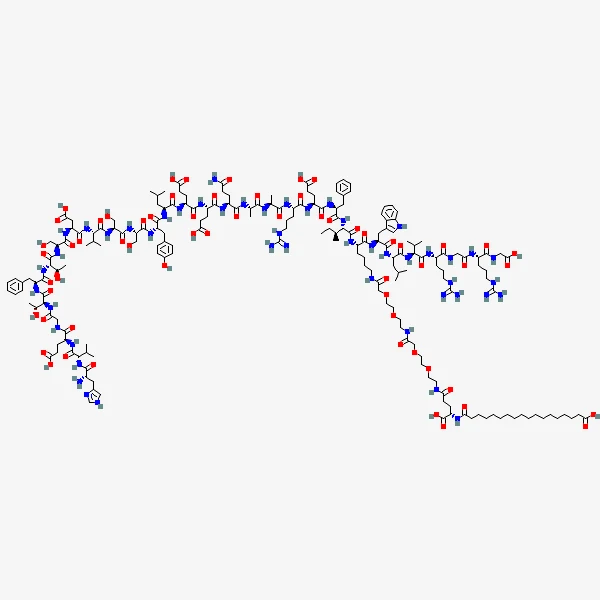
2D chemical structure of Ecnoglutide

2D depiction generated from the PubChem record. Depictions are schematic and do not show salt form, counter-ions or conformation.

Formula
C194H304N48O61
Molecular weight
4285 g/mol
CAS
2459531-73-6
InChIKey
DJMLKAVQDZZBNC-NYHUXPQOSA-N

Research overview

Human research

The published programme is phase 1 to phase 3 and conducted in China with manufacturer funding. A phase 2 randomised, double-blind, placebo-controlled trial in adults with type 2 diabetes preceded the pivotal studies 5. EECOH-1 (NCT05680155) randomised 211 adults with type 2 diabetes at 32 centres to once-weekly ecnoglutide at two levels or volume-matched placebo for 24 weeks; least-squares mean HbA1c change was -1.96% and -2.43% versus -0.87% with placebo 3. EECOH-2 (NCT05680129) was a 52-week open-label trial at 52 hospitals in 623 adults with type 2 diabetes on metformin, comparing two ecnoglutide groups with dulaglutide; HbA1c reductions at week 32 were 1.91% and 1.89% versus 1.65% with dulaglutide, meeting non-inferiority, with reductions sustained to week 52, and treatment discontinuation due to adverse events in 3% to 4% of participants in each group 4. The obesity trial (NCT05813795, registry record) randomised 664 adults with BMI at or above 28, or at or above 24 with a weight-related comorbidity, without diabetes, at 36 centres for 40 weeks: least-squares mean body-weight change was -9.1%, -10.9% and -13.2% across ascending groups versus +0.1% with placebo, and 77%, 84% and 87% versus 16% achieved at least 5% reduction 2,9. Trials in adolescents with obesity (NCT07143227), a head-to-head comparison with semaglutide (NCT07073417), obstructive sleep apnoea and knee osteoarthritis populations are registered, and an oral formulation programme is in clinical development 1,10,11.

Animal research

In db/db mice and a diet-induced obese rat model, ecnoglutide reduced blood glucose, increased insulin induction and produced a greater body-weight reduction than semaglutide in the developers' experiments 6.

In-vitro research

In GLP-1 receptor signalling assays, ecnoglutide induced cAMP with an EC50 of 0.018 nM but did not promote receptor internalisation (EC50 above 10 micromolar), the basis for describing it as cAMP-biased 6.

Key studies

  1. Multicentre, randomised, double-blind, placebo-controlled phase 3 trial, 40 weeks, 36 centres in China
    Model: Humans (664 Chinese adults with overweight or obesity, without diabetes)

    Least-squares mean body-weight change was -9.1%, -10.9% and -13.2% across three ascending once-weekly groups versus +0.1% with placebo; 77% to 87% versus 16% achieved at least 5% reduction; treatment-emergent adverse events occurred in 93% of each active group versus 84% with placebo.

  2. Multicentre, randomised, double-blind, placebo-controlled phase 3 monotherapy trial, 24 weeks, 32 centres in China
    Model: Humans (211 Chinese adults with type 2 diabetes)

    HbA1c fell by 1.96% and 2.43% in the two ecnoglutide groups versus 0.87% with placebo; estimated treatment differences were -1.09% and -1.56%.

  3. 52-week, multicentre, open-label, active-controlled non-inferiority phase 3 trial versus dulaglutide, 52 hospitals in China
    Model: Humans (623 Chinese adults with type 2 diabetes on metformin)

    HbA1c reductions at week 32 were 1.91% and 1.89% versus 1.65% with dulaglutide, meeting non-inferiority; the authors judged the statistically greater reduction in the higher ecnoglutide group not clinically relevant.

  4. Randomised, double-blind, placebo-controlled phase 2 trial
    Model: Humans (adults with type 2 diabetes)

    Reported efficacy and safety results supporting progression to phase 3; funded by the manufacturer.

  5. Receptor signalling assays, rodent models, and a double-blind randomised placebo-controlled single and multiple ascending dose phase 1 study (NCT04389775)
    Model: Cells, animals (db/db mice, diet-induced obese rats) and humans (healthy participants)

    cAMP EC50 of 0.018 nM without receptor internalisation; greater body-weight reduction than semaglutide in rodents; steady-state half-life 124 to 138 hours, with decreased appetite, nausea and headache among adverse events.

  6. Open-label, fixed-sequence crossover interaction study
    Model: Humans (healthy participants)

    Reported that no dose adjustment is required for warfarin or metformin when coadministered with ecnoglutide.

Doses used in published trials

What investigators administered in the cited studies, recorded as a fact about those studies. Not a protocol and not a recommendation.

Full dosing reference, study durations and vial arithmetic →
  • No amounts are reproduced here. The phase 3 obesity trial (NCT05813795) randomised participants to three ascending once-weekly subcutaneous ecnoglutide groups or volume-matched placebo for 40 weeks 2.
  • EECOH-1 (NCT05680155) randomised participants to two ascending once-weekly subcutaneous ecnoglutide groups or volume-matched placebo for 24 weeks 3.
  • EECOH-2 (NCT05680129) randomised participants to two ascending once-weekly subcutaneous ecnoglutide groups or once-weekly dulaglutide, open-label, for 52 weeks 4.
  • The first-in-human study (NCT04389775) used single and multiple ascending once-weekly subcutaneous administration in healthy participants for up to 6 weeks 6.

Published adverse-event data

Reported in the cited trials or product labels. Frequencies apply to the stated population and do not transfer to other settings.

  • Treatment-emergent adverse events (any)
    93% in each of the three ecnoglutide groups versus 84% with placebo
    Phase 3 obesity trial, 664 adults, 40 weeks 2 · Most common events were mild-to-moderate gastrointestinal events
  • Discontinuation due to adverse events
    10 ecnoglutide-treated participants
    Phase 3 obesity trial, 40 weeks 2 · Not further graded in the report
  • Discontinuation due to adverse events
    3% (6 of 206) and 4% (8 of 208) in ecnoglutide groups versus 3% (6 of 207) with dulaglutide
    EECOH-2, type 2 diabetes on metformin, 52 weeks 4 · Not further graded in the abstract
  • Decreased appetite, nausea, headache
    Reported among adverse events in the first-in-human study
    Phase 1, healthy participants, up to 6 weeks of once-weekly administration 6 · Not graded in the report

Emerging safety signals

  • Gastrointestinal adverse events dominate the reported profile, as with other GLP-1 receptor agonists: nearly all participants in each active group of the phase 3 obesity trial had at least one treatment-emergent adverse event, mostly mild-to-moderate gastrointestinal events 2. 2 (2025)
  • All pivotal evidence comes from trials conducted in China and funded by the manufacturer, so generalisability to other populations and independent replication remain open 2,3,4. 4 (2026)

What is not known: Long-term outcomes, including cardiovascular outcomes, have not been reported in the sources reviewed. Whether the cAMP signalling bias produces any clinical advantage over established GLP-1 receptor agonists is unresolved; the one active-controlled trial met non-inferiority to dulaglutide and its authors judged the statistically greater HbA1c reduction not clinically relevant 4. All pivotal trials were conducted in China in largely Chinese populations and funded by the manufacturer, and no non-Chinese regulatory approval was identified 1,8. A head-to-head trial against semaglutide in obesity is registered but not reported in the sources reviewed 10. Paediatric use is under study rather than established 1,11.

Background viewing

We haven't found a clinician video focused on Ecnoglutide yet. Meanwhile, this widely watched talk covers the science of aging in general. It does not discuss Ecnoglutide.

David Sinclair, PhD (Harvard Medical School) on the biology of aging
The Diary Of A CEO · 6.9M views · 2026

These creators are not affiliated with Amiravo and do not endorse Amiravo or any product linked on this site. Nothing here is medical advice. Video views counted on YouTube as of Oct 24, 2026.

Regulatory status

Status
Approved outside the United States. A 2026 review of its development reports first approval in China in January 2026 for glycaemic control in adults with type 2 diabetes, followed in March 2026 by approval in China for long-term weight management in adults with obesity, or with overweight plus at least one weight-related comorbidity, in combination with diet control and increased physical activity 1. No Drugs@FDA application record was returned on 24 October 2026 8. No amounts are quoted anywhere in this entry because the Chinese national register document was not opened for this review.
United States (FDA)
Not approved in the United States; an openFDA Drugs@FDA query for ecnoglutide returned no application record on 24 October 2026 8.
Sport (WADA)
Not named individually in the sources reviewed 13. Because approval status bears on the S0 class, and because this compound now has governmental approval in at least one jurisdiction, athletes should seek a ruling from their anti-doping organisation rather than inferring status from absence of a name 13.

Status varies by country and changes over time. How we describe regulatory status.

Quality and testing notes

Research material should be distinguished from the approved Chinese product, which is supplied under its own specification. A certificate of analysis for research material would be expected to show identity by mass spectrometry against the expected mass (PubChem lists C194H304N48O61, about 4285 Da), purity by reverse-phase HPLC with the trace shown, confirmation of the Ala8Val substitution and of the gamma-Glu-2xAEEA-linked C18 diacid side chain, net peptide content separate from gross weight, counter-ion identity and an endotoxin measurement [7]. Analytical methods for simultaneous measurement of several GLP-1 receptor agonists, including ecnoglutide, have been published and are relevant to identity checks on mislabelled material [1].

How purity testing works · Reading a certificate of analysis

Check a Ecnoglutide certificate of analysis against its expected mass (4,285 Da)

Storage and handling

Follow the approved product's own labelling where the approved product is involved, and the supplier's documentation for research material. Acylated GLP-1 analogues are generally handled cold and protected from freezing, agitation and light in research settings. No temperatures or preparation steps are given here.

Frequently asked questions

Is ecnoglutide approved?
Yes, in China. A 2026 review of its development reports first approval in January 2026 for glycaemic control in adults with type 2 diabetes and in March 2026 for long-term weight management 1. No Drugs@FDA application record was returned, so it is not approved in the United States 8.
What does "cAMP-biased" mean here?
In receptor assays it induced cAMP with an EC50 of 0.018 nM while not driving GLP-1 receptor internalisation, so signalling is described as biased toward the cAMP pathway rather than beta-arrestin recruitment 6.
How much body-weight change was reported in the obesity trial?
In 664 Chinese adults over 40 weeks, least-squares mean body-weight change was -9.1%, -10.9% and -13.2% across three ascending groups versus +0.1% with placebo 2.
How does it compare with other GLP-1 receptor agonists?
The only published active comparison is against dulaglutide in type 2 diabetes, where both ecnoglutide groups met non-inferiority for HbA1c at week 32 and the authors judged the statistically greater reduction in the higher group not clinically relevant 4. A head-to-head obesity trial against semaglutide is registered but not reported in the sources reviewed 10.
How long does it stay in the body?
Steady-state half-life was 124 to 138 hours in healthy participants, which the developers said supports once-weekly administration 6.
What adverse events were reported?
In the phase 3 obesity trial, 93% of participants in each ecnoglutide group versus 84% with placebo had at least one treatment-emergent adverse event, most commonly mild-to-moderate gastrointestinal events, and 10 ecnoglutide-treated participants discontinued because of adverse events 2.
Why are no amounts listed on this page?
The approvals are outside the United States and the Chinese national register document was not opened for this entry, so this page gives trial designs and outcomes without amounts.
Is it allowed in sport?
It is not named individually in the sources reviewed, and it now holds governmental approval in at least one jurisdiction, which bears on how the S0 class applies; athletes should seek a ruling from their anti-doping organisation 13.

Latest indexed research

Search all studies on Ecnoglutide (PubMed, Europe PMC, ClinicalTrials.gov)

Listed by publication type from the index record. Inclusion is not an endorsement; open the source to read the findings.

Revision history

Meaningful changes to this entry, with dates and sources. Last reviewed Oct 24, 2026. Typo and layout fixes are not listed.

  • New section· entryOct 24, 2026

    New research reference added: Ecnoglutide.

References

  1. Ecnoglutide: First Approvals Drugs. 2026
  2. Efficacy and safety of a biased GLP-1 receptor agonist ecnoglutide in adults with overweight or obesity: a multicentre, randomised, double-blind, placebo-controlled, phase 3 trial Lancet Diabetes Endocrinol. 2025
  3. Efficacy and safety of cAMP signalling-biased GLP-1 analogue ecnoglutide monotherapy versus placebo in patients with type 2 diabetes (EECOH-1): a multi-centre, randomised, double-blind, placebo-controlled, phase 3 trial Nat Commun. 2026
  4. Efficacy and safety of cAMP-biased GLP-1 receptor agonist ecnoglutide versus dulaglutide in patients with type 2 diabetes and elevated glucose concentrations on metformin monotherapy (EECOH-2): a 52-week, multicentre, open-label, non-inferiority, randomised, phase 3 trial Lancet Diabetes Endocrinol. 2025
  5. Efficacy and safety of GLP-1 analog ecnoglutide in adults with type 2 diabetes: a randomized, double-blind, placebo-controlled phase 2 trial Nat Commun. 2024
  6. Discovery of ecnoglutide - A novel, long-acting, cAMP-biased glucagon-like peptide-1 (GLP-1) analog Mol Metab. 2023
  7. Ecnoglutide (CID 162625103) PubChem. 2026
  8. Drugs@FDA application data queried through openFDA for ecnoglutide (no matching application record returned on 24 October 2026) openFDA / Drugs@FDA. 2026
  9. A Phase 3 Study to Evaluate the Efficacy of XW003 in Adults With Overweight or Obesity (NCT05813795) ClinicalTrials.gov. 2026
  10. A Study to Compare XW003 Injection and Semaglutide Injection in Chinese Adults With Obesity (NCT07073417) ClinicalTrials.gov. 2026
  11. A Study of XW003 Injection in Chinese Adolescents With Obesity (NCT07143227) ClinicalTrials.gov. 2026
  12. No dose adjustment required for warfarin or metformin when coadministered with the novel GLP-1 receptor agonist ecnoglutide: an open-label, fixed-sequence, crossover study Front Pharmacol. 2026
  13. International Standard: Prohibited List 2026 World Anti-Doping Agency. 2026

Last reviewed October 24, 2026 by the Amiravo editorial team.

Read our editorial policy · Report an error on this page

For research use only. Not for human or veterinary use. Not a drug, food, or dietary supplement. This page is educational and is not medical advice.

Unbranded reference vial illustrating Ecnoglutide; not an actual product

Unbranded reference image. Amiravo does not produce, supply or sell this compound.

Specifications

Molecular formula
C194H304N48O61
Molecular weight
4,285 g/mol
CAS number
2459531-73-6
PubChem CID
162625103
FDA UNII
KM6YM7L8LH
Type
Single compound

Identifiers from PubChem. Verify against the supplier’s documentation for your lot.

Research stats

How much has been published, not how good it is.

PubMed records
16
Indexed as human research
12
Animal-only research
0
Randomized controlled trials
5
Registered trials
17
Trials with posted results
0
2006: 02007: 02008: 02009: 02010: 02011: 02012: 02013: 02014: 02015: 02016: 02017: 02018: 02019: 02020: 02021: 02022: 02023: 12024: 22025: 52026: 920062026
PubMed records per year (current year is partial).

Counts from title/abstract searches of PubMed, ClinicalTrials.gov, openFDA and NIH RePORTER, checked 2026-10-24. Names shared with other substances can inflate counts. FAERS reports are spontaneous and do not establish cause. Funding shows interest, not evidence. Method

Follow Ecnoglutide

See every new citation, evidence-grade or status change and correction in My Research, with optional email alerts. Free account.