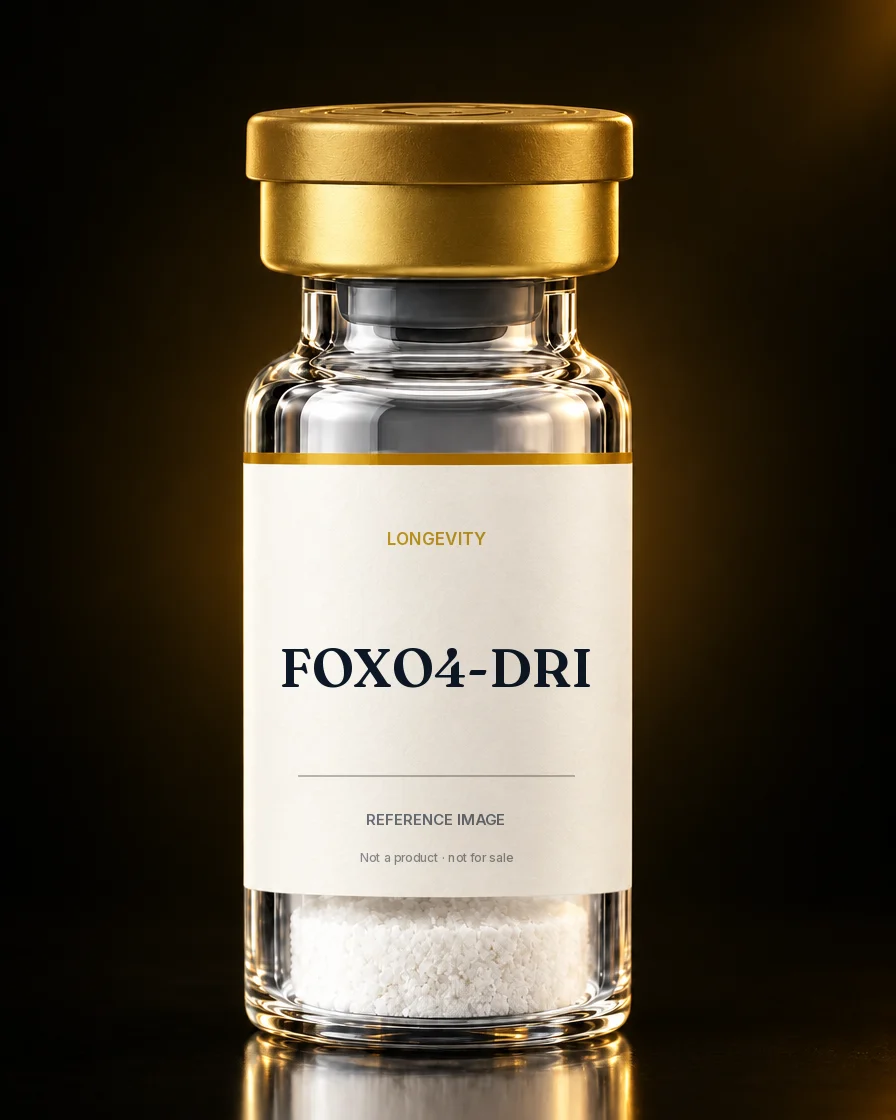
 Longevity · Dosing reference
FOXO4-DRI dosage
What the human evidence does and does not show, how long studies ran, and the arithmetic for working with vials.
- Regulatory status
- Not approved — research use only
- Human amounts
- None established in humans
- Route studied
- —
- Frequency
- Not established
- Half-life
- Not established
- Evidence grade
- Grade C · Preclinical research
- Vial sizes on the market
- 10 mg
- Other forms seen
- —
What FOXO4-DRI is
A synthetic D-retro-inverso peptide that disrupts FOXO4 and p53 interaction, studied in senescent cell research.
In senescent cells, FOXO4 has been reported to associate with p53 and keep it in the nucleus, which was described as maintaining viability and suppressing apoptosis in those cells 1,7. FOXO4-DRI was designed as a competing peptide: in cell experiments it caused p53 nuclear exclusion and apoptosis selectively in senescent cells 1. Structural basis A 2025 NMR study reported that both FOXO4 and FOXO4-DRI target the… How it works →
Key evidence
- Baar et al., Cell · 2017 · Cells, then mice (doxorubicin chemotoxicity; XpdTTD/TTD fast-ageing and naturally aged animals)A designed FOXO4-interfering peptide caused p53 nuclear exclusion and apoptosis selectively in senescent cells and, in mice, was associated with counteraction of chemotoxicity and with restored fitness, fur density and renal function. 1
- Zhang et al., Aging (Albany NY) · 2020 · Human tissue, TM3 Leydig cells, naturally aged miceReported selective apoptosis of senescent Leydig cells and, in naturally aged mice, an improved testicular microenvironment and alleviation of age-related testosterone secretion insufficiency. 8
- Born et al., Circulation · 2023 · Human lung tissue, mice (including serotonin-transporter overexpressing) and ratsElimination of senescent pulmonary endothelial cells, including with FOXO4-DRI, was associated with worsened pulmonary haemodynamics and loss of pulmonary endothelial cells, leading the authors to caution about senolytic strategies. 10
What the human evidence shows
We searched PubMed and ClinicalTrials.gov and found no human studies that administered FOXO4-DRI. The research described on its page is from cells or animals, and animal amounts do not translate to people.
How long did human studies run?
No human study durations are recorded for FOXO4-DRI.
Cycle-length evidence for FOXO4-DRIFOXO4-DRI draw calculator
Pick the vial strength and the water added, enter an amount, and see the concentration, the units to draw and how many draws the vial holds. Arithmetic only.
Computed from your inputs. Not a dose or a recommendation.
Compare water volumes for this vialShow
More water = lower concentration = a larger, easier-to-measure draw. Tap a row to use it.
| Water | mg/mL | Draw |
|---|---|---|
| 0.5 mL | 20 | — |
| 1 mL | 10 | — |
| 1.5 mL | 6.667 | — |
| 2 mL | 5 | — |
| 2.5 mL | 4 | — |
| 3 mL | 3.333 | — |
| 5 mL | 2 | — |
Supplies and handling
- Lyophilized vialSealed vial with the freeze-dried cake. Check the label, lot and the certificate of analysis before opening.
- Sterile diluentThe diluent named on the product documentation. Bacteriostatic water contains benzyl alcohol; sterile water does not.
- Graduated syringesSized to the volume being measured. U-100 insulin syringes are graduated in units where 100 units = 1 mL.
- Alcohol prep padsFor wiping vial stoppers before each puncture.
- Nitrile glovesClean gloves for aseptic handling.
- Sharps containerPuncture-resistant container for used needles.
Storage
General research-context handling only. Lyophilized synthetic peptides are typically held cold and protected from light and moisture, and reconstituted material is less stable than lyophilized material; defer to the supplier's own stability and handling documentation for the specific lot. No preparation or administration instructions are given on this page.
- Lyophilized (unmixed) vials: typically stored cold and dry, away from light, as the documentation directs. Many are stable longer frozen.
- Reconstituted vials: typically refrigerated (about 2–8 °C), protected from light and not frozen.
- Bacteriostatic water contains benzyl alcohol, which inhibits bacterial growth in multi-use vials; sterile water has no preservative.
Handling mistakes and troubleshooting
- Added the wrong volume of diluent
- The concentration changes, not the amount of compound in the vial. Recalculate with the volume actually added and relabel the vial.
- Shook the vial and it foamed
- Let it settle in the refrigerator. Foam is a sign of agitation; some peptides aggregate when shaken. Note it on the label.
- The solution is cloudy or has particles
- Do not use it. Cloudiness can indicate incomplete dissolution, contamination or degradation. Record the lot and contact the supplier with the certificate of analysis.
- The powder cake looks melted or shrunken before reconstitution
- This can indicate the vial was exposed to heat or moisture. Record the lot and condition on arrival.
- Liquid sprayed back when the needle was removed
- Pressure built up in the vial. Withdraw a small volume of air while adding diluent to keep pressure neutral.
Regulatory status
- Status
- Not approved by the FDA for any use, and no DailyMed drug label for it was found 3,4. No registered clinical trial of FOXO4-DRI was identified in a ClinicalTrials.gov search, which returned no studies for the term 5. It does not appear in any category of FDA's May 14, 2026 503A bulk drug substances list 6.
- United States (FDA)
- No approved FDA application exists for FOXO4-DRI, and a DailyMed name search returned no label 3,4. The compound does not appear in category 1, 2 or 3 of FDA's May 14, 2026 503A bulk drug substances list, so it has no recognised position in that compounding framework 6. No registered clinical trial was identified on ClinicalTrials.gov 5.
- Sport (WADA)
- FOXO4-DRI is not named anywhere in the WADA 2026 Prohibited List 16. That is hedged negative evidence, not a clearance: section S0, Non-Approved Substances, prohibits at all times any pharmacological substance not addressed by a later section and with no current approval by any governmental regulatory health authority for human therapeutic use, and introduces its named examples with "including but not limited to" 16. A substance with no approval anywhere and no section of its own is the situation S0 is written to cover, so an athlete should not read the absence of the name as permission 16.
Status varies by country and changes over time. How we describe regulatory status.
FOXO4-DRI compared with related compounds
| Compound | Status | Evidence | Human amounts | Half-life |
|---|---|---|---|---|
| FOXO4-DRI | Not approved — research use only | C | None established | — |
| Methylene Blue | FDA-approved | A | FDA label | Approximately 24 hours |
| L-Glutathione | Not approved — research use only | B | None established | — |
| Epithalon | Not approved — research use only | C | None established | — |
| N-Acetyl Epithalon Amidate | Not approved — research use only | — | None established | — |
| NAD+ | Not approved — research use only | B | None established | — |
Frequently asked questions
What doses of FOXO4-DRI have been studied in humans?
Is there an established FOXO4-DRI cycle length?
How much bacteriostatic water should be added to a FOXO4-DRI vial?
How many units is a given amount on an insulin syringe?
Is FOXO4-DRI FDA-approved?
References
- Targeted Apoptosis of Senescent Cells Restores Tissue Homeostasis in Response to Chemotoxicity and Aging Cell. 2017
- FOXO4-DRI (CID 168431240): molecular formula C228H388N86O64, molecular weight 5358 PubChem. 2026
- Therapeutic peptides in gerontology: mechanisms and applications for healthy aging Front Aging. 2026
- DailyMed drug name search returned no labels for FOXO4 (searched 22 October 2026) DailyMed. 2026
- ClinicalTrials.gov search for "FOXO4-DRI" returned 0 studies (searched 22 October 2026) ClinicalTrials.gov. 2026
- Bulk Drug Substances Nominated for Use in Compounding Under Section 503A of the Federal Food, Drug, and Cosmetic Act (updated May 14, 2026) FDA. 2026
- Cellular Senescence Contributes to the Progression of Hyperoxic Bronchopulmonary Dysplasia Am J Respir Cell Mol Biol. 2024
- FOXO4-DRI alleviates age-related testosterone secretion insufficiency by targeting senescent Leydig cells in aged mice Aging (Albany NY). 2020
- FOXO4-DRI regulates endothelial cell senescence via the P53 signaling pathway Front Bioeng Biotechnol. 2025
- Eliminating Senescent Cells Can Promote Pulmonary Hypertension Development and Progression Circulation. 2023
- The disordered p53 transactivation domain is the target of FOXO4 and the senolytic compound FOXO4-DRI Nat Commun. 2025
- Targeting the FOXO4-p53 axis by retro-inverso peptide senolytic agents: a pharmacological strategy to mitigate brain aging and cognitive decline Naunyn Schmiedebergs Arch Pharmacol. 2026
- FOXO4-D-Retro-Inverso targets extracellular matrix production in fibroblasts and ameliorates bleomycin-induced pulmonary fibrosis in mice Naunyn Schmiedebergs Arch Pharmacol. 2023
- FOXO4 as a Redox-Sensitive Regulator of Antioxidant Defense and Cellular Senescence: Cysteine-Based Signaling, p53 Interaction, and Therapeutic Targeting Antioxidants (Basel). 2026
- Targeting Multiple Homeostasis-Maintaining Systems by Ionophore Nigericin Is a Novel Approach for Senolysis Int J Mol Sci. 2022
- World Anti-Doping Code International Standard: Prohibited List 2026 WADA. 2026
Last reviewed October 22, 2026 by the Amiravo editorial team. Editorial policy · Report an error