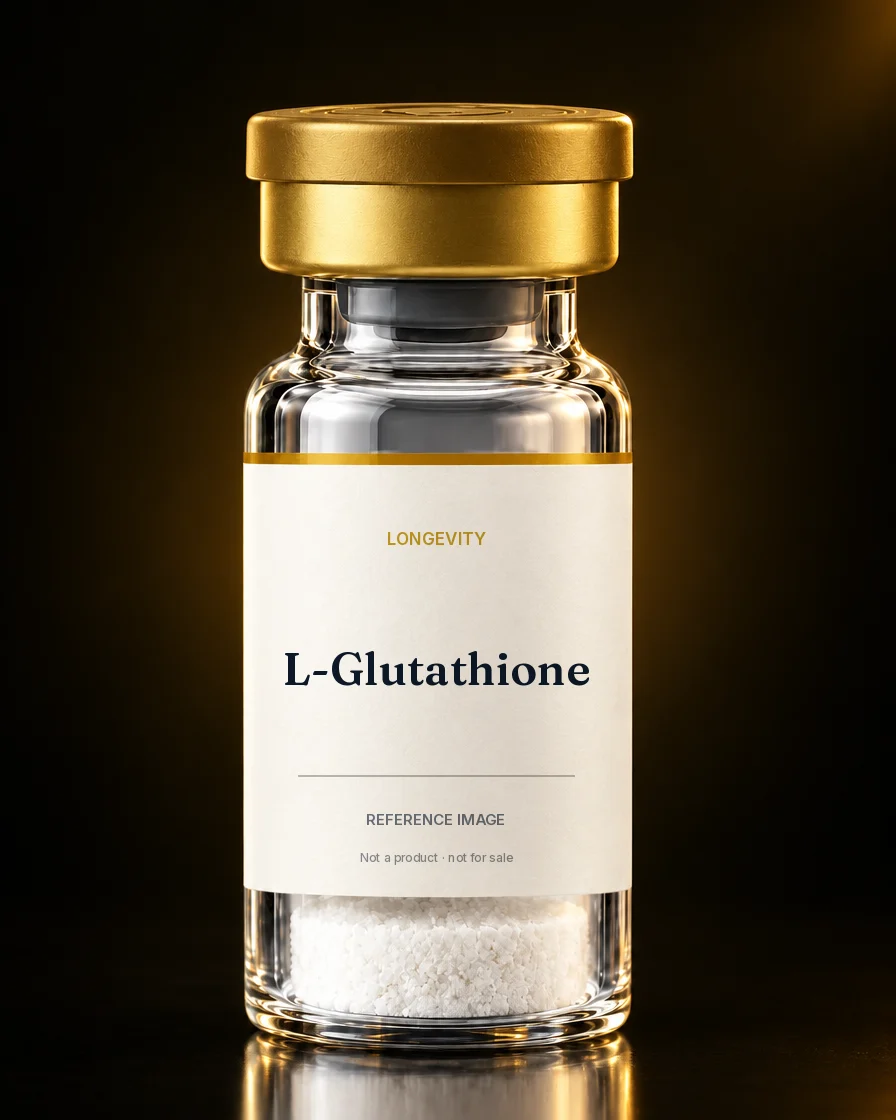
 Longevity · Dosing reference
L-Glutathione dosage
What the human evidence does and does not show, how long studies ran, and the arithmetic for working with vials.
- Regulatory status
- Not approved — research use only
- Human amounts
- None established in humans
- Route studied
- Oral, sublingual, intravenous and nebulized inhalation in the human studies reviewed
- Frequency
- Not established
- Half-life
- Not established
- Evidence grade
- Grade B · Limited human data
- Vial sizes on the market
- 600 mg · 1200 mg · 1500 mg
- Other forms seen
- Liquid spray 10 mL (500 mg, 50 mg/mL)
What L-Glutathione is
A naturally occurring tripeptide of glutamate, cysteine and glycine, studied in research on redox biology and oxidative stress.
Glutathione is a tripeptide composed of glutamate, cysteine and glycine 6,8. Its reactive group is the cysteine thiol, which is what allows it to participate in redox chemistry; the oxidised form, glutathione disulfide (GSSG), is two glutathione molecules joined through that thiol, and the ratio between reduced and oxidised forms is the measure usually treated as an index of cellular redox state 1,2. Enzymatic… How it works →
Key evidence
- Richie et al., European Journal of Nutrition · 2015 · Humans (54 non-smoking adults)Glutathione increased at 1, 3 and 6 months at both intake levels; at 6 months increases were about 30–35% in erythrocytes, plasma and lymphocytes and about 260% in buccal cells in the higher group (P < 0.05), returning to baseline after a one-month washout. Whole-blood oxidised-to-reduced ratio decreased and natural killer cytotoxicity increased more than two-fold versus placebo in the higher group at 3 months. 1
- Schmitt et al., Redox Biology · 2015 · Humans (20 volunteers with metabolic syndrome)The sublingual form produced higher plasma total and reduced glutathione and a higher GSH/GSSG ratio than oral glutathione (p = 0.003), with a significant plasma vitamin E increase only in the sublingual group (p = 0.04). The authors note glutathione's very low bioavailability as the problem being addressed. 2
- Hauser et al., Movement Disorders · 2009 · Humans (21 subjects with Parkinson's disease inadequately controlled on existing medication)No significant differences in change in UPDRS scores; ADL plus motor scores improved by a mean 2.8 units more with glutathione (P = 0.32) then worsened by a mean 3.5 units more over the following 8 weeks (P = 0.54). Reported adverse events were similar between groups and no safety concerns were identified in this small sample. 3
What the human evidence shows
Human studies of L-Glutathione are listed below by design, population and duration. None was designed or powered to establish an amount, and Amiravo does not reproduce their amounts for a compound approved nowhere.
- A 6-month randomized, double-blinded, placebo-controlled trial in 54 non-smoking adults compared two oral glutathione levels with placebo, measuring glutathione in blood, erythrocytes, plasma, lymphocytes and exfoliated buccal cells at 1, 3 and 6 months, with immune markers in a subset; glutathione levels rose in a dose- and time-dependent way and returned to baseline after a 1-month washout 1.
- A three-week randomized crossover trial in 20 volunteers with metabolic syndrome compared a sublingual glutathione form with oral glutathione and N-acetylcysteine, measuring plasma total and reduced glutathione, the GSH/GSSG ratio and oxidative stress markers at several time points during each 21-day period 2.
- A randomized, placebo-controlled, double-blind pilot trial in Parkinson's disease randomly assigned 21 subjects whose motor symptoms were inadequately controlled to intravenous glutathione (n = 11) or placebo (n = 10) for 4 weeks, with UPDRS scores as the outcome; there were no significant differences between groups 3.
- A randomized, double-blind, placebo-controlled study at a Bangkok teaching hospital randomized 60 healthy medical students to oral glutathione capsules or placebo for 4 weeks, with mean reduction in melanin index at six skin sites as the main outcome and UV spots by VISIA as a secondary outcome 10.
- A randomized, double-blind, placebo-controlled trial in people with cystic fibrosis aged 8 years and older with FEV1 of 40 to 90% predicted assigned 73 subjects to inhaled glutathione and 80 to placebo via an investigational eFlow nebulizer for 6 months; FEV1, the primary efficacy endpoint, did not differ between groups over the treatment period, and the treated group had neither fewer pulmonary exacerbations nor better quality-of-life scores 12.
- An earlier study in cystic fibrosis determined pulmonary deposition of a radiolabelled monodisperse glutathione aerosol in 6 patients and assessed bronchoalveolar lavage fluid before and after 14 days of glutathione inhalation in 17 further patients; lavage glutathione rose three- to fourfold one hour after inhalation, and FEV1 increased after 14 days while markers of oxidative injury did not change 13.
How long did human studies run?
- The oral supplementation trial ran 6 months with measurements at 1, 3 and 6 months and a 1-month washout 1; the sublingual crossover used 21-day periods 2.
- The intravenous Parkinson's disease pilot administered study medication over 4 weeks and followed participants for a further 8 weeks 3.
- The oral skin-lightening study treated for 4 weeks 10; the inhaled cystic fibrosis trial treated for 6 months 12, and the earlier aerosol study for 14 days 13.
Who was excluded from the studies
- The oral supplementation trial enrolled non-smoking adults only 1; the sublingual crossover enrolled volunteers with metabolic syndrome 2; the skin-lightening study enrolled otherwise healthy medical students 10.
- The inhaled cystic fibrosis trial enrolled people with cystic fibrosis aged 8 years and older with FEV1 of 40 to 90% of predicted 12.
Side effects reported in studies
- Adverse events overall (intravenous glutathione)Reported adverse events were similar in the glutathione and placebo groups, with no withdrawals because of adverse events in either group · Randomized double-blind pilot trial, 21 subjects with Parkinson's disease, 4 weeks 3
- Side effects attributed to intravenous glutathione in the skin-lightening literatureNot quantified in the systematic review, which cites side effects alongside lack of efficacy as the basis for concluding that intravenous glutathione is contraindicated for this use · Systematic review of glutathione for skin lightening and melasma; only one placebo-controlled intravenous study was identified 4
L-Glutathione draw calculator
Pick the vial strength and the water added, enter an amount, and see the concentration, the units to draw and how many draws the vial holds. Arithmetic only.
Computed from your inputs. Not a dose or a recommendation.
Compare water volumes for this vialShow
More water = lower concentration = a larger, easier-to-measure draw. Tap a row to use it.
| Water | mg/mL | Draw |
|---|---|---|
| 0.5 mL | 2,400 | — |
| 1 mL | 1,200 | — |
| 1.5 mL | 800 | — |
| 2 mL | 600 | — |
| 2.5 mL | 480 | — |
| 3 mL | 400 | — |
| 5 mL | 240 | — |
Supplies and handling
- Lyophilized vialSealed vial with the freeze-dried cake. Check the label, lot and the certificate of analysis before opening.
- Sterile diluentThe diluent named on the product documentation. Bacteriostatic water contains benzyl alcohol; sterile water does not.
- Graduated syringesSized to the volume being measured. U-100 insulin syringes are graduated in units where 100 units = 1 mL.
- Alcohol prep padsFor wiping vial stoppers before each puncture.
- Nitrile glovesClean gloves for aseptic handling.
- Sharps containerPuncture-resistant container for used needles.
Storage
General research-context handling only. The reduced thiol is readily oxidised by air, and solutions are substantially less stable than solid material; cool, dry, light-protected storage of the solid and minimal headspace exposure are the usual practical considerations, and material in solution should be expected to drift toward the oxidised form over time. Defer to the supplier's own documentation for the specific lot and form. Nothing here is a preparation, infusion or administration instruction.
- Lyophilized (unmixed) vials: typically stored cold and dry, away from light, as the documentation directs. Many are stable longer frozen.
- Reconstituted vials: typically refrigerated (about 2–8 °C), protected from light and not frozen.
- Bacteriostatic water contains benzyl alcohol, which inhibits bacterial growth in multi-use vials; sterile water has no preservative.
Handling mistakes and troubleshooting
- Added the wrong volume of diluent
- The concentration changes, not the amount of compound in the vial. Recalculate with the volume actually added and relabel the vial.
- Shook the vial and it foamed
- Let it settle in the refrigerator. Foam is a sign of agitation; some peptides aggregate when shaken. Note it on the label.
- The solution is cloudy or has particles
- Do not use it. Cloudiness can indicate incomplete dissolution, contamination or degradation. Record the lot and contact the supplier with the certificate of analysis.
- The powder cake looks melted or shrunken before reconstitution
- This can indicate the vial was exposed to heat or moisture. Record the lot and condition on arrival.
- Liquid sprayed back when the needle was removed
- Pressure built up in the vial. Withdraw a small volume of air while adding diluent to keep pressure neutral.
Regulatory status
- Status
- Reduced L-glutathione is not approved by the FDA as a drug for systemic use. A Drugs@FDA query returned two approved applications containing glutathione disulfide — the oxidised form — as one of several components of an ophthalmic irrigating solution (BSS PLUS, NDA018469, Alcon; and a discontinued application NDA020079), which is not an approval of reduced glutathione for systemic administration 7. The openFDA NDC directory lists reduced glutathione products only as unapproved homeopathic preparations or an OTC monograph topical soap 7. FDA's May 14, 2026 503A list places “Glutathione” in category 1, bulk drug substances under evaluation 9.
- United States (FDA)
- There is no FDA-approved application for reduced L-glutathione for systemic use. A Drugs@FDA query for glutathione as an active ingredient returned two applications in which glutathione disulfide — the oxidised form, GSSG — is one of eight components of an ophthalmic irrigating solution: NDA018469 (BSS PLUS, Alcon, prescription) and NDA020079 (discontinued) 7. That is an approval of a multi-component irrigating solution, not of glutathione as a systemic therapeutic. In the openFDA NDC directory, reduced glutathione products appear only as unapproved homeopathic oral preparations and one OTC monograph topical soap 7. FDA's May 14, 2026 list of bulk drug substances nominated for use in compounding under section 503A places “Glutathione” in category 1, Bulk Drug Substances Under Evaluation 9; it is not in category 2 (significant safety risks) or category 3 (nominated without adequate support).
- Sport (WADA)
- Glutathione is not named anywhere in the WADA 2026 Prohibited List 11. That absence is hedged negative evidence and not a clearance. As with NAD+, the most practically relevant provision for glutathione is not a substance section: section M2, Chemical and Physical Manipulation, subsection M2.2 prohibits “Intravenous infusions and/or injections of more than a total of 100 mL per 12-hour period except for those legitimately received in the course of hospital treatments, surgical procedures or clinical diagnostic investigations” 11. Intravenous glutathione is commonly given as an infusion, so that volume rule can be engaged independently of whether the substance itself is named. Class S0, which prohibits any pharmacological substance not addressed elsewhere on the List and with no current approval by any governmental regulatory health authority for human therapeutic use, is also worth reading in this context, noting that glutathione's regulatory position is complicated by its presence as a component of an approved ophthalmic product in its oxidised form 7,11.
Status varies by country and changes over time. How we describe regulatory status.
L-Glutathione compared with related compounds
| Compound | Status | Evidence | Human amounts | Half-life |
|---|---|---|---|---|
| L-Glutathione | Not approved — research use only | B | None established | — |
| Methylene Blue | FDA-approved | A | FDA label | Approximately 24 hours |
| Epithalon | Not approved — research use only | C | None established | — |
| N-Acetyl Epithalon Amidate | Not approved — research use only | — | None established | — |
| NAD+ | Not approved — research use only | B | None established | — |
| SS-31 (Elamipretide) | FDA-approved | A | FDA label | — |
Frequently asked questions
What doses of L-Glutathione have been studied in humans?
Is there an established L-Glutathione cycle length?
How much bacteriostatic water should be added to a L-Glutathione vial?
How many units is a given amount on an insulin syringe?
Is L-Glutathione FDA-approved?
References
- Randomized controlled trial of oral glutathione supplementation on body stores of glutathione European Journal of Nutrition. 2015
- Effects of N-acetylcysteine, oral glutathione (GSH) and a novel sublingual form of GSH on oxidative stress markers: A comparative crossover study Redox Biology. 2015
- Randomized, double-blind, pilot evaluation of intravenous glutathione in Parkinson's disease Movement Disorders. 2009
- Glutathione as a skin-lightening agent and in melasma: a systematic review International Journal of Dermatology. 2025
- Mechanisms and regulations of ferroptosis Frontiers in Immunology. 2023
- A review of the potential benefits and limitations of oral glutathione supplementation Inflammopharmacology. 2026
- Drugs@FDA and openFDA NDC directory queries for glutathione (NDA018469 BSS PLUS; NDA020079 discontinued; NDC unapproved homeopathic and OTC monograph entries) openFDA. 2026
- Glutathione (CID 124886) computed properties PubChem. 2026
- Bulk Drug Substances Nominated for Use in Compounding Under Section 503A of the FD&C Act (updated May 14, 2026) FDA. 2026
- Glutathione as an oral whitening agent: a randomized, double-blind, placebo-controlled study Journal of Dermatological Treatment. 2012
- World Anti-Doping Code International Standard: Prohibited List 2026 WADA. 2026
- Inhalation treatment with glutathione in patients with cystic fibrosis. A randomized clinical trial Am J Respir Crit Care Med. 2013
- Improvement of alveolar glutathione and lung function but not oxidative state in cystic fibrosis Am J Respir Crit Care Med. 2004
Last reviewed October 23, 2026 by the Amiravo editorial team. Editorial policy · Report an error