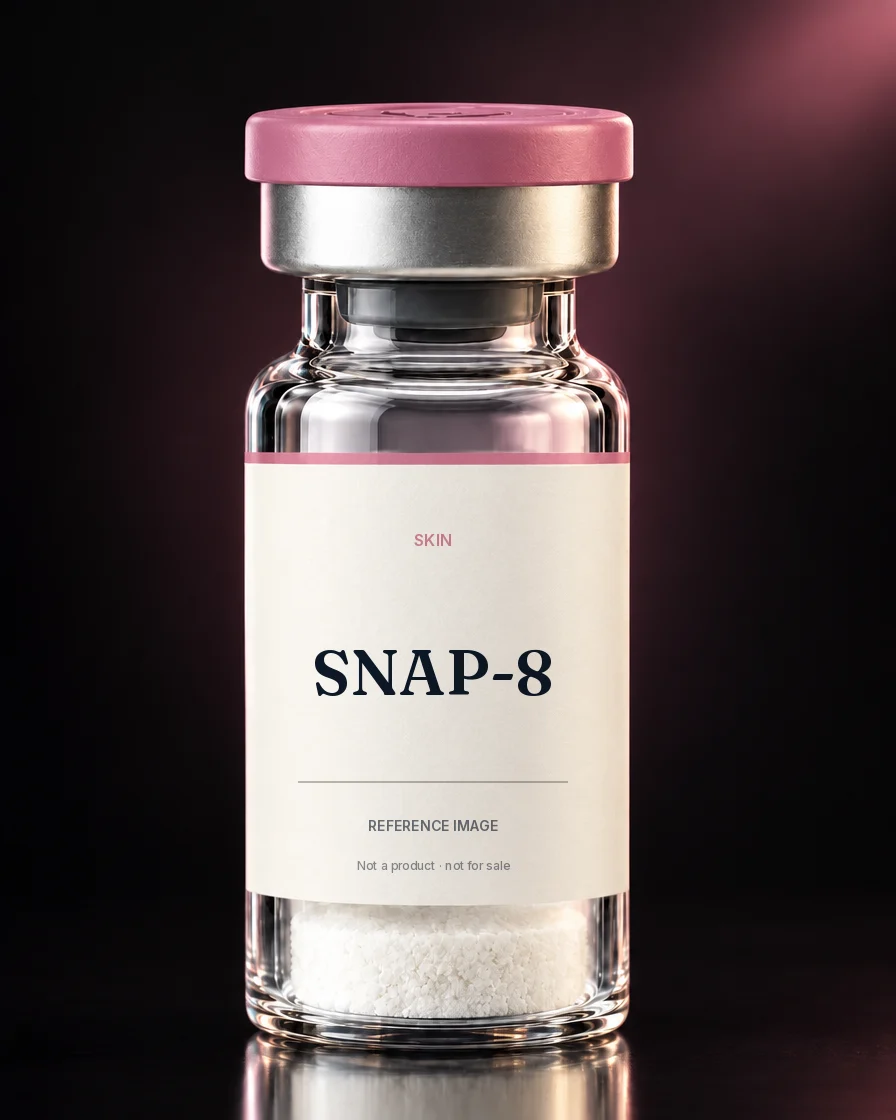
 Skin · Dosing reference
SNAP-8 dosage
What the human evidence does and does not show, how long studies ran, and the arithmetic for working with vials.
- Regulatory status
- Not approved — research use only
- Human amounts
- None established in humans
- Route studied
- —
- Frequency
- Not established
- Half-life
- Not established
- Evidence grade
- Not yet assessed
- Vial sizes on the market
- 10 mg
- Other forms seen
- —
What SNAP-8 is
An eight-amino-acid peptide that mimics part of the SNAP-25 protein, studied in research on SNARE complex dynamics.
SNAP-8 is the International Nomenclature of Cosmetic Ingredients substance acetyl octapeptide-3, an eight-residue peptide with the sequence Ac-Glu-Glu-Met-Gln-Arg-Arg-Ala-Asp-NH2, molecular formula C41H70N16O16S and average mass about 1075 Da 1. It is an elongation of the six-residue cosmetic peptide acetyl hexapeptide-8, marketed as Argireline, which is described in the dermatology literature as a topical… How it works →
Key evidence
- Avcil et al., Journal of Cosmetic Dermatology · 2020 · Humans (healthy subjects with aged skin)Fine lines and wrinkles decreased by a reported 25.8% and skin hydration increased; the patch contained acetyl octapeptide-3 together with four other actives, so no effect is attributable to the peptide. 2
- Shin et al., Annals of Dermatology · 2024 · Humans (24 healthy subjects)The multi-ingredient patch improved eye wrinkles relative to placebo; acetyl octapeptide-3 was one of three actives, so the peptide's individual contribution was not isolated. 3
- Palmieri et al., Clinica Terapeutica · 2020 · Humans (26 patients with scars, skin tags and wrinkles)A gel-cream containing 10% acetyl hexapeptide-8 was associated with improved instrumental skin quality parameters and self-image; this concerns the hexapeptide, not SNAP-8, and the design does not support causal inference. 4
What the human evidence shows
We searched PubMed and ClinicalTrials.gov and found no human studies that administered SNAP-8. The research described on its page is from cells or animals, and animal amounts do not translate to people.
How long did human studies run?
No human study durations are recorded for SNAP-8.
Cycle-length evidence for SNAP-8SNAP-8 draw calculator
Pick the vial strength and the water added, enter an amount, and see the concentration, the units to draw and how many draws the vial holds. Arithmetic only.
Computed from your inputs. Not a dose or a recommendation.
Compare water volumes for this vialShow
More water = lower concentration = a larger, easier-to-measure draw. Tap a row to use it.
| Water | mg/mL | Draw |
|---|---|---|
| 0.5 mL | 20 | — |
| 1 mL | 10 | — |
| 1.5 mL | 6.667 | — |
| 2 mL | 5 | — |
| 2.5 mL | 4 | — |
| 3 mL | 3.333 | — |
| 5 mL | 2 | — |
Supplies and handling
- Lyophilized vialSealed vial with the freeze-dried cake. Check the label, lot and the certificate of analysis before opening.
- Sterile diluentThe diluent named on the product documentation. Bacteriostatic water contains benzyl alcohol; sterile water does not.
- Graduated syringesSized to the volume being measured. U-100 insulin syringes are graduated in units where 100 units = 1 mL.
- Alcohol prep padsFor wiping vial stoppers before each puncture.
- Nitrile glovesClean gloves for aseptic handling.
- Sharps containerPuncture-resistant container for used needles.
Storage
General research-context handling only. Lyophilised peptides of this type are typically stored dry, cool and protected from light, moisture and oxidising conditions, with methionine-containing sequences particularly sensitive to oxidation; aqueous solutions are treated as short-lived. Finished cosmetic formulations follow the manufacturer's own stability data. Defer to supplier documentation for the specific lot. No temperatures, concentrations or preparation steps are given here.
- Lyophilized (unmixed) vials: typically stored cold and dry, away from light, as the documentation directs. Many are stable longer frozen.
- Reconstituted vials: typically refrigerated (about 2–8 °C), protected from light and not frozen.
- Bacteriostatic water contains benzyl alcohol, which inhibits bacterial growth in multi-use vials; sterile water has no preservative.
Handling mistakes and troubleshooting
- Added the wrong volume of diluent
- The concentration changes, not the amount of compound in the vial. Recalculate with the volume actually added and relabel the vial.
- Shook the vial and it foamed
- Let it settle in the refrigerator. Foam is a sign of agitation; some peptides aggregate when shaken. Note it on the label.
- The solution is cloudy or has particles
- Do not use it. Cloudiness can indicate incomplete dissolution, contamination or degradation. Record the lot and contact the supplier with the certificate of analysis.
- The powder cake looks melted or shrunken before reconstitution
- This can indicate the vial was exposed to heat or moisture. Record the lot and condition on arrival.
- Liquid sprayed back when the needle was removed
- Pressure built up in the vial. Withdraw a small volume of air while adding diluent to keep pressure neutral.
Regulatory status
- Status
- SNAP-8 is a cosmetic ingredient, not an approved drug. There is no approved FDA drug application and no openFDA drug label listing acetyl octapeptide-3 as an active substance, and it does not appear in any of the three categories of FDA's 503A bulk drug substances list as updated May 14, 2026 6. No clinical trial of SNAP-8 as a single agent was identified in PubMed or on ClinicalTrials.gov; the two human studies found tested multi-ingredient microneedle patches in which acetyl octapeptide-3 was one of several actives, so no effect can be attributed to the peptide 2,3,7.
- United States (FDA)
- SNAP-8 is marketed as a cosmetic ingredient, not a drug. There is no approved FDA drug application and no openFDA drug label listing acetyl octapeptide-3 as an active substance, and the substance does not appear in any of the three categories of FDA's 503A bulk drug substances list as updated May 14, 2026 6. Cosmetic ingredients in the United States are not subject to premarket FDA approval, so absence from drug databases is expected and says nothing about efficacy.
- Sport (WADA)
- Neither SNAP-8, acetyl octapeptide-3 nor acetyl hexapeptide-8 is named in the WADA 2026 Prohibited List, and the words acetyl, octapeptide and hexapeptide do not appear in it 9. That is hedged negative evidence. The S0 Non-Approved Substances class provides that "Any pharmacological substance which is not addressed by any of the subsequent sections of the List and with no current approval by any governmental regulatory health authority for human therapeutic use (e.g. drugs under pre-clinical or clinical development or discontinued, designer drugs, substances approved only for veterinary use) is prohibited at all times", with examples given as "including but not limited to" 9. Cosmetic status does not of itself place a substance outside the List, since the List is organised by substance rather than by product category. Athletes should seek a ruling from their anti-doping organisation.
Status varies by country and changes over time. How we describe regulatory status.
SNAP-8 compared with related compounds
| Compound | Status | Evidence | Human amounts | Half-life |
|---|---|---|---|---|
| SNAP-8 | Not approved — research use only | — | None established | — |
| Argireline | Not approved — research use only | B | None established | Not located in the sources reviewed. Rel |
| Afamelanotide | FDA-approved | A | FDA label | Approximately 15 hours (apparent, from t |
| Matrixyl | Not approved — research use only | B | None established | Not located in the sources reviewed. In |
| GHK-Cu | Not approved — research use only | B | None established | — |
| Melanotan I | Not approved — research use only | — | None established | — |
Frequently asked questions
What doses of SNAP-8 have been studied in humans?
Is there an established SNAP-8 cycle length?
How much bacteriostatic water should be added to a SNAP-8 vial?
How many units is a given amount on an insulin syringe?
Is SNAP-8 FDA-approved?
References
- Acetyl octapeptide-3 (CID 76283482): compound summary, synonyms and computed properties PubChem. 2026
- Efficacy of bioactive peptides loaded on hyaluronic acid microneedle patches: A monocentric clinical study Journal of Cosmetic Dermatology. 2020
- Clinical Safety and Efficacy Evaluation of a Dissolving Microneedle Patch Having Dual Anti-Wrinkle Effects With Safe and Long-Term Activities Annals of Dermatology. 2024
- Skin scars and wrinkles temporary camouflage in dermatology and oncoesthetics: focus on acetyl hexapeptide-8 Clinica Terapeutica. 2020
- Polydioxanone Bioactive Sutures-Acetyl Hexapeptide-8 (Argireline): An Intelligent System for Controlled Release in Facial Harmonization Journal of Cutaneous and Aesthetic Surgery. 2023
- Bulk Drug Substances Nominated for Use in Compounding Under Section 503A of the Federal Food, Drug, and Cosmetic Act (updated May 14, 2026) FDA. 2026
- PubMed search for acetyl octapeptide-3 (two records, both multi-ingredient microneedle patch studies) PubMed. 2026
- Public Interest in Acetyl Hexapeptide-8: Longitudinal Analysis JMIR Dermatology. 2024
- World Anti-Doping Code International Standard Prohibited List 2026 WADA. 2026
Last reviewed October 22, 2026 by the Amiravo editorial team. Editorial policy · Report an error