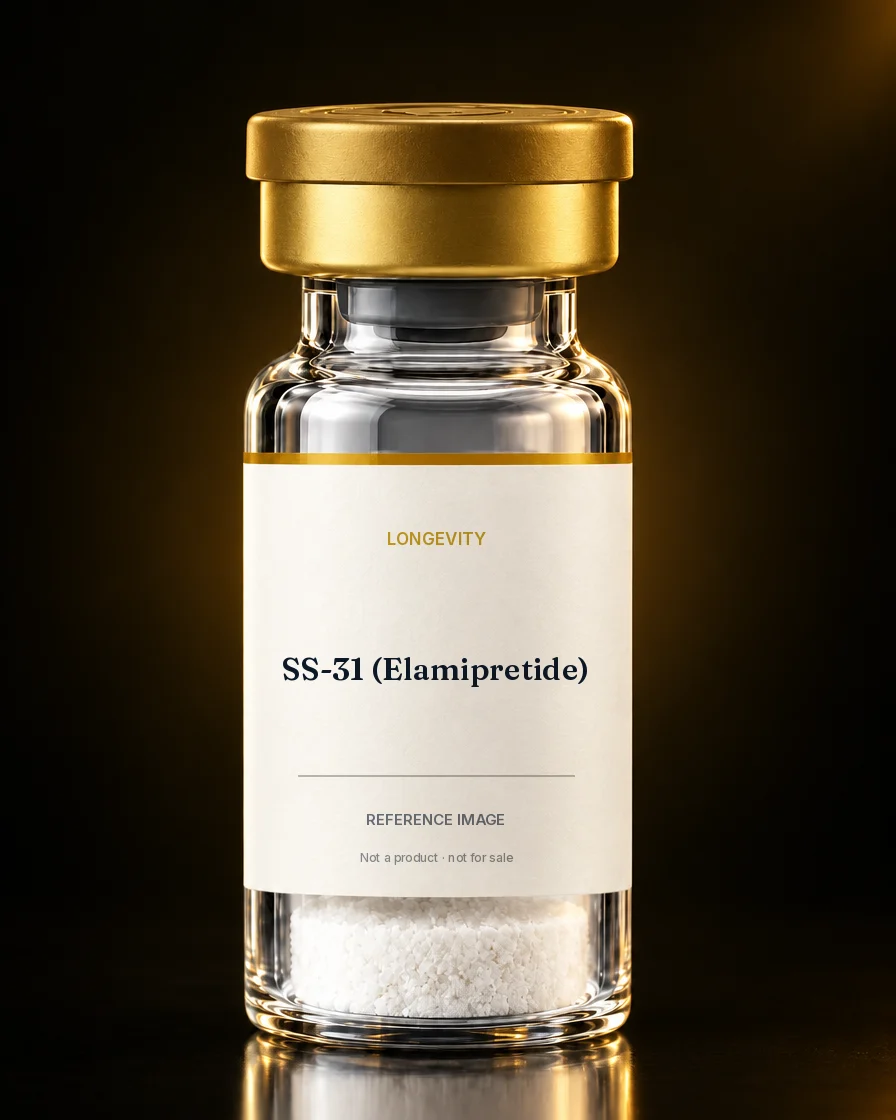
 Longevity · Dosing reference
SS-31 (Elamipretide) dosage
Dosing as the FDA label states it, how long trials ran, and the arithmetic for working with vials.
- Regulatory status
- FDA-approved
- Human amounts
- 40 mg once daily (FORZINITY label, patients weighing at least 30 kg); 20 mg once daily in adults with eGFR below 30 mL/minute not on dialysis
- Route studied
- Subcutaneous injection
- Frequency
- Once daily, at the same time each day
- Half-life
- Not established
- Evidence grade
- Grade A · Human trial evidence
- Vial sizes on the market
- 10 mg · 30 mg · 50 mg
- Other forms seen
- —
What SS-31 (Elamipretide) is
SS-31, also called elamipretide, is a mitochondria-targeted synthetic tetrapeptide. In September 2025 the FDA granted accelerated approval to its injectable form (FORZINITY) for Barth syndrome, based on an intermediate muscle-strength endpoint. Studies in other conditions have been reported, and the approval does not extend to them.
Elamipretide (SS-31) is described as a mitochondria-targeting tetrapeptide that selectively binds cardiolipin in the inner mitochondrial membrane 1. The FDA label classifies it as a mitochondrial cardiolipin binder that binds the inner mitochondrial membrane and improves mitochondrial morphology and function 3. Preclinical findings A review reports that in preclinical models SS-31 was associated with stabilized… How it works →
Key evidence
- Stealth BioTherapeutics, FORZINITY prescribing information (Clinical Studies) · 2025 · Humans (12 patients aged 12 years or older and over 30 kg with Barth syndrome)Not superior to placebo on the 6-minute walk and fatigue primary endpoints; knee extensor strength rose in the open-label extension (median change 63 N at week 168, n = 8 from a baseline median of 124 N). 3
- ClinicalTrials.gov NCT03098797 · 2017 · Humans (12 participants, Barth syndrome)Registered design of the Barth syndrome crossover study that underlies the label; status listed as completed. 5
- Karaa et al., Neurology (MMPOWER-3) · 2023 · Humans (218 adults with primary mitochondrial myopathy)Differences versus placebo in 6-minute walk distance (-3.2 m, p = 0.69) and fatigue score (p = 0.37) did not meet the primary endpoints. 6
Dosing as stated on the FDA label
- For improving muscle strength in Barth syndrome (FORZINITY), patients weighing at least 30 kg: the recommended dosage is 40 mg subcutaneously once daily, at the same time each day. 3
- For improving muscle strength in Barth syndrome (FORZINITY), missed dose: skip the missed dose and take the next dose at the scheduled time; do not take a double dose. 3
- For improving muscle strength in Barth syndrome (FORZINITY), adults with eGFR below 30 mL/minute and not on dialysis: 20 mg subcutaneously once daily; for eGFR of 30 mL/minute or more, 40 mg once daily. The label states there is insufficient information to recommend a dosage in adults on dialysis or in pediatric patients weighing 30 kg or more with renal impairment. 3
- FORZINITY (elamipretide) label: the recommended dosage in patients weighing at least 30 kg is 40 mg subcutaneously once daily, and patients should receive the dose at the same time each day 3.
- FORZINITY label, missed dose: if a dose is missed, skip the dose and take the next dose at the scheduled time; do not take a double dose 3.
- FORZINITY label, renal impairment (Table 1, adults): for an estimated glomerular filtration rate of 30 mL/minute or more, 40 mg subcutaneously once daily; for less than 30 mL/minute and not on dialysis, 20 mg subcutaneously once daily. The label states there is insufficient information to recommend a dosage regimen in adults with eGFR below 30 mL/minute who are on dialysis, or in pediatric patients weighing 30 kg or more with renal impairment 3.
- FORZINITY label, clinical studies: the randomized, double-blind, placebo-controlled crossover trial evaluated FORZINITY 40 mg injected subcutaneously once daily for 12 weeks in 12 subjects aged 12 years and older weighing more than 30 kg with genetically confirmed Barth syndrome, and FORZINITY was not superior to placebo on the primary endpoints (6-minute walk distance and Total Fatigue Score) 3.
- The corresponding registry record (NCT03098797, completed, with posted results) describes 12 weeks of daily subcutaneous elamipretide 40 mg and 12 weeks of placebo in two treatment periods separated by a 4-week washout, followed by an open-label extension in which all subjects received elamipretide 40 mg subcutaneously daily for up to 168 weeks 5.
- In the phase 3 MMPOWER-3 trial, 218 participants with primary mitochondrial myopathy (mean age 45.6 years) were randomized 1:1 to 24 weeks of subcutaneous elamipretide 40 mg per day or placebo; the trial did not meet its primary endpoints of change in 6-minute walk distance or total fatigue score (NCT03323749) 6.
- In the MMPOWER phase 1/2 trial, 36 participants with genetically confirmed primary mitochondrial myopathy were randomized to intravenous elamipretide at 0.01, 0.1 or 0.25 mg/kg/hour, or placebo, infused over 2 hours in a dose-escalating sequence, with change in 6-minute walk distance after 5 days of treatment as the primary efficacy measure; the highest dose group walked a mean of 64.5 m farther at day 5 versus 20.4 m with placebo (p = 0.053) 7.
How long did human studies run?
- The label describes a 12-week randomized crossover treatment period and a 192-week open-label extension; ten of the twelve subjects entered the extension and eight participated through week 168, with knee extensor muscle strength measured by handheld dynamometry as a secondary endpoint that increased during the extension but not during the randomized trial 3.
- MMPOWER-3 administered study drug for 24 weeks 6; the MMPOWER phase 1/2 trial administered 2-hour infusions over 5 days 7.
Contraindications on the label
- FORZINITY label contraindication: serious hypersensitivity to elamipretide or any of the excipients in FORZINITY 3.
- FORZINITY label warnings: it is not approved for use in neonates, because serious and sometimes fatal reactions of new onset or worsening metabolic acidosis progressing to neurotoxicity, and in some cases gasping syndrome, have been reported in low-birth-weight and preterm neonates given benzyl alcohol, which FORZINITY contains at 20 mg per mL; hypersensitivity reactions including serious allergic reactions requiring emergency intervention have been reported 3.
- FORZINITY label, specific populations: safety and effectiveness have not been established in pediatric patients weighing less than 30 kg; there are no data in pregnant women and no data on presence in human milk, which the label attributes to Barth syndrome being an X-linked recessive disorder not likely to affect females 3.
Side effects reported in studies
- Any local administration reaction12 (100%) vs 8 (67%) placebo · Barth syndrome crossover study, n = 12 3
- Injection site erythema12 (100%) vs 3 (25%) placebo · Barth syndrome crossover study, n = 12 3
- Injection site pain9 (75%) vs 5 (42%) placebo · Barth syndrome crossover study, n = 12 3
- Injection site induration and pruritus8 (67%) each vs 2 (17%) each placebo · Barth syndrome crossover study, n = 12 3
- Increased eosinophil countsNoted frequently with 30 days or more of dosing; mean rise about 0.5 to 0.6 x10^3/uL · Pooled studies per label 3
SS-31 (Elamipretide) draw calculator
Pick the vial strength and the water added, enter an amount, and see the concentration, the units to draw and how many draws the vial holds. Arithmetic only.
Computed from your inputs. Not a dose or a recommendation.
Compare water volumes for this vialShow
More water = lower concentration = a larger, easier-to-measure draw. Tap a row to use it.
| Water | mg/mL | Draw |
|---|---|---|
| 0.5 mL | 20 | — |
| 1 mL | 10 | — |
| 1.5 mL | 6.667 | — |
| 2 mL | 5 | — |
| 2.5 mL | 4 | — |
| 3 mL | 3.333 | — |
| 5 mL | 2 | — |
Supplies and handling
- Lyophilized vialSealed vial with the freeze-dried cake. Check the label, lot and the certificate of analysis before opening.
- Sterile diluentThe diluent named on the product documentation. Bacteriostatic water contains benzyl alcohol; sterile water does not.
- Graduated syringesSized to the volume being measured. U-100 insulin syringes are graduated in units where 100 units = 1 mL.
- Alcohol prep padsFor wiping vial stoppers before each puncture.
- Nitrile glovesClean gloves for aseptic handling.
- Sharps containerPuncture-resistant container for used needles.
Storage
The FDA label for FORZINITY states vials are stored refrigerated at 2 to 8 C and not frozen 3. For research material, follow the supplier's documentation for the specific lot.
- Lyophilized (unmixed) vials: typically stored cold and dry, away from light, as the documentation directs. Many are stable longer frozen.
- Reconstituted vials: typically refrigerated (about 2–8 °C), protected from light and not frozen.
- Bacteriostatic water contains benzyl alcohol, which inhibits bacterial growth in multi-use vials; sterile water has no preservative.
Handling mistakes and troubleshooting
- Added the wrong volume of diluent
- The concentration changes, not the amount of compound in the vial. Recalculate with the volume actually added and relabel the vial.
- Shook the vial and it foamed
- Let it settle in the refrigerator. Foam is a sign of agitation; some peptides aggregate when shaken. Note it on the label.
- The solution is cloudy or has particles
- Do not use it. Cloudiness can indicate incomplete dissolution, contamination or degradation. Record the lot and contact the supplier with the certificate of analysis.
- The powder cake looks melted or shrunken before reconstitution
- This can indicate the vial was exposed to heat or moisture. Record the lot and condition on arrival.
- Liquid sprayed back when the needle was removed
- Pressure built up in the vial. Withdraw a small volume of air while adding diluent to keep pressure neutral.
Regulatory status
- Status
- FDA-approved as FORZINITY (elamipretide) injection under accelerated approval on September 19, 2025, to improve muscle strength in adult and pediatric patients with Barth syndrome weighing at least 30 kg; continued approval may depend on a confirmatory trial 3,4. It is not approved for any other indication 3.
- United States (FDA)
- FORZINITY (elamipretide) injection received FDA accelerated approval on September 19, 2025, to improve muscle strength in adults and pediatric patients with Barth syndrome weighing at least 30 kg, based on knee extensor muscle strength as an intermediate clinical endpoint; the FDA noted priority review and rare pediatric disease designation and a required confirmatory randomized trial 3,4.
- Sport (WADA)
- Elamipretide is not named in the 2026 WADA Prohibited List text reviewed 9.
Status varies by country and changes over time. How we describe regulatory status.
SS-31 (Elamipretide) compared with related compounds
| Compound | Status | Evidence | Human amounts | Half-life |
|---|---|---|---|---|
| SS-31 (Elamipretide) | FDA-approved | A | FDA label | — |
| Methylene Blue | FDA-approved | A | FDA label | Approximately 24 hours |
| L-Glutathione | Not approved — research use only | B | None established | — |
| Epithalon | Not approved — research use only | C | None established | — |
| N-Acetyl Epithalon Amidate | Not approved — research use only | — | None established | — |
| NAD+ | Not approved — research use only | B | None established | — |
Frequently asked questions
What doses of SS-31 (Elamipretide) have been studied in humans?
Is there an established SS-31 (Elamipretide) cycle length?
How much bacteriostatic water should be added to a SS-31 (Elamipretide) vial?
How many units is a given amount on an insulin syringe?
Is SS-31 (Elamipretide) FDA-approved?
References
- Elamipretide: A Review of Its Structure, Mechanism of Action, and Therapeutic Potential Int J Mol Sci. 2025
- The mitochondria-targeted peptide SS-31 binds lipid bilayers and modulates surface electrostatics as a key component of its mechanism of action J Biol Chem. 2020
- FORZINITY (elamipretide) injection, prescribing information FDA label (DailyMed). 2025
- FDA grants accelerated approval to first treatment for Barth syndrome FDA press announcement. 2025
- A Phase 2 Randomized, Double-Blind, Placebo-Controlled Crossover Trial to Evaluate the Safety and Efficacy of Subcutaneous Injections of Elamipretide in Subjects With Genetically Confirmed Barth Syndrome (NCT03098797) ClinicalTrials.gov. 2017
- Efficacy and Safety of Elamipretide in Individuals With Primary Mitochondrial Myopathy: The MMPOWER-3 Randomized Clinical Trial Neurology. 2023
- Randomized dose-escalation trial of elamipretide in adults with primary mitochondrial myopathy Neurology. 2018
- Clinical Trial in Patients With Barth Syndrome- 4TAZPower (NCT07531251) ClinicalTrials.gov. 2026
- WADA 2026 Prohibited List World Anti-Doping Agency. 2026
Last reviewed October 23, 2026 by the Amiravo editorial team. Editorial policy · Report an error