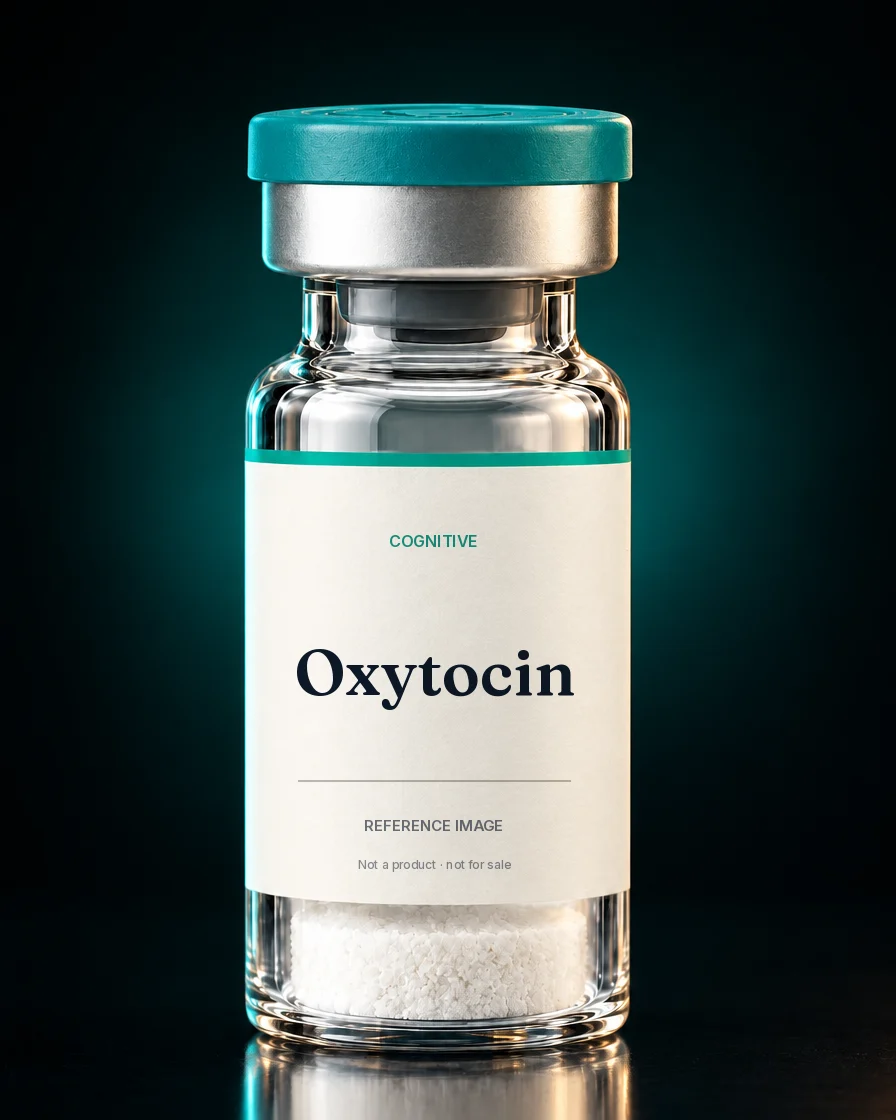
 Cognitive · Dosing reference
Oxytocin dosage
Dosing as the FDA label states it, how long trials ran, and the arithmetic for working with vials.
- Regulatory status
- FDA-approved
- Human amounts
- Labor: 0.5–1 mU/min by IV infusion, increased gradually; postpartum bleeding: 10–40 units in an IV infusion or 10 units IM (FDA label) 2
- Route studied
- Intravenous infusion; intramuscular (postpartum)
- Frequency
- Continuous infusion (labor); single IM injection (postpartum)
- Half-life
- The Pitocin label states a plasma half-life of about 1 to 6 minutes, decreased in late pregnancy and during lactation, with rapid removal from plasma accomplished largely by the kidney and liver 2.
- Evidence grade
- Grade A · Human trial evidence
- Vial sizes on the market
- 2 mg · 5 mg · 10 mg
- Other forms seen
- Liquid spray 10 mL (10 mg)
What Oxytocin is
A nine-amino-acid neuropeptide hormone made in the hypothalamus, studied in reproductive physiology, social behavior and stress signaling.
Oxytocin is a nonapeptide that acts at a single identified receptor, the oxytocin receptor (OXTR), a seven-transmembrane G protein-coupled receptor able to couple to Gq or Gi proteins and to activate MAPK, PKC, PLC and CaMK signalling cascades converging on transcription factors such as CREB and MEF-2 5. Uterine action The label describes uterine motility as depending on formation of the contractile protein… How it works →
Key evidence
- Pitocin (oxytocin injection, USP) prescribing information · 2026 · Humans (regulatory label)Establishes approved obstetric indications, contraindications, a boxed warning against elective induction of labor, the maternal and fetal/neonatal adverse reaction lists, and a plasma half-life of about 1 to 6 minutes. 2
- Sikich et al., N Engl J Med (SOARS-B) · 2021 · Humans (290 children and adolescents aged 3-17 with autism spectrum disorder)No significant between-group difference on the primary social-withdrawal outcome (-3.7 vs -3.5; difference -0.2, 95% CI -1.5 to 1.0; P = 0.61); secondary outcomes generally did not differ and adverse events were similar between groups. 6
- Jurek and Neumann, Physiol Rev · 2018 · Review of animal and human literatureDescribes OXTR expression, coupling and downstream signalling and maps the oxytocinergic circuits implicated in anxiety and stress regulation, while noting that the link from signalling pattern to behaviour remains poorly understood. 5
Schedules by time period
Label regimens and laid out week by week. Each bar is what the label states or what investigators gave participants; none is a recommendation.
Pitocin (FDA label): induction or stimulation of labor, IV titration 2
Pregnant patients undergoing induction or stimulation of labor
- 0.5-1 mU/min · Initial dose
- Increase by 1-2 mU/min · At 30-60 minute intervals, until the desired contraction pattern is established
Label wording: dosage is individualized by uterine response. Once the desired contraction frequency is reached and labor has progressed to 5-6 cm dilation, the dose may be reduced by similar increments. The label notes that rates above 9-10 mU/min are rarely required at term. Steps are in minutes, so no week numbers apply.
Intravenous infusion is the only acceptable parenteral method for induction or stimulation of labor (label).
Dosing as stated on the FDA label
- Induction or stimulation of labor (Pitocin): intravenous infusion is the only acceptable parenteral route; the label gives an initial dose of 0.5–1 mU/min, increased gradually in increments of 1–2 mU/min at 30–60 minute intervals until the desired contraction pattern is established, and states that rates exceeding 9–10 mU/min are rarely required at term 2.
- Control of postpartum uterine bleeding (Pitocin): 10 to 40 units added to a running intravenous infusion (maximum 40 units to 1000 mL), with the rate adjusted to sustain uterine contraction; or 10 units intramuscularly after delivery of the placenta 2.
- Incomplete, inevitable or elective abortion (Pitocin): intravenous infusion of 10 units added to 500 mL of physiologic saline or 5% dextrose in water after suction or sharp curettage 2.
How long did human studies run?
No human study durations are recorded for Oxytocin.
Cycle-length evidence for OxytocinSide effects reported in studies
- Maternal: anaphylactic reaction, postpartum haemorrhage, cardiac arrhythmia, premature ventricular contractions, subarachnoid haemorrhage, fatal afibrinogenaemia, hypertensive episodes, pelvic haematoma, nausea, vomiting, rupture of the uterusNot quantified on the label · Mothers receiving oxytocin, per approved labeling 2
- Uterine hypertonicity, spasm, tetanic contraction or rupture of the uterusNot quantified · Associated on the label with excessive dosage or hypersensitivity to the drug 2
- Severe water intoxication with convulsions and coma, and maternal death due to oxytocin-induced water intoxicationReported; associated with slow infusion over a 24-hour period · Mothers receiving prolonged infusion, per approved labeling 2
- Fetal or neonatal: bradycardia, premature ventricular contractions and other arrhythmias, low Apgar scores at five minutes, neonatal jaundice, neonatal retinal haemorrhage, permanent CNS or brain damage, neonatal seizures, fetal deathNot quantified on the label · Fetus or neonate, per approved labeling 2
- Adverse event incidence and severity similar to placeboNo between-group difference · 290 children and adolescents with autism spectrum disorder, 24 weeks of intranasal oxytocin 6
Oxytocin draw calculator
Pick the vial strength and the water added, enter an amount, and see the concentration, the units to draw and how many draws the vial holds. Arithmetic only.
Computed from your inputs. Not a dose or a recommendation.
Compare water volumes for this vialShow
More water = lower concentration = a larger, easier-to-measure draw. Tap a row to use it.
| Water | mg/mL | Draw |
|---|---|---|
| 0.5 mL | 20 | — |
| 1 mL | 10 | — |
| 1.5 mL | 6.667 | — |
| 2 mL | 5 | — |
| 2.5 mL | 4 | — |
| 3 mL | 3.333 | — |
| 5 mL | 2 | — |
Supplies and handling
- Lyophilized vialSealed vial with the freeze-dried cake. Check the label, lot and the certificate of analysis before opening.
- Sterile diluentThe diluent named on the product documentation. Bacteriostatic water contains benzyl alcohol; sterile water does not.
- Graduated syringesSized to the volume being measured. U-100 insulin syringes are graduated in units where 100 units = 1 mL.
- Alcohol prep padsFor wiping vial stoppers before each puncture.
- Nitrile glovesClean gloves for aseptic handling.
- Sharps containerPuncture-resistant container for used needles.
Storage
General research-context handling only. For approved drug products, the storage conditions on the manufacturer's labeling govern and nothing here substitutes for them 2. Research-grade lyophilised oxytocin is normally kept cold, dry and protected from light, with disulfide-containing peptides particularly sensitive to oxidation, reduction and pH extremes once in solution; the marketed injection is formulated at a low pH with preservative and buffers, which indicates how sensitive the molecule is to its solution environment 2. Defer to the supplier's documentation for the specific lot; no preparation or handling instructions are given here.
- Lyophilized (unmixed) vials: typically stored cold and dry, away from light, as the documentation directs. Many are stable longer frozen.
- Reconstituted vials: typically refrigerated (about 2–8 °C), protected from light and not frozen.
- Bacteriostatic water contains benzyl alcohol, which inhibits bacterial growth in multi-use vials; sterile water has no preservative.
Handling mistakes and troubleshooting
- Added the wrong volume of diluent
- The concentration changes, not the amount of compound in the vial. Recalculate with the volume actually added and relabel the vial.
- Shook the vial and it foamed
- Let it settle in the refrigerator. Foam is a sign of agitation; some peptides aggregate when shaken. Note it on the label.
- The solution is cloudy or has particles
- Do not use it. Cloudiness can indicate incomplete dissolution, contamination or degradation. Record the lot and contact the supplier with the certificate of analysis.
- The powder cake looks melted or shrunken before reconstitution
- This can indicate the vial was exposed to heat or moisture. Record the lot and condition on arrival.
- Liquid sprayed back when the needle was removed
- Pressure built up in the vial. Withdraw a small volume of air while adding diluent to keep pressure neutral.
Regulatory status
- Status
- Oxytocin injection is an approved prescription drug product in the United States; Drugs@FDA records NDA 018248 (Fresenius Kabi USA) and NDA 018261 (Pitocin), plus generic applications including ANDA 200219, all listed with a "Prescription" marketing status 1. Current manufacturer labeling for marketed oxytocin injection products is published in DailyMed 2.
- United States (FDA)
- Approved. Drugs@FDA / openFDA returns NDA 018248 (Fresenius Kabi USA, oxytocin injection), NDA 018261 (Pitocin) and ANDA 200219 (Hikma), each with products in "Prescription" marketing status 1; DailyMed carries current labeling for marketed oxytocin injection products 2. No dosing information is reproduced here.
- Sport (WADA)
- The word "oxytocin" does not appear anywhere in the WADA 2026 Prohibited List; on that basis oxytocin is not a named prohibited substance for 2026 3. Athletes should still consult their anti-doping organisation, since the list's class definitions are open-ended.
Status varies by country and changes over time. How we describe regulatory status.
Oxytocin compared with related compounds
| Compound | Status | Evidence | Human amounts | Half-life |
|---|---|---|---|---|
| Oxytocin | FDA-approved | A | FDA label | The Pitocin label states a plasma half-l |
| Vasopressin | FDA-approved | A | FDA label | 10 minutes or less at shock infusion rat |
| Cerebrolysin | Approved outside the US | A | Ex-US label | Not directly measurable (peptide mixture |
| Selank | Approved outside the US | B | None established | — |
| Semax | Approved outside the US | B | None established | — |
| Dihexa | Not approved — research use only | C | None established | — |
Frequently asked questions
What doses of Oxytocin have been studied in humans?
Is there an established Oxytocin cycle length?
How much bacteriostatic water should be added to a Oxytocin vial?
How many units is a given amount on an insulin syringe?
What is the half-life of Oxytocin?
Is Oxytocin FDA-approved?
References
- Drugs@FDA application records for oxytocin injection, including NDA 018248 (Fresenius Kabi USA), NDA 018261 (Pitocin) and ANDA 200219, each with products in Prescription marketing status openFDA / Drugs@FDA. 2026
- PITOCIN (oxytocin injection, USP): prescribing information (Par Health USA, LLC / Endo USA), DailyMed set ID dddcdcc3-cd4d-4573-98ac-9468bea23a8b FDA label (DailyMed). 2026
- International Standard: Prohibited List 2026 (full-document search for "oxytocin" returned no named entry) World Anti-Doping Agency. 2026
- Oxytocin: the great facilitator of life Prog Neurobiol. 2009
- The Oxytocin Receptor: From Intracellular Signaling to Behavior Physiol Rev. 2018
- Intranasal Oxytocin in Children and Adolescents with Autism Spectrum Disorder (SOARS-B) N Engl J Med. 2021
- PubChem compound record for oxytocin (CID 439302; CAS 50-56-6) PubChem. 2026
Last reviewed October 23, 2026 by the Amiravo editorial team. Editorial policy · Report an error