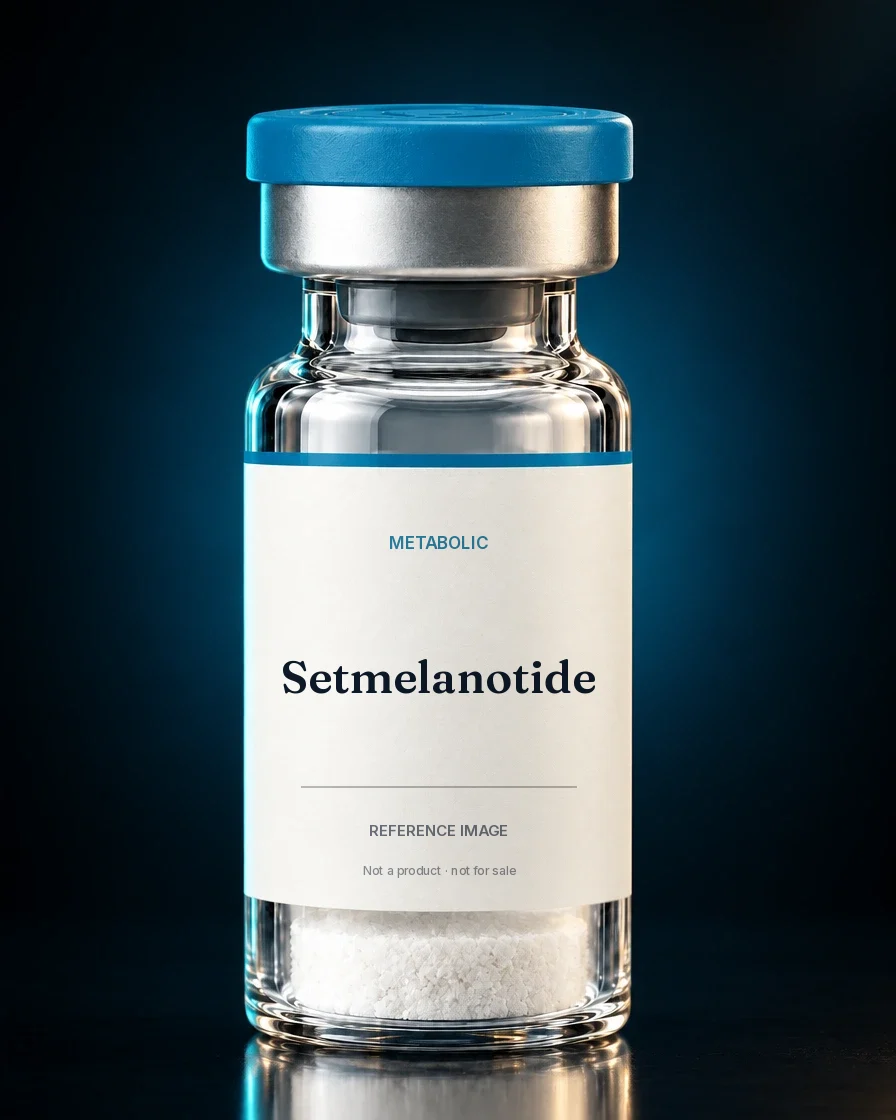
 Metabolic · Dosing reference
Setmelanotide dosage
Dosing as the FDA label states it, how long trials ran, and the arithmetic for working with vials.
- Regulatory status
- FDA-approved
- Human amounts
- Maintenance 3 mg once daily for patients aged 6 and older (all indications), after a 2-week starting dosage of 0.5 mg (acquired HO) or 2 mg (BBS/POMC/PCSK1/LEPR, age 12+); weight-based maintenance under age 6 (IMCIVREE label)
- Route studied
- Subcutaneous injection
- Frequency
- Once daily
- Half-life
- About 11 hours
- Evidence grade
- Grade A · Human trial evidence
- Vial sizes on the market
- Not recorded
- Other forms seen
- —
What Setmelanotide is
Setmelanotide is a cyclic eight-residue melanocortin-4 receptor agonist that the FDA approved in 2020 as Imcivree for obesity caused by specific genetic MC4R-pathway disorders, with acquired hypothalamic obesity added to the label by 2026.
Setmelanotide activates the melanocortin 4 (MC4) receptor, which is involved in regulating hunger, satiety and energy expenditure in the brain; it has about 20-fold less activity at MC3 and MC1 receptors 1. Why it targets specific disorders The label states that, based on nonclinical evidence, it may re-establish MC4 receptor pathway signaling when obesity stems from insufficient MC4 receptor activation, as in… How it works →
Key evidence
- Clément et al., Lancet Diabetes Endocrinol · 2020 · Humans (10 with POMC/PCSK1 deficiency, 11 with LEPR deficiency)
- Haqq et al., Lancet Diabetes Endocrinol · 2022 · Humans (38 with Bardet-Biedl or Alström syndrome)
- Miller et al., N Engl J Med (TRANSCEND, NCT05774756) · 2026 · Humans (120 aged 4-66 with acquired hypothalamic obesity)
Dosing as stated on the FDA label
- Acquired hypothalamic obesity, age 4 and older (IMCIVREE): starting dosage 0.5 mg subcutaneously once daily for 2 weeks, then titrated per the label's tables 1.
- BBS or POMC, PCSK1 or LEPR deficiency: starting dosage 2 mg once daily for 2 weeks (age 12 and older), 1 mg (age 6 to under 12) or 0.5 mg (age 2 to under 6) 1.
- Recommended maintenance dosage for adults and children aged 6 and older for all indications is 3 mg subcutaneously once daily; for younger children the maintenance dosage is based on body weight 1.
- The label specifies dose reductions if starting or escalated dosages are not tolerated, dosing in renal impairment, and patient selection by clinical or genetic diagnosis; those details are in the prescribing information and not reproduced here 1.
How long did human studies run?
No human study durations are recorded for Setmelanotide.
Cycle-length evidence for SetmelanotideSide effects reported in studies
- Skin hyperpigmentationMajority of treated patients; 67% versus 0% placebo in the 14-week BBS placebo period · Label clinical trials 1
- Spontaneous or increased penile erections7% versus 4% placebo (acquired HO trial); 8% (BBS trial) · Males in label trials 1
- Acute adrenal insufficiency (serious)5% versus 0% placebo · Acquired HO with secondary adrenal insufficiency 1
- Hyponatremia / hypernatremia6% versus 2% / 5% versus 4% · Acquired HO with central diabetes insipidus 1
- Vomiting11% versus 0% placebo · BBS trial, 14-week placebo period 1
- Serious adverse events (any)28% versus 8% placebo · TRANSCEND, acquired hypothalamic obesity 5
Supplies and handling
- Lyophilized vialSealed vial with the freeze-dried cake. Check the label, lot and the certificate of analysis before opening.
- Sterile diluentThe diluent named on the product documentation. Bacteriostatic water contains benzyl alcohol; sterile water does not.
- Graduated syringesSized to the volume being measured. U-100 insulin syringes are graduated in units where 100 units = 1 mL.
- Alcohol prep padsFor wiping vial stoppers before each puncture.
- Nitrile glovesClean gloves for aseptic handling.
- Sharps containerPuncture-resistant container for used needles.
Storage
Follow the current IMCIVREE label for storage of vials; research material per supplier documentation.
- Lyophilized (unmixed) vials: typically stored cold and dry, away from light, as the documentation directs. Many are stable longer frozen.
- Reconstituted vials: typically refrigerated (about 2–8 °C), protected from light and not frozen.
- Bacteriostatic water contains benzyl alcohol, which inhibits bacterial growth in multi-use vials; sterile water has no preservative.
Handling mistakes and troubleshooting
- Added the wrong volume of diluent
- The concentration changes, not the amount of compound in the vial. Recalculate with the volume actually added and relabel the vial.
- Shook the vial and it foamed
- Let it settle in the refrigerator. Foam is a sign of agitation; some peptides aggregate when shaken. Note it on the label.
- The solution is cloudy or has particles
- Do not use it. Cloudiness can indicate incomplete dissolution, contamination or degradation. Record the lot and contact the supplier with the certificate of analysis.
- The powder cake looks melted or shrunken before reconstitution
- This can indicate the vial was exposed to heat or moisture. Record the lot and condition on arrival.
- Liquid sprayed back when the needle was removed
- Pressure built up in the vial. Withdraw a small volume of air while adding diluent to keep pressure neutral.
Regulatory status
- Status
- FDA-approved as IMCIVREE (NDA 213793, original approval November 25, 2020) 2. The April 2, 2026 label covers people aged 4 years and older with acquired hypothalamic obesity and aged 2 years and older with Bardet-Biedl syndrome or POMC, PCSK1 or LEPR deficiency; it is not indicated for other genetic syndromes or general (polygenic) obesity 1.
- United States (FDA)
- FDA-approved under NDA 213793 (IMCIVREE, Rhythm), original approval November 25, 2020 per Drugs@FDA 2; indications per the April 2, 2026 DailyMed label include acquired hypothalamic obesity, Bardet-Biedl syndrome and POMC, PCSK1 or LEPR deficiency 1.
- Sport (WADA)
- Setmelanotide is not named in the 2026 Prohibited List text reviewed; as an approved drug it falls outside S0, so status should be confirmed with the relevant anti-doping organization 6.
Status varies by country and changes over time. How we describe regulatory status.
Setmelanotide compared with related compounds
| Compound | Status | Evidence | Human amounts | Half-life |
|---|---|---|---|---|
| Setmelanotide | FDA-approved | A | FDA label | About 11 hours |
| Tesofensine | Investigational | B | Trial doses | About 234 hours (M1 metabolite about 374 |
| Mazdutide | Approved outside the US | A | Trial doses | 150.9 to 403.5 hours (phase 1b in overwe |
| Cagrilintide | Investigational | A | Trial doses | 159 to 195 hours (phase 1b, co-administe |
| SLU-PP-332 | Not approved — research use only | C | None established | Unknown in humans |
| MariTide (maridebart cafraglutide) | Investigational | A | Trial doses | Not reported numerically in the sources |
Frequently asked questions
What doses of Setmelanotide have been studied in humans?
Is there an established Setmelanotide cycle length?
How much bacteriostatic water should be added to a Setmelanotide vial?
How many units is a given amount on an insulin syringe?
What is the half-life of Setmelanotide?
Is Setmelanotide FDA-approved?
References
- IMCIVREE (setmelanotide) injection, prescribing information (DailyMed SPL version 14, published Apr 02, 2026) FDA label (DailyMed). 2026
- Drugs@FDA application NDA 213793 (IMCIVREE, Rhythm; original approval 2020-11-25) via openFDA FDA (openFDA Drugs@FDA). 2026
- Efficacy and safety of setmelanotide, an MC4R agonist, in individuals with severe obesity due to LEPR or POMC deficiency: single-arm, open-label, multicentre, phase 3 trials Lancet Diabetes Endocrinol. 2020
- Efficacy and safety of setmelanotide, a melanocortin-4 receptor agonist, in patients with Bardet-Biedl syndrome and Alström syndrome: a multicentre, randomised, double-blind, placebo-controlled, phase 3 trial with an open-label period Lancet Diabetes Endocrinol. 2022
- Setmelanotide for the Treatment of Acquired Hypothalamic Obesity N Engl J Med. 2026
- Tractatenblad 2026 Nr. 25: Anti-doping convention (ETS No. 135), amendment to the appendix - The 2026 Prohibited List, World Anti-Doping Code (English text; entry into force 1 January 2026) Tractatenblad van het Koninkrijk der Nederlanden (official government publication). 2026
- PubChem compound record for setmelanotide (CID 11993702) PubChem. 2026
Last reviewed October 24, 2026 by the Amiravo editorial team. Editorial policy · Report an error